Confused about Eccentrics and Slip Eccentrics

Confused about Eccentrics and Slip Eccentrics

Home Forums Locomotives Confused about Eccentrics and Slip Eccentrics

Viewing 16 posts - 1 through 16 (of 16 total)
  • Author
    Posts
  • #832872
    James A
    Participant
      @jamesalford67616

      Can anyone help, please?

      I have been looking at the way that locomotives use eccentrics to drive the valves and am getting confused.

      Some seem to show a plain eccentric between the wheel and the frames and a “plain” eccentric strap around this. A rod from the strap operates the valve.

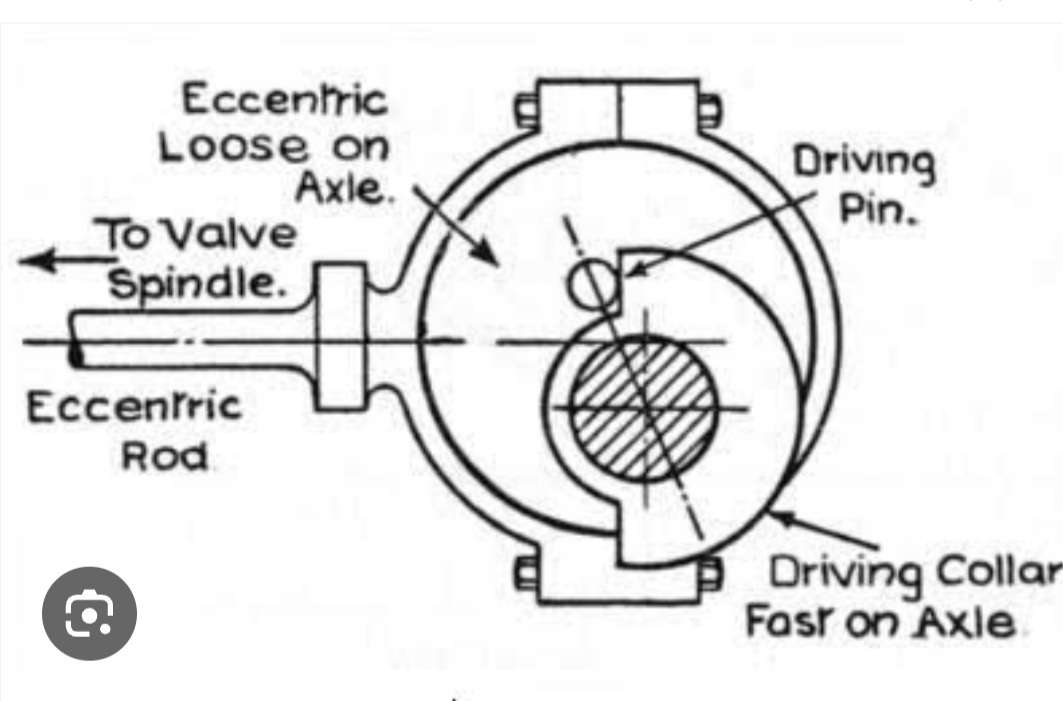
      Others seem to show a similar arrangement, but use a driving pin to drive the eccentric strap. There also seems to be some sort of cut-out in the eccentric that allows reversing.

      I cannot work out whether in the first description I have been looking at simplified drawings or whether these are two different designs. I am assuming that in the first description, the direction of rotation, or travel, is fixed whereas in the second, more complicated design, it is reversible.

      Can anyone please clarify for me? I am sure that it is a simple matter that I am confusing.

      Thank you.

      James.

      #832876
      duncan webster 1
      Participant
        @duncanwebster1
        On James A Said:
        ……….I am assuming that in the first description, the direction of rotation, or travel, is fixed whereas in the second, more complicated design, it is reversible.

        Can anyone please clarify for me? I am sure that it is a simple matter that I am confusing.

        Thank you.

        James.

        Your assumption is correct, to get reverse you need to change the angular relation twixt eccentric and crank

        #832879
        James A
        Participant
          @jamesalford67616

          Thank you, Duncan.

          That makes it clearer. So to reverse the fixed eccentric, I assume that you can use a steam reverser like an oscillating engine to swap around the inlet and exhaust.


          James

          #832888
          duncan webster 1
          Participant
            @duncanwebster1

            You could swap the passages between valve and cylinder, but not just switch steam and exhaust feeds to the valve as the lap on the steam side complicates the issue. Plus if it is a slide valve, live steam up the exhaust will lift the valve off its seat.

            #832898
            noel shelley
            Participant
              @noelshelley55608

              I’m no expert but, if you only want the engine to run in one direction then a single eccentric is used, if you want both directions then you EITHER must move the eccentric in relationship to the crank ( a slip eccentric ) or have 2 eccentrics and a means of changing from one to the other, the reverser mechanism. That is the simple answer, if you want to know about notching up (expansive working ) then come back and we,ll give you more information. Good Luck, Noel.

              #832904
              Bazyle
              Participant
                @bazyle

                The version with the pin is called ‘slip eccentric’ and is a convenient and cheap way of providing reverse for a model locomotive in smaller gauges like gauge1. To reverse the loco a giant hand comes along and moves the train backwards a few inches so that the eccentric is moved into its alternative position. No good for radio control or boat engines.
                It was even used in one full sized locomotive for one low pressure cylinder where there were two conventional high pressure cylinders to provide the short move backwards.

                #832908
                James A
                Participant
                  @jamesalford67616
                  On duncan webster 1 Said:

                  You could swap the passages between valve and cylinder, but not just switch steam and exhaust feeds to the valve as the lap on the steam side complicates the issue. Plus if it is a slide valve, live steam up the exhaust will lift the valve off its seat.

                  I had not considered the lap. I had piston valves in mind, so lifting off would not be a problem, but the lap would still be.


                  On 17 January 2026 at 12:51 noel shelley Said:
                  I’m no expert but, if you only want the engine to run in one direction then a single eccentric is used, if you want both directions then you EITHER must move the eccentric in relationship to the crank ( a slip eccentric ) or have 2 eccentrics and a means of changing from one to the other, the reverser mechanism. That is the simple answer, if you want to know about notching up (expansive working ) then come back and we,ll give you more information. Good Luck, Noel.

                  Thank you.


                  On 17 January 2026 at 12:59 Bazyle Said:
                  The version with the pin is called ‘slip eccentric’ and is a convenient and cheap way of providing reverse for a model locomotive in smaller gauges like gauge1. To reverse the loco a giant hand comes along and moves the train backwards a few inches so that the eccentric is moved into its alternative position. No good for radio control or boat engines.
                  It was even used in one full sized locomotive for one low pressure cylinder where there were two conventional high pressure cylinders to provide the short move backwards.

                  #832909
                  Howard Lewis
                  Participant
                    @howardlewis46836

                    A slip eccentric has an angular gap between where it contacts the drive pin. One position sets the eccentric  so that the valve is positioned for forward motion. The other extreme position sets the vale for reverse running.

                    Webb used a slip eccentric on his compound 2-2-2 locomotives.

                    This lead to the ludicrous situation of a loco having backed onto a train, and then the  HP cylinder trying to move the train forward while the LP was still trying to reverse it. Hopefully, the HP pressure cylinder managed to move the train, so that the slip eccentric became set for forward, and both sets of driving wheels then revolved in the same direction.

                    A slip eccentric does not allow expansive working. Having separate eccentrics for forward and reverse running does allow expansive working, if the control system is configured for this.

                    For a steam engine where reverse running is not required, such as a mill engine, the valve motion can be controlled by just one eccentric, possibly set to optimise power and steam consumption.

                    Howard

                    #832967
                    James A
                    Participant
                      @jamesalford67616

                      Thank you for the information about eccentrics which has been really helpful.

                      What piqued my interest was a steam powered Hornby Rocket that I bought from eBay. It has eccentrics and is reversed by rotating the position of the piston rods.

                      Overall, although it looks nice, it has not been a brilliant purchase. The gas tank leaked badly so I tested the engine with a blowtorch in the boiler. This worked well until one of the piston rods parted company with the coupling rod because the plastic connector failed.

                      I made a new gas tank which holds gas well and screwed it on. Gas wept around the gas pipe onto which it screws: the pipe itself has lost its flex and has seen better days too. No gas seems to come out of the gas burner which had clearly been apart before I bought it.

                      I have come to the conclusion that it seems most suited as a source of spares or a restoration project for someone else.

                      James.

                      #832985
                      Paul Lousick
                      Participant
                        @paullousick59116

                        A slip eccentric is good for simple engines and requires you to manually reverse the direction of the crankshaft by turning the flywheel in opposite direction. It can be used on full size small boats

                        This is a video of the miniature engine that I have made and is powered by a hand held steam cleaner.

                        https://www.youtube.com/watch?v=ygG549zQDqI


                        #832999
                        duncan webster 1
                        Participant
                          @duncanwebster1
                          On Howard Lewis Said:

                          ……..

                          For a steam engine where reverse running is not required, such as a mill engine, the valve motion can be controlled by just one eccentric, possibly set to optimise power and steam consumption.

                          Howard

                          A proper mill engine, ie one to drive a cotton or wool mill developing hundreds or thousands of horsepower, would have variable expansion gear and separate gear for inlet and exhaust. Many of them used trip gear, often Corliss driving semi rotary vales, 4 for each cylinder (2 inlet, 2 exhaust). Later ones used piston drop valves. They all had variable expansion. the gear linkages were a work of art.

                          #833020
                          SillyOldDuffer
                          Moderator
                            @sillyoldduffer
                            On Paul Lousick Said:

                            A slip eccentric is good for simple engines …


                            I’d add small to the description too.  Slip eccentrics are comparatively weak.  OK on low-power engines, becoming ever more unreliable on big ones.   Lots of power is needed to drive the valves on a steam engine, and it gets worse with size. Not seen any figures, but I guess big engines fitted with slip eccentrics were high-maintenance.   (On top of the disadvantages mentioned by others in this Topic.)

                            Dave


                            #833027
                            Nigel Graham 2
                            Participant
                              @nigelgraham2

                              In full-size, some of the smaller stationary steam-engines were made sort of halfway house, with a slip eccentric the customer could set for the rotation of what the engine was to drive. Once set, it was locked, generally by the driving-pin being a stout stud carring a large nut. It was simple and convenient, both technically and commercially.

                              LBSC designed slip eccentric gear for some of his smallest 2-1/2″, even 3-1/2″, gauge locomotives but that is not really satisfactory for a passenger hauler, especially on a there-and-back line.   It is more work to make properly reversing valve-gear, but not hugely so in proportion to the entire project.

                              I am not sure why slip eccentrics per se on small engines should be weak as Dave accuses, if designed properly for the particular engine, but they are not ideal. Even a lot of the 16mm-scale model locomotives have reversing valve-gear, a sort of stripped-down version of Walschaert’s*, and it works well plus being reasonably prototypical to the narrow-gauge practice that seems the majority for such models.


                              Returning to the model that inspired this thread, if the boiler is sound and the mechanical parts in serviceable condition, it would not seem too difficult to restore.

                              ….

                              * “stripped-down…” By omitting the combination lever, so the return-crank emulates a simple eccentric by giving the entire valve travel. The expansion-link etc. gives the direction only, as I think these small models normally use only full forward and back, and mid, gear settings.

                              #833031
                              Greensands
                              Participant
                                @greensands

                                I think the original Stephenson’s Rocket was fitted with slip eccentrics, reversal of direction being achieved by a foot operated mechanism  located low down on the footplate. A change of direction was achieved with the engine still in motion whilst approaching the end of the run to ensure that when restarting, she would take off in the right direction. Failure to do this would require the engine to physically manhandled to engage the eccentrics in their right position.

                                #833255
                                James A
                                Participant
                                  @jamesalford67616

                                  Thank you for all of the replies and explanations. They have really helpful.


                                  JAmes.

                                  #833261
                                  half whit
                                  Participant
                                    @half-whit

                                    Hi James,

                                    One last post for you.

                                    I have this arrangement on my stuart 10H.

                                    Probably as simple as it gets, slip eccentric with a reversing facility.

                                    GeoffScreenshot_20260120-080205_Google

                                  Viewing 16 posts - 1 through 16 (of 16 total)
                                  • Please log in to reply to this topic. Registering is free and easy using the links on the menu at the top of this page.

                                  Latest Replies

                                  Home Forums Locomotives Topics

                                  Viewing 25 topics - 1 through 25 (of 25 total)
                                  Viewing 25 topics - 1 through 25 (of 25 total)

                                  View full reply list.