Hardening a form tool made from Gauge Plate

Hardening a form tool made from Gauge Plate

Home Forums General Questions Hardening a form tool made from Gauge Plate

Viewing 25 posts - 1 through 25 (of 30 total)
  • Author
    Posts
  • #26664
    Buffer
    Participant
      @buffer
      #414223
      Buffer
      Participant
        @buffer

        Hi

        I have just had two failed attempts to harden a form tool made from a piece of steel sold as Gauge Plate 01 20x8mm. Its being made to cut mild steel and I heated it to red heat for 10mins then quenched in engine oil. I tempered the first at 230 C (Peter Wright Model Engineering Foundation Course) in the oven then the second at 190 C (Tubal Cain Hardening &Tempering). Both were not hard enough to cut the mild steel on the lathe.

        Does anyone know if its likely that I just didn't get it hot enough? The time seems about right to me for 8mm thickness.

        If its not hot enough would it be ok to just blast it with the burner to get it much hotter or do I need to try and be more accurate with the temperature.

        Any advice would be much appreciated.

        Regards Rich

        #414226
        Chris Evans 6
        Participant
          @chrisevans6

          Try a bit of the remaining steel quenched in water.

          #414230
          Anonymous

            You're probably not getting it hard enough in the first place. I heat gauge plate to 800°C before hardening. I've got an electric furnace so i don't need to judge colour. It's recommended to soak for 30 minutes per inch of thickness, so 10 minutes is about right. Quenching in engine oil is a crap shoot, and I suspect it's the crap that is doing the shooting. I quench in brine and to get full hardness, >65Rc, you need to agitate vigorously during quench. Even a small hesitation results in a hardness of 40Rc or so, if you're lucky. I'd temper at 180°C and leave the tool to soak for at least an hour at tempering temperature. After tempering I quench in brine, but you don't need to agiatate as much.

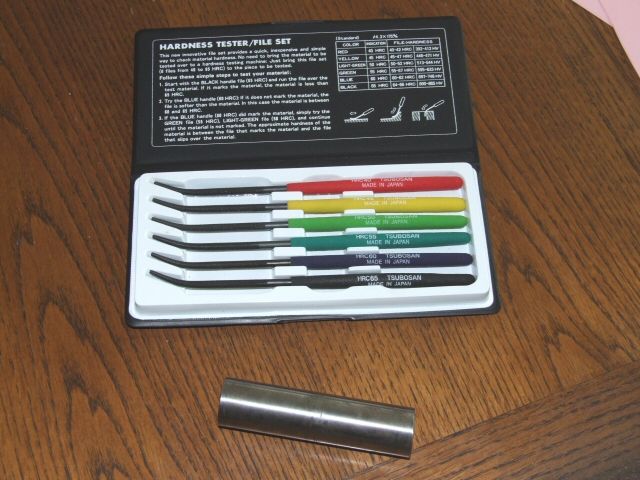
            Not quenching properly leads to a significant loss of hardness, as measured by these:

            hardness_sized.jpg

            Andrew

            #414231
            SillyOldDuffer
            Moderator
              @sillyoldduffer

              Sounds like one of my attempts! First, no point in tempering if the initial hardening step failed. After quenching try running a file across it – the file should slide off, not cut.

              Very likely the form tool wasn't hot enough OR, it cooled off enough on the way to the quench to spoil it. What's needed is to heat the steel hot enough to change its internal state without burning it (ie remove carbon), and then cool it so rapidly it doesn't have time for form the usual soft structure.

              Bit of a wild guess based on my failures but I reckon it's more difficult to harden small steel items than big ones because small items lose heat much more quickly than big lumps. I blast the item to get it extra hot just before quenching, but I'm not sure it's effective. Perhaps a clockmaker can advise? What's the best way to harden small parts?

              Changing the cooling fluid might help. Water (provided the tool is stirred violently to disperse cooling steam) makes harder steel than oil, and salt-water even harder. Often too hard!

              The purpose of tempering is to increase toughness at the expense of reducing hardness. There's a risk of untempered steel shattering because its brittle. On partly hardened steel, tempering will leave the tool too soft.

              Dave

              #414235
              Rik Shaw
              Participant
                @rikshaw

                My experience with gauge plate ended in the '80's. Most of the gauge plate I had used up till then was top quality of the more expensive variety and would harden very easily – usually quenched in oil. My last job before I retired myself from "dirty hand" jobs was in a tool and die shop in the automotive industry and cost savings were the order of the day.

                This was the first time I had ever come across cruddy so called gauge plate. The only bloke I knew who could harden it worked in the heat treatment department and all I can remember is that it involved overnight treatment in an oven.

                Rich – just hope you have not been passed of with a piece of "cruddy"

                Rik

                #414241
                JasonB
                Moderator
                  @jasonb

                  I would not bother to temper, just use it hard.

                  #414244
                  Buffer
                  Participant
                    @buffer

                    Om so I will quench in brine and ias I cant accurately gauge the temp is it worth just giving it full blast with the gas. Can it get too hot? Or am I likely to just be wasting gas.

                    Thanks rich

                    #414247
                    speelwerk
                    Participant
                      @speelwerk

                      I have no problems using oil to harden parts made from gauge plate but they are very small in size. Larger parts gave problems when using the same size container filled with oil. You need a good size container for quenching in oil, better larger than smaller, otherwise you cannot get rid of the heat fast enough. Niko.

                      #414251
                      jimmy b
                      Participant
                        @jimmyb

                        Is the gauge plate of known good quality?

                        I bought some gauge plate off ebay that machined really well and would not harden….

                        I have had very good results with "case hardening compound" on mild steel.

                        Jim

                        #414262
                        Buffer
                        Participant
                          @buffer

                          Jim it was bought off an ebay seller who says it meets bs specs but that's as much as I know. I have no other way to.telll if it's of a good quality.

                          Think I'll just get it real hot and try it without tempering. I have used it on brass so even if it doesnt harden enough it's not totally useless.

                          Thanks rich

                          #414266
                          Anonymous

                            Nowt to say that's it's gauge plate at all. It might meet BS specs, but who's to say that means British Standards, might be bullsit spec. smile

                            Andrew

                            #414288
                            David George 1
                            Participant
                              @davidgeorge1

                              It sounds like the piece wasn't hot enough did you use a hearth to keep the heat enclosed and when you say red hot it should be more orange to be hot enough to get a decent hardening. I have a pile of fire bricks which I enclose the piece to get it hot enough and a nice large blow torch. I also have a gallon tub of oil right next to quench it in. You must vigorously move the piece in the oil to remove the heat quickly. Test with a file and it should just skid off. To temper the piece polish with emery cloth and I sometimes descale in brick cleaner and degrease as well. Heat slowly until a light brown colour is atained and then wait a minute and quench in water. Job done. This is how I harden gauge plate and silver steel I hope it helps.

                              David

                              #414294
                              John Reese
                              Participant
                                @johnreese12848

                                When quenching in oil keep the part moving to expose the surface to fresh oil. It improves the heat transfer.,

                                Is there a possibility the gauge plate was mis-labeled? Low carbon plate could explain the problems you are experiencing.

                                #414296
                                SillyOldDuffer
                                Moderator
                                  @sillyoldduffer
                                  Posted by Richard brown 1 on 14/06/2019 20:08:37:

                                  … I have no other way to.telll if it's of a good quality.

                                  Have a read of Wikipedia on spark testing. Simple to do, though don't jump to conclusions without practice.

                                  When you push steel against a grinding wheel it produces a shower of sparks characteristic of the metal. Mild steel is least sparkly and usually easy to tell apart from a tool steel like gauge plate.

                                  I doubt it's a quality problem, more likely it's heat. I've failed and succeeded hardening bits off the same Silver Steel rod. The weakest link was me!

                                  Dave

                                  #414306
                                  speelwerk
                                  Participant
                                    @speelwerk
                                    Posted by SillyOldDuffer on 14/06/2019 17:34:01:

                                    Perhaps a clockmaker can advise? What's the best way to harden small parts?

                                    I am not a clockmaker but with hardening small parts you have to make sure the tool with which you hold it does not act as a heatsink . I use a stainless tweezer to hold the part and make sure that is heated first. Also of course your jar of oil is as close as possible without catching fire and burning the place down. Niko.

                                    #414315
                                    Neil Lickfold
                                    Participant
                                      @neillickfold44316

                                      Gauge plate needs to be bright orange in heat, Yellow is too hot , bright red is too cold. A low light room will give a better result than in day light or with bright lights on. Quench in oil is fine, you need enough oil, so that the oil does not get hotter than 30c or so, otherwise the volume is too small and the quench is inadequate. Temper in the oven at 150c to 180 c, or if heating with a torch when clean from any oil and dry, is a pale straw colour. Allow for sharpening of the edge after the heat treatment. The edge will be rounded off and burnt away from the heating of the part. If you have stainless gauze to wrap the part in for the heating will significantly protect the very sharp edges or corners. Best to remove the cage just prior to quenching, as it will hamper in the quench cooling.

                                      Neil

                                      #414322
                                      Hopper
                                      Participant
                                        @hopper

                                        Make sure you use a good amount of oil or water for quenching. Like a bucket full, not a little used baked-beans tin full etc.

                                        There is flat ground stock that is ordinary mild steel sometimes passed off as "gauge plate" by unknowledgable or uncaring suppliers. Check the spec of your gauge plate.

                                        Also, remember to run your lathe much slower than you would for HSS tooling. At least halve the rpm. Otherwise it will burn the edge right off a carbon steel tool.


                                        Edited By Hopper on 15/06/2019 04:02:53

                                        #414323
                                        Plasma
                                        Participant
                                          @plasma

                                          Not sure if it's been mentioned already but I use a magnet to test if the steel has reached the curie point and is hot enough to quench.

                                          I only Quench in brine if I want glass hard results and stick to Quenchall 22 oil for most jobs.

                                          I have a chart of useful tempering temperatures in my shop for various tools, I'll have a gander to see if it mentions lathe tools.

                                          Regards Mick

                                          #414338
                                          Roger Woollett
                                          Participant
                                            @rogerwoollett53105

                                            As has been said you need to get it hot enough but not too hot. Use a dim light and aim for a carrot colour. Soak times are to get the material hard right through but for a cutting tool it is only the outer millimetre or so that really maters. If the core is still tough as supplied so much the better. I wait maybe a minute after I have got it to carrot colour.

                                            Oil is correct for gauge plate but I am afraid I just use warm water. Keep the water bath close to the hearth so the part does not cool on the way. Plunge straight in and stir to get rid of any surface bubbles.

                                            Clean up and temper by colur or in the oven. I use a flame and quench as soon as the cutting edge gets to light straw.

                                            Having tempered use a stone to get the cutting edge sharp again.

                                            Finally when you use the tool go easy. If the cutting edge goes above the temper temperature it will blunt very quickly.

                                            #414354
                                            Buffer
                                            Participant
                                              @buffer

                                              I have just had a success by heating it to carrot colour then quenching in brine. Perhaps it was cooling to slowly in the oil. As advised I also didn't temper it I just took it easy and it works well.

                                              Anyway thanks to all of you who offered advice. I can now make accurate form tools that work.smiley

                                              Regards Rich

                                              #414356
                                              Vic
                                              Participant
                                                @vic
                                                Posted by JasonB on 14/06/2019 18:20:27:

                                                I would not bother to temper, just use it hard.

                                                Yes I’ve done that with several things I’ve made from 01 and not had any problems.

                                                #414371
                                                Anonymous

                                                  I note that a few people don't temper after hardening. That might imply that tempering isn't necessary. But it could also mean that the hardening didn't work properly. In that case tempering will have little or no effect.

                                                  Andrew

                                                  #414372
                                                  JasonB
                                                  Moderator
                                                    @jasonb

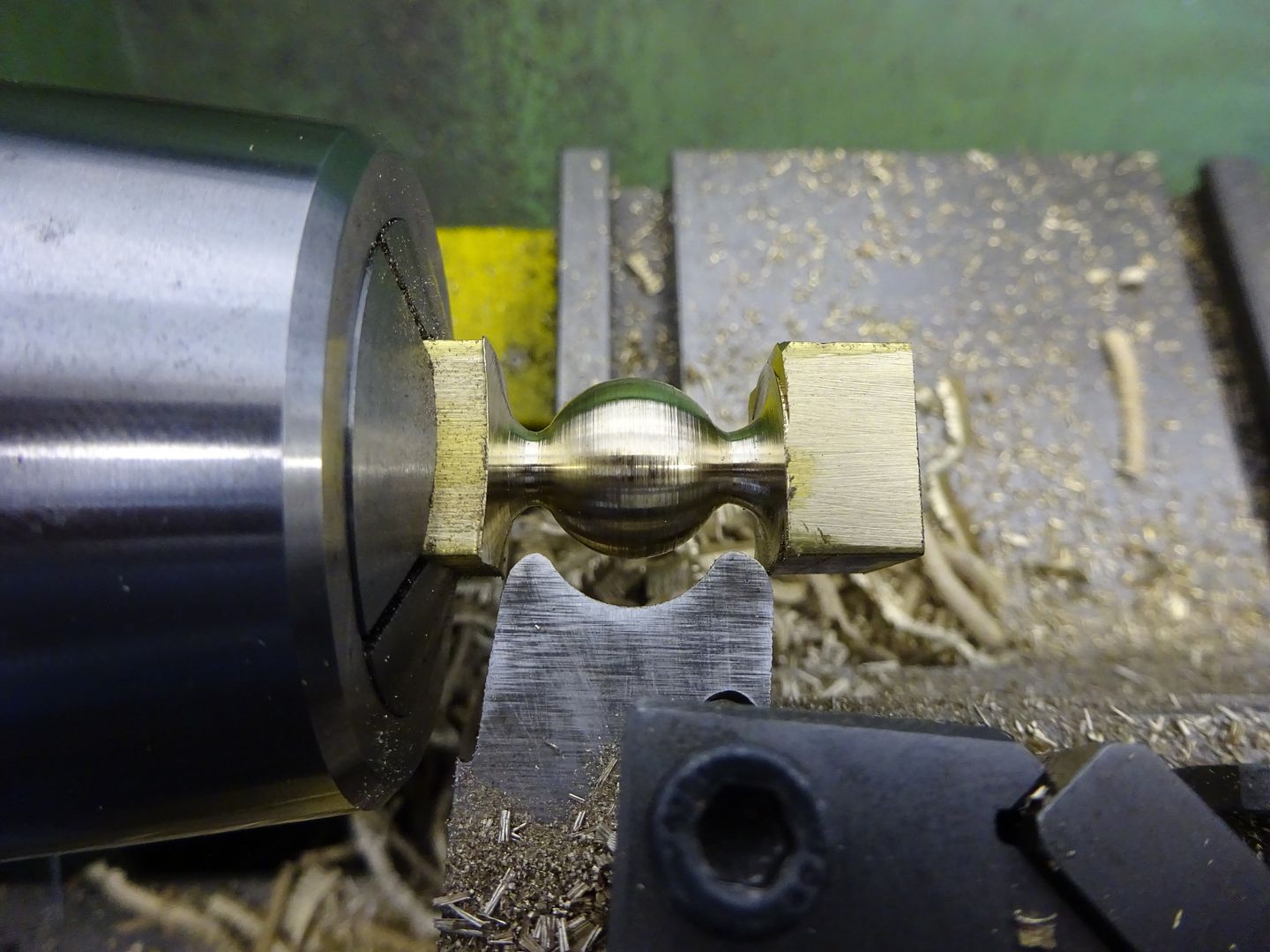
                                                    Not sure about tha, this one for expmple held up OK for making these brass fittings

                                                    And with a bit of regrinding (not to the cutting edge)went on to cut a batch of steel decorative nuts, still has a sharp edge

                                                    If it were not hard I would have expected the steel hex to blunt it. I know the likes of Ramon seldom tempers his homemade cutters and he used to do a lot of hardening for a living though he does have a tub of whale oil to hand.


                                                    I do feel that the section of the part being hardened can have an effect, if you have machined the cutting edges then they will be thinner and pointed and will quench faster than the bulk of the part so you can get a harder edge with a less brittle body so the tool may not shatter but the edge could chip.

                                                    Edited By JasonB on 15/06/2019 13:37:38

                                                    #414379
                                                    Vic
                                                    Participant
                                                      @vic
                                                      Posted by Andrew Johnston on 15/06/2019 13:23:15:

                                                      But it could also mean that the hardening didn't work properly. In that case tempering will have little or no effect.

                                                      Andrew

                                                      And you think we wouldn’t notice?! In my case at least all the parts ended up glass hard as determined by a file just skidding over the surface. I’ve made trigger parts and scraper tips and they’ve all worked very well.

                                                    Viewing 25 posts - 1 through 25 (of 30 total)
                                                    • Please log in to reply to this topic. Registering is free and easy using the links on the menu at the top of this page.

                                                    Latest Replies

                                                    Home Forums General Questions Topics

                                                    Viewing 25 topics - 1 through 25 (of 25 total)
                                                    Viewing 25 topics - 1 through 25 (of 25 total)

                                                    View full reply list.