Screwcutting aluminium.

Screwcutting aluminium.

Home Forums Workshop Techniques Screwcutting aluminium.

Viewing 19 posts - 1 through 19 (of 19 total)
  • Author
    Posts
  • #214281
    Mark P.
    Participant
      @markp

      I need to cut a 14×1.5mm thread on some 6082 aluminium bar. Do I cut at a fairly fast speed with light cuts or run the lathe slowly? I have made a “test nut” to test the thread. Should I finish off with a die?
      Mark P.

      #15815
      Mark P.
      Participant
        @markp
        #214283
        Brian Wood
        Participant
          @brianwood45127

          Hello Mark,

          I think some speed would be best, use paraffin or WD 40 as a lubricant on the tooling. Slow is more likely to tear up the material.

          If you have a die then by all means finish your thread with it, I usually leave a little on my lathe cut threads to allow a die something to do and clean up all the geometry at the same time

          Brian

          #214286
          JasonB
          Moderator
            @jasonb

            Really comes down to how quickly you can stop the machine or disengage the leadscrew.

            One option if its against a shoulder or a blind hole is to mount the tool at the back of the work and run the lathe backwards that way you can run at a speed that suits the material and have plenty of time to stop/disengage.

            A die will help give the crests and vallys the right radius so cut to about 80% and then use the die.

            #214288
            Mark P.
            Participant
              @markp

              Thanks for the replys, Jason I am cutting toward a shoulder so have to stop the lathe I am also using a flip up toolholder.I really don’t enjoy screwcutting but needs must.
              Mark P.

              #214289
              Emgee
              Participant
                @emgee

                Good advice given already but if you haven't got a die consider buying a full form insert for the 1.5mm thread, will also be OK for other diameters, not like a die which will only suit 1 diameter.

                Emgee

                #214320
                Tim Stevens
                Participant
                  @timstevens64731

                  Do be careful when running a modelling lathe backwards. Many smaller lathes have a screwed-on chuck, whereas proper man-sized versions (the sort you can't get into a Transit Van) hold the chuck by a mechanism that can turn both ways. You might get away with it, but it can be expensive if you don't …

                  Cheers, Tim

                  #214324
                  Neil Wyatt
                  Moderator
                    @neilwyatt

                    When I made an M42 to 1 1/4" eyepiece adaptor in aluminium recently I just used an HSS tool, my mandrel handle and neatcut. Got within 1.5mm of the flange, and then undercut the thread. Going slow didn't cause any issues.

                    Neil

                    #214331
                    Joe Page
                    Participant
                      @joepage27051

                      I cut a hell of a lot of threads in aluminium and I've found running fast only speeds up the threading process, it seems to make little difference on finish. I found the best method for aluminium was to use a full profile insert, it will be called something like a 16ER ISO1.5. The 16 part being it measures about 16mm across, ER being right handed and 1.5 being the pitch. Then use lots of thin oil, WD40 or water based coolant works fine for me to stop the aluminium sticking to the tip.

                      I would turn the aluminium to exactly 14mm, and then make passes moving in 0.2mm at a time until I get to 13.8mm, and then do two or three spring passes. I wouldn't bother angling the compound as it seems to make no difference on aluminium. I wouldn't pass a die over it either as the full profile insert will have done its job. It would be best to make a groove at the end of the thread at the shoulder so that when you disengage the halfnut you won't break the tip. I tend to run the lathe about 400rpm at that size just to speed up the process, but it all depends how confident you are at disengaging the halfnut fast enough and at the right time.

                      #214358
                      Anonymous
                        Posted by Joe Page 1 on 27/11/2015 20:54:21:

                        I cut a hell of a lot of threads in aluminium and I've found running fast only speeds up the threading process, it seems to make little difference on finish. I found the best method for aluminium was to use a full profile insert, it will be called something like a 16ER ISO1.5. The 16 part being it measures about 16mm across, ER being right handed and 1.5 being the pitch.

                        The ER stands for external right handed; the internal equivalent would be IR. Internal and external inserts for nominally the same thread are not equal in form, as well as having different clearances.

                        Andrew

                        #214381
                        Bob Unitt 1
                        Participant
                          @bobunitt1

                          A slight divert – be careful not to make the thread too good a fit, if the receiving thread is also aluminium. Years ago i was making threads to join two aluminium tubes for a friend, must have been around 1" by 12tpi. I cut the thread to my usual standards for steel or brass, and then screwed them together for a 'test fit'. Never did manage to get them apart again… I later learned that too good a fit on aluminium threads can cold-weld the threads together, irretrievably.

                          #214389
                          John Stevenson 1
                          Participant
                            @johnstevenson1
                            Posted by Joe Page 1 on 27/11/2015 20:54:21:


                            I would turn the aluminium to exactly 14mm, and then make passes moving in 0.2mm at a time until I get to 13.8mm, and then do two or three spring passes.


                            .


                            Think we have a typo here ?

                            Metric fine thread data here.


                            https://mdmetric.com/tech/thddat3.htm

                            Edited By John Stevenson on 28/11/2015 13:09:45

                            #214400
                            Joe Page
                            Participant
                              @joepage27051

                              Hi John,

                              Sorry no typo, there's tolerances on threads and because aluminium seems to be so sticky I work to the bottom major diameter tolerance. If I were to work to exactly 14mm then the thread would be tight and like Bob says it would weld itself together.

                              I find the following website really useful, I follow it and everything seems to fit.

                              **LINK**

                              Andrew – suppose I should have worded that better, yes there being four different forms. The ER, NL being almost identical as with the EL,NR. (N used instead of I).

                              Regards,

                              Joe

                              #214406
                              John Stevenson 1
                              Participant
                                @johnstevenson1

                                Joe

                                At first glance it doesn't read like this.

                                You say start off at 14mm and cut to 13.8. Most people would take that as root.

                                I can see what you are saying now and that is with the full profile inserts you would cut so the OD dropped to 13.8

                                #214421
                                Anonymous
                                  Posted by Joe Page 1 on 28/11/2015 15:35:37:

                                  Andrew – suppose I should have worded that better, yes there being four different forms. The ER, NL being almost identical as with the EL,NR. (N used instead of I).

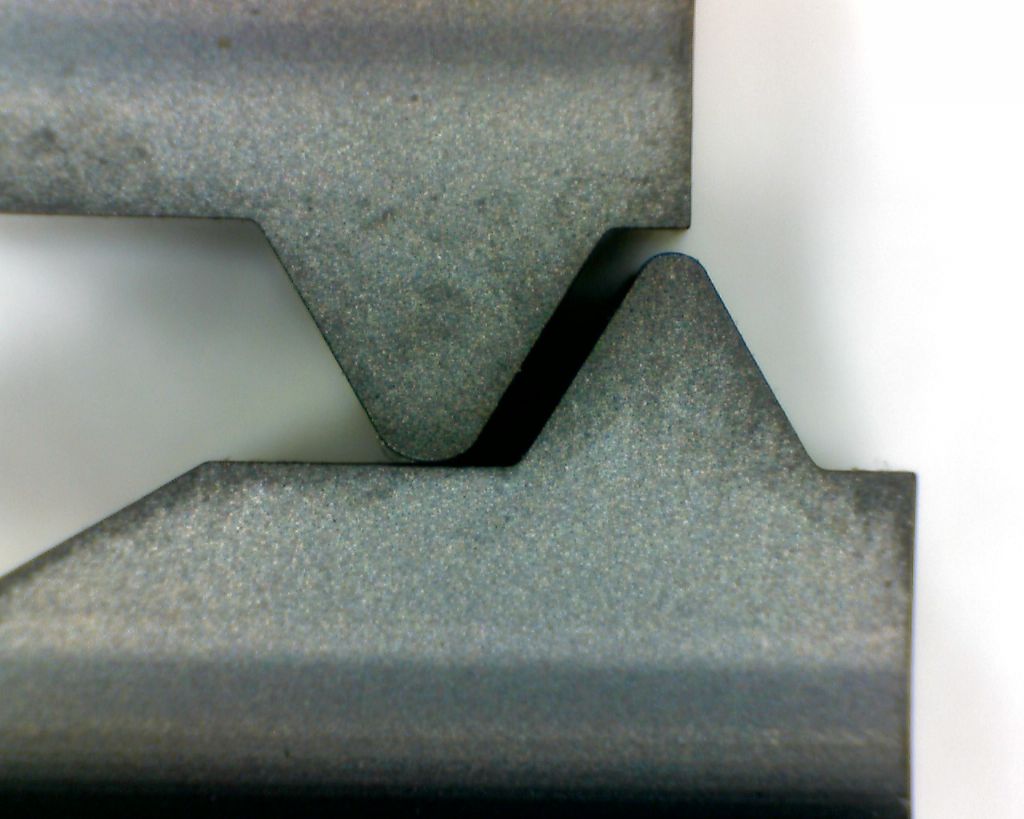
                                  Quite so, E seems pretty universal for external thread inserts but N or I seem to be used for internal inserts depending upon the manufacturer. Not sure why, unless there was a concern that the 'I' may be mistaken for a '1'. The external and internal threads forms are quite different:

                                  external_internal_2iso.jpg

                                  These inserts are both full form for 2mm pitch ISO; external at the top, internal at the bottom.

                                  Andrew

                                  #214428
                                  Joe Page
                                  Participant
                                    @joepage27051

                                    Andrew, I think it was Seco that used "N" first instead of "I" and then most just followed suit, I guess you could be right in saying its to stop "l" being mistaken for one. Off top of my head I think the radius of the external point should 1/4 the pitch and the internal be 1/8 of the pitch.

                                    #214463
                                    Ajohnw
                                    Participant
                                      @ajohnw51620

                                      As I understand it rads are added in places for practical reasons.

                                      It's not too difficult to anodize aluminium but it's best to establish the current density per unit area on a sample rather than just taking figures from the web or the me book. The thicker oxide layer should help stop threads from binding.

                                      John

                                      #214896
                                      Martin Connelly
                                      Participant
                                        @martinconnelly55370

                                        Have you got an old M10 tap that you can grind up. If so you can make a thread chaser for 1.5mm pitch threads from it. I have done this with other sizes and have used them for CNC thread milling as well. They are not perfect for an external thread form but the difference is very small. You could probably use one for cutting the thread as well if you grind away all but one and a half teeth on one land. Make sure you are keeping full teeth, not ones in the tapered part of the tap.

                                        Martin

                                        #214898
                                        Mark P.
                                        Participant
                                          @markp

                                          Job done, thanks guys.
                                          Mark P

                                        Viewing 19 posts - 1 through 19 (of 19 total)
                                        • Please log in to reply to this topic. Registering is free and easy using the links on the menu at the top of this page.

                                        Latest Replies

                                        Home Forums Workshop Techniques Topics

                                        Viewing 25 topics - 1 through 25 (of 25 total)
                                        Viewing 25 topics - 1 through 25 (of 25 total)

                                        View full reply list.