Recommend an Analogue Multimeter?

Recommend an Analogue Multimeter?

Home Forums Electronics in the Workshop Recommend an Analogue Multimeter?

Viewing 21 posts - 1 through 21 (of 21 total)
  • Author
    Posts
  • #822773
    SillyOldDuffer
    Moderator
      @sillyoldduffer

      My inexpensive analogue multimeter is misbehaving after only 30 years service: the movement is sticky, probably due to dirt.  Used indoors for basic electronic testing, rarely on mains or higher voltages.

      I thought replacing it would be easy, and can’t find one that meet my needs.  Tried Amazon, Farnell, RS, CEF, Pass and  various hobby suppliers like Maplin.  Problems:

      • Very cheap meters have small scales and insufficient ranges.  Also, their movements are insensitive enough to distort readings.  Not good enough.
      • Next size up budget meters are bigger and sensitive enough, but, with one exception, I can’t find any with an x10k resistance range (up to 20MΩ, actually useful between 50kΩ and 5MΩ)  Rarely do AC current up to 10A, though that’s not essential.  Prices between £6 and £40.
      • Professional meters have the same range limitations as budget models, and add expensive features I don’t need.  Physically more robust, Ingress Protection,  improved accuracy, true RMS, idiot-proof overload protection, and the CAT II, III or IV safety ratings needed by electricians.  Prices between £150 and £400.  Not found one that can measure high resistances.

      What I don’t want.

      • Digital.  Already have one and analogue is ideal for needle flick testing.
      • A bench meter. (Unless it’s portable and reads quickly!)
      • An Avo8.  Got one.  Inconveniently heavy and clunky for electronics.  Works well, but gets in the way, and uses a weird battery!

      My old meter is close to what I need.  Ranges:

      • DCV: 0.5, 2.5, 10, 50, 250, 1000V
      • ACV  10, 50, 250, 1000V
      • DCmA 50uA, 2.5mA, 25mA, 250mA
      • Ohms X1, X10, X100, X1000, X10000.  (Effective range about 0.5Ω to 5MΩ)

      I’ve found one meter similar to my old one, but it’s suspiciously cheap (£8.99).  Might be worth a punt.  Anyone know of better match.  My budget could stretch to £400 as xmas is coming!   Under £50 is more my line!

      Also, is my desire for analogue out-of-date?   Are better digital meters fast enough to so a flick test? i.e quickly showing volts are present, with no need to measure them.

      Ta,

      Dave


      #822775
      Michael Gilligan
      Participant
        @michaelgilligan61133

        Dipping a toe in the muddy waters of  t’internet ….

        https://www.findthisbest.com/best-multimeters/analog

        MichaelG.

        #822778
        Michael Gilligan
        Participant
          @michaelgilligan61133
          #822783
          Julie Ann
          Participant
            @julieann
            On SillyOldDuffer Said:

            ….Also, is my desire for analogue out-of-date?

            Basically yes! I have an AVO8Mk7 for old times sake but can’t remember the last time I used it. When I was young I had analogue meters but they are long gone, decades since I’ve used one. I either use a DVM or a digital oscilloscope if I suspect the signal might be time varying.

            Analogue meters are specified in terms of ohms per volt, ie, how much current they draw from the circuit. I vaguely remember that 20kohm/V was regarded as the minimum for ‘proper’ measurements. That value equates to a 50µA meter movement.

            Just looked at the RS website and they still do analogue multimeters but not cheap and only 17 out of 730 multimeters are analogue.

            Julie

            #822792
            Merddyn’s Dad
            Participant
              @merddynsdad

              Have a look at a Voltcraft  VC 2030……………..

              Scale goes up to 10k, 10 amps, mirrored scale, cat III at 500v.

              Leads are a bit clunky, I made my own.

              No case, but suitable hard cases available on ebay,

              Very satisfied with mine, might be too cheap  though. 🙂

              Steve

              #822793
              SillyOldDuffer
              Moderator
                @sillyoldduffer
                On Michael Gilligan Said:

                https://testmeterpro.com/tekpower-tp7040-review/

                https://www.desertcart.co.uk/products/4817421-tekpower-tp7040-20-range-ac-dc-analog-multimeter-general-purpose

                I wondered how I missed this one – looks ideal!  Didn’t find it because it’s not available in the UK, though desertcart would ship it.  Not investigated p&p and tax yet!

                Why is nothing ever easy?

                🙁

                Dave

                #822794
                SillyOldDuffer
                Moderator
                  @sillyoldduffer
                  On Merddyn’s Dad Said:

                  Have a look at a Voltcraft  VC 2030……………..

                  Scale goes up to 10k, 10 amps, mirrored scale, cat III at 500v.

                  Leads are a bit clunky, I made my own.

                  No case, but suitable hard cases available on ebay,

                  Very satisfied with mine, might be too cheap  though. 🙂

                  Steve

                  Alas, doesn’t meet the resistance scale requirement.  I need X10k, and it stops at X1k.   Looks good otherwise and is available here.

                  Ta,
                  Dave

                  #822798
                  SillyOldDuffer
                  Moderator
                    @sillyoldduffer
                    On Julie Ann Said:
                    On SillyOldDuffer Said:

                    ….Also, is my desire for analogue out-of-date?

                    Basically yes! … decades since I’ve used one. I either use a DVM or a digital oscilloscope if I suspect the signal might be time varying.

                    …Julie

                    Yes, but they don’t meet my ‘quick test’ requirement.   “Analogue measuring instruments are ideal for quickly detecting fluctuating readings’.  My DVM is better at taking measurements but it doesn’t react quickly enough to take fluctuating readings, or showing that  volts are present simply by dabbing the probes and watching to see if the needle jumps.   Can your DVM do that? Mine doesn’t, perhaps because it’s ADC is cheap.

                    Oscilloscope doesn’t meet my requirement either.  I have one, but it’s a bench instrument, much clunkier than a small analogue meter for what I often do.   Actually, I’m using both on my clock project at the moment!  The oscilloscope shows pulses and lets me measure them, whilst the meter shows volts present on the board, and that the wiring harness has continuity.

                    Analogue vs digital meters is a bit like filing vs milling machines.  Usually the milling machine wins hands down, but there are many occasions when filing removes metal with less fuss.

                    Dave


                    #822810
                    duncan webster 1
                    Participant
                      @duncanwebster1

                      I made a high impedance analogue voltmeter using a meter from some medical equipment and a 741 op amp. Great for varying voltage and flicks, but no use for amps and ohms.

                      #822816
                      Robert Atkinson 2
                      Participant
                        @robertatkinson2

                        Hi Dave,

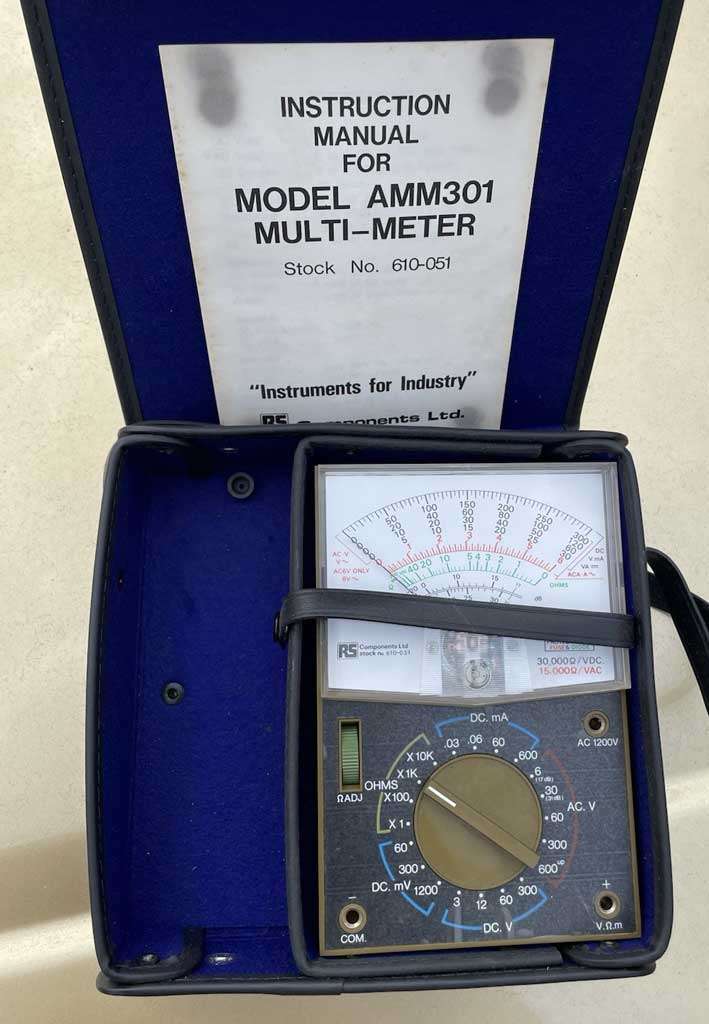
                        If you can wait a few days I have a job lot of stuff coming in which has a couple of RS Components AMM301 multimeters amongst it. They look virtually unused. They are 30 kilohm per volt, large scale. Resistance to 2M in 4 ranges. They have a tautband movement so very rugged. Only two short falls. Current is only up to 600mA (you can use a shunt) and the sockets will not take shrouded plugs so not suitable for mains.
                        Random picture from web of one.

                        Let me know if you want one.

                        Robert.AMM301

                        #822876
                        Huub
                        Participant
                          @huub

                          I haven’t used my analog multi meters for decades. Most of the time I use a true RMS auto range multi meter, my digital oscilloscope and for “low frequency” measurement a cheap Chinese multi meter (ET2010A) with build in scope.

                          #822901
                          Nicholas Farr
                          Participant
                            @nicholasfarr14254

                            Hi Dave, this  anologue multimeter seems to cover most of what you are asking.

                            Regards Nick.

                            #822918
                            SillyOldDuffer
                            Moderator
                              @sillyoldduffer

                              Excellent answers thanks.   The analogue meters identified by Michael, Robert, and Nick are a good match, my only worry about Nick’s find is it’s too cheap!   May not be too cheap at all, because it’s a well-established design, and a factory making them will have paid off it’s tooling costs decades ago.

                              Anyway I decided to:

                              • take up Robert’s kind offer.   His meter is better specified than I wanted, with a 30kiloohm movement, and it’s ranges are slightly better suited to my needs.  Mostly I measure 3v3, 5V and 12V, so a meter with a top end of 10V means I have to switch up.   The only mild negative is the lead sockets aren’t safety shrouded; not a problem to me because I’m not an electrician.  Not seen it yet but I’m expecting an older RS meter to be well-made, probably fairly expensive when new, not a cheapy.
                              • buy the digital meter with basic oscilloscope recommended by Huub.  The oscilloscope display might do my flick test, but if it doesn’t, the meter is better than my DVM, and having a simple oscilloscope will save getting out my big clunky oscilloscope, when I’m working on a dining table.

                              I ought to have explained what the meter is for in more detail.

                              • I don’t do much repair work, build amplifiers, or radios etc.  When I do, these are best tested with a DVM and oscilloscope because waveforms are informative and accurate measurements are needed.  I don’t do enough of this work to justify a bench-meter.
                              • I rarely use a multimeter for electrical work.  Mains is either off, or tested with a neon screwdriver.   When a multimeter is needed for testing single and 3-phase testing, safety is important.  Ordinary electronics rarely needs CAT level safety, so this is a feature I don’t have to pay for!
                              • I have little need for a rough workshop instrument.  Very cheap disposable is good enough or you can spend big money on a robust instrument.  Testing batteries and continuity doesn’t need an expensive meter – a 1000ohm movement with a few ranges is often good enough.   Neither type suits me!
                              • Much of what I do involves electronics to be attached to a microcontroller, either 3.3V or 5V.   Mostly simple and digital, where the meter is used to confirm supply present, confirm voltages correct inside the circuit, and connector continuity.  Also checking resistors are the right value before installation, and maybe checking dividers on OpAmps etc.  This meter is for simple sanity checks rather than deep diagnostics.   When that’s necessary I call on other instruments.    I know Robert’s meter does what I need, as would the one identified by Nick, and – with luck – so will Huub’s ET2010A.   The ET2010 has advantageous digital features like auto-ranging, and, if it’s fast enough, it will cover most of my needs with a single compact instrument.

                              I still want an analogue meter though.  Problem with digital meters is they take time to settle.   A DVM might not detect intermittent volts due to a bad connection, whereas an analogue needle often reveals them by jumping about.   Oscilloscopes aren’t perfect for this either: they have multiple sweep and trigger options that have to be set appropriately to catch events.

                              I’ll report back how I get on with analogue vs digital later.  I expect to be pleased with both – for different reasons!

                              Cheers,

                              Dave


                              #822927
                              Julie Ann
                              Participant
                                @julieann
                                On SillyOldDuffer Said:

                                …Analogue vs digital meters is a bit like filing vs milling machines.  Usually the milling machine wins hands down, but there are many occasions when filing removes metal with less fuss.

                                Many DVMs use dual slope integrators so inherently smooth out fluctuations. They measure time differences not an electrical parameter directly. The cycle time is often set as a multiple of mains frequency so mains pickup is reduced. In an analogue meter the inertia of the movement acts to smooth out small fluctuations.

                                Analogue scopes can be a pain when looking at low frequency events but the newer, almost universal, digital scopes are very good for recording parameters over a slow time scale without one having to stare at meter needle for ages. My scope sits on a shelf above the electronics bench so one scope lead dangling down is less obtrusive than meter leads.

                                All measurement instruments can give false readings and/or affect the circuit to which they are attached. As an example on the last circuit I designed (gas sensing board with a design brief to measure changes of 200pA and ideally down below 100pA) my business partner (software) saw small, 2mV, pulses appearing on the analogue signal lines. I asked a number of questions and couldn’t see where the pulses were coming from. Once we’d established that the pulses were also on the input and output of a linear regulator, with the whole board running from a battery, I categorically stated that there was nowt wrong with my design. Turns out the pulses came from the oscilloscope he was using, a Pico scope connected to a computer.

                                I am not sure that the analogy of filing versus milling is valid, although I agree that it is often easier to file something. I use files a lot, I did several large orders to Arc before they shut down buying as many of the files as were in stock. As an example I’ve never got on with the standard advice to round the end of a connecting rod on the mill using a rotary table. It is only too easy to go a gnats too far and it is then difficult to get rid of the indentation. Far easier, and quicker, to use filing buttons so that the rounded end can be blended in with the rest of the rod, even if the hole isn’t exactly central. I am in the camp of leaving filing buttons soft and treating them as disposable.

                                Julie

                                #825168
                                SillyOldDuffer
                                Moderator
                                  @sillyoldduffer

                                  Quick update.  I’ve received the ET2010A DVM recommended by Huub and Robert’s RS meter.  Robert’s meter needed TLC because batteries had leaked, doing some interesting damage.

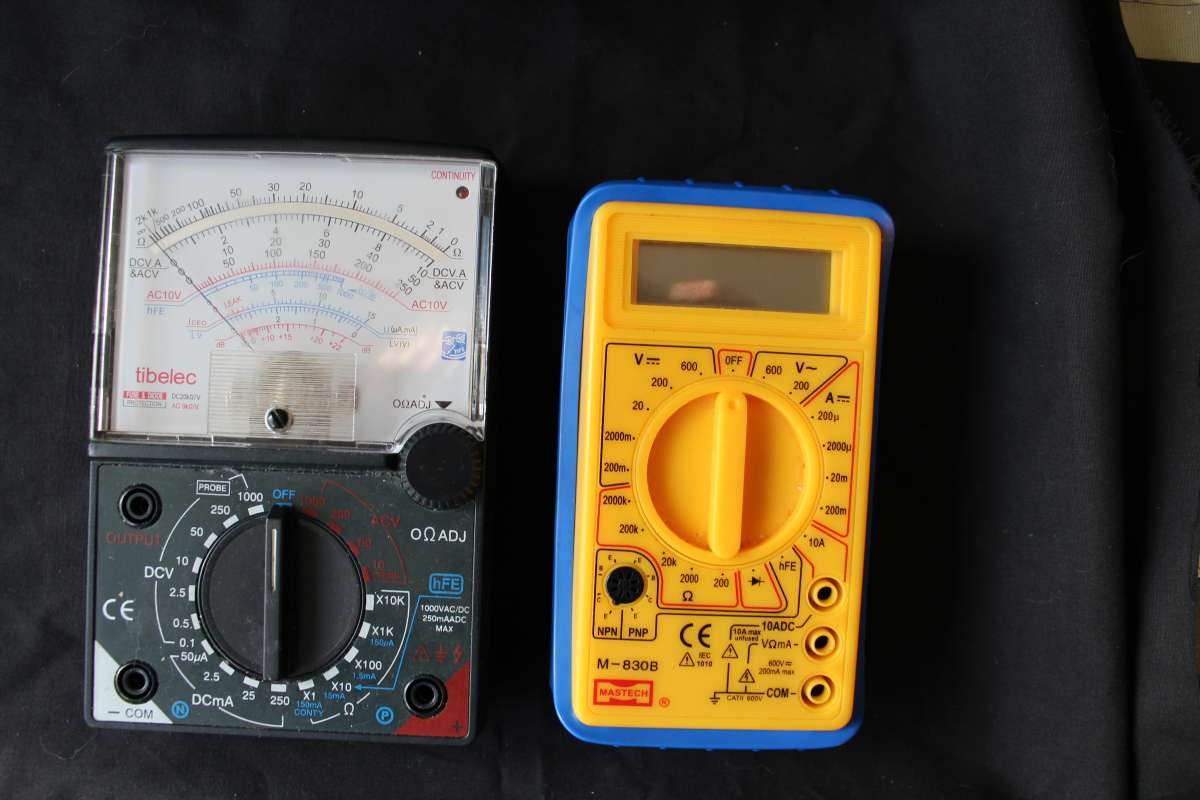
                                  What I use at the moment, both budget meters.  I also have an Avo 8.  The analogue meter started this thread by sticking, read on for twist at the end!

                                  Their application is mainly low voltage electronics.   In general the DVM is used when values are measured accurately, whilst the analogue meter is good for “does the needle jump” tests, continuity and such.

                                  IMG_5391

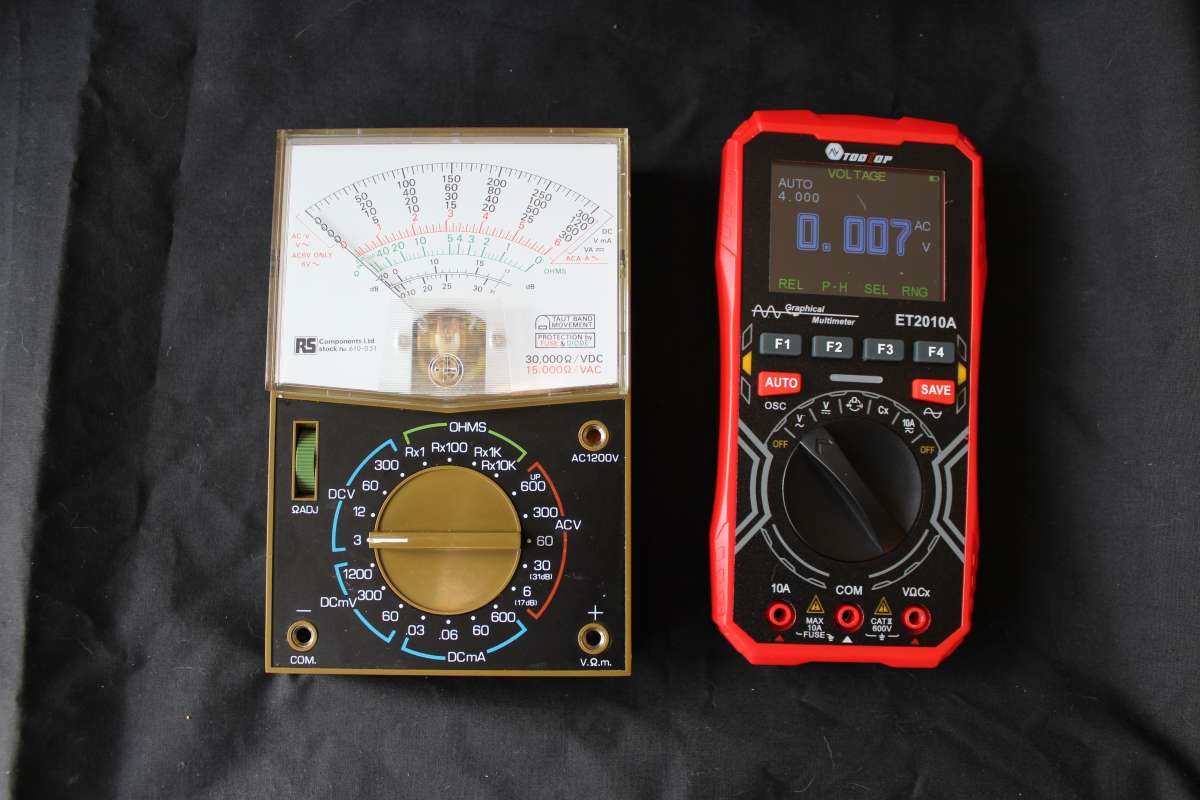
                                  Robert supplied a nice RS-Components meter, expensive when new, and made circa 1980 at the pinnacle of analogue meter development, just before Digital meters kicked off big time.

                                  My old meters above replaced by:

                                  IMG_5392

                                  Same functions as my original meters, but both are an improvement.

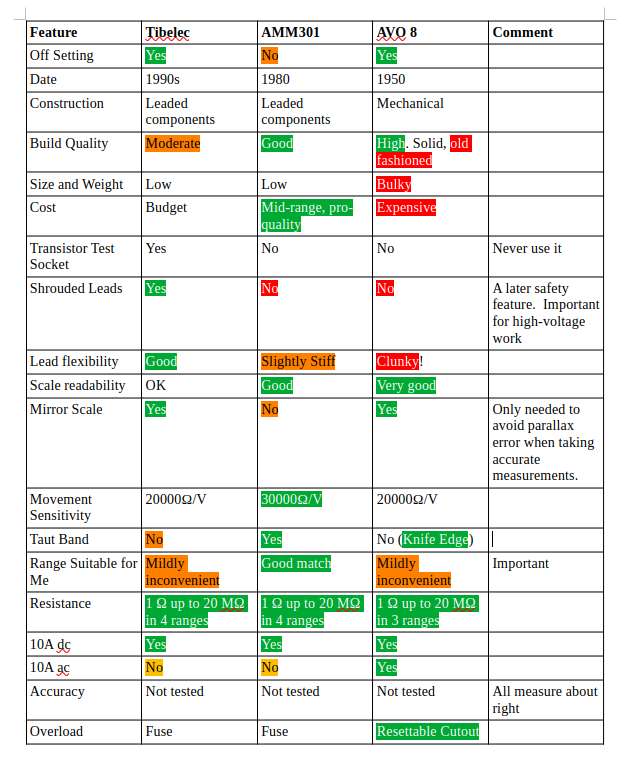
                                  Analogue meters as scored by me: your mileage may differ!  Best match to my needs is the RS meter, my old meter does surprisingly well, and the much venerated Avo8 scores a lot of reds.  Mainly because it’s a boat-anchor.

                                  Screenshot From 2025-11-18 17-54-15

                                  Nothing is perfect!  The RS meter pre-dates shrouded leads, dodgy when measuring high-voltages.  Doesn’t matter for low-voltage work.  Also missing, no OFF switch, a small thing.  The meter comes in a decent case, which is good.  The Avo8 wins whenever I need to measure a heavy AC current, otherwise rarely allowed out to play.

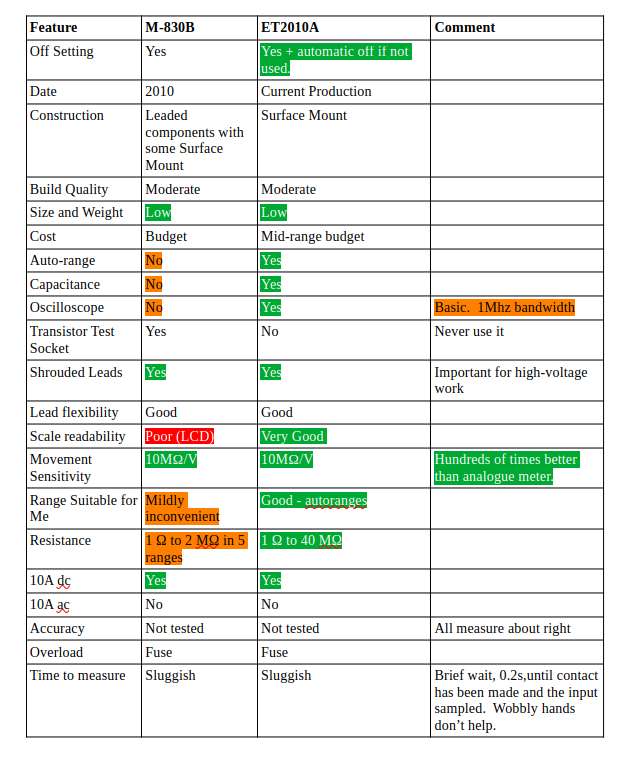
                                  Old and new DVMs compared.  Both budget instruments; the ET2010A wins:

                                  Screenshot From 2025-11-18 18-11-34

                                  In conclusion:

                                  • Both replacement meters are improvements – I’m pleased.
                                  • None of these meters are suitable for high-voltage or rough work.  They’re great for genteel electronics, rather too delicate for bash about automotive work, and an electrician is advised to buy a CAT rated meter.   Although the Avo is built like a battleship, they don’t like being dropped.  Accuracy not tested beyond ‘close enough’.  Not in the same league as a bench meter.  Fortunately I don’t need one.

                                  The twist!  After the new meters arrived, I risked taking the faulty Tibelec apart.  A tiny spider had set up shop in the spring, little Sod.

                                  Knowing my luck, one of these:

                                  blackwindow

                                  Dave

                                  Ran away whilst I looked for my camera.  The meter works perfectly now the beast is gone.  Aargh!!!


                                  #825169
                                  Robert Atkinson 2
                                  Participant
                                    @robertatkinson2

                                    You can never have too many meters 🙂

                                    #828175
                                    Sonic Escape
                                    Participant
                                      @sonicescape38234
                                      On SillyOldDuffer Said:

                                      Are better digital meters fast enough to so a flick test? i.e quickly showing volts are present, with no need to measure them.

                                      Ta,

                                      Dave


                                      Yes they are. That is why most mid range models have the bar graph. I made this video to have an idea of the speed. I disabled the auto ranging. So full scale is 50V.

                                      That is a Brymen BM869s, their top model. If you don’t need 1µV resolution you can pick a cheaper one. Bar graph speed must be the same.

                                      On SillyOldDuffer Said:
                                      • A bench meter. (Unless it’s portable and reads quickly!)

                                      True bench meters are super fast. They can update the readings hundred of times per second when averaging is removed. They are not bound by the low power requirements of portable DMM. You can’t see the last digits. In your budget you could easily find a used HP/Keysight/Agilent 34401A bench meter. This was the industry standard. 1000 readings per second with crazy accuracy specs. Just to do flick test with style with 6+1/2 digits 🙂


                                      #828195
                                      Andrew Tinsley
                                      Participant
                                        @andrewtinsley63637

                                        Interesting. I use high quality digital and analogue meters and I certainly would not be without the best analogue meter. It can pick events up which my best DVM with bar graph would be struggling to interpret.

                                        Andrew.

                                        #828201
                                        Robert Atkinson 2
                                        Participant
                                          @robertatkinson2

                                          Another issue with digital meters is related to their high input impedance. This can cause them to read voltage on disconnected circuits. This is due to resistive and capacive leakage. A resistive leakage of 1M would cause a DMM to read over 200V dispite 1M being acceptable for a mains circuit. Capacitance is even worse especially on lighting circuits where you can have two “lives” in a twin cable with no earth or neutral between them.
                                          Some DMM’s intended for electricians have special low impedance “Lo-z” modes to reduce this effect.

                                          Nothing beats the “ballistic” effects of a moving pointer when adjusting for a peak or null.

                                          Robert.

                                          #828214
                                          SillyOldDuffer
                                          Moderator
                                            @sillyoldduffer
                                            On Sonic Escape Said:
                                            On SillyOldDuffer Said:

                                            Are better digital meters fast enough to so a flick test? i.e quickly showing volts are present, with no need to measure them.

                                            Ta,

                                            Dave


                                            Yes they are. That is why most mid range models have the bar graph. I made this video to have an idea of the speed. I disabled the auto ranging. So full scale is 50V.

                                            That is a Brymen BM869s, their top model. If you don’t need 1µV resolution you can pick a cheaper one. Bar graph speed must be the same.

                                            On SillyOldDuffer Said:
                                            • A bench meter. (Unless it’s portable and reads quickly!)

                                            True bench meters are super fast. They can update the readings hundred of times per second when averaging is removed. They are not bound by the low power requirements of portable DMM. You can’t see the last digits. In your budget you could easily find a used HP/Keysight/Agilent 34401A bench meter. This was the industry standard. 1000 readings per second with crazy accuracy specs. Just to do flick test with style with 6+1/2 digits 🙂

                                            Good to know, thanks, but here’s the case for the prosecution, ho ho!

                                            Fails to meet the requirement!   What I don’t want. … A bench meter. (Unless it’s portable and reads quickly!) …  And I said “My budget could stretch to £400 as xmas is coming! Under £50 is more my line!”

                                            • Too big.  A 34401 is 88mm x 212mm x 348mm and weighs 3.6kg.  An excellent meter, but not on my dining table!
                                            • Cost.  Quick look on ebay shows the cheapest untested secondhand 34401A available today is £200, whilst tested units range from £400 to £700.  £1200 new from Farnell.  Either way, a lot of money to spend on a quick blip indication that volts are present, which a cheap analogue meter does for £10.

                                            I’m conflicted:

                                            • Bench meter too big, expensive and functionally over-the-top for what I’m doing.
                                            • The ET2010A DVM recommended by Huub does a good job apart from the flick test because I have to wait a couple of seconds for it to settle.  It’s auto-ranging and easier to read for everything but flick tests.
                                            • The analogue meter is better for flick tests, but not auto-ranging or easy to read because I gave to think about the scale and needle.

                                            Owning a budget DVM and analogue meter works quite well, provided they’re both on the table and ready to go.  Good to know a posh bench meter replaces both, expect I can’t justify spending hundreds of pounds on one.  99% of the time hobby meters are more than good enough for my purposes, and much cheaper.

                                            It’s a cruel world!

                                            Dave


                                            #828267
                                            Nicholas Farr
                                            Participant
                                              @nicholasfarr14254

                                              Hi, I’ve got a few analogue multimeters, but I don’t use them very much now.

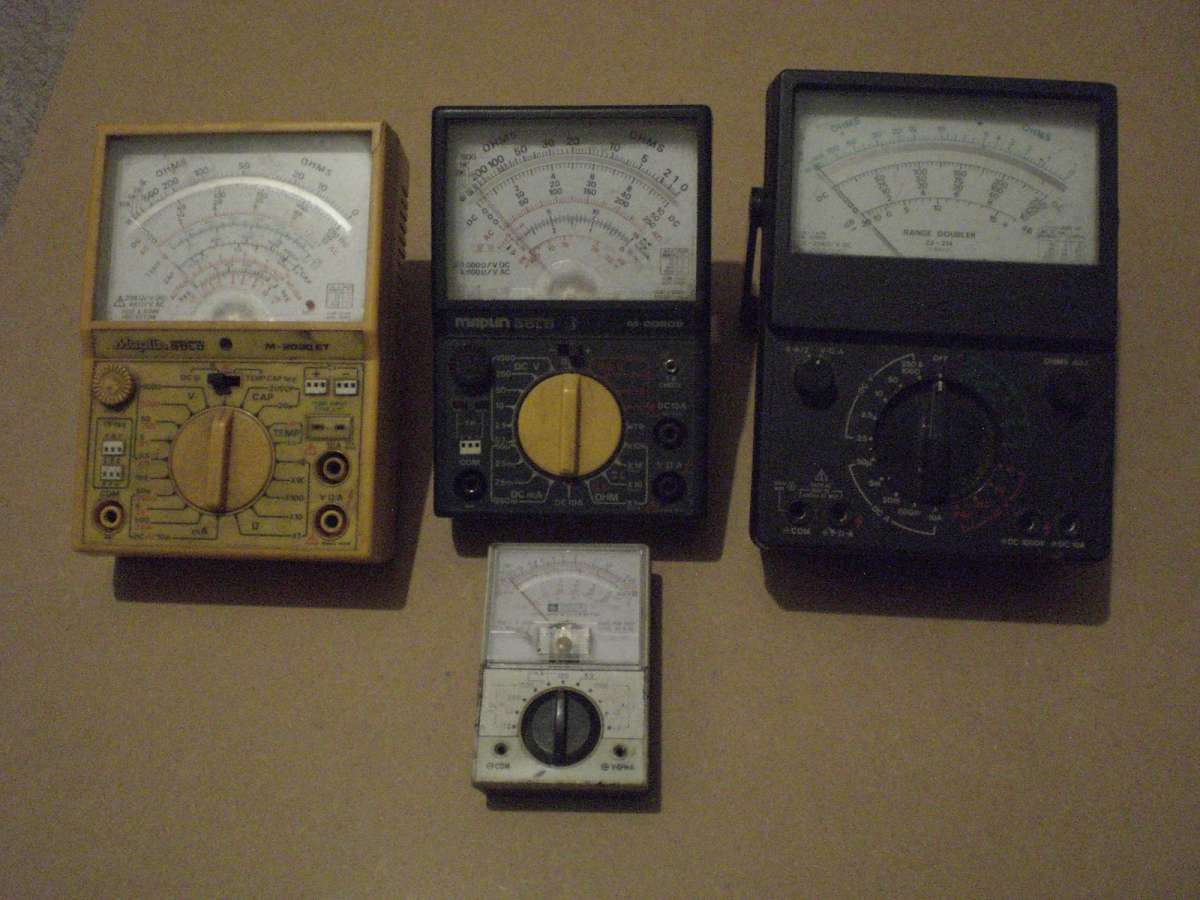
                                              CIMG3489

                                              However, although the black one with the yellow selector is okay as far as the electrics are concerned, it’s un-useable, as the the plastic part that holds and turns the selection  contactor is broken, and although I’ve thought of ways to fix it, I haven’t found a suitable solution, I dare say a new one could be printed these days, but I don’t know anyone in my part of the world, who would be able to do it. It was a black selector originally, but that one broke, and Maplin Electronics, at the time sent me that new yellow one. The other black one on the right, is a Micronta range doubler, which was given to me by a workmate, many years ago. The little one is a TTC model C 1000M, which is fairly basic, but has had its uses, and was small enough for my tool box at work for occasional use, and doing checks on my car.

                                              Regards Nick.

                                            Viewing 21 posts - 1 through 21 (of 21 total)
                                            • Please log in to reply to this topic. Registering is free and easy using the links on the menu at the top of this page.

                                            Latest Replies

                                            Viewing 25 topics - 1 through 25 (of 25 total)
                                            Viewing 25 topics - 1 through 25 (of 25 total)

                                            View full reply list.