Potentiometer?

Potentiometer?

Home Forums Electronics in the Workshop Potentiometer?

Viewing 24 posts - 1 through 24 (of 24 total)
  • Author
    Posts
  • #842513
    Bo’sun
    Participant
      @bosun58570

      Good morning.

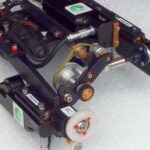
      I need to replace the potentiometer on my Warco WM250 lathe.  This will be the second time in nearly six years.  I’m reasonably confident the pot is at fault, because the lathe is doing the same as it did last time the pot was replaced (under warranty).

      With the replacement pot being the same as the original, I’m reluctant to order the same pot again from Warco.  The pot in question is 10K ohms, 2W, 6mm shaft, 10mm thread, ref No. WTH(118).  Is that sufficient information to source an alternative (hopefully better quality) pot?

      Currently I’m looking at a Bourns 3590 wire wound pot from RS (789-9387).

      The Warco pot doesn’t have any identifications for the three terminals.  Are they likely to be the same orientation on the RS pot?  If not, how can I determine what each one is?

      I did consider a squirt of terminal cleaner/lubricant, but there isn’t any access.

      Any thoughts/suggestions appreciated.  Thank you.

      #842524
      Julie Ann
      Participant
        @julieann

        Looking at the product picture on the RS website the connections are moulded into the body. Commonly the outer two connections are the ends of the track and the middle connection is the wiper. However that is not universal, especially with wire wound and higher power pots. For the suggested pot one of the outer connections is gold plated rather than tin plated. Which implies the connections are not ‘standard’.

        It is easy to determine the connections using a multimeter set on resistance. Set the pot roughly in the middle of it’s travel. Then determine which two pins have 10k between them. Those pins will be the ends of the winding and thus the third pin will be the wiper. Measure from the wiper to one, or the other, of the winding pins to determine which way round the winding pins should be connected such that resistance increases with the desired movement, clockwise or anti-clockwise.

        Julie

        #842525
        Bazyle
        Participant
          @bazyle

          Is the (118) a Warco part number? You need to know whether it is linear or log which will hopefully be written on the existing one but it is probably linear. A wirewound one is going to be better than a carbon film one.
          Most simple carbon track potentiometers have the 3 terminals in one plane pointing out radially and the wiper is always the middle one. However the RS part seems to be in-line axially and the pins are numbered with pin 2 as the wiper. I can’t definitively see which one that is from the picture.


          #842526
          V8Eng
          Participant
            @v8eng

            The Data sheet shows the connection information for the Bourne Pot.

            as Bazyle says you will need to check lin or log.

            The data sheet is downloadable on the RS web page as a pdf under the Technical Reference header.

            Direct link to it here.

            https://docs.rs-online.com/eea0/0900766b813f3677.pdf

            #842527
            Clive Foster
            Participant
              @clivefoster55965

              Three terminals in line parallel to the shaft are normally typical of a multi-turn (usually 10) potentiometer. Three in radial configuration are normal for single turn ones.

              Nooging around reveals a 10 turn variant of the same potentiometer with an S on the end of the type number, RS 107-0785. It appears that the same body is used for both types. So be careful not to get mixed up when ordering.

              Clive

              #842534
              Robert Atkinson 2
              Participant
                @robertatkinson2

                A wirewound pot would not be my first choice for this application. I would look at a CERMET type. You don’t need 2W either (you have to apply 140V to dissipate 2W in a 10k Resistor). This is probably to get a bigger device and overcome some short falls of a wirewound pot.

                e.g Bourns 93 https://uk.rs-online.com/web/p/potentiometers/5225305 with a life of 100,000 cycles compared to 10,000 for typical wirewound.

                It will be linear.

                Robert.

                #842539
                Bo’sun
                Participant
                  @bosun58570

                  Thanks for the replies everyone.  A little more to consider.

                  Bazyle – The Warco part No. is 3211BL00A, so I suspect 118 is the manufacturer.  The only markings on the pot are the manufacturers logo X, WTH(118) and 10K-2W.  I have no idea if the pot is log or linear, is there a way to tell?

                  Clive – According to the RS specification, the pot is single turn.

                  I’m sure that, having to return the pot to the start position, in order to restart the lathe everytime, isn’t helping it’s longevity.

                  #842541
                  Robert Atkinson 2
                  Participant
                    @robertatkinson2

                    Does the pot have a switch on the back?

                    This type of control will always be linear.

                    Robert.

                    #842542
                    Ian P
                    Participant
                      @ianp
                      On Robert Atkinson 2 Said:

                      Does the pot have a switch on the back?

                      This type of control will always be linear.

                      Robert.

                      or more likely always be logarythmic if its the volume control in a radio or HiFI etc

                      Ian P

                      #842553
                      Robert Atkinson 2
                      Participant
                        @robertatkinson2

                        Hmm, I wonder if my post wasn’t clear enough.

                        It was a question: Does it have a switch?
                        and a statement: This type of control will always be linear.

                        I didn’t consider them being read together. A better statement would have been :
                        A motor speed control potentimeter on a hobby lathe will always be linear

                        Unfortunaly, as IanP’s comment reminded me (perhaps not his intent) that most 10k pots you come across with a built in switch will be logarithmic as they are intended for audio applications, volume control and on-off switch combined.

                        Robert.

                        #842568
                        Bo’sun
                        Participant
                          @bosun58570

                          Thank you Robert,

                          No switch.  I had assumed it to be linear for consistant speed control.

                          #842570
                          mike barrett 1
                          Participant
                            @mikebarrett1

                            if you take it out it would be easy to measure with a meter to check if its linear or log (or even anti log..).

                            #842572
                            Robert Atkinson 2
                            Participant
                              @robertatkinson2
                              On mike barrett 1 Said:

                              if you take it out it would be easy to measure with a meter to check if its linear or log (or even anti log..).

                              The fault on the pot could make checking difficult. In anycase it wno’t be a log pot or the speed  would not be linearly related to the knob position. With a log pot the first 50% of the rotation will only cover 10% of the speed range.

                              Robert.

                              #842573
                              Robert Atkinson 2
                              Participant
                                @robertatkinson2
                                On Bo’sun Said:

                                Thank you Robert,

                                No switch.  I had assumed it to be linear for consistant speed control.

                                PM me your address and I’ll send you a new Bourns 90 series pot.

                                Robert.

                                #844600
                                Bo’sun
                                Participant
                                  @bosun58570

                                  Just a quick update.  Fitted a new potentiometer today, kindly supplied by Robert, and all is working fine.  I feel confident it will be more reliable than the OEM ones have been.  Bourns appear to have a decent reputation.

                                  #844695
                                  Charles Lamont
                                  Participant
                                    @charleslamont71117

                                    While we are here, I think the pot I used for the remote speed control of my lathe’s VFD is playing up as the speed can be rather erratic around the 50Hz position where it mostly sits.

                                    I bought a wirewound one, thinking that if I did not specify that, I might be getting one with a carbon track. It has done about 5 years. It is only working on 24V.

                                    What would be a more durable replacement – 1 turn, 10k, linear, panel mount, steel shaft?

                                    #844756
                                    renardiere7
                                    Participant
                                      @renardiere7

                                      Back in 2022 there was a thread on Home Shop Machinist forum discussing Hall effect sensors and their possible use as potentiometers. I was attracted by the fact that they’re contactless therefore no “crackle” and very linear. So I hoped would be ideal to use for speed control with a VFD. I was pointed to this particular item

                                      https://www.digikey.ca/en/products/detail/tt-electronics-bi/6127V1A180L-5FS/2620661


                                      It was pointed out to me however that for that particular component it could only reach 0.25V at the low end and 4.75V at the high end.

                                      Would be interested to hear what our electronics experts have to say on the subject. This is topical for me at the moment as I desperately need to replace the pot on my VFD speed controller.

                                      #844773
                                      Robert Atkinson 2
                                      Participant
                                        @robertatkinson2

                                        See my earlier post on this thread:

                                        Potentiometer?


                                        Cerme Type pots are the preferred choice for this application. Cermet is a co-fired ceramic / metallic mixture. Conductive Plastic is second choice. Wirewound is third choice but is compromised in terms of resolution and smoothness. They can have good life but the low cost ones don’t. Ten turn is only if you need very precise setting without frequent large changes. Otherwise it’s like using a quill feed or winding the head up and down.

                                        Hall and similar “contactless” devices can be used providing they have the correct output. Most VFDs are configured for 0-10 volt input and the sensors tend to be 0-5 volt. Many VFDs can be re-configured of 0-5V input. However you would probably have to provide a low current 5V supply for the device. Another option is a current loop 4-20 milliamp system but this is normally only found on higher specification devices.
                                        Pots just work and common failure modes are to zero output / speed.

                                        Robert.

                                        #844788
                                        renardiere7
                                        Participant
                                          @renardiere7

                                          Thanks Robert.

                                          #844826
                                          Nealeb
                                          Participant
                                            @nealeb

                                            There are electric cars around where throttle pedal travel goes from braking to 500BHP at the wheels. So, very high resolution, no intermittent contact, high (safety-critical) reliability, etc, required. Anyone have any insight into what sensor technology is used for things like that? I’m not designing one – just curious!

                                            A few years ago I built an Arduino-based temperature controller for a Weller soldering iron as the original controller had failed. I used the original pot into an AtoD input on the Arduino but it turned out that the pot was noisy and I have lived with it ever since while mentally debating whether to replace the pot or update the firmware and use a rotary encoder. At least that one’s not safety-critical!


                                            #844857
                                            Adrian R2
                                            Participant
                                              @adrianr2

                                              Such vehicles don’t just depend on the sensor, they also have features in the control software to guard against rogue inputs, open/short circuit, interference etc.

                                              The behaviour described earlier in this thread of having to turn the knob back to minimum each time may be related – the motor controller wants to know that the pot can deliver a valid input before allowing machine to start?

                                              #844862
                                              Julie Ann
                                              Participant
                                                @julieann

                                                It was common to use two potentiometers mechanically connected, one going up and one going down. Resistors are placed at each end of the potentiometers so that the voltage range from the potentiometer is less than the supply voltage. The resistors allow detection of shorts/opens. Newer systems use non-contact sensors.

                                                Julie

                                                #844894
                                                Robert Atkinson 2
                                                Participant
                                                  @robertatkinson2

                                                  Julie beat me to it (I’m currently in a different timezone to the UK).
                                                  The nearest to an ideal sensor for things like a throttle is a variable differential transformer. These come in two common types, linear (LVDT) and rotary RVDT) As the name suggests these are AC electromagnetic devices. LVDT is easiest to explain basically three coils wound one after the other along a tube. A magnetic core moves inside the tube (assume it’s slightly longer than the middle coil for this explanation). The two outer coils are connected to an AC signal source so their magnetic fields oppose each other (out of phase). The middle coil provides the output voltage. If the core is in the middle position the output is zero. As it moves away the mid position the voltage increases. It will be in phase with the source for movement in one direction and out of phase for the other. The signal output is directly proportional to the movement. If the coil is accurately wound the output is also accurate. They can be made to cover a wide range of travel of the core. An LVDT is always much longer than it’s working travel. No moving contacts and infinite resolution. Only moving part is the core. The resolution is typically limited by the interface electronics.
                                                  RVDTs are what is typically used for the power levers etc on modern aircraft gasturbine engine controls.

                                                  They are also used for some high accuracy electronic comparator indicators aka DTI. I have a Solartron DR-600 Gauge with a DP10 LVDT Probe for example.

                                                  Robert.

                                                  #844962
                                                  duncan webster 1
                                                  Participant
                                                    @duncanwebster1

                                                    For speed control on a lathe I reckon small steps in the input voltage wouldn’t matter. If this is the case a rotary encoder feeding into an arduino with an RC filter on the pwm output would suffice. Output would be 0 to 5v in 255 steps. If you need 0 to 12v then add an op amp.

                                                    All a lot more complicated than fitting a quality pot of course

                                                  Viewing 24 posts - 1 through 24 (of 24 total)
                                                  • Please log in to reply to this topic. Registering is free and easy using the links on the menu at the top of this page.

                                                  Latest Replies

                                                  Viewing 25 topics - 1 through 25 (of 25 total)
                                                  Viewing 25 topics - 1 through 25 (of 25 total)

                                                  View full reply list.