milldrill tilting fix

milldrill tilting fix

Home Forums Manual machine tools milldrill tilting fix

Viewing 25 posts - 1 through 25 (of 30 total)
  • Author
    Posts
  • #118247
    michael howarth 1
    Participant
      @michaelhowarth1

      I have a Warco WM14 mill drill which has a tilting head facility. When I bought the machine I thought that this facility would prove to be of great use but I have subsequently found that I can achieve any "tilting" that I require much more easily with a tilting vice. I would like to accurately set and fix the column in a more stable and permanent manner than the current swivel bolt arrangement.

      Any ideas would be welcome.

      Mick

      #12125
      michael howarth 1
      Participant
        @michaelhowarth1
        #118251
        Brian Wood
        Participant
          @brianwood45127

          Hello Mick,

          I don't know the machine in any detail, but if you are happy to do so, once it is set truly correct, I would drill, ream and dowel the head and column together to lock them in postion. Do it in two positions to avoid any risk of jacking out from vibration in subsequence use. Headed dowels will also prevent them from 'walking' in as well, rather on the lines of a gib headed taper key.

          It might also be a prudent precaution to provide a threaded socket end on the dowels, before fitting, to enable a subsequent owner something to extract them with if they wish.

          Regards

          Brian

          #118254
          John McNamara
          Participant
            @johnmcnamara74883

            Hi Mick H

            Threaded socket end taper or straight dowels are available.

            In fact my Shizuoka vhr-g Mill uses Taper pins to lock at zero the head in 2 planes. They are not a perfect fix, you still need to tweak the last couple of thou to align the head if you are doing accurate work. but the pins do get you close. Taper pins are better and easier to withdraw (some have a nut on the end to pull them out), however you will need to make a taper D reamer out of silver steel and harden it or buy one to prepare the hole.

            As Brian Wood mentioned two may be better than one, However there will always be a tiny error if you remove them move the head then move it back and replace them. Or maybe a little crash disturbs them Hmmm……

            You could of course make your own pins. Maybe from a High tensile bolt? turn the head off and then lock two nuts on the threaded end (You will have to try a few of nuts until they lock with the flats aligned) then clamp the nuts in the three jaw and turn the taper on the lathe. With light cuts it should work without support from the tail stock, although you could use the tail stock if needed. This method makes sure the threaded end of the bolt is not damaged by the chuck.

            Cheers

            John

            #118255
            michael howarth 1
            Participant
              @michaelhowarth1

              Thanks, Brian and John.

              May I also ask you for your observations on whether a more practicable route towards ensuring accuracy might be to invest in a twin clock tramelling device.

              Mick

              #118260
              Tony Pratt 1
              Participant
                @tonypratt1

                Hi Mick, you really do not need to invest in a twin clock tramming system, learn to use a single clock and save your hard earned £'s for something more useful. There are numerous threads on the net discussing the pros and cons of various tramming methods.

                Tony

                #118261
                Thor 🇳🇴
                Participant
                  @thor

                  Hi Mick,

                  several have wanted to do something with the column. I dont't know if you have found these sites?,

                  ***Link***

                  ***Link***

                  Regards

                  Thor

                  #118271
                  Brian Wood
                  Participant
                    @brianwood45127

                    Hello again Mick,

                    I agree with Tony in his advice over tramming heads, I don't use one believing one DTI swung round from the spindle is much better. It saves you money and who can guarantee the two clocks on a trapping heads respond identically? An expensive gimmick in my opinion

                    Regards Brian

                    #118280
                    Paul Lousick
                    Participant
                      @paullousick59116

                      I seldom use the swivel facility on my mill and normally use a tilting vice for angled milling but would not think of locking it in a fixed position. It is there for those odd accasions when I may need it.

                      Does not take long to check the alignnment of the mill head by swinging a single DTI around the spindle. The twin clock gadget is a nice toy but is not needed. You still have to swing it thru 180 degrees to check that both clocks are reading the same.

                      #118281
                      John McNamara
                      Participant
                        @johnmcnamara74883

                        Tramming:

                        I normally just swing a dial indicator mounted in the spindle on the table, you have to be careful because the probe can get damaged in the T slots. and it does jump around a bit if the table is old and has a few battle scars. not good for a precision indicator.

                        I recently had to replace the brake discs on my car as they were out of spec. one of them is about to become a tramming aid. I plan to turn the projecting hub off just leaving the disc itself, then face both sides flat on the lathe. (That will be an interesting exercise in itself to get the sides perfectly parallel)

                        For tramming I plan to place the disc on the bed of the mill and run the indicator in the spindle over the nice clean surface. Maybe I will get around to making a nice holder for the indicator…

                        This is not my Idea but it should work well.
                        If you do not have a disc car repair shops toss them out every day.

                        Cheers

                        John

                        #118282
                        michael howarth 1
                        Participant
                          @michaelhowarth1

                          In retrospect, perhaps I am making something out of nothing. By the sound of it I would be best advised to perfect the tramming technique……I do like the sound of the disc though.

                          Thanks for all your answers and interest.

                          Mick

                          #118283
                          Paul Lousick
                          Participant
                            @paullousick59116

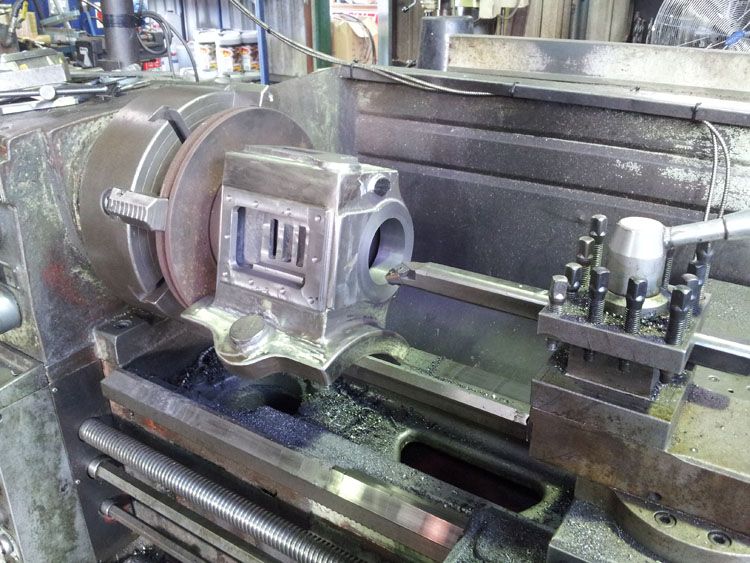
                            I recently used an old disc brake as a mounting plate on a lathe while boring a hole. The job was difficult to hold in a chuck or existing face plate so faced both sides of the brake disc and bolted the casting to it. (casting had 6 tapped holes on the opposite side)

                            boring steam chest.jpg

                            #118287
                            Gordon W
                            Participant
                              @gordonw

                              Buy a new brake disc, very cheap on some models, you'll have to search the net for best buy.

                              #118290
                              Brian Wood
                              Participant
                                @brianwood45127

                                John Mcnamara.

                                I suggest facing the disc on BOTH sides in one holding if you can BEFORE you remove the hub, that way you have a sporting chance of getting them parallel.

                                If you have a fine diamond plate run that over the turned surfaces as well to leave a nice smooth finish that is kind to the tip of a DTI.

                                Regards

                                Brian

                                #118301
                                John McNamara
                                Participant
                                  @johnmcnamara74883

                                  Thanks Brian
                                  Yeah a good idea, As it happens the lathe is big enough.

                                  Hi Gordon
                                  Buying a new one would take all the fun out of it, making something useful out of scrap is always a good feeling. The discs came off a Daimler Super 8 my new 14 years young toy quite a goer. Possibly the discs are even made from British iron? well a nice thought anyway.

                                  Hi Paul Good idea…
                                  I better keep the other one as well…… You never know when it will come in handy!

                                  cheers
                                  John

                                  Edited By John McNamara on 02/05/2013 13:35:43

                                  #118303
                                  Gordon W
                                  Participant
                                    @gordonw

                                    I make almost everthing out of scrap when possible, and it usually shows. Just that I can't swing a brake disc on my lathe, not even off the 2CV.

                                    #118307
                                    Russell Eberhardt
                                    Participant
                                      @russelleberhardt48058

                                      I very rarely tilt the head on my mill but it is useful on occasions. I can get a better finish on some materials when surfacing with an endmill if I tilt the head about 1/2 degree so that the trailing edge doesn't rub.

                                      Russell.

                                      #118311
                                      joegib
                                      Participant
                                        @joegib

                                        With respect I don't really see the need for rings to carry out this job. The object of the exercise is to take 2 readings, East and West, to establish that the machine spindle is truly perpendicular to the plane of the table in the X axis. As long as the Dial Indicator(DI) is solidly mounted in the spindle there's no necessity for the DI to be in continuous contact with the table or a ring as it is swung through 180*.

                                        All you need is a small block whose sides are truly parallel to serve as a contact base for the DI plunger pointer. This can be a broad ground tool bit, a small ground V-block or any item that's reliably parallel on 2 surfaces — I use a Coventry die chaser but anything similar will serve.

                                        So, with a DI mounted on an 'L' arm in the spindle and pointing West, position the parallel block under the DI pointer and lower the machine head until the pointer rests on the contact block and shows a deflection of, say, 10 thou. Rotate the dial bezel until the needle lines up with the zero. Almost invariably, dial indicators have a button at the top of the dial that can be pulled up to raise the sprung plunger. So having set the West reading, raise the button/plunger, remove the contact block and release the button.Then swing the DI/arm through 180* to the East position. Raise the plunger via the button, position the contact block under it, release the button and note the deflection. This way there's no need to scrub the DI pointer over T-slots or other obstructions.

                                        Incidentally, having made appropriate adjustments to eliminate deflection in the West/East X-axis, you can check the Y-axis in the same session. Just swing the indicator round through 90* to the South position (the column being taken as North). Ideally, that will show the same Nil deflection as the corrected West/East readings. In this case you can be assured that not only is your X-axis truely perpendicular but so is your Y-axis. By definition, if 3 readings taken in the 2 axes of a truly flat surface (the machine table) are the same, any 4th reading will likewise be the same. In other words, there's no need to explicitly check the North position. Some people make a song-and-dance about the need for "rubbernecking" or "tricks with mirrors" in order to carry out a North reading. It just isn't necessary if the West/East/South readings are the same.

                                        If there is a deflection in the North/South Y-axis, well, that's a whole 'nuther story that'll need more than rings and other fancy gizmos to resolve.

                                        Joe

                                        Edited By joegib on 02/05/2013 15:22:17

                                        #118334
                                        Douglas Johnston
                                        Participant
                                          @douglasjohnston98463

                                          I use a piece of plate glass on the mill table when tramming the mill. I checked out the flatness and whether both faces were parallel before use and found they were spot on.

                                          Doug

                                          #118338
                                          mechman48
                                          Participant
                                            @mechman48

                                            Hi Mick Cutting a long story short I fabricated two blocks & attached them to my WM column, & head,one either side, after tramming & locking everything in place, any angled work I have had to to (minimal ) I have used my tilting vice, see pics

                                            2012-11-30 head lock device 2 (800x600).jpg

                                            2012-11-30 head lock device 1 (800x600).jpg

                                            Cheers

                                            George

                                            #118339
                                            Geoff Theasby
                                            Participant
                                              @geofftheasby

                                              The 'granite' table mats sold by many supermarkets for a few pounds are accurate enough to be workable surface plates, and also make a good plane surface for tramming your mill.

                                              Regards

                                              Geoff

                                              #118358
                                              Lambton
                                              Participant
                                                @lambton

                                                I have been tramming the head of my Tom Senior mill for years just using a 10mm diameter “L” shaped rod, short leg in the collet chuck, & long enough to reach close to the table ends when it is set centrally under the head. I then set the head roughly vertical using the engraved scale provided on the head of the machine and just nip up the fixing bolts enough to hold the head in position. I them set the DTI at the end of the rod to just touch the table at one end by about 3 thou – i.e. just enough to get a reading then I swing the rod round carefully and check the deflection at the other end of the bed.

                                                Of course it is never right first time so I tap the head lightly with a plastic hammer in the appropriate direction, test again, and repeat the process until identical readings are obtained at both ends of the table. Tighten the head fixings and check again. It is important to maintain the very small deflection on the DTI as this enables it to ride over the slightly chamfered edges of the T slots without damage provided the movement is slow.

                                                A few years ago I made a twin headed tramming device cloned from commercial models using pair of identical DTIs but I found it most confusing to use compared with the simple single DTI method and less accurate as its “measuring base” was much less.

                                                So I agree with the other contributors that twin DTI tramming gauges are a total waste of money.

                                                Eric

                                                #118383
                                                John McNamara
                                                Participant
                                                  @johnmcnamara74883

                                                  As Heraclitus said "you can not put your foot in the same river twice", The double headed tramming device breaks the rule.

                                                  It is not a practical resolution of the problem, that is unless your spindle taper is perfectly aligned to the spindle, many are a few tenths out, and there is not a spec of dirt in the taper interface when you insert the tool, and the double headed tramming device is set perfectly.

                                                  I guess you could always insert it in exactly the same place to an index point and keep it in a velvet lined case for protection from bumping. but even then I would have to check it every time i used it. however you are still breaking measurement rules. the two dial indicators may not be perfectly matched. They are indicators not measuring tools. they are not designed to be perfectly linear compared to a standard.

                                                  Clearly the twin head device is a bad design.

                                                  Swinging a single indicator solves all of the above problems.

                                                  Cheers
                                                  John

                                                  #118388
                                                  Douglas Johnston
                                                  Participant
                                                    @douglasjohnston98463

                                                    I don't think these twin headed tramming devices rely on each indicator being perfectly matched. As I understand it, each indicator is set to zero on the same test block (without moving the block). This then sets the plane of the indicators at exactly 90 degrees to the spindle and eliminates any misalignment of the tool in the holding collet or chuck.

                                                    Doug

                                                    #118449
                                                    joegib
                                                    Participant
                                                      @joegib
                                                      Posted by Douglas Johnston on 04/05/2013 09:23:55:

                                                      I don't think these twin headed tramming devices rely on each indicator being perfectly matched. As I understand it, each indicator is set to zero on the same test block (without moving the block). This then sets the plane of the indicators at exactly 90 degrees to the spindle and eliminates any misalignment of the tool in the holding collet or chuck.

                                                      Doug

                                                      The problem's not with the twin-dial device itself — it may well be perfectly formed and calibrated. The problem is with the way it's mounted on the machine under test.

                                                      As I understand it, it's simply mounted via a drill chuck or collet. But we all know the ills chucks/collets are potentially heir to, notably angular runout. So if your first use of the device shows a deflection, you're left with the question — is the spindle really out-of-square with the table or is the deflection the product of the chuck/collet's angular runout? And the runout won't be constant but variable dependent on how you happened to mount the chuck/collet for that particular test session.

                                                      So, you might say, make sure you use a chuck/collet of known angular accuracy when using the two-dial device. That's all very well but, already, you're introducing pre-conditions and uncertainties into a process that's supposed to be a 'simplified' form of tramming.

                                                      The single-dial method has none of this uncertainty. The dial's pointer revolves around the spindle's centre of rotation and the plane it generates in space is truly perpendicular to that centre. So, if by adjusting the mill's head with the pointer in contact with the mill's table you manage matters so that the pointer's deflection is the same at 3 or more reasonably well-spaced points in its rotation, you've established that the mill table is likewise perpendicular to the spindle's centre of rotation in both axes. You may well use a chuck or collet to hold the 'L' arm but the accuracy/deficiencies of those devices won't affect the accuracy of the test at all.

                                                      Joe

                                                    Viewing 25 posts - 1 through 25 (of 30 total)
                                                    • Please log in to reply to this topic. Registering is free and easy using the links on the menu at the top of this page.

                                                    Latest Replies

                                                    Home Forums Manual machine tools Topics

                                                    Viewing 25 topics - 1 through 25 (of 25 total)
                                                    Viewing 25 topics - 1 through 25 (of 25 total)

                                                    View full reply list.