LED lamp help please

LED lamp help please

Home Forums Help and Assistance! (Offered or Wanted) LED lamp help please

Viewing 11 posts - 1 through 11 (of 11 total)
  • Author
    Posts
  • #605283
    Glyn Davies
    Participant
      @glyndavies49417

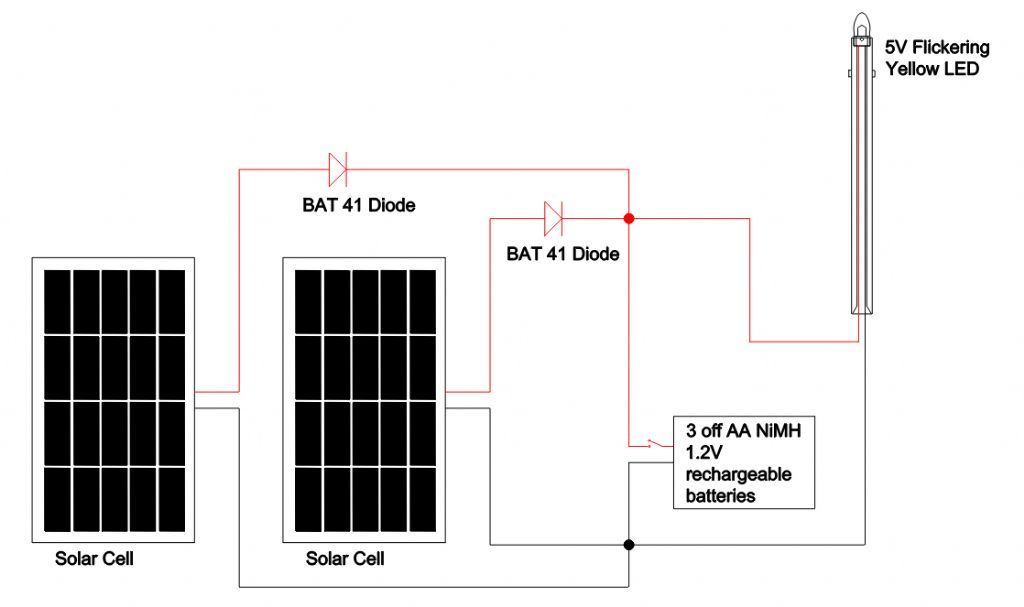
      I have been asked to convert a propane eternal flame to solar powered LED. This is the set up I have built and it seems to be working well, with the batteries powering the LED as daylight fades.circuit.jpgMy question concerns the diodes. I just measured the forward resistance of a BAT41 diode at 270K ohms. I thought diodes were low resistance in the forward direction. Would the set up work better if I replaced a single diode with two or more diodes in parallel? Are there any other improvements that could be made to the circuit? My electronics knowledge is limited! Thanks.

      #34046
      Glyn Davies
      Participant
        @glyndavies49417
        #605284
        malcolm wright 3
        Participant
          @malcolmwright3

          The BAT41 is a Schottky diode which requires a forward voltage to switch on, i.e. 200mV at 25deg C.

          It is only rated at 100mA so you might need something that will carry a bit more current. but before buying diodes I would check the data sheets for the solar panels as a lot of them have a built in diode.

          #605285
          Peter Cook 6
          Participant
            @petercook6

            Diodes pass current one way, but not the other. In the forward direction they exhibit a voltage drop. For a BAT 41 the drops 0.45v @ 1ma and 1v @ 450ma. So the measured "resistance" depends on your measurement system.

            However I suspect you have a bad diode.

            One other comment, the continuous current rating for a BAT 41 is only 100ma. At dawn, with the battery drained, your circuit seems to have nothing to limit the current through the BAT 41s. I think you need some beefier diodes, and some sort of current limiting resistance in the circuits.

            #605300
            SillyOldDuffer
            Moderator
              @sillyoldduffer

              The circuit's OK other than BAT41 being a small signal diode and a bit delicate. If the battery is completely flattened by a few dull days, followed by a bright hot dawn, I suppose the solar panels might deliver enough current to pop one. How much current can they produce? I guess they're tiny if the load is a single LED, perhaps a few square centimetres as found in garden ornaments, so might not manage 100mA into a short circuit, in which case a BAT41 would do.

              I suspect either a mistake measuring 270k or the diode is broke.

              Paralleling diodes isn't a particularly good idea because they're not balanced. One of them might take current before the others wake up, so there's a risk of them popping one after the other rather than sharing the load safely. Easier to upgrade to a bigger device, possibly an SR150, like this example from Farnell. Depends on the current output of the panel, but an SR150 is good for 1A. Plenty of larger schottky rectifiers available if the panels are monsters.

              Dave

              #605313
              Glyn Davies
              Participant
                @glyndavies49417

                Thanks for the replies. I had some LEDs and diodes spare so I used my power supply to test the actual resistance of the diode. With the voltage set to 5V (the max open circuit voltage of the solar cells), with no diode, the current is 67mA; with a diode in circuit, the voltage across the LED is 4.4V and the current is 45mA. With the voltage set at 3.6V and no diode, the current is 31mA. With a diode, the voltage across the LED is 3.0V and the current is 9mA. So by my reckoning, the diode resistance is .6/.045 = 13 ohm at 5V and .6/.009 = 66 ohm at 3.6V. I tried two diodes in parallel and the voltage and current were the same as with one diode.
                I have no data sheet for the solar cells (off ebay) – is there a way of finding if there is a blocking diode in them without causing damage? The cells are 100mm x 172mm and are rated at 2W at 5V. I measured the 270K by putting my pocket multimeter across a diode.

                #605319
                AdrianR
                Participant
                  @adrianr18614

                  Hi Glyn,

                  You can't just measure the resistance of a diode using a meter as diodes are not simple resistances but are non-linear devices.

                  No component is perfect, it always has resistance, capacitance and inductance. There is the concept of equivalent circuits, where a circuit of perfect components can represent a component.

                  A diode can be thought of as an ideal diode in series with an ideal resistor. The "low resistance" in the specifications refers to the value of the equivalent perfect resistor.

                  Diodes need a minimum forward voltage to start conducting, as said above for yours, this is 0.4V. This voltage is nearly constant and is always dropped across the diode.

                  So as the forward voltage(Vf) of a diode increases the resistance changes. Below Vf the resistance is very high, but as Vf is reached the resistance rapidly drops. But there will always be the diode voltage drop across it plus the voltage drop of the equivalent resistor.

                  From the specs sheet at 0.1A the Vf across the BAT41 is 0.9V @25C So the equivalent resistor is (0.9-0.4)/0.1 = 5 Ohms

                  I don't know the power output of your solar cells, but if they can supply more than 0.1A you will likely burn out the diodes. Also if the voltage of the solar cells is more than about 4.8V you will have the chance to overcharge the batteries. The max voltage across the batteries should not be more than about 4.5V ideally about 4V.

                  Although with the LED load constantly across the batteries will limit the max voltage so you may be OK.

                  #605329
                  Bruce Edney
                  Participant
                    @bruceedney59949

                    Maybe you should just include one of these in your circuit.

                    #605341
                    SillyOldDuffer
                    Moderator
                      @sillyoldduffer

                      I wouldn't worry about the resistance of the diodes; for a circuit like this it's usually enough to confirm the resistance is high on one direction and low in the other, showing the device is working. Measuring the actual resistance requires an experimental set-up measuring amps whilst the volts are accurately varied over a range. As semiconductors don't obey Ohm's Law, the result is a curve on a graph, not needed in this case.

                      How well or badly Glyn's circuit behaves depends on the properties of the components:

                      • The Solar Cells deliver 2W at 5V, that is a maximum of 0.4A each, 0.8A total.
                      • BAT41 diodes support a maximum of 100mA. Therefore diodes are at least eight times too small to cope with the maximum output of the solar cells, which is a risk
                      • An AA-size NiMh cell has a capacity of about 1900mAh. Three of them in series (4.6V) will charge reasonably well from a 5V solar cell so that's OK.
                      • The power requirement of Glyn's flickering yellow LED is unknown, but the small tea-light type run for a claimed 100hours on a CR2032 cell. As the capacity of a CR2032 is about 230mAh, the current drawn by the LED might only be 2.5mA. It would run for about 760 hours on a NiMh AA.

                      So, if Glyn is using a small LED, and the AA batteries are fully charged at the outset, there's a good chance in normal service that the batteries will never discharge to the point that the solar cells will exceed 100mA output.

                      All good, unless 'normal service' doesn't happen. If the NiMh batteries go flat in storage, or deteriorate with age, then their resistance will drop massively, causing the Solar Cells to deliver a heavy current, with a high risk of popping a BAT41. (Cells don't obey Ohm's Law either!)

                      The component values really depend on the current drawn by the flickering LED. In the good old days, LEDs rarely consumed more than a few tens of milliamps, but modern devices can be much more powerful. It would help to know how much current in drawn by Glyn's LED.

                      From a 'common-sense' perspective the circuit is reasonable, but the operating conditions need to be defined and the sums done. Here common-sense has delivered a solution likely to work, perhaps for years, but – assuming a small LED – there's risk of failure depending on how it's operated. For example, the diodes are likely to fail if the batteries go flat in storage and the unit is suddenly exposed to bright sunlight. Or they might survive if the solar cell output is limited by weak sunshine and the batteries recharge slowly. As always common-sense relies too much for comfort on luck – real engineers work to requirements, do the maths, and set specifications!

                      Doesn't matter for Glyn's purposes, but – again assuming the LED is small – on the face of it the Solar Panels and Battery are both over-engineered; bigger and more expensive than needed to do the job.

                      A professional designing a commercial product like this would start from the current requirement of the Lamp, from that decide the capacity of the battery (perhaps assuming long Scottish nights and short winter days rather than Florida), and derive the size of the solar panels needed to charge the battery in the target conditions. The diodes would probably be rated to take the maximum charging current drawn by a completely flat battery from a Solar Panel at peak output.

                      For cheapness, diodes are fine, but if the device requirement included long-life, then a more or less clever recharger of the type recommended by Bruce Edney would be used. They extend battery life considerably by matching charging volts and amps to the batteries ideal recharge cycle. A requirement for long-life, say the light on a life-jacket, would trigger a bunch of other specifications, such as water-proofing, liable to push the price up considerably. Daft to pay safety-critical equipment prices for a garden ornament, or to expect a garden novelty to last forever!

                      Dave


                      Edited By SillyOldDuffer on 11/07/2022 10:53:40

                      #605350
                      Anonymous

                        Modelling a diode as having a resistance, or trying to measure same isn't useful. The forward characteristic of a diode is exponential. The forward voltage drop of a diode varies with current, temperature and the particular diode. The theoretical value (at an arbitrary current) is set by the semiconductor physics of the precise materials and doping levels used.

                        Most multimeters have a diode symbol on the dial, in which position the forward voltage drop of the diode can be measured. No measured drop means the diode is the wrong way round, or is duff.

                        From a practical stance the most important number for a power diode is the forward voltage drop at rated current as this will determine device dissipation and voltage loss for the following circuit. The drop at rated current is usually several times the nominal voltage drop.

                        I would agree with the above comments that a signal diode isn't the best choice; a power Schottky, say 1A rated, would be better.

                        On other points I'd also agree that running diodes in parallel is frowned upon. But sometimes needs must; a rule of thumb is that each diode should be rated for two thirds of total current. The only time resistance and diodes go together is when looking at the slope of the breakdown voltage with current in Zener diodes. The 'resistance' in breakdown is often listed on datasheets. The name Zener diode is a bit of a misnomer, as at higher voltages the breakdown mechanism is dominated by avalanche breakdown, not the Zener effect.

                        Andrew

                        #605399
                        Glyn Davies
                        Participant
                          @glyndavies49417

                          Thanks for the additional replies – I've learned a lot! In the short term, I've ordered some SR160 diodes to replace the BAT41s and as a longer term fix, have ordered from China the multipurpose charger circuit. When I get that, I'll connect a battery to the output and see if there's any voltage at the input. If there's none I can presumably ditch the blocking diodes altogether.

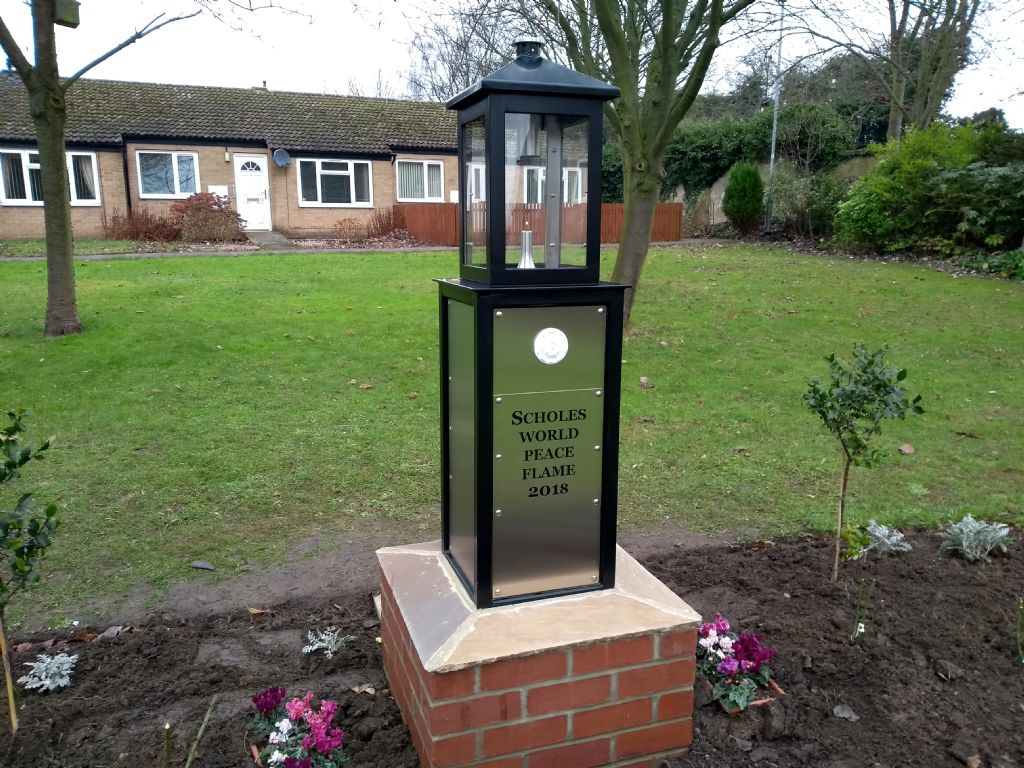
                          For interest, here's the lamp as first built running on propane:

                          img_20181212_113929117.jpg

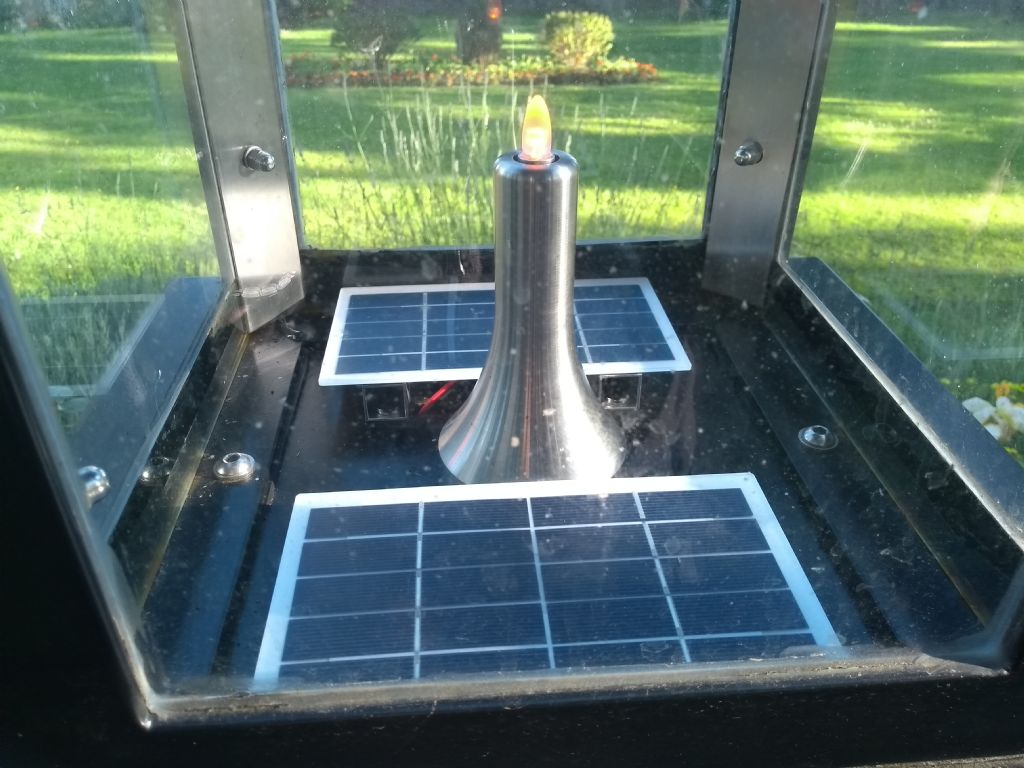
                          And here's the LED conversion:

                          img_20220702_193302100.jpg

                        Viewing 11 posts - 1 through 11 (of 11 total)
                        • Please log in to reply to this topic. Registering is free and easy using the links on the menu at the top of this page.

                        Latest Replies

                        Viewing 25 topics - 1 through 25 (of 25 total)
                        Viewing 25 topics - 1 through 25 (of 25 total)

                        View full reply list.