How Would I Make This Bit Move (in Alibre)?

How Would I Make This Bit Move (in Alibre)?

Home Forums CAD – Technical drawing & design How Would I Make This Bit Move (in Alibre)?

Viewing 16 posts - 1 through 16 (of 16 total)
  • Author
    Posts
  • #826513
    Nigel Graham 2
    Participant
      @nigelgraham2

      Please.

      It’s not essential but neat if it does.

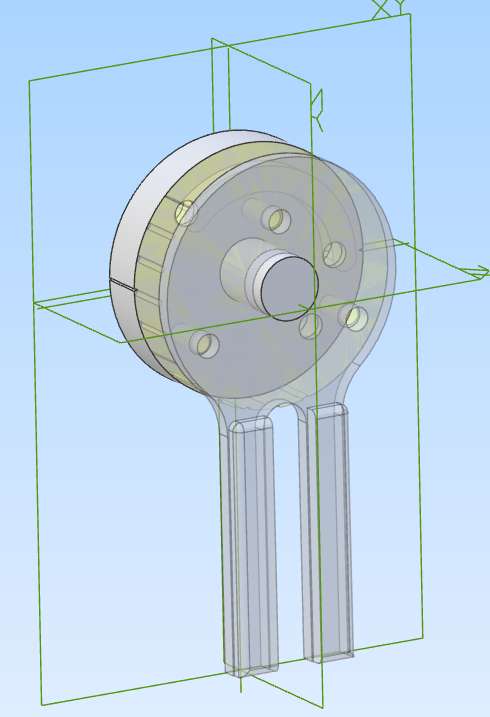
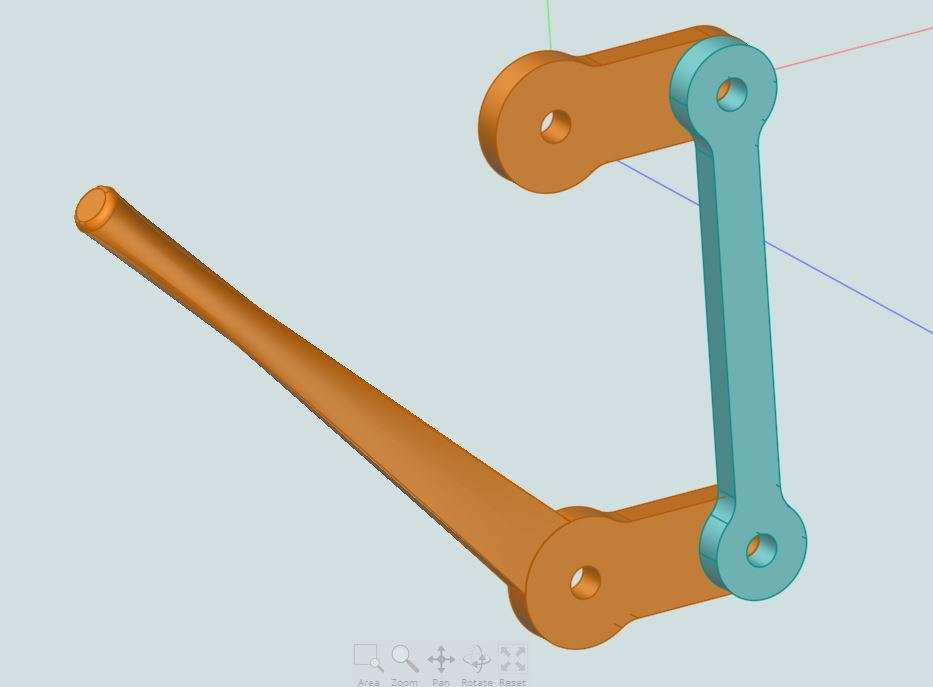
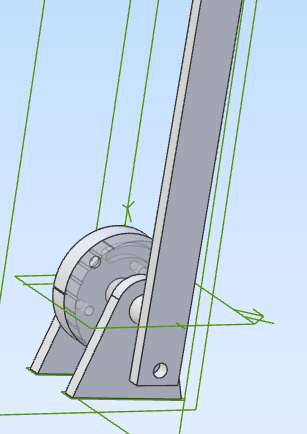
      The upper image is of my vacuum-brake valve now sporting a forked handle that will be engaged by a pin from the existing brake-lever. It also shows three smaller holes that will take screws holding the handle to the rotor.

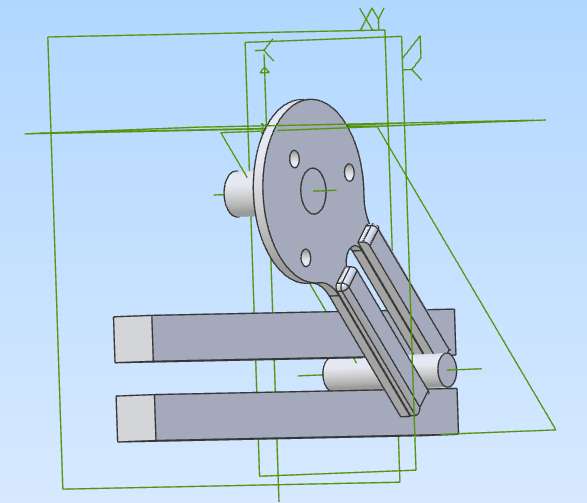
      The lower represents that link to the main lever, and is purely diagrammatic to help me arrange its operation.


      The inspiration for this form of movement is part of the feed motion on my Drummond hand-shaper.


      In Alibre terms the central pivot at the top is anchored, the two guide-bars are anchored individually but drawn together as one Part. So when moved around they move in unison. I didn’t know they would, with no visible means of mutual support, but was pleased they do – makes things easier to adjust them vertically, with their anchors temporarily off.

      I created the 45º limit plane by experiment. I realised it needed the axis through the top pivot first, but wasn’t sure what else it wanted. That represents the limit of travel – needing verifying but I think it’s less than 90º.

      The pin in the fork, which might be slightly too fat, represents that protruding from the main lever to swing the valve rotor.


      The handle swings nicely on its pivot, but the lever pin stays where it is.

      So… though not strictly necessary, can it made to move with the handle?

      Screenshot 2025-11-26 210243


      Screenshot 2025-11-26 210121

      #826516
      Nigel Graham 2
      Participant
        @nigelgraham2

        The pin’s movement is significant.

        I later realised the lever pin will of course move in an arc of radius set by its position on the lever, with that pivoted below the valve. The direction will the same but the arc will be convex while the valve fork’s locus is concave. So this will affect the pin’s depth of engagement in the fork.

        That will need more measuring on the truck itself.

        For now, I’ve designed the valve, apart from how to mount it, so it’s a step by step process.


        Once I have measured the lever – it’s some distance away so I won’t see it until next week – I can add it to this model, so wanting the pin to oblige is more important than I had realised.

        There is an alternative. Keep the valve as it is but operated axially with a new form of lever fulcrum, presently just a bolt. That may be the simplest in the long run, and the most elegant.

        #826551
        JasonB
        Moderator
          @jasonb

          Assuming you are doing this in an assembly.

          You should only anchor the non moving parts, so in this case it would be the two bars. They can have their fixed position set by using the offset constraint from one of the planes.

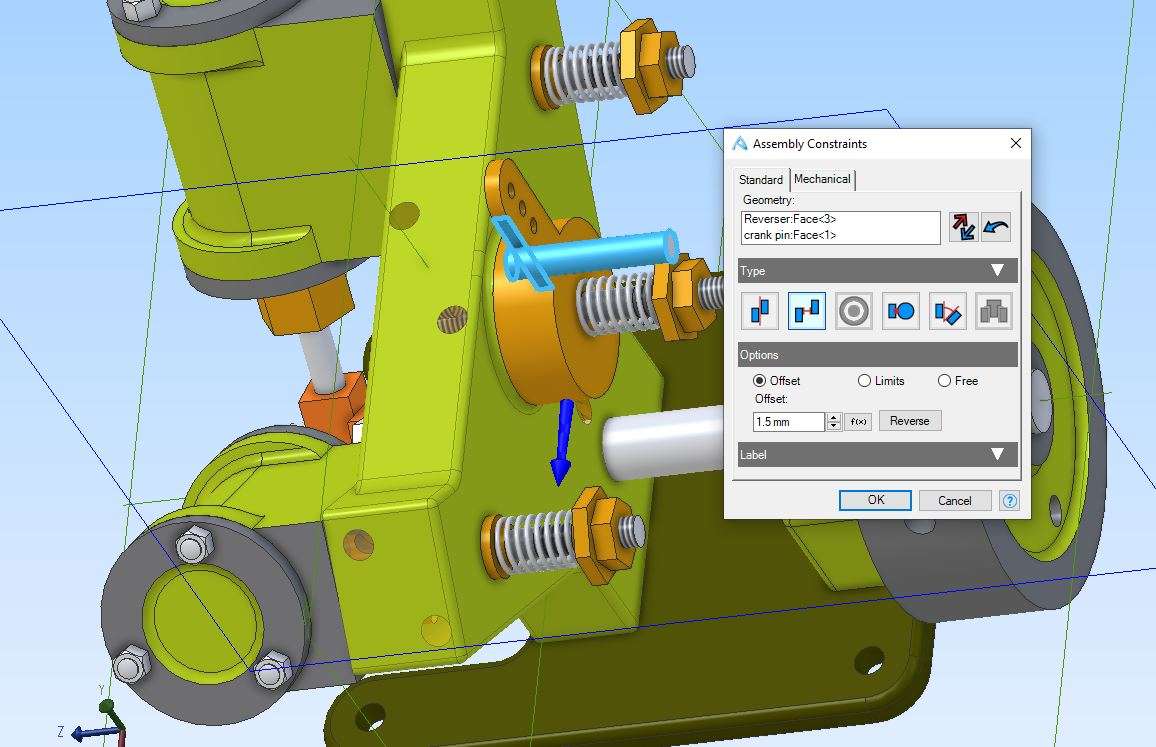
          The valve should have one of it’s concentric diameters constrained to one of th emain axis pn the screen so it can rotate about that axis. so with the constraints box open click it’s OD as that is the easierst to click and then click the axis line.

          Lastly the pin. Thi sneeds to slide against two different parts so will need two constraints.

          Again sith constraints open click the outside of the pin and one of the surface sit is to run againts. It will jump to lining up the middl eof teh pin by default so click the offset option and then enter a value that is half the pins diameter which will now move the pin so its edge is in contact with the chosen edge say the valve in this instance.

          slide

          Now do the same offset constraint for one of the bar faces.

          You will also want to constrain the pin so it does not move in and out  so constrain and end to say the back fac eof the rail.

          The pin can now be clicked on with the mouse and holding the button down the pin can be dragged along the rails and the valve will rotate with the

          If you want a full video ask. My constrain screen is a bit different to yours but you should have the same functions

          At the moment I’m not totally clear how the pin moves, sounds like it is on a lever but don’t know wher that pivots. If so the constraint may be to a corner not a face of the slot. And/or the slot may need rounder internal faces.

          #826561
          David Jupp
          Participant
            @davidjupp51506

            As is often the case, there are multiple ways this could be done.

            One option – as per Jason’s suggestion, but use tangent constraint instead of an offset.

            Another option – ‘show reference geometry’ for the forked handle part, it may well have a suitable plane which can be constrained to the axis of the pin.

            If you e-mail a Package file created from the assembly, I’ll take a look.

            #826669
            Nigel Graham 2
            Participant
              @nigelgraham2

              Thankyou.


              Jason –

              I can’t yet add the operating lever because I do not yet know its length and throw, but its fulcrum is vertically below the centre of the valve. The pin would protrude rigidly from its face, to engage the fork, but I don’t yet know where along the lever; and it will move in an arc.

              One problem to examine is that this lot is on the side of an approximate replica of a slate-mine wagon, with a steel-strip cage frame, so it’s possible this option won’t work anyway.

              +++++

              Well, I tried it all but not very well, with a very odd result. It took me some time to find some of those controls, too.

              The handle rotates as it should, round its fixed axis. The bars were where I anchored them.


              The pin was floating slightly above the lower bar because I made it slightly thinner, but it cut into the upper bar. I deleted the top bar, leaving the pin slightly above the lower one.

              All my attempts to constrain the pin anywhere sent it turning over on end, or sliding away from other parts.

              However, eventually I managed to find that Reference Geometry tool, and made the pin symmetrical in the fork. I had created it centred on the cross-hairs that appear on the Part screen so it did have diametral planes.

              It now sort of worked in a very odd way.

              Trying to drag the pin along failed. Pulling the fork round bounced the pin up and down the slot in a very strange way.

              So I replaced the top bar… only I was unable to make it symmetrical lengthways with the lower. Ah well, never mind. It just looks peculiar.

              Saved that, closed it, re-opened the assembly.

              It gets worse.

              The bars were out of line vertically, with the upper one inside the fork. Increasingly frustrated with this nonsense, I upped-anchor and slid them with the cursor into a position where they’d not pass through other objects like ghosts in walls. Dropped anchor.

              The fork still pulls round as it should, but passes through the pins. The pin can only move along its axis, not along the bar.

              Trying to constrain the pin to the bar surface or axially now flips the pair of bars onto their sides.


              Same old story.

              Two steps forwards, almost two back all the time.

              As I say, I can draw simple, single objects but sticking three or more together is just so hard, and doing so to examine their movements, beyond me. Just as well I’m not trying to design steam-engine valve-gear or a better mouse-trap: it’d never work.

              .

              This is for a real project, not just an Alibre exercise, and this model was to assess two or three possible options. The second option would have the valve in line with the main lever’s fulcrum and operated that way, so would not need this complicated fork and pin set-up.

              #826678
              David Jupp
              Participant
                @davidjupp51506

                The trickiest aspect here is to constrain the pin, because it is not fixed to anything else yet, to limit degrees of freedom.

                You should be able to set the axis of the pin parallel to the Z axis of the assembly, use an offset command with the free option.  As Jason pointed out, a constraint to fix the pin along it’s own axis will also be needed.

                Assembly constraints mimic those imposed by the rest of any real mechanisms.  You’ll need to apply enough constraints to ensure realistic behaviour, but without over-constraining.

                #826679
                blowlamp
                Participant
                  @blowlamp

                  If Alibre can animate a rack and pinion, then can you treat this like a single tooth version?


                  Martin.

                  #826689
                  Nigel Graham 2
                  Participant
                    @nigelgraham2

                    The pin is parallel to the Z-axis, as I drew everything concentric with that.

                    I could not fix it axially though, nor constrain it to that flat surface (which is not meant to exist in reality, just as a drawing aid). All my attempts failed in odd ways. Nor could I drag it along the bar, just back and forth along its axis.

                    It did not take long to over-constrain things, either. Any assembly I try normally produces plenty of over-constrained messages and constraint names in red letters in the list down the side. (That index’s name has slipped my mind! Well, it is late at night.)


                    I once tried a 3D CAD Assembly of my model steam-wagon’s engine, quite a complicated machine. When I rotated it, it started to break up. I tried drawing its cylinder block in Alibre too, a single lump but also complicated. These were too ambitious, needing 3D CAD skill beyond me, and made me give up on CAD assemblies for months. I still have other versions of those, but very unfinished and probably useless as the design documents they were intended to be.

                    #826698
                    blowlamp
                    Participant
                      @blowlamp

                      I don’t have contraints or assemblies in my CAD, but can do transformations easily enough to approach some kind of simulation of those functions. Maybe Alibre can do that for you for now?

                      Short video below.


                      Martin.

                      Moving Parts

                      #826711
                      JasonB
                      Moderator
                        @jasonb

                        Atom does not have the gear/rack constraints that the other versions have

                        Nigel, I’m still not clear how the pin/lever is arranges as you say it moves in an arc. Can you do a simple pencil sketch and post a photo as that will affect how things need to be constrained.

                        This shows it with the pin moving in one plane which is how it appears on your images at the moment. I did get the tangents wrong first time but go back and correct them.

                        #826712
                        David Jupp
                        Participant
                          @davidjupp51506

                          Nigel,

                          Without seeing your files, it’s difficult to speculate about exactly where the problems are.  You have my e-mail address, please create a Package file from the assembly and send it to me.

                          #826713
                          JasonB
                          Moderator
                            @jasonb

                            Is the invisible lever like this? Or is the lever’s pivot vertical and it swings in a horizontal plane?

                            You also have my email.

                            #826737
                            Nigel Graham 2
                            Participant
                              @nigelgraham2

                              Martin –

                              I suppose a single-tooth lantern-pinion and rack is a closer analogue, and something as I first imagined, but I spotted a problem with it. And have just realised another!


                              Jason –

                              Pretty much as you have there, yes. Extend the lever up to its handle above the valve.

                              ……

                              David & Jason –

                              Thankyou for the offers but I think hold fire for the moment. I need investigate things more deeply than I’d appreciated. I really need the driving-truck here at home, not away at the club!

                              I am doing this very much stage-by-stage and need more measurements from the real thing, which is likely too complicated for me to draw in CAD. It’s possible my arrangement won’t work because fixed parts of the structure will be in the way. The truck side is essentially a grid of steel flats with an angle rim, the lever outside of that and its pivot somewhere below that, on the sole-bar or underframe. I need the valve and other parts of the system within the truck, safe from accidental handling damage in a cramped store but also out of the driver’s way.

                              My original experiment was the existing valve, screwed to a plate clamped to the truck’s rim. That valve is a commercial one intended for a locomotive footplate, where it resembles the full-size version in looks and operation.

                              It had been on the loco but very inaccessible to the driver, and experience showed we need improve things. The simplest way is just move the valve nearer the driver but I realised we can do better than that.

                              It’s just two discs about an inch or so diameter with a stub handle in the rim of the moving one. However, it would not provide the links and timing between vacuum-brake and mechanical brake that I need achieve.


                              My valve’s fork may be obstructed by confining steelwork, so my further option has the same valve now operated by the stub-shaft as in your illustration, that is also the hand-lever’s fulcrum.

                              Presently the lever merely pivots on a bolt shank, with the Bowden-cable connection to a mechanical brake below that.


                              So before any more CAD-confusion means I have to be scraped off the ceiling (a vertical constraint?) I need examine the whole caboodle more thoroughly.

                              #826745
                              David Jupp
                              Participant
                                @davidjupp51506

                                Nigel – understood, but it might still be helpful for you, and possibly others, to work out why you have had such problems with this assembly (before it gets more complicated).

                                #826747
                                blowlamp
                                Participant
                                  @blowlamp

                                  Wouldn’t something like this be easier to make and give you more options with regard to mounting and actuation angles?


                                  Martin.


                                  Capture

                                  #826760
                                  Nigel Graham 2
                                  Participant
                                    @nigelgraham2

                                    David –

                                    I agree, but I really have no idea what I was doing wrong. The more I tried to sort it out the worse it became and I realised I would never know.


                                    Martin –

                                    Thank you for that idea.

                                    It looks as if the two short links are the same length so the angle the main lever is moved will be repeated by the valve spindle, as the valve’s internal design is intended to take.  The valve does not have to be at the top of the truck, nor at some intermediate height, if the lever is linked directly to it.

                                    I’ll try to create an image of what I mean by my second option…..

                                    [Goes off and winds up Alibre Atom…]


                                    The Alibre model is diagram rather than actual plan, and it won’t rotate correctly, but at least it’s a start. The small hole at the end of the lever is for the connector for the Bowden cable operating the truck’s own brake.

                                    It’s more elegant, and requires fewer moving parts.

                                    Screenshot 2025-11-28 171127


                                    All these screen-shots, incidentally, end up in a default folder Microsoft happily calls “Pictures” and plunders for its Cloud server, so I expect the CIA and China are already puzzling over my contribution to the World Take-over Stakes. I don’t own a white cat, though.


                                  Viewing 16 posts - 1 through 16 (of 16 total)
                                  • Please log in to reply to this topic. Registering is free and easy using the links on the menu at the top of this page.

                                  Latest Replies

                                  Viewing 25 topics - 1 through 25 (of 25 total)
                                  Viewing 25 topics - 1 through 25 (of 25 total)

                                  View full reply list.