Gear Train

Gear Train

Home Forums Beginners questions Gear Train

Viewing 16 posts - 1 through 16 (of 16 total)
  • Author
    Posts
  • #815562
    wetzel
    Participant
      @wetzel

      I have just bought a Myford M7 Lathe, And I think the gear train is set up for threading and I don’t know how to set the gear wheels for normal turning I have a full set of wheels.

      #815582
      DC31k
      Participant
        @dc31k

        You are fortunate in having a machine which has a large collection of written and photographic material concerning its operation existing.

        Avail yourself of that advantageous situation make use of it

        Normally there is a chart printed on a plaque inside the gear train cover. Is that missing? If so, go to lathes.co.uk and look at the photos to find one. See bottom of first column here:

        Thinking about the issue will also help. For power feeding (your ‘normal turning’), you need a large reduction ratio between spindle and leadscrew, so you will always need a small gear driving a larger gear.

        A good place to start is vintagemachinery.org for download of the manufacturer’s original operating instructions.

        Other useful items are Martin Cleeve’s screwcutting book, Brian Wood’s Screwcutting and Ian Bradley’s Myford 7 book.

        #815588
        noel shelley
        Participant
          @noelshelley55608

          Your question is unclear as to is it an ML7 or super 7. Bradley gives 20 driver, 1st stud 65/25, 2nd stud 70/20 and 75 on the lead screw. gives a feed of .0037″, There is a fine feed tumbler gear with 12T as an extra, this will give a feed of .0018″. Hope this makes sense. Good luck. Noel.

          #815618
          SillyOldDuffer
          Moderator
            @sillyoldduffer

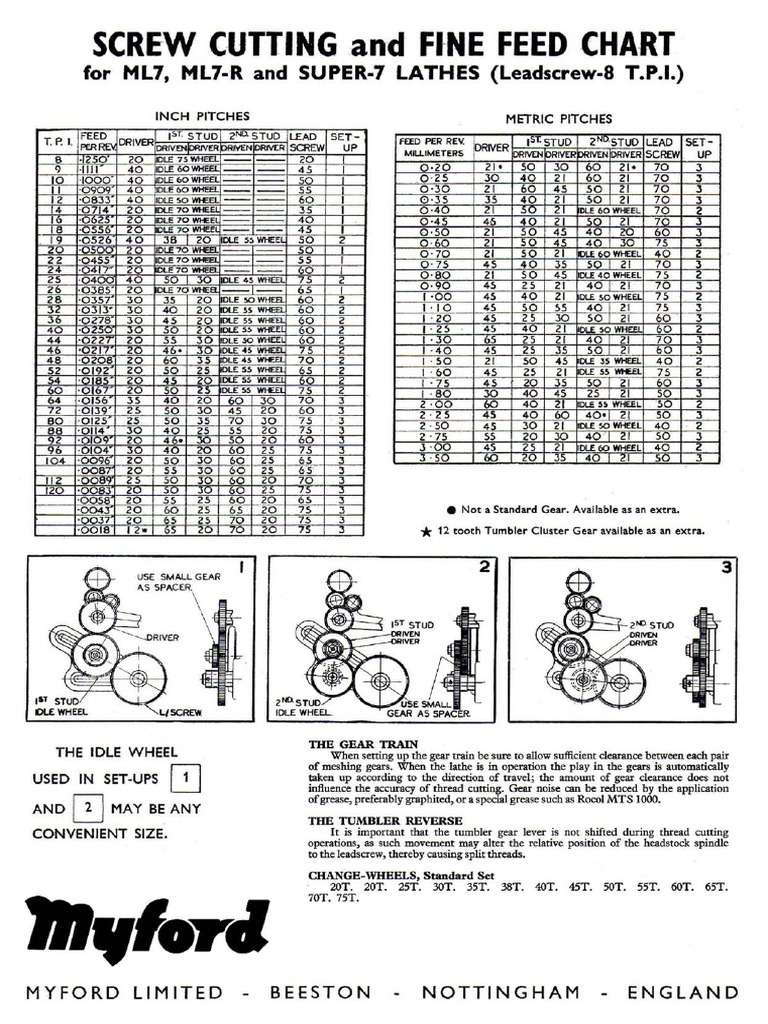
            This chart may help:

            ml7gears

            The chart shows the combination suggested by Noel at bottom left, and there’s an even finer setting.

            In principle, finishing calls for a gear combination that steps down from a small gear on the spindle to a big gear on the lead-screw.  Using Noel’s example:

            • 20 teeth on spindle (small) drives 65 (large) on  compound
            • 65 turns a 25 toothed gear (small), driving 70 teeth (big) on the next compound
            • 70 turns a 20 toothed gear (small), driving 75 teeth (big) on the lead-screw

            The diagrams show how the gears are arranged. I don’t own a Myford, but I think you want arrangement 3.   Someone will correct me if the guess is wrong, or try it and see.

            Dave

            #815622
            Howard Lewis
            Participant
              @howardlewis46836

              You set up the changewheels to give the required ratio between chuck and Leadscrew, to give the feed that you want, in the same way that you do for screwcutting.

              Since the Leadscrew is moving the saddle along the bed as the chuck rotates, you are generating a helix.

              A screw thread is helix, and a fine feed for finishing is a very fine helix, as if generating a thread with a fine pitch, such as 200 tpi, and very shallow depth, of say 0.001″.

              If cutting a 16 tpi thread, you would set up  a train so that the leadscrew rotates at half the speed of the chuck. (Myford Leadscrew is 8 tpi)

              If you wanted a fine feed, of say 0.004″ per rev, you would set a gear train with a ratio of 31.25:1.

              This would probably requires compound gears as Idlers, (Possibly two and use the Tumbler Reverse) rather than just a plain Idler, so two gears, would be keyed together on the same stud, so that the small one would drive the large gear on the next stud, or the Leadscrew.

              Such as 20: 70/20 : 65/20 : 60  This will give a ratio of 34.125:1 giving a feed of 0.00366″ per rev.  but need the Tumbler Reverse to be used, to cause the Saddle to move towards the chuck

              HTH

              Howard

              #815624
              cogdobbler
              Participant
                @cogdobbler

                Basically choose the three smallest and three largest gears in your set. Then set them up with small driving big all the through the train to give you the lowest gearing possible for the finest feed possible.

                #815647
                John Purdy
                Participant
                  @johnpurdy78347

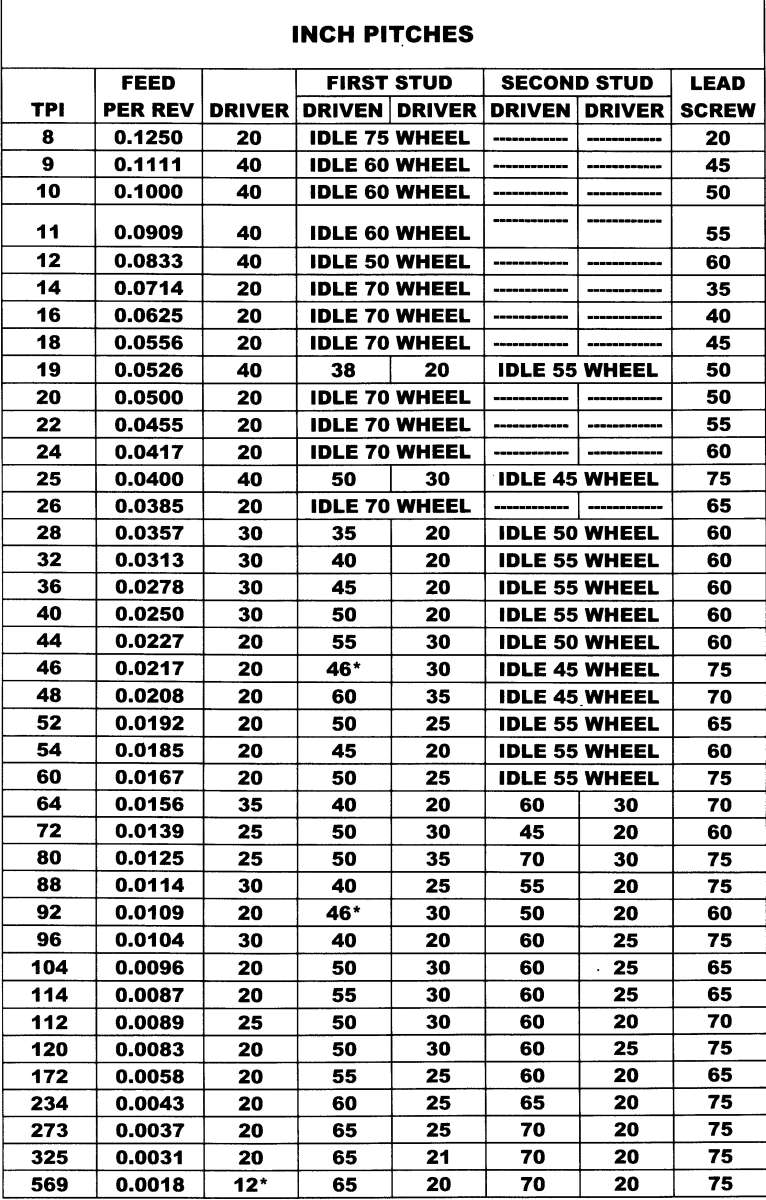
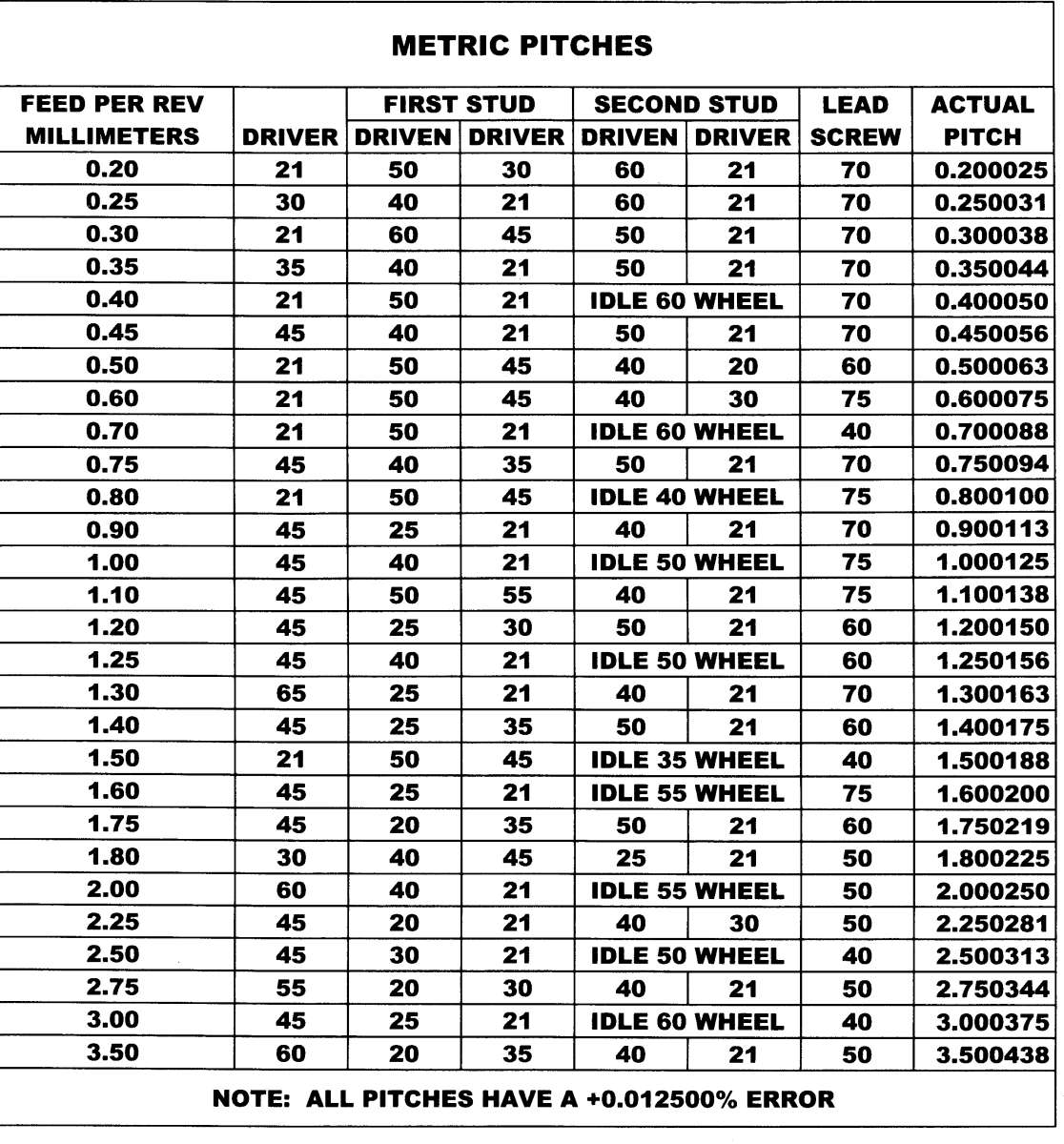
                  I have made these charts that hang on the wall behind the lathe. They are printed off 8 1/2 X 11 and laminated. They are a lot easier to read than the ones in the gear cover. The last 5 or 6 entries are the turning fine feeds. I have them as PDFs and JPEGs. If any one would like a copy to print off for their OWN USE send me a PM.

                  John

                  Change Wheel Chart Imperial

                  Change Wheel Chart Metric

                  #815650
                  Howard Lewis
                  Participant
                    @howardlewis46836

                    Wetzel, You have a PM

                    Howard

                    #816331
                    Nigel Graham 2
                    Participant
                      @nigelgraham2

                      One tip – a brief note in that copy of the Myford instructions reminded me.

                      Don’t set the gear mesh tightly (nor too loose, obviously) when swinging the banjo into place, or meshing wheels on the same slot.

                      The usual recommendation is to put a slip of ordinary printer or similar paper between the two wheels you are setting together, so that it is nipped in place while you tighten the assembly. Then roll the paper out by rotating the wheels by hand. This gives the teeth a weeny working clearance.

                      #816351
                      DC31k
                      Participant
                        @dc31k
                        On John Purdy Said:

                        The last 5 or 6 entries are the turning fine feeds.

                        Does that mean I cannot have fine feeds in metric?

                        The 0.2mm pitch is 127 tpi, which is within the last six of the other chart.

                        It could be useful to extend the metric one upwards as far as possible.

                        There might be another one to add to the imperial chart, based on 325 tpi but using a 20t instead of the 21t.

                        #816365
                        Charles Lamont
                        Participant
                          @charleslamont71117

                          When I bought my first lathe, a 2nd hand ML7, it came with an extra 85T wheel (among others). It has turned out to be very handy. It is the largest wheel you can fit on the Super-7 leadscrew and still close the cover. My habitual fine feed train is 20 – 70, 20 – 75, 20 – 85.  This provides a feed of 0.0022″

                          #816385
                          SillyOldDuffer
                          Moderator
                            @sillyoldduffer
                            On DC31k Said:
                            On John Purdy Said:

                            The last 5 or 6 entries are the turning fine feeds.

                            Does that mean I cannot have fine feeds in metric?

                            The 0.2mm pitch is 127 tpi, which is within the last six of the other chart.

                            It could be useful to extend the metric one upwards as far as possible.

                            Metric vs imperial makes no difference when the lathe is set up in fine feed.  Below about 120tpi/0.2mm, the lathe fine cuts, and, provided it’s tight enough, the spiral is equally effective in metric or imperial.  Fine feeds are for finish cutting, not threading. There is no requirement for parts to screw together!   Just as well, because below, say, pitch=0.007″ (120tpi) lathes struggle to cut accurate fine threads. Instead, removing a fine spiral of metal at high TPI results in a smoothish finishing cut, and the spiral is poorly defined.

                            How fine is needed for finishing?  It’s a compromise between finish and speed.  A low pitch/high TPI produces the best finish but takes longer, whilst a higher pitch is quicker, the cost being a rougher finish.   Generally speaking that is,  because the cutter shape and material can make a considerable difference.  For example, I get a very good finish by driving a blunt carbide insert deep into EN3 with pitch=0.28mm at 2500rpm.  I guess the metal is soft enough for the blunt cutter to smooth and polish the steel by pushing the peaks into the valleys as the cut moves along the work;  mild-steels are distinctly plastic!

                            With its banjo set up for finest feed, my metric lathe’s gearbox provides pitches:  0.07mm (363tpi);  0.14mm (181tpi);  and 0.28mm (91tpi).  0.28mm usually leaves a visible spiral, so roughing only.   363tpi rarely leaves any sign of a spiral.  It’s somewhat finer than a standard Myford 7, though the Myford owner could cough up for the optional 12 toothed gear needed to produce 569tpi!   I’ve not needed a feed finer than 363tpi for finish, but – as usual – this may depend on what the lathe is used for.

                            When better than a “straight-off the lathe” finish is needed, I polish with emery paper, starting with 600 or 800 grade.  Polishing removes so little metal I can’t detect the difference with a micrometer.  Does 569tpi remove the need to polish with emery paper?  Dunno, and don’t care!  Emery paper does what I need, and it goes all the way to a mirror finish if necessary.  Emery might not suit others though!

                            Dave

                            #816393
                            noel shelley
                            Participant
                              @noelshelley55608

                              Power feed is just that and is not as such a screw thread in this case, whether it is metric or Imperial makes no odds. so a feed of .0037″ or the slower .0018″ will be fine. Even .0043 is OK and quicker, depends what you want. I bought the 12Tooth fine feed cluster but never got round to fitting or using it. As Dave has said if the finish is not smooth enough then out with the abrasive cloth/tape. Good Luck. Noel.

                              #816395
                              Macolm
                              Participant
                                @macolm

                                A good alternative to abrasive tape for finishing is a “reserved for the lathe” fine tooth single cut file, the latter feature most important to prevent surface tearing. While seriously expensive, a good quality one will last a long time provided it is kept for finishing tasks, and not stored in the cold chisel drawer!

                                #816401
                                John Purdy
                                Participant
                                  @johnpurdy78347

                                  The charts I included above are just a copy of the Myford charts that were made to alleviate bending down and trying to read the small ones in the gear cover. They were never intended to include all possible pitches/feeds available with the normal set of Myford gears. If someone wants to expand on them, please do. The originals were done in Excel.

                                  John

                                  #816406
                                  Grindstone Cowboy
                                  Participant
                                    @grindstonecowboy

                                    Just to add (as I always do when the subject of change gears crops up 🙂 ) there is a very handy gear train calculator called Ride The Gear Train developed and maintained by Evan Lewis, an active member of the  Boxford IO group, and who has also produced some pretty good YouTube videos about Boxfords. His software works for all sorts of lathes, not just Boxfords, and the only slight drawback is that it runs online in a browser, with no stand-alone option.

                                    Rob

                                  Viewing 16 posts - 1 through 16 (of 16 total)
                                  • Please log in to reply to this topic. Registering is free and easy using the links on the menu at the top of this page.

                                  Latest Replies

                                  Home Forums Beginners questions Topics

                                  Viewing 25 topics - 1 through 25 (of 25 total)
                                  Viewing 25 topics - 1 through 25 (of 25 total)

                                  View full reply list.