Faulty Sieg C0 Lathe

Faulty Sieg C0 Lathe

Home Forums Manual machine tools Faulty Sieg C0 Lathe

Viewing 13 posts - 1 through 13 (of 13 total)
  • Author
    Posts
  • #559390
    Paul Kennedy
    Participant
      @paulkennedy14200

      Hey Guys, Looking for a little advice. Got a new, to me, sieg C0 lathe the other day. Its sustained some mechanical damage, bent lead screws, bent sheet metal, and bent carriage compound feed-screw. However the conduit sheath at the rear of the speed control and emergency stop was crushed flat. Now i suspected it of shorting the wires as the chuck does not revolve at a constant speed. It speeds up or slows down without any machining load being present. However when i turn the speed control to the off position, the chuck comes to a full stop as expected ! HOWEVER when i lift the small chuck guard, which engages the limit switch, connected to the power rail then the chuck spins for a second or two before coming to a full stop again. When i say spin its more like a short jog but its variable but not for longer than 2 seconds. So i stripped the control board out of the lathe situated in the underside of the lathe rather than de-solder wiring from the controls in the housing and un-crushed the conduit before pulling it far enough out to examine the wiring in the crush location and they seem for the most part to be :/ ok. There's some sign of cuts in the wire insulation but not fully through and not exposing copper. I know shorts could still occur but to my mind it would have been ok. I'm going to shrink wrap/ tape up the little damage there is to the wiring but i doubt this will resolve the issues. SO any electronics guys here familiar with the sieg C0 control board and power rails ? OK i know replace the control board may be my next move but hey I'm not made of money and on inspection of the power board or control board they are poorly soldered in places and not worth the asking price if you ask me. My hope was just shorted wiring but my fear is shorted surface mount components. Ive got a decent soldering iron, hot air work station and a fairly strong magnifier for such work and a cheep multi-meter etc but I'm no expert in these matters and while i have a steady hand and can recognize the basic components I'm unsure how to fully diagnose faults yet. So anyone able to help with this thorny issue ?

      Ive just thought that the non constant speed could be a slipping pulley ? It still doesn't answer the chuck jog but that might also be a fault with it. The belt appears tight. I cant get it off without undoing the motor but maybe its worn and slipping ?

      Edited By Paul Kennedy on 22/08/2021 13:12:06

      #14336
      Paul Kennedy
      Participant
        @paulkennedy14200

        Electrical / Component level issue ? Or HIGH FRICTION ?

        #559422
        Bob Stevenson
        Participant
          @bobstevenson13909

          I can't (usually) ignore a true optimist……or are you simply way out of your depth? This is not really a "faulty" lathe by the sound of it so much as a seriously smashed up one!……

          Firstly, I suggest trying to see if you actually have a viable lathe that can be put back into useable condition…….all the 'faults' that you have described might just indicate an 'ex-lathe' that is no more in real practical terms….So, first I sugges getting the lathe completely apart so that you can examine and 'prove' each component…if you can't see the basic structure of a lathe potentially working well thn you, frankly, have nothing that will be of use to you in the future,…you might simply have to sell off the bits and start looking for another lathe.

          Get the thing down to it's basics,…aquire centres for both spindle throat and tailstock and check that they line up exactly,…..examine the spindle bearings and their function to make sure that the headstock is not bashed out of alingment,……..remove the leadscrew and any toothed wheels while you check these basic functions,….see if you can straighten out the leadscrew by CAREFULLY reworking it using a hammer with leadscrew between two hardwood blocks,…look down the length of the leadscrew and keep tapping away until you can't see any deviation along the length……..do same with the saddle screw and slide screws,….make sure everything is nice and free and well lubed, then start to look at the electronics,…first test the motor for function without the electronics if poss.

          You might want to remove the chuck cover in it's entirety as it is only there for effect and the lathe wil be much better in use without it anyway! Works steadily thu the lathe examing and proving each part…ask here for advice on each part you are unsure about….Good Luck! you are going to need it!

          #559427
          not done it yet
          Participant
            @notdoneityet

            My advice? Scrap it. Use what is of any use as spares.

            #559430
            Martin W
            Participant
              @martinw

              Paul

              What part of the country, hopefully UK, are you in? Nearest large town will be fine. There might be someone in your vicinity that could help you out even if it is only to confirm that the lathe is beyond sensible repair.

              Martin

              Edit; rewording

              Edited By Martin W on 22/08/2021 19:13:46

              #559448
              Paul Kennedy
              Participant
                @paulkennedy14200

                Thanks guys but I think I will accept the challenge to resurecting this little girl.

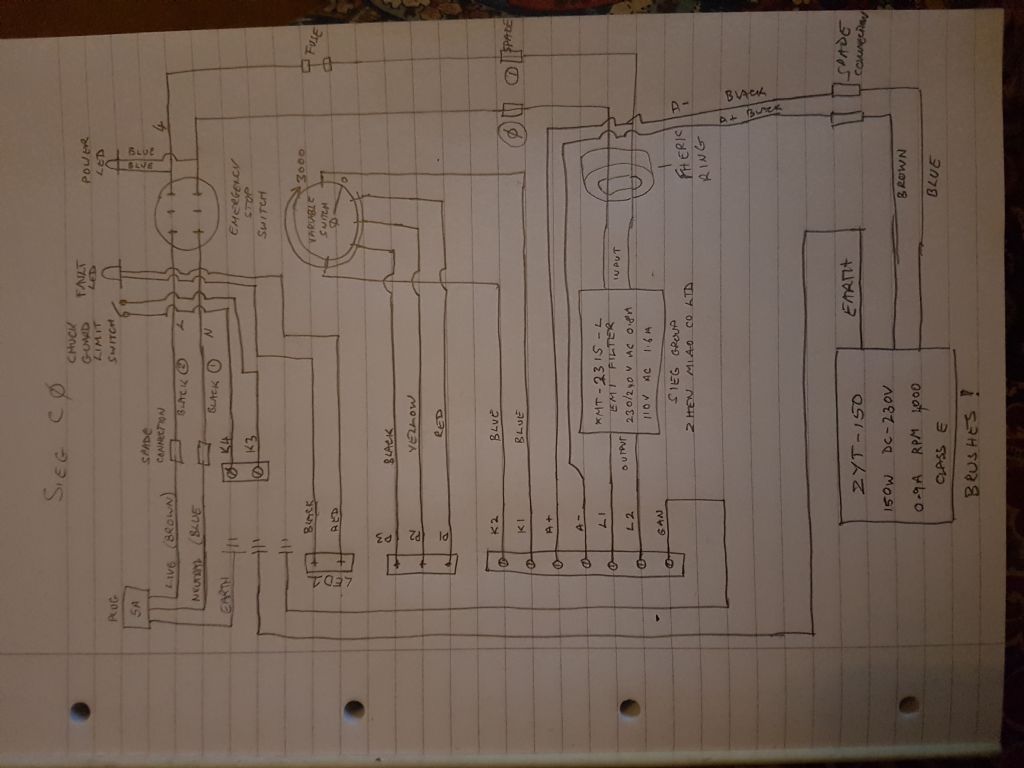
                I stripped the lathe's electronics earlier to familiarize myself with them and to see if i could spot anything obvious. Ive discovered the control board are sold for @ £100 and not worth that IMHO. anyway Ive attached a link to a preliminary sketch of the electronic circuit. Its rough and not to any 'STANDARD' but may be of use to someone.

                SEIG C0 Basic Wiring Diagram.jpg

                #559456
                Robert Butler
                Participant
                  @robertbutler92161

                  A new Seig CO lathe is obtainable from Axminster Power Tools for less than £450-00 with a three year warranty. Easy to spend similar amount on parts!

                  Robert Butler

                  #559469
                  Martin W
                  Participant
                    @martinw

                    Paul

                    If you do want to pursue the restoration of this lathe then you can quickly check the speed control board by replacing the motor with a 80-100W filament bulb and varying the speed control pot. If the intensity of the bulb varies uniformly from dim/off to full brightness with the adjustment of the speed control pot then there is a fair chance that the speed control board is OK. Depending on how badly bent the lead screw and cross slide screws are bent there is a good chance that they could, with care, be straightened enough to check basic operations. What could be a problem is damage to the head, chuck spindle, chuck and head bearings though bearings are relatively cheap and can be replaced. The original sheet metal work can either be hammered into submission/shape or bits fabricated and bolted/pop rivetted in place.

                    If you do take it on as a project then good luck and I hope you get a working lathe.

                    Martin

                    ps:

                    The motor can be checked by connecting it to a low voltage DC supply, 12/24V, and if it spins up and rotates freely and evenly in both directions then it is likely to be OK

                    Edited By Martin W on 23/08/2021 00:35:51

                    #559472
                    Pete.
                    Participant
                      @pete-2

                      I saw a little John lathe on ebay last week, I've seen a few comments from an owner on here that highly recommended them as good quality machines, not knowing anything about them I read the write up at Lathe. UK to find out a bit more about them.

                      It mentioned a technique used to straighten leadscrews that had bowed after machining operations removed tension causing them to bow.

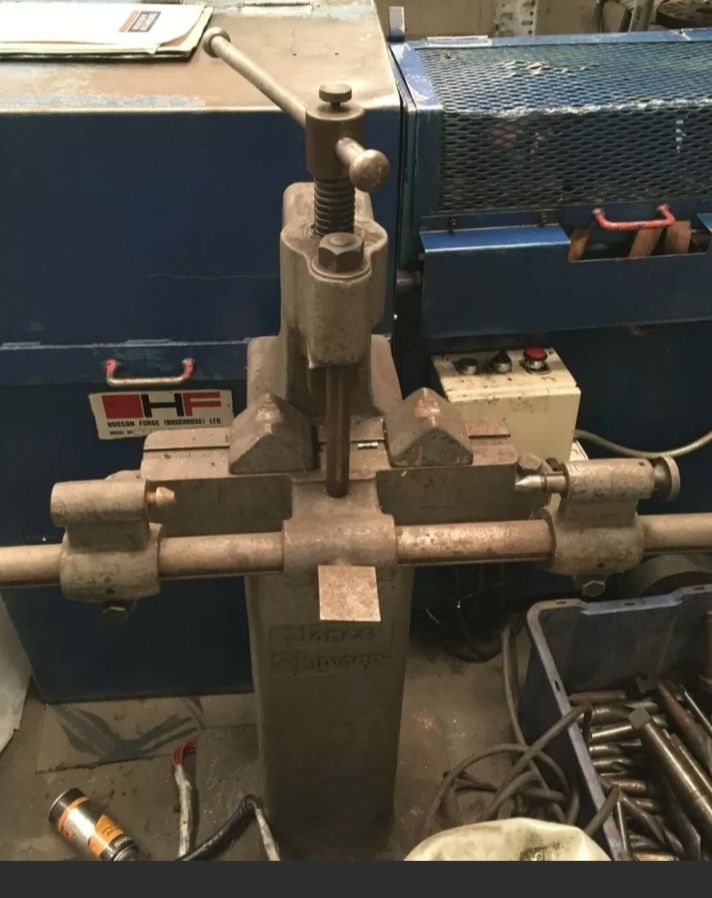
                      They used a Jones a Shipman screw press that has 2 V blocks the leadscrew sits on while the screw pushes down in the centre.

                      There's no reason you couldn't rig up something similar in your bench vice, as the leadscrew is very small, with a bit of care you should be able to produce a result that is usable.

                      #559473
                      Pete.
                      Participant
                        @pete-2

                        After looking at the specific press J&s made for this, they had 2 centres on the base of the screw press to hold the leadscrews, but you could no doubt achieve decent results with small V blocks in your bench vice.

                        img_20210823_010225.jpg

                        #559480
                        Andy_G
                        Participant
                          @andy_g

                          “the chuck does not revolve at a constant speed. It speeds up or slows down without any machining load being present.”

                          If the speed is constantly cycling or ‘hunting’ it could be caused by a badly adjusted controller board (there may be several preset potentiometers that could have been inadvertently disturbed.)

                          You may get lucky if you search for information using the code number on the particular board that you have.


                          (Edit to add: If the speed is varying randomly, it could be the speed control pot, especially if it shows signs of mechanical damage – they aren’t the best quality parts.)

                          Edited By Andy_G on 23/08/2021 08:29:21

                          #559493
                          not done it yet
                          Participant
                            @notdoneityet

                            I expect that given the low price of this model when new, and the described condition of this particular item, it did not cost much at all. However, the cost of parts to return it to s sensible user-condition may well be close to the cost of a new machine – and still not work as well as it should. If he paid more than a hundred for it, in that condition – especially if at on auction site – nobody else wanted it in that state.

                            If dirt cheap, some parts sold or retained as spares might be a means of recoupment. If too expensive, it may well have cost more than a brand new item. Things like warranty probably mean the real valuevof the machine is less than a new fully warranted item.

                            I can only guess that it was bought at a ‘spares’ price (not even ‘spares or repairs&rsquo. If it was the ‘devil I knew’ it would be better than the ‘devil I don’t’ from a point of repair or not. But some buy things to repair – insurance write-offs, etc. Paul needs to sort this one out for himself. My question is: how much is a good second hand machine selling for? I would think that £250-£300 tops?

                            #559498
                            Mick B1
                            Participant
                              @mickb1

                              Having run a C0 myself for a year or so, and its immediate ancestor Unimat 3 for 20-odd years, I wouldn't want to proceed with such a project unless my machining work was entirely taken up with small-scale modelling. In as-new condition the C0 is just about usable for such work, the U3 less well-featured but a bit better-made.

                            Viewing 13 posts - 1 through 13 (of 13 total)
                            • Please log in to reply to this topic. Registering is free and easy using the links on the menu at the top of this page.

                            Latest Replies

                            Home Forums Manual machine tools Topics

                            Viewing 25 topics - 1 through 25 (of 25 total)
                            Viewing 25 topics - 1 through 25 (of 25 total)

                            View full reply list.