Coupling two motors

Coupling two motors

Home Forums General Questions Coupling two motors

Viewing 9 posts - 1 through 9 (of 9 total)
  • Author
    Posts
  • #847523
    Sonic Escape
    Participant
      @sonicescape38234

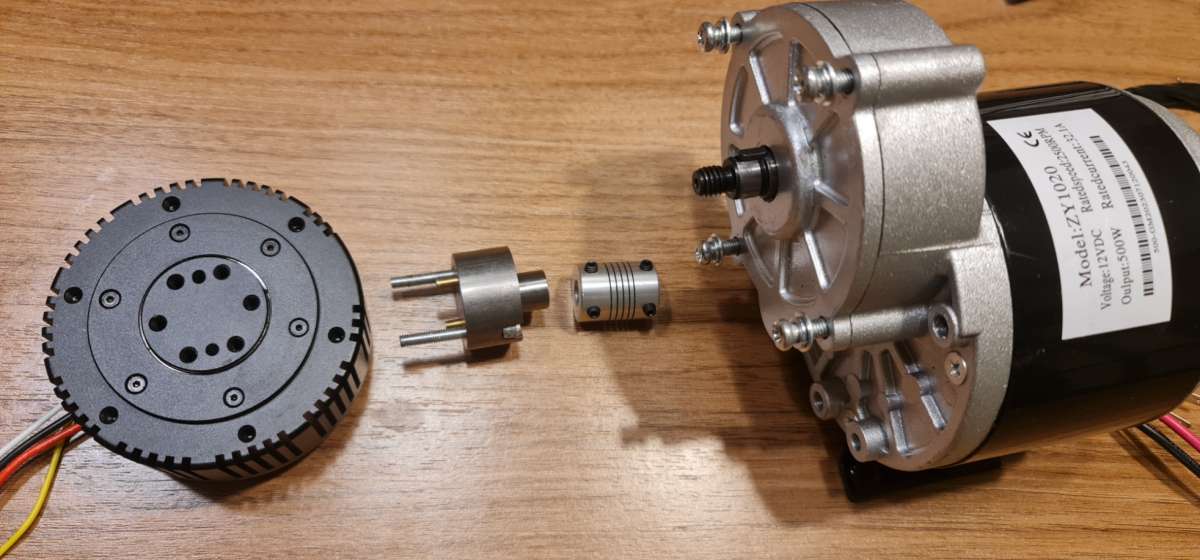
      At work, we purchased a few X6-8 motors (the black one on the left). They have an 8:1 planetary reducer, a maximum speed of 310 RPM, a power rating of 135W and a peak torque of 8 Nm. I need to test them under different loads.
      The first idea that crossed my mind was to couple one to a brushed DC motor generating current into a programmable load. I ordered a 500 W brushed motor with a 9:1 reducer, hoping it will provide enough braking torque at low speed to properly stress the X6-8 motor. That remains to be seen.      20260508_215857

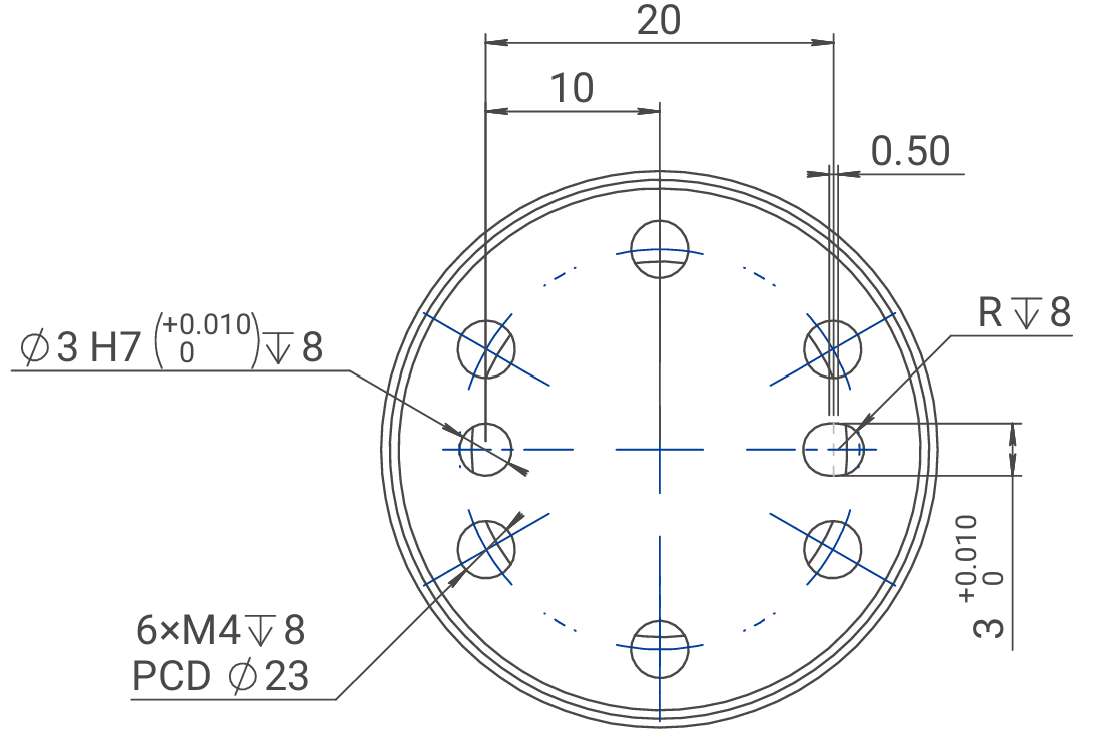
      The problem is that X6-8 doesn’t have a shaft but some kind of flange. And there is no central reference to allign against. Here are the drawings of that flange:

      Screenshot 2026-05-08 225713

      I did my best to make that shiny part next to the motor. It has two pins that fit into the two holes on the flange. And I used two of the 6 M4 screws to hold it in place. My first idea was to use an elastic coupling to the brushed motor on the right. But now that aluminium elastic coupler starts to look to flimsy. So I’m thinking to make a new rigid coupler that will connect directly the two motors.
      Is this a good idea? I’m woried that it will be very hard to make the part concentric with the flange, since there is no central pin/hole. Or maybe to use a more solid flexible coupler?

      Another idea is to fix the motor in the lathe bed somehow. Mount the coupling part to the flange. And then turn on the motor and machine it to make it perfectly concentric. But I wounder if this would be possibe since X6-8 has such a low speed.

      #847531
      Nigel Graham 2
      Participant
        @nigelgraham2

        It looks as if that X6-8 was intended for a specific industrial customer buying enough of them for economy. I have seen similar practice elsewhere, though not that curious flange arrangement.


        I think it safe to assume the flange and its ring of 6 holes are very tightly concentric to the 6 holes near the rim of the casing; and with the rim itself; similarly with the mounting-screws and shaft on the ZY1020 motor, but you can test by careful measuring.

        That so, I think I’d design and make some form of cage that links the two motors using their static features as registers, though still include the flexible coupling. Design it so as to be practicable to make and avoids needing any attempt to machine the motors themselves.


        Machining the coupling you fit to the flange, on the lathe as if the motor is some sort of headstock (as I think I understand you) should be feasible with very careful setting up. I take it to mean clamping the motor to the bed similarly to fitting a fixed steady.

        A speed of “only” 300rpm won’t matter unless the extra time to complete the task is itself significant!


        You should find the torque strength of the coupling in the manufacturer’s or supplier’s catalogue provided you know its source.


        #847629
        Neil Wyatt
        Moderator
          @neilwyatt

          Another way to test a motor like that would be to make a prony brake.

          You need to attach a rotating cylinder or shaft to the motor’s output, clamp two wooden blocks around the cylinder with a lever and use hanging weights or a spring balance to put a load on the lever. By moving the attachment point in and out you can easily adjust to get the applied load within your range of measurement or find the stall torque.

          https://en.wikipedia.org/wiki/Prony_brake.

          Neil

          #847677
          Robert Atkinson 2
          Participant
            @robertatkinson2

            The idea of using a brushed DC motor and electronic load is a good one. The power displayed on the load will be the driving motors output power less the driven motor and gearbox efficency. The current from the driven motor will be proportional to the torque of the driving motor regardles of speed or losses. If you have a torque/current curve for the driven motor (multiply by the gear ratio if it’s not included) it will be a very good indication of the actual torque. If the electronic load has a constant voltage mode you can meaure the torque at a constant speed while varying the voltage supplied to the driving motor

            To get stall torque you can power the driven motor from a constant current source (via a diode if it can’t stand voltage being fed into it) connected to run in the reverse direction and turn up the current until the driving motor stalls. The current is proportional to the torque.

            On the aluminium coupler you are right it is unlikely to be strong enough. Few flex-beam couplings are rated over 5 nm. For testing it may be OK but in service it’s life would be short.
            How about a simple oldham (sliding disk) type? Or use a minature toothed belt as long as the flat motor can take side loads.

            Robert

            #847687
            Bazyle
            Participant
              @bazyle

              As you are not too worried about losses and constant velocity all you need is a T handle running in a slot. Pop a radial pin through the adaptor you have made then another through the gearbox shaft. Any tube that fits both and has slots in each end (at 90 to each other) will link the two.

              #847699
              Sonic Escape
              Participant
                @sonicescape38234

                The end goal is to have multiple different motors, each with its own programmable load dynamically adjustable, and to investigate how much can be inferred about each motor by analyzing only the common current. It is essentially a kind of motor current signature analysis, but not limited to a single motor. Because of this, it is desirable to be able to change the load programmatically in order to test the algorithm, generate training data, and so on. This excludes the possibility of using any kind of manually operated brake.

                Also, these motors are expected to run through only a fraction of a complete rotation and to reverse direction. Because of this, I’m not sure how important backlash is, especially if the braking torque is applied with a delay and a sharp step. Therefore, it would be better to have a coupling with no backlash. These are the main constraints.

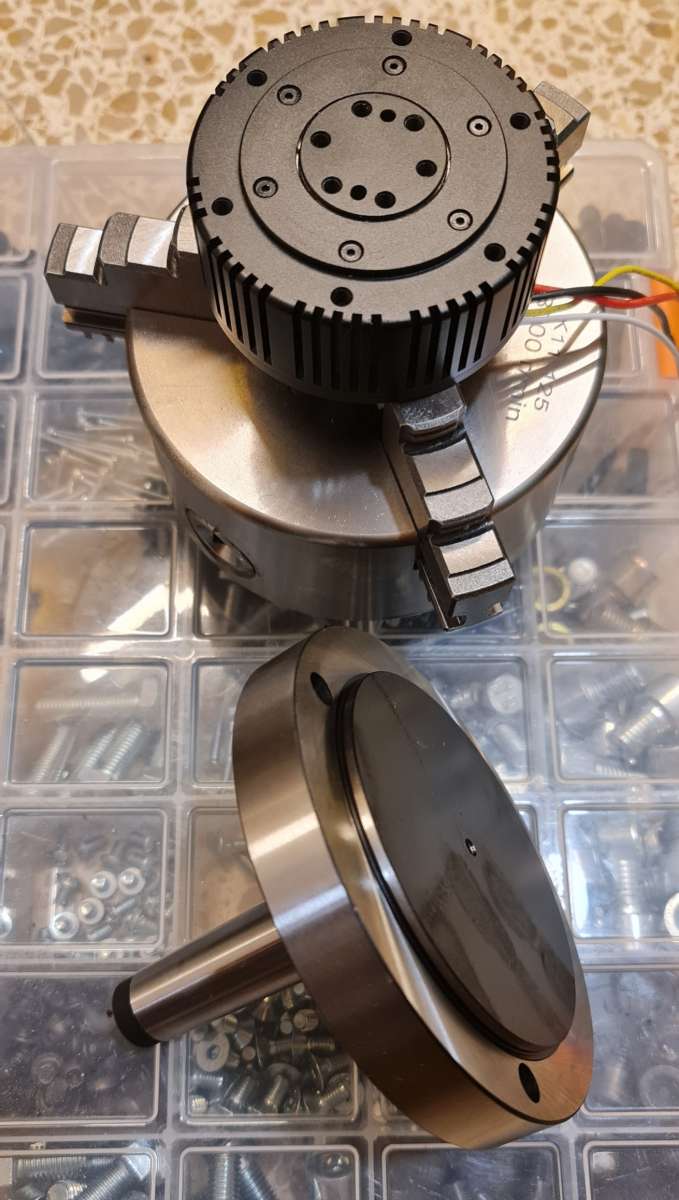
                But I have a plan. I can hold the X6-8 motor in a 125 mm chuck from the dividing head. My lathe chuck is only 100 mm and does not have reverse jaws, but I do have an MT3 flange for the larger chuck. All I need is to put the flange in the lathe spindle, block the chuck from turning, turn on the motor, and machine a perfectly concentric hole in a rigid coupler bolted to the motor flange. How to mount the motors together is another story, I will deal with that later. But for now, this looks like the simplest solution.

                20260509_194500


                #847700
                Sonic Escape
                Participant
                  @sonicescape38234
                  On Robert Atkinson 2 Said:

                  To get stall torque you can power the driven motor from a constant current source (via a diode if it can’t stand voltage being fed into it) connected to run in the reverse direction and turn up the current until the driving motor stalls. The current is proportional to the torque.

                  I thought about this, but it is tricky. Without correlating it with the X6-8 motor current, it could start spinning it in reverse. Who knows what its BLDC controller would think about that 🙂

                  #847709
                  Ian P
                  Participant
                    @ianp

                    The X6-8 motor output face appears to have a 31mm diameter register so your adapter (held on with six M4 fixings) will be accurately concentric. If you make a new adapter that is a direct solid fit between the two motors the lighter X6-8 can just be overhung off the DC motor shaft, all that is then needed is a ‘torque arm’ to keep the two motor casings locked together.

                    Regarding your last post about motor in reverse, you could install a freewheel or sprag clutch in your coupling between the motors.

                    Ian P

                    #847738
                    Robert Atkinson 2
                    Participant
                      @robertatkinson2
                      On Sonic Escape Said:
                      On Robert Atkinson 2 Said:

                      To get stall torque you can power the driven motor from a constant current source (via a diode if it can’t stand voltage being fed into it) connected to run in the reverse direction and turn up the current until the driving motor stalls. The current is proportional to the torque.

                      I thought about this, but it is tricky. Without correlating it with the X6-8 motor current, it could start spinning it in reverse. Who knows what its BLDC controller would think about that 🙂

                      Ah, I did not realise the driving motors were BLDC. Running them backwards against the drive should not be an issue unless the maximum current has been set too high. It may back-feed into the power supply though.

                      Robert.

                    Viewing 9 posts - 1 through 9 (of 9 total)
                    • Please log in to reply to this topic. Registering is free and easy using the links on the menu at the top of this page.

                    Latest Replies

                    Home Forums General Questions Topics

                    Viewing 25 topics - 1 through 25 (of 25 total)
                    Viewing 25 topics - 1 through 25 (of 25 total)

                    View full reply list.