Conical bore

Conical bore

Home Forums Beginners questions Conical bore

Viewing 19 posts - 1 through 19 (of 19 total)
  • Author
    Posts
  • #8845
    Iain Downs
    Participant
      @iaindowns78295

      So what am I doing wrong now?

      #314207
      Iain Downs
      Participant
        @iaindowns78295

        I'm in the process of making my first steam engine. It's as easy as it gets with plans and build steps from Steve's Workshop.

        The problem is the cylinder. The first one I made was in aluminium which I decided to do with a blind bore and not a cap. However, it appears step in or narrow part way down so that the piston would only fit part way down before jamming.

        Next attempt was in brass. this time following the plans and boring through with an end cap. That's when I found my recently acquired reamers only went up to a 10 (acquired because I thought I should have a set not for this job).

        So I bored again. This time with a solid indexable boring bar with a 10mm shank mounted on an ally QCTP. Lathe is a Real Bull CJ18 – a 7 x 14.

        I felt I was getting a good result but I had the same thing happen. When I measure the inner diameter with my calipers there was around 0.1mm (4 thou) difference between one end and the other.

        I'm pretty sure that the big end was the one sticking out of the chuck, though I did the measurement after the cylinder was out.

        So, the cylinder is 25mm brass with a 12mm bore. It is 30mm long and almost completely held in the 3 jaw jaws. Not much sticking out.

        The boring bar should have the same flex at all points in the bore so that should notbe the problem. Same applies for the rigidity of the toolpost.

        I ran the boring bar through a couple of times with the last few cuts only being a few thou as I was trying to trim it up to the piston size.

        I'm trying to work out if the chuck could be be off centre in a way which would cause this. Or if some other component is a challenge.

        In a spirit of model engineering, I'm going to have a 3rd go at this. This time with a 12mm reamer. However, I'm somewhat concerned that the reaming will have the same problem if the chuck is dodgy.

        Thanks

        Iain

        #314208
        Tony Pratt 1
        Participant
          @tonypratt1

          Iain,

          The work run out [eccentricity] does not affect how the lathe will or will not cut parallel as seems to be your problem. 1st question have you set your lathe up to cut parallel, also I believe this question has been asked before maybe a search on the forum will help?

          Tony

          #314209
          JasonB
          Moderator
            @jasonb

            I would say use a HSS boring tool. The blunter nature of the indexable bits combined with a light lathe will tend to push the tool off the surface of the bore.

            Also you may be below the minimum bore for a 10mm shank tool which causes the bottom edge of the insert to rub and push the tool off the surface

            On critical bores I change to an HSS tool with about 0.5mm to go and make light cuts to finished size.

            Edited By JasonB on 27/08/2017 20:32:10

            #314213
            Iain Downs
            Participant
              @iaindowns78295

              Hi, Tony. I don't believe that there is anything I can do to change how parallel the lathe cuts (short of a regrind).

              The bed has a V for alignment which the headstock and carriage are linked to. Recently I replaced the spindle and have a decent runout against a test bar in the spindle (much much much less that 4 though in 1.25 inches!

              I was wondering if the chuck was at an angle to the axis of the spindle that one would see this effect?

              JasonB. The ally one was done with a self ground (and just sharpened) HSS boring bar. I swapped up to the indexable carbide one as the self ground one was 4mm in shaft and the indexable one 10mm which I thought would be more stable.

              Also, I can't see how the deflection would change with the depth of hte bore. If the bar was sticking out from the chuck, then yes I could see how that could be deflected.

              Maybe I needed to tighten the chuck more? Or use my pristine 4 jaw which is probably better than the 3 jaw that came with the lathe…

              Iain

              #314214
              JasonB
              Moderator
                @jasonb

                4mm would be a lot too flexible

                See my extra comment above about your 1omm bare being too big, as this chart shows.

                Its an often discussed issue of why a bore is tapered and what causes it regardless of loads etc

                #314225
                Richard S2
                Participant
                  @richards2

                  If the Boring tools you have used are found not to be the cause, how well adjusted are the Gib Strips on the Carriage?. If there is too much slack there, it can produce the issues that you have. It may even be a combination of both !.

                  #314235
                  Clive Foster
                  Participant
                    @clivefoster55965

                    Further to Jason's comment about boring bar sizes if you have a CAD program its well worth spending some quality time doing some large scale drawings of holes with boring bar ends in cutting operation. This should give you a much better feel for what sort of shape is needed on the heel of the tool if its not to interfere with the bore. I found that my intuitive assessment was pretty reasonable from about 1 " / 25 mm diameter upwards but in smaller sizes rapidly became sadly erroneous. Went through this exercise a few years back and discovered that one tool with "usually worked pretty well" was actually cutting on the heel not the tip. Ooops! Supposed to be OK in holes down to 1/2" – 5/8" or thereabouts diameter I think.

                    Arranging proper clearance for the shank behind the cutting end can be a right problem, especially on smaller holes. I frequently set my ground from solid ones at a slight angle. Limits the size of the tool steel that can be used but I figure its still bigger and better (stiffer) than the shank on the "mutant golf club style" tool with the shank ground down for clearance shank needed.

                    Clive

                    #314243
                    Hopper
                    Participant
                      @hopper

                      Bellmouthing, or tapering larger at the right hand end is common with boring. As well as setting up the right tooling etc as outlined above, the final cuts need to be repeated several times at the same setting, ie taking a zero depth cut, to allow spring to work out of the boring bar. It tends to accumulate as teh bar goes into the job, resulting in the far end being undersize. Final cuts should be in the region of one thou or so and when size is reached, or almost reached, run the tool through repeatedly at the same setting. Bore the hole first, then machine your piston to suit the size of the hole is the easiest way too.

                      #314269
                      Ian S C
                      Participant
                        @iansc

                        Apart from the taper bore, you say you were boring out to piston size. Don't, just bore to the nominal size then make the piston to fit the bore. You can hone and lap the cylinder round and parallel, and once you have done that, stop, it's then easier to adjust the size of the piston to fit.

                        Ian S C

                        #314273
                        duncan webster 1
                        Participant
                          @duncanwebster1

                          +1 for IanSC suggestion. It's a long time since ME or MEW did an article on lapping. I've only done it once, but it transformed the bore of my petrol engine. On my steam locos I cheated and took cylinders to local headshop. They honed the bores and surface ground the slide valve faces for not a lot of money.

                          #314629
                          Iain Downs
                          Participant
                            @iaindowns78295

                            Not that I doubt the technical knowledge and excellence of my esteemed forum colleagues – but you have to try things for yourself, no?

                            So I took a piece of 20mm steel bar about 30mm long (coincidentally the same length as the cylinder and chosen cos I'd just made something with the last few mm of if).

                            I drilled it to 12mm (my biggest drill bit) and then bored it out just a little bit with my indexable carbide boring bar. As a poster said, it's meant to only work from 13mm up, but it seemed OK in this instance – there was no touching at any point. I put a new tip in the boring bar.

                            I ran the boring bar backwards and forwards about 4 times on the finest automatic feed I can get and then measured the bore.

                            The inner end (left hand side) was significantly narrower than the outer end (0.1mm or more).

                            I then ground an hss boring bar. Actually I could have done this better. It was an 8mm square tool which I thinned to around 6mm and put a round on the bottom. It only occurred to me later that I could have made it as a circle and not a semi-circle – if you see what I mean.

                            Again I ran it through about 4 times under power feed after taking off a few thou.

                            The results were strikingly different. The bore is straight within the limits of my measuring accuracy!

                            In mitigation, I note that measuring the bore of a cylinder with digital calipers when you're thumble fingered like me isn't terribly easy. However the difference was quite striking.

                            I might have a go on the brass cylinder rather than making another one.

                            Ian – I was doing what you suggest, however when I made the second cylinder I wanted the bore to be close to the piston I'd already made so I could hone that down a little

                            #314650
                            JasonB
                            Moderator
                              @jasonb

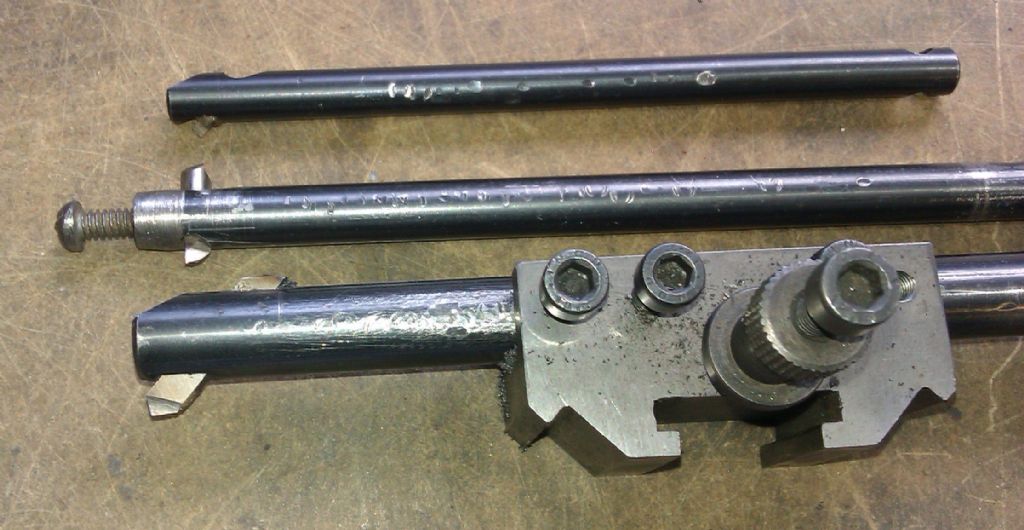
                              Ian you may well get even better if you use a round bar that will hold a small dia HSS tool bit as you will be able to get a more rigid shank.

                              Simply take a piece of say 10mm dia mild steel, cross drill it to take a 4mm HSS toolbit or if you have any broken ctr drills make the hole to suit them. As it is a through hole drill in from the end to take a clamping screw to retain teh tool bit and away you go.

                              Something like the one in the middle

                              imag2727.jpg

                              #314654
                              john carruthers
                              Participant
                                @johncarruthers46255

                                I have only done a couple of cylinders but my method was to turn a mandrel, then use it to set up the cylinder in a vertical slide.
                                I then used a boring bar in the chuck, supported by the tailstock, to cut a (reasonably) parallel bore.

                                #314656
                                Martin Connelly
                                Participant
                                  @martinconnelly55370

                                  Running a carbide insert at a low feed and low speed will result in rubbing not cutting. You have to be aggressive with carbide as it does not usually hold as sharp an edge as HSS. Chances are with carbide boring that the initial strike on the cylinder will have enough pressure to start cutting but as the tool goes further into the bore it starts to rise up onto the surface and rub. As you try to increase the bore there is a chance at some point that the pressure of the tool on the workpiece will be high enough to start cutting but this may be after a small section of not cutting resulting in a very variable bore.

                                  The only way I can get a carbide tipped boring tool to cut a bore to tight tolerances is to be doing a large bore that I can use a 25m diameter boring bar in to get the necessary rigidity for very small cuts. By all means rough out with carbide but do not expect to get small bores to size without finishing it some other way eg HSS boring tool or reamer or anything else that will successfully take a fine cut.

                                  Martin C

                                  #314659
                                  Raglan Littlejohn
                                  Participant
                                    @raglanlittlejohn

                                    "Not that I doubt the technical knowledge and excellence of my esteemed forum colleagues – but you have to try things for yourself, no?"

                                    Iain, I think you've hit the nail on the head here. You've found something not right (tapered bore), asked questions etc, had concerns about chuck alignment, and tried different things. You've now had a good result, and know your lathe is ok. You also know a HSS boring bar can produce a parallel bore. Excellent result.

                                    As you suggested, have a go on your cylinder with the new hss boring bar. Just make the piston a bit bigger to fit the finished bore.

                                    Regards,

                                    John.

                                    #314687
                                    Iain Downs
                                    Participant
                                      @iaindowns78295

                                      Thanks for all that. Martin – I hope we have a typo there – a 25m diameter boring bar seems outside the scope of model engineering… smiley

                                      Iain

                                      #314691
                                      Martin Connelly
                                      Participant
                                        @martinconnelly55370

                                        I do all sorts of things on my machines (often helping out other people) and bearing housings are often big enough to take a 25mm bar. I acquired it out of a scrap bin.

                                        Martin C

                                        #314704
                                        Iain Downs
                                        Participant
                                          @iaindowns78295

                                          Sorry, Martin. I was rather rudely implying your text said you had a 25 metre boring bar.

                                          As I misspell every 3rd word and miskey every 2nd digit, it was said with some wryness.

                                          Iain

                                        Viewing 19 posts - 1 through 19 (of 19 total)
                                        • Please log in to reply to this topic. Registering is free and easy using the links on the menu at the top of this page.

                                        Latest Replies

                                        Home Forums Beginners questions Topics

                                        Viewing 25 topics - 1 through 25 (of 25 total)
                                        Viewing 25 topics - 1 through 25 (of 25 total)

                                        View full reply list.