Can you identify this object

Can you identify this object

Home Forums General Questions Can you identify this object

Viewing 11 posts - 1 through 11 (of 11 total)
  • Author
    Posts
  • #610687
    Tony Martyr
    Participant
      @tonymartyr14488

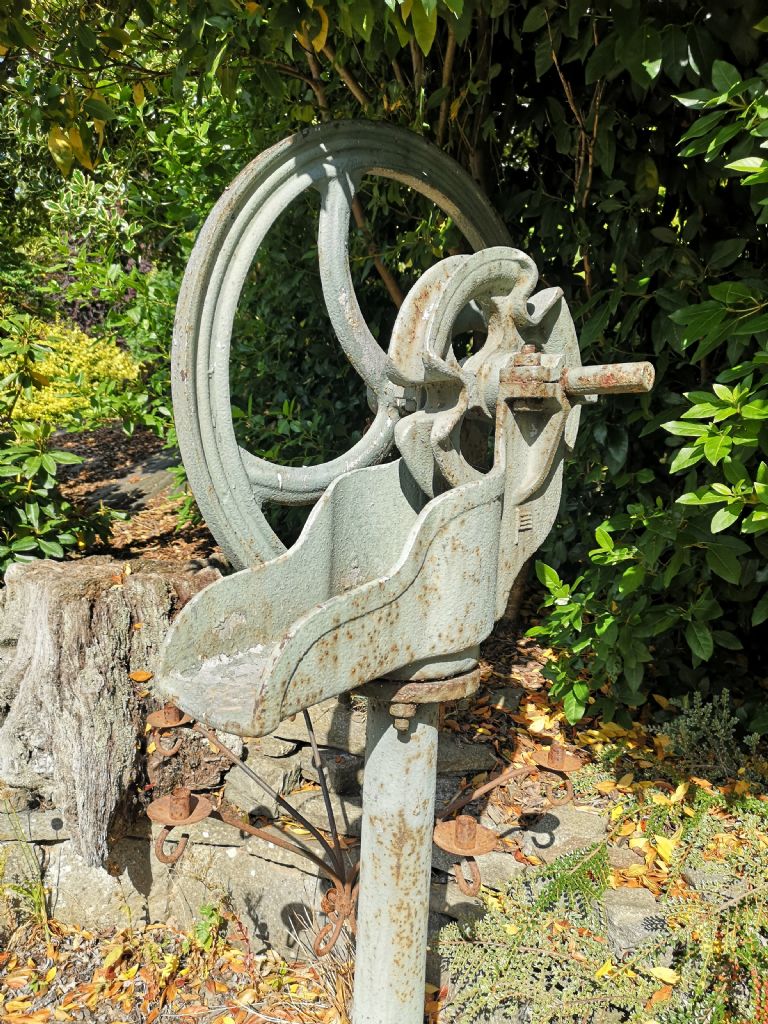
      This hand cranked device is ridgidly installed near a farmhouse near to my house in the Welsh Marches and nobody seems to know what it was used for. Its location may be a false lead as the previous owner was a magpie who collected all sorts of stuff. I will not add my thoughts which maybe totally wrong and mislead. It looks like a pump of some sort but perhaps you have seen one before?

      the object.jpg

      #28815
      Tony Martyr
      Participant
        @tonymartyr14488
        #610691
        DC31k
        Participant
          @dc31k

          Rope washer pump.

          #610697
          peak4
          Participant
            @peak4
            Posted by DC31k on 22/08/2022 11:55:11:

            Rope washer pump.

            Here's a reasonably good explanation.
            https://www.rural-water-supply.net/en/implementation/public-domain-handpumps/rope-pump

            I couldn't find a suitable video.

            Bill

            Edited By peak4 on 22/08/2022 12:22:27

            #610706
            Nigel Graham 2
            Participant
              @nigelgraham2

              As your photograph suggests, there is nothing new in them despite the impression given by the cited article, of being some fancy recent invention.

              Prior to using plastic or rubber washers, they usually had balls of cloth knotted onto the rope, with the advantage of it accommodating itself to some extent, to uneven pipe walls. They might also have used Turk's Head type knots, forming a ball of rope.

              The text rather coyly means you have to operate the machine faster than the water can leak back down! They would be difficult to make very leak-proof but these examples seem based on crudeness of construction being fine if only you can wind the handle quickly enough! If they use standard plastic piping for the riser, it should be possible to make these quite efficient, even without recourse to any sort of lathe.

              The idea in fact is ancient.

              This is the well version of the water-wheel irrigator that lifts water out of a shallow channel by using buckets round the rim of a large wheel, discharging into a launder at right-angles to the wheel.

              #610716
              Tony Martyr
              Participant
                @tonymartyr14488

                Thanks Guys – quite obvious when it's explained isn't it!?

                What fooled me is that its been put next to a chaff cutter of similar age and nowhere near water (my excuse)

                #610719
                Martin Kyte
                Participant
                  @martinkyte99762

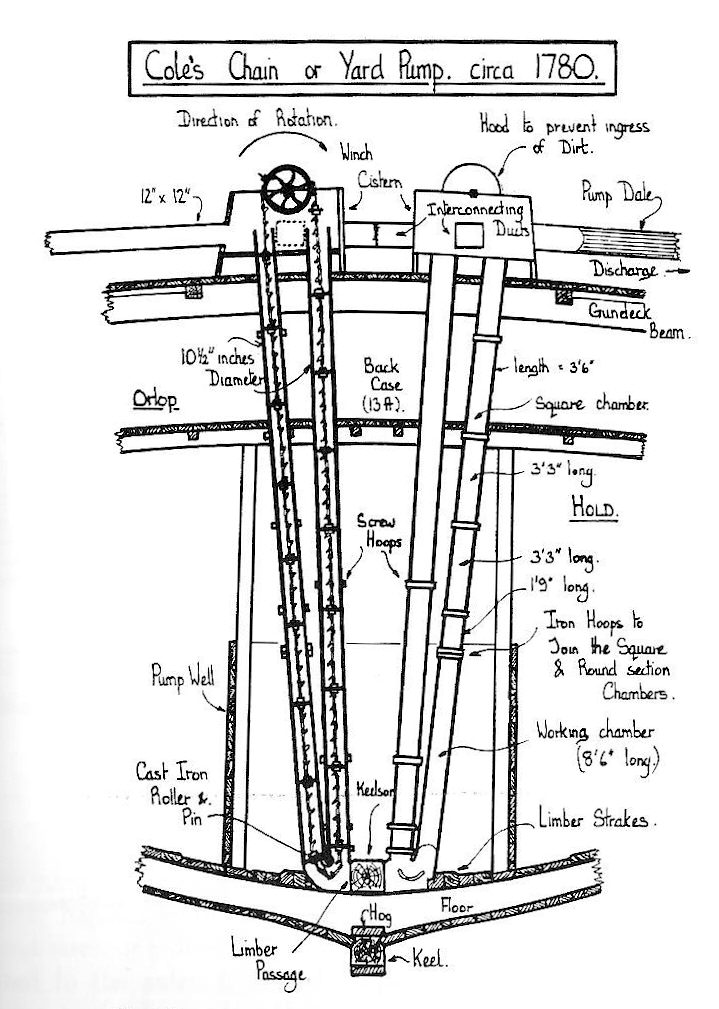
                  Chain pumps, operating on the same principle were a typical fitment to 18th and 19th Century ships as shown here:-

                  I have to admit to not recognising it untill it was pointed out and then the similarity dawned.

                  Chain Pump jpeg

                  regards Martin

                  #610854
                  Nigel Graham 2
                  Participant
                    @nigelgraham2

                    A very interesting drawing – for its shipwrighting aspects as well as explaining the pump.

                    I wonder why the pump ducts appear to change from round to square section part way up. What does "square chamber" mean, needing its special iron hoops to join it to the round ones?

                    On the face of it it might seem to have been easier to fit a square tube through the deck than round, but they did have lathes at the time so making a bush would not have been difficult. After all, they had to pass the much larger cylindrical masts through the decks to their feet on the ship's deeper structure.

                    Or is the square actually a trunking around the pump riser and return?

                    The pump well looks remarkably deep, but the drawing does not show the level of its inlets. I assume it was really a wall to protect the pump pipes from anything breaking loose in the hold.

                    The crew on the old wooden-walled sailing-ships often (routinely?) had to sound the depth of water in bilge. I don't know if this was done by physically going below or through a duct from main deck level.

                    I'd wondered in the past what the "orlop deck" was – evidently the lower deck forming the hold ceiling. I think it held such compartments as the sick-bay.

                    .

                    Chian / rope pumps were just one of a quite a variety of water-supply (and as on the ship, drainage) pumps and equivalents invented since BP era.

                    One of the simplest, the shaduf, is still being used in parts of the Middle East and Africa some 3000 years after its first know evidence. It is not a "pump", but a simple counter-weighted derrick to lift water over a low height, such as a stream bank .

                    The shaduf has a sort of opposite: a gravity-driven mine drainage pump, conserved non-operably in the lead-mining museum site at Leadhills, SW Scotland. Water from a stream filled a bucket on a rocking beam to raise the mine pump-rods suspended from its other end. At the bottom of the stroke the bucket emptied to allow the pump-rods' weight to return the machine to its starting position.

                    While Archimedes could never have envisaged the Screw named after him being used over 2000 years later, in reverse: not to be turned by an energy-source (a person or donkey) to raise water; but to use the water as the energy-source – descending through it to run the machine in reverse, driving an alternator!

                    Try this:

                    https://www.mdpi.com/2073-4441/7/9/5031/htm

                    [Evolution of water-lifting devices over time.]

                    As a philosophical point, these very early machines could be seen as exemplifying the best principles of Engineering: creating a machine to solve a practical problem in the most efficient and reliable manner possible, with the most suitable materials and skills available in their place and time.

                    #610915
                    Howard Lewis
                    Participant
                      @howardlewis46836

                      As I understand it, the bilges were checked using a pipe that went down into the bilges. The method was similar to that used above deck to ascertain the depth of water in which the ship was sailing, and the nature of the seabed. ( The pipe prevented the knotted Leadline from swinging when the ship rolled or pitched, to provide a more accurate reading ) Hence "swinging the lead" meant going through the motions but not actually doing anything productive.. Ship speeds are still measured in knots.

                      The leadline carried a lead weight, to sink it, and the depth measured by them number of regularly spaced knots that were wet when the line was hauled onboard again.

                      Mark Twain took his pen name from this, "By the mark twain" being a call from the man swinging the lead on Mississipi river boats.)

                      Rag pumps were popular because they were compact and used rotary motion rather than reciprocating.

                      Howard.

                      #610932
                      Nigel Graham 2
                      Participant
                        @nigelgraham2

                        The knot as a measure of ships' and later aircraft speeds became formalised as 1 Nautical Mile per hour, the distance being related to degrees of angle around the Earth so directly related to Lat. & Long. (I think it was that which should have been set as the kilometre, though it is longer than the Statute Mile so a lot longer than the French km.)

                        I think the derivation for speed was in using a knotted line and float to time the ship's progress.

                        "Swinging" the lead properly, before its use to denote pretending to be busy, was done to cast the line ahead of the ship so the line was vertical when the measurement was taken.

                        Originally the lead-line was used only to ensure safe clearance above the "ground" near land; but a different form worked from a winch was used in the first surveys of the sea floors. That must have been a remarkably tedious operation as they ventured onto the oceans and discovered the Continental Slopes descending to depths averaging some two to three miles.

                        #610937
                        SillyOldDuffer
                        Moderator
                          @sillyoldduffer
                          Posted by Nigel Graham 2 on 23/08/2022 16:59:12:

                          The knot as a measure of ships' and later aircraft speeds became formalised as 1 Nautical Mile per hour, the distance being related to degrees of angle around the Earth so directly related to Lat. & Long. (I think it was that which should have been set as the kilometre, though it is longer than the Statute Mile so a lot longer than the French km.)

                          The why knot, geddit, is that the metric system set out to be decimal and time and longitude are base 60. Instead the metre was defined as as the ten-millionth of the length of a half meridian (distance between the equator and the North Pole.

                          Maybe basing the metre in terms of the knot would have made life easier for navigators but kilometre is a centigrad, or 0.01 of a gradian of arc, which works OK if anyone needs to do metric navigation, which as far as I know no-one ever does. These days it doesn't matter much because a GPS or calculator does the sums in whatever units are wanted.

                          Dave

                        Viewing 11 posts - 1 through 11 (of 11 total)
                        • Please log in to reply to this topic. Registering is free and easy using the links on the menu at the top of this page.

                        Latest Replies

                        Home Forums General Questions Topics

                        Viewing 25 topics - 1 through 25 (of 25 total)
                        Viewing 25 topics - 1 through 25 (of 25 total)

                        View full reply list.