Boring large deep holes, can it be done?

Boring large deep holes, can it be done?

Home Forums Workshop Tools and Tooling Boring large deep holes, can it be done?

Viewing 19 posts - 1 through 19 (of 19 total)
  • Author
    Posts
  • #834373
    joebouy
    Participant
      @joebouy

      Guys,

      I have a project in mind, a ml7, time, ambition, a lack of experience and perhaps a lack of sound insight, but I wanna have a crack at it anyway…… if it can be done.


      The project is boring a golf ball sized blind hole, 5 1/2 deep in 1018 round bar stock. Yes, a golf ball small scale mortar.

      I am pretty sure, that I will need to buy a solid carbide boring bar, 200mm in length at minimum

      Then, I will need to figure out a way / method of holding a 16mm-20mm diameter bar, on the ml7, most likely in a custom made holder of sorts.

      Yes, I have done boring on the ml7 before, but not to this scale.

      I am hoping that others that may have done this on their hobby sized lathe might be willing to share their insight and experiences with boring deep, blind holes on a Myford, or similar.

      Can it be done?

      Thanks


      #834381
      jimmy b
      Participant
        @jimmyb

        Anti-vibration being should be able to do this, but at a very high cost (£600+?)

        There are so many factors that could affect this, depth of cut/feed/”solidness” of tool and work etc etc


        I’d have a go with whatever I had. I’m pretty sure it’s more than doable.


        Good luck!


        Jimb

        #834383
        Grizzly bear
        Participant
          @grizzlybear

          Hi,

          Have you ruled out a suitable steel tube?

          You could solder/weld the extra bits on.

          See Jason’s work for ideas.

          Good luck.

          Bear….

          #834386
          Peter Cook 6
          Participant
            @petercook6

            Several questions

            1) Why does it have to be a blind hole. Could you not make a through hole and add a “breech block” in the closed end.

            2)What precision does the ID have to have? Is it for a gas tight piston, or would rings or wadding be an option.

            3)If you could do 1, then start with tube (say 40mm ID) with an appropriate wall thickness. It will save a lot of swarf!

            4)If 1 & 3 then set it up as a line boring job. 30mm diameter bar with a suitable tool bit sticking out at right angles. Mount the bar between centres with a drive dog. Clamp the tubing to the saddle so that the bar is through the centre. Then rack the carriage up and down so that the tube passes the rotating cutter.

            #834391
            JasonB
            Moderator
              @jasonb

              If I can do that sort of thing on my Imported lathe then a Myford should be able to do it too. However an ML7 could possibly be showing it’s age so a bit of a tapered bor emay result.

              You will certainly need a fixed steady as having that much metal sticking out of a chuck is not practical or safe.

              Drill out a smuch a spossible using “blacksmith” drills which have a reduced diameter shank so can be held in a tailstock chuck or pick up some old MT2 shank bits and sharpen them, doe snot have to be perfect as you will be boring after drilling out to 1″

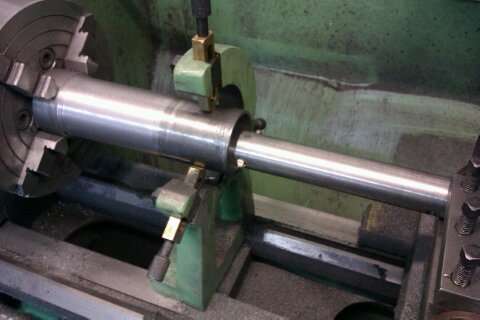
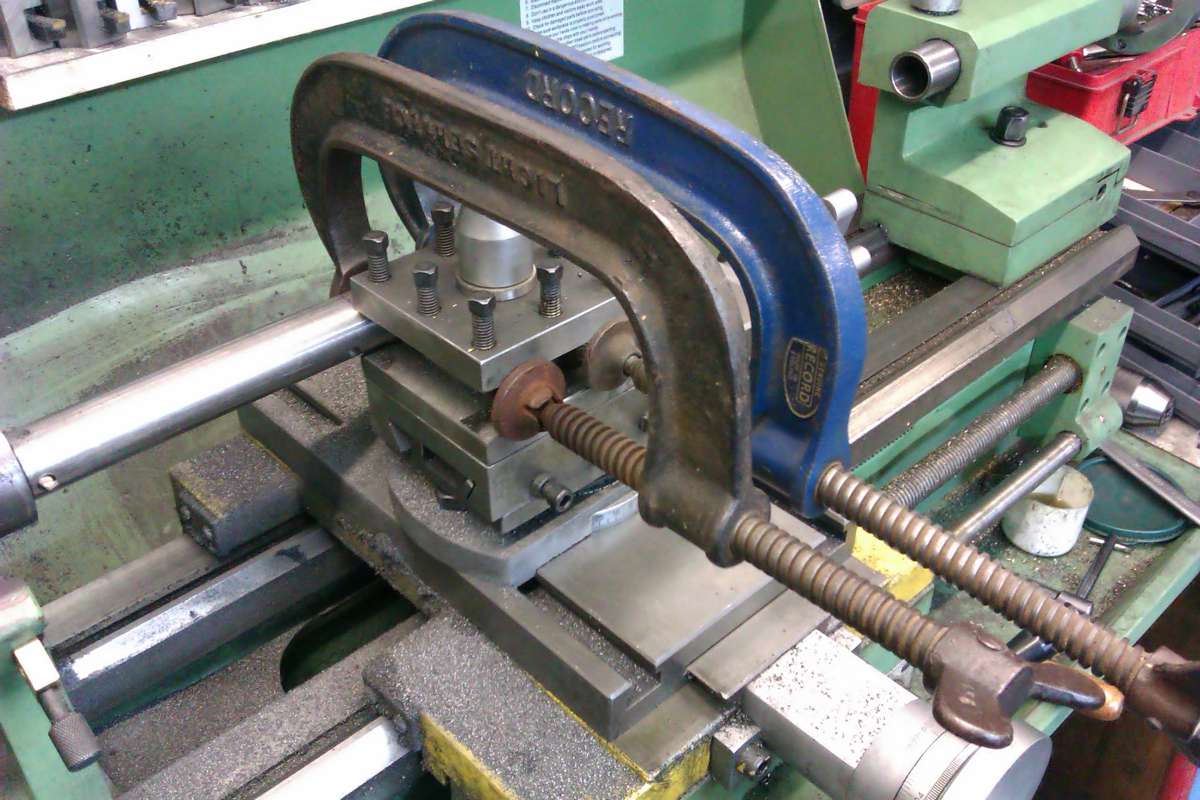
              As for a boring bar the choice is yours Carbide insert in which case use CCMT 09T302 inserts which are sharper than CCMT. Or make your own from say 22mm bar, drilled at an angle to take a 1/4″ HSS round tool bit and cross drilled & tapped for a grub screw to hold the bit. Clamp bar direct to cross slide or even remove that and use a solid block fixed to te cross slide.

              If you could put the fuse in to the opposite end then the possibilities for between centre boring bars which are likely to give a more parallel bore should be considered.

              IMAG2349

              IMAG2350


              #834395
              SillyOldDuffer
              Moderator
                @sillyoldduffer

                Certainly, though it depends on how accurately shaped and well-finished the hole needs to be.  Vibration is likely, and the bore might taper a bit. Tapering can be reduced by taking lots of spring cuts.

                A golf ball being about ⌀40mm,  I’d bore it starting from a 12mm drilled hole with a bought ⌀10mm bar, and then switch to a fat home-made bar for the last few mm.   An obese DIY ⌀35mm bar should chatter less than a thin bought one.

                Should be easy enough if a bit of taper and some chatter marks don’t matter in a model mortar. A perfect parallel cylinder with a polished wall, as needed for an engine with a tight piston is more challenging.

                Dave


                #834397
                peak4
                Participant
                  @peak4

                  Never tried this particular job, but a couple of observations.
                  I’ve been out the the garage and can only just fit a 50mm bar into my Myford fixed steady, which is well worn.
                  A new one might need replacement fingers, though large bore steadies are available.

                  50mm OD 40mm ID tube is available, seemingly for hydraulic use, so maybe a scrapyard/hydraulic ram refurbisher would have something available. One end might even be already welded closed.
                  New tube is available, just as an example; other sources my be cheaper or closer>
                  https://electrohydraulicscontrols.com/product/honed-steel-tubes-size-od-50-mm-id-40-mm-per-meter/

                  Cutting Edge Engineering regularly shows videos of modifications of hydraulic rams & cylinders, albeit at a larger scale.

                  Not all golf balls are the same size, as only the minimum OD is specified (1.680 inches 42.67 mm)
                  https://www.randa.org/en/roe/the-rules-of-equipment/part-4-conformance-of-balls#43-size

                  The bottom of a blind hole might not need to be flat if the “piston” is spherical

                  If you can borrow a second fixed steady, then that could possibly be used to support a large diameter boring bar as it enters the hole. Depth of cut could be adjusted by moving the boring insert, rather than the cross slide.

                  Bill

                  #834399
                  noel shelley
                  Participant
                    @noelshelley55608

                    I made a cannon when an apprentice out of thick walled tube wall about 1/2″ and bore about 1.5″, welded a plug in the end. Propellant was weed killer and icing sugar – it worked.  Noel.

                    #834415
                    Bazyle
                    Participant
                      @bazyle

                      Perhaps you can find some sort of hydraulic cylinder of the right bore and cut it short. I’m assuming you are making a pump or something not an actual mortar, even as a firework or starting gun is illegal without the right licences.

                      #834421
                      duncan webster 1
                      Participant
                        @duncanwebster1

                        Many moons ago I worked at a place where they made 10s of thousands of long, thin wall tubular things machined inside and out from extruded material. They used a boring bar nearly the size of the bore with 2 diametrically opposed cutting bits. Slight longitudinal displacement, the trailing cutter at a slightly larger radius. It effectively took 2 cuts at once, from extrusion to finished size in one pass. If set right, there is very little net bending force in the boring bar, but double the torsion. For the life of me I can’t remember whether there was a sort of travelling steady with teeth that did the od at the same time

                        #834440
                        DC31k
                        Participant
                          @dc31k
                          On joebouy Said:

                          ..might be willing to share their insight and experiences

                          If you want people to share their experiences and help you, please have the courtesy to link to the thread you have started elsewhere.

                          Then people here would learn of the suggestions you have already received (this saves repetition). This saves repetition. They might also learn from those suggestions for their own projects.

                          https://www.practicalmachinist.com/forum/threads/is-this-possible-on-a-ml7.445963/

                          #834497
                          Robert Atkinson 2
                          Participant
                            @robertatkinson2

                            Glad to see you are in Canada. Building your “toy” in the UK would get you locked up if caught.

                            #834566
                            cedric 1
                            Participant
                              @cedric

                              5.5 inch deep hole at that diameter is no big deal. As Jason said  drill it then bore with progressively larger bars, either insert or HSS. No need for solid carbide or exotica.

                              If you get a bit of vibration or chatter,  a lot can be done with wrapping strips of rubber inner tube around the job to dampen it. Common practice on reboring large  hydraulic cylinders on old worn out lathes.

                              #834573
                              John Purdy
                              Participant
                                @johnpurdy78347

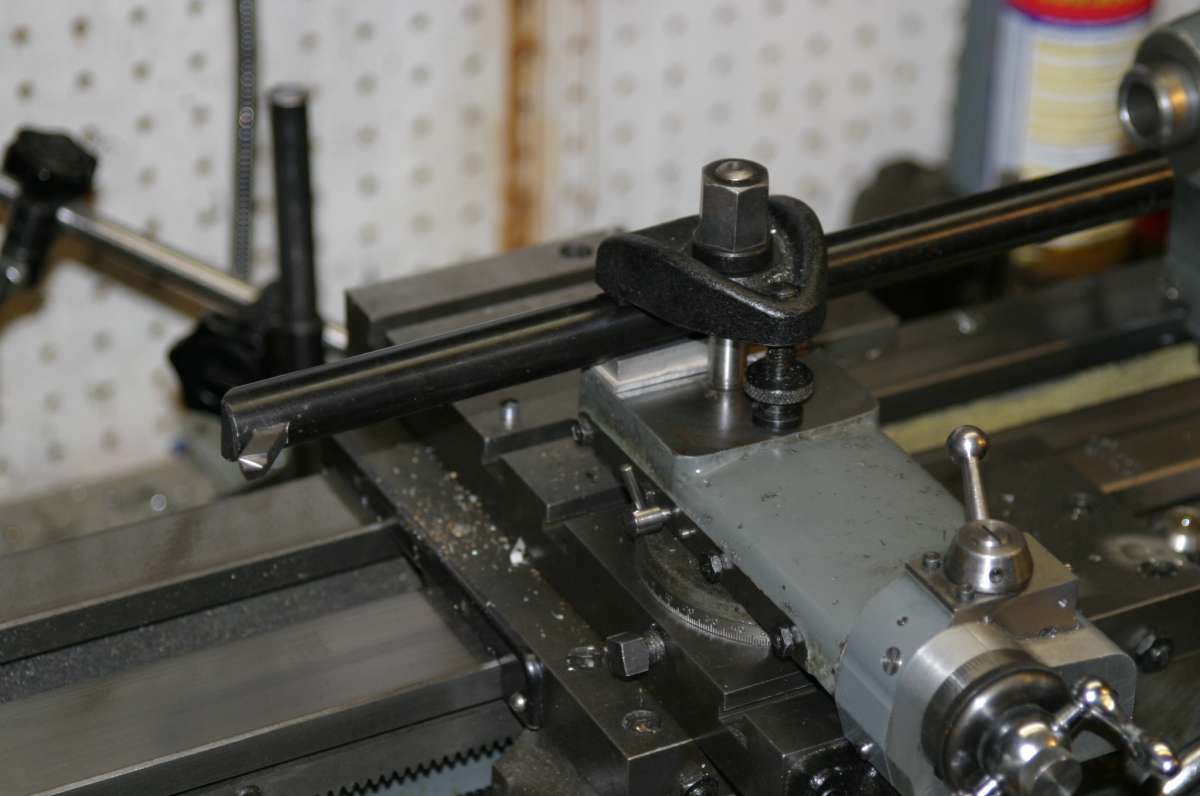
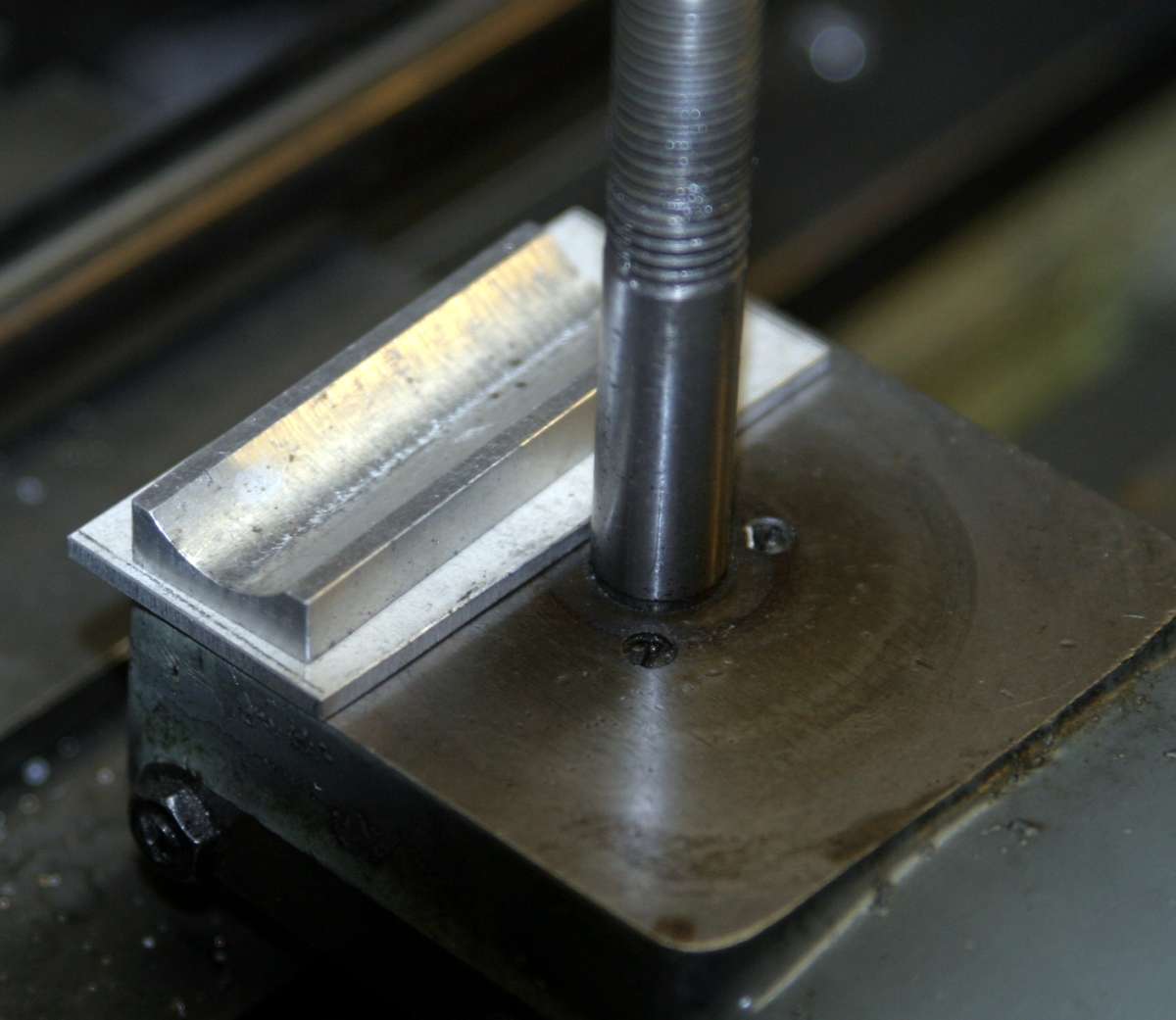
                                Here’s what I have used to do similar sized deep holes. The boring bar is held in a piece of aluminum with a semi circular cutout ( a “V” would work just as well) with the cutting edge of the tool bit shimmed up to centre height. This one is a commercial 3/4″ dia bar with a 1/4″ sq. tool bit. I also have a 1″ home made one also with a 1/4″ bit.

                                John

                                tool2

                                tool

                                #834711
                                joebouy
                                Participant
                                  @joebouy

                                  Thank you gents, for offering your advice.

                                  To answer a few of your questions;


                                  Yes, making a black powder mortar, and firing it, is legal here, as long as it is used as for signal purposes, and cannon fuse is it’s igniter. Ditto for making / firing a small-scaled signal cannon, which is also on my list to make.

                                  Yes, I wish to “make”, or rather “turn” these scaled models vs buying them, because I ( hopefully ) can.

                                  For the mortar, my thoughts are that it should be the “easier” of the two to make, than a cannon, for a first attempt. Thus my questions based upon the tooling / techniques for making it.

                                  My Myford is in good condition, and is not clapped out. The PO took very good care of it, and it hasn’t seen much use. The PO had also made a heavy duty fixed steady rest, that I acquired. It will accept 4″ stock or perhaps larger diameter. So it should suffice.
                                  I don’t have another steady rest, as in a factory Myford rest.

                                  John, I like your method of holding your large diameter bar on your Myford. I will research more on boring bar holder options.

                                  I have a few home-made boring bars utilizing a hss bit / grub screw for securing it, but all are larger dia than 12mm, so making a bar holder for them, or a purchased solid carbide bar, is a must.


                                  For the mortar, it will have a smaller diameter recess in the breech, 1″ wide x 1″ deep, than the bore. This is for the powder charge. This will ensure a thick-walled breech, and will hopefully ensure that when I am dead and gone, the next person to fire it will use the appropriate amount of BP, and not over-charge it to an ignorant / potentially dangerous level.  I want it “safe” for the next mortar-happy nimrod.

                                  For drilling out the initial bore, will the ml7 handle / have the power for a 1″ sharp drill?
                                  I have a few M2 drills….. but my concern is, that it might spin in the tail stock when drilling, is it likely score / burr the bore of the tail stock? The tail stock shaft is in good condition, and it seems to hold smaller tooling ok without loosening, but I have yet to try a large MT drill.
                                  What might be some other drill-holding options on the ml7 be?

                                  Thanks for your thoughts


                                  #834713
                                  JasonB
                                  Moderator
                                    @jasonb

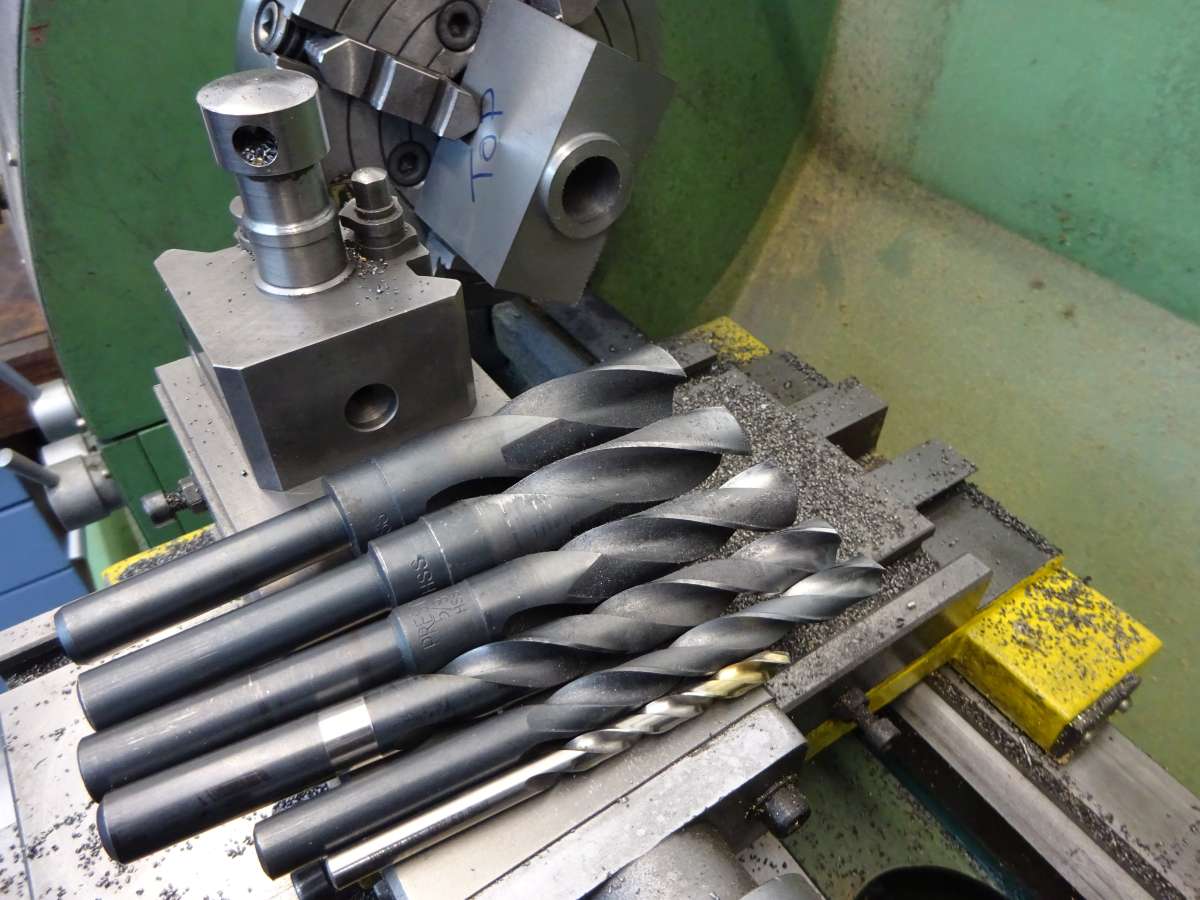
                                    If you work up through sucessively larger diameter drill bits rather than going straight in with a 1″ that will put considerably less load on the machine and the drill holding arrangement. 1/8″ increments would be OK

                                    DSC00584

                                    #834718
                                    cedric 1
                                    Participant
                                      @cedric

                                      My ML7 will drive a 1″ drill easily at about 200rpm  ie low speed but not back gear. MT2 will not slip if seated firmly. Whack it with a brass bar or copper hammer . Drill a pilot hole first and then 1/2″ before the 1″.


                                      #834874
                                      joebouy
                                      Participant
                                        @joebouy

                                        Thank you Jason and cedric, your advice helps.


                                        #834903
                                        Pete
                                        Participant
                                          @pete41194

                                          Fwiw Joe and what I learned with my own 1/6th scale Napoleon 12 pdr project. For it and because I hate continual polishing of brass or the correct bronze, I chose 303 stainless for the barrel and all other metal. I’ll need to mix a bit of imperial and metric measurement units though. For the correct scale bore size, my barrel needed a 20 mm bore for nominal sized tooling, that’s not 100% to exact scale size, but still within a very few thousandths, and just over 266 mm deep. Obviously it’s highly desirable for safety to have the barrel O.D. as concentric as possible to the bore. So start with an oversize barrel blank for diameter and length, then fully finish the bore first.

                                          To do so, I started with a good accurate center drilled location, rough turning a location for my steady rest fingers, then a normal jobber length 3/16″ drill to about 1/4″ deep. I then single point bored that to as close to 1/4″ diameter as I could measure. That now round and precise short bore helped guide a jobber length 1/4″ drill to it’s full depth much like a drill bushing would. Because of the center to center distance of the smaller lathe I was using, I had to then transfer everything to my floor model drill press. Indicating all that back in and step drilling about 5 more times, using extra table supports down to the floor for gaining extra table rigidity etc. I then used a 12″ long 1/4″ drill to full depth. From that, I started using a 1/2″, then 3/4″ extended length drills. That ridiculous impracticable set up and the drilling took just about another 5 hrs to do. But I can say that all drills should be of high quality and extremely sharp. This isn’t the place to cut corners !!!

                                          For a smooth bore black powder model, no great accuracy is needed since you’d still be patching the projectile much like a black powder rifle might. I’d think even more so with golf balls since I highly doubt from brand to brand the exact diameters are held to very tight diameter tolerances. For myself I considered two choices, final drill with a proper 20 mm drill, or make a 20 mm D bit reamer. I took the easy way and drilled. In hind sight, drills don’t leave a great surface finish and most likely the D bit reamer would I now think have been the much better choice. It’s the one place I really should have done better.

                                          If you chose to go that route, I’ve recently read but still can’t say for sure that at least .005″ – .008″ should be left under size for a D bit to produce a decent finish and straight hole. If too little is left, the D bit will tend to follow any drilled hole which may not be all that straight.

                                          With the bore finished, you then need to check how concentric it might be to the barrel blanks O.D. To do that is actually quite easy. I simply used a long length of 1/2″ round stock, drilled and tapped very close to the end for a short set screw. I then turned the set screw end to a point and threaded it through the end of the rod until it’s point was protruding. Hold the rod angled slightly up in a bench vise with that set screws point up. Slide your barrel blank over the rod until it then stops against the bottom of the bore. Now set up a magnetic base and with the dial indicators tip roughly where the tip of that set screw should be. Zero the indicator, then slowly rotate the barrel. Even with all the effort I took, I found I still had about .063″ of run out. Mark the barrel blank with a scratch mark or felt tip marker for either its highest or lowest number and how much and in which direction it is. For a drilled hole 10 – 1/2″ / 266 mm deep and mostly drilled using a drill press and not a lathe, I considered my final result as not too bad. I still think I got a bit lucky and certainly wouldn’t bet I could repeat that again. But the initial single point boring to help guide the first drill was a huge help. I’d still do the same again even now while having larger lathe with enough between centers distance.

                                          With the off set number and the bore position known, I then offset the end of the barrel blank to that known bore C/L and center drilled it. Using the top slide to then turn a very short and narrow 60 degree land at the muzzle end will then allow turning the barrel blank between centers.

                                          Again it isn’t exact scale as the barrel trunnions would have been cast integral with the barrel. But I step bored each of those trunnion positions, then drilled and tapped to within about .100″ of the bore. Depending on if your using a scale drawing of what you want, some trunnion C/L’s are located on the bore C/L, and some were purposely offset to have the top of the trunnions pivot at the same elevation as the center of the bore. In my case, the trunnion C/L’s are centered on the bore which made it a bit easier. I hope some of this might help.

                                          But to use a full size Napoleon 12 pdr barrel for bore size and length. From my own reference material and in the 1860’s, they were boring these barrels to around a 4.72″ bore a bit over 60″ deep, with at best high carbon cutting tools and some fairly rudimentary machine tools. I’m unsure about land based artillery, but I know for a fact that at least the north had naval inspectors using for the time quite high precision go-no-go gauges for smooth bore ship board artillery. Surprisingly to me those gauges allowed checking to under .001″ before any barrel was accepted and paid for. And while they weren’t blind bores, the then new and rifled Armstrong artillery pieces had even much longer bores. Few real details about how all this was accomplished back then seem to be easily available. But I suspect an extremely close fitting and sliding bushing the boring bar gained support from as the bore was deepened. It’s about the only method I can think of with the available materials, machine tools and cutting tool technology they had at the time.


                                        Viewing 19 posts - 1 through 19 (of 19 total)
                                        • Please log in to reply to this topic. Registering is free and easy using the links on the menu at the top of this page.

                                        Latest Replies

                                        Viewing 25 topics - 1 through 25 (of 25 total)
                                        Viewing 25 topics - 1 through 25 (of 25 total)

                                        View full reply list.