Is LBSC correct

Is LBSC correct

Home Forums Beginners questions Is LBSC correct

Viewing 25 posts - 1 through 25 (of 29 total)
  • Author
    Posts
  • #110808
    Eric Cox
    Participant
      @ericcox50497

      Reading LBSC's article on the Bantom Cock he describes boring the cylinders ME 4449 p 221.

      At the end of the article he states "when the bore is the correct size, take a couple of traverses through the bore without shifting the cross slide. This will make up for any springing in the tool"

      Surely, if the bore is the correct size then you don't need to make any more passes with the tool.

      #6557
      Eric Cox
      Participant
        @ericcox50497
        #110811
        CHRIS WOODS 1
        Participant
          @chriswoods1

          Further passes with the tool at its last setting will reduce the amount of taper in the bore inevitably left by most model engineers working on small machines, also it is likely an improvement in the finish will result.

          As the piston will be turned to an appropriate fit in the bore an extra thou. or two on top of the nominal size will not matter. Or you can approach the final size and before reaching it you can do as LBSC suggested to get a parallel bore with a good finish at the drawing size.

          #110812
          NJH
          Participant
            @njh

            Hi Eric

            I suspect he is implying that the bore will not be correct throughout its length. It is after all more important that the bore is parallel that that it is dead to size.

            Regards

            Norman

            #110815
            colin hawes
            Participant
              @colinhawes85982

              Boring tools will always spring away from the cut and leave a small taper; how much depends on the rigidity of the tool. I think LBSC was referring to the entrance to the bore where it is easiest to measure it. To be sure the bore is parallel it is wise to make a plug gauge that will travel along the whole length of the bore before you set up the boring operation. LBSC is right. Colin

              #110816
              John Stevenson 1
              Participant
                @johnstevenson1

                "When the bore is the correct size" probably done as well as to add " As measured at the throat"

                But hindsight is a wonderful thing and bear in mind it was probably a weekly mag at this point in time and he did a lot more than a lot of modern writers in that he supplied far better descriptions than " turn the piston rod to size "

                #110820
                Sub Mandrel
                Participant
                  @submandrel

                  Eric,

                  He's right the tool only has to spring by a tenth of a thou for there to be a noticeable difference on a second cut and the bore will become more consitent along its length..You may be surprised how much metal comes out on a second or third pass.

                  For any critical job I always take multiple cuts at the same setting when approaching size.

                  Don't forget to wind the tool out of contact with the bore before winding it back.

                  Neil

                  #110824
                  Bazyle
                  Participant
                    @bazyle

                    I don't think LBSC was doing any more than repeat a standard term of phrase both he and countless other writers had used before because it was common knowledge that that was how it should be done. Just like every hole drilling is along the lines of 'start small and open out in stages'. There will always be one newcomer for whom this was their first reading of ME so it would help though most regular readers would already know.
                    Some of this is also instruction for people using amateur equipment at home because there would be some 'experts' and 'toolmakers' whose work equipment allowed boring dead true and drilling a 2 in hole in one pass and were too dumb to realise they couldn' do that on a £5 lathe.

                    .

                    #110828
                    chris stephens
                    Participant
                      @chrisstephens63393

                      Hi Neil,

                      "Don't forget to wind the tool out of contact with the bore before winding it back." Why?

                      I find a cut taken "backwards" often produces a far better finish. This applies to internal and external turning. Can you explain why it should be necessary to do as you suggest, is there something else I don't know?frown

                      chriStephens

                      #110834
                      David Haynes
                      Participant
                        @davidhaynes53962

                        Okay, so the boring tool has been passed through several times without altering the cross slide, but LBSC does not go on to recommend lapping in order to remove the tiny undulations that may be present along the length of the bore. Is this because they will be taken up by the piston packing?

                        Dave

                        #110836
                        Keith Long
                        Participant
                          @keithlong89920

                          Hi Chris

                          Depending on the design of the lathe and the wear and slackness in the gibs it is possible for the saddle to twist ever so slightly in going from rightwards to leftwards travel or vice versa. This movement can get magnified by the boring tool sticking out of the tool holder and can easily put an an extra cut of several thou just when you don't need it.

                          Keith

                          Edited By Keith Long on 03/02/2013 15:25:28

                          #110838
                          Russell Eberhardt
                          Participant
                            @russelleberhardt48058

                            "Don't forget to wind the tool out of contact with the bore before winding it back." Why?

                            Because, on a lathe with flat ways rather than inverted "V", if the saddle gib is not correctly adjusted or the bed is worn, the saddle can twist slightly when winding back. This causes the tip of the boring tool to cut a little deeper and produce a nice helical groove. Don't ask how I knowsad

                            Russell.

                            #110852
                            Sub Mandrel
                            Participant
                              @submandrel

                              Chris,

                              It has been answered for me. Even on a bed with an inverted V like my lathe there is still the possibility of slight twist. What matters is that all finishing cuts are in the same direction so each cut matches the others.

                              Also, using power feed can help improve the finish.

                              Neil

                              #110853
                              Sandy Morton
                              Participant
                                @sandymorton10620

                                It will be a very brave engineer who will argue with the writings of LBSC surprise

                                #110873
                                NJH
                                Participant
                                  @njh

                                  Hi David

                                  You say :-

                                  LBSC does not go on to recommend lapping in order to remove the tiny undulations that may be present along the length of the bore. Is this because they will be taken up by the "packing?"

                                  Do Steam engine cylinders NEED lapping? I suspect that in LBSC's day this would have been an unnecessary refinement – do folk even do it today?

                                  Norman

                                  Edited By NJH on 03/02/2013 21:07:12

                                  #110893
                                  61962
                                  Participant
                                    @61962

                                    I think you mustn't forget that in the days when LBSC was writing most model engineers didn't have access to the equipment that most of us have now. Micrometers – telescopic bore gauges, digital measurement have all become common since LBSC was about. Then many people were working with inside and outside calipers and made go-no go gauges if they needed great accuracy.

                                    I always take the back cut and measure that when I'm going for high accuracy. I can measure the forward cut and it gives me a good idea where I'm at and I can decide whether it's finished or whether I need the extra thou.

                                    Some very good model locos that were built in the fifties had lapped bores, and plain pistons with no packing or rings. It's a labourious process, (I remember doing a CI engine) and very much likely to go wrong if you are impatient. I've never done that with a loco myself, always using piston rings with a relatively easy fit for the pistons. Works for me. I've been considering buying some hones for the latest creation – any experience out there?

                                    Eddie


                                    Edited By 61962 on 03/02/2013 22:59:01

                                    #110896
                                    NJH
                                    Participant
                                      @njh


                                      Hi Eddie

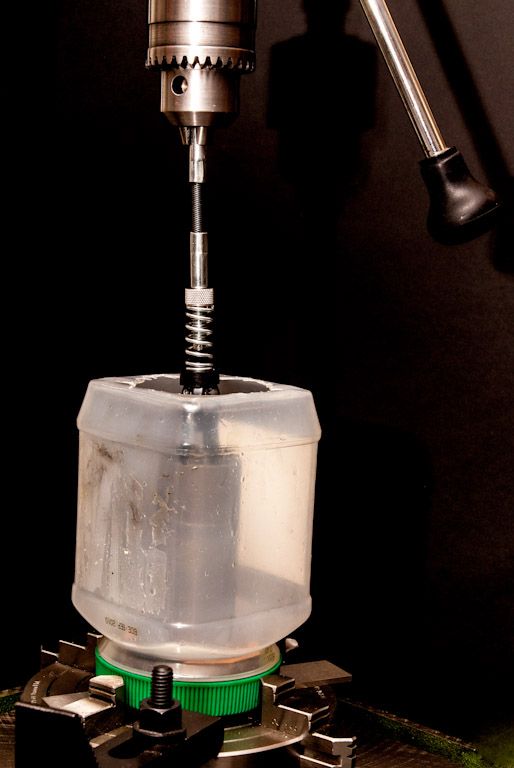
                                      I have used a hone from Polly Model on a hot air engine and, with care ( and patience!), it produced a very nice smooth bore. I mounted the cylinder, inside a plastic jar ( to stop spraying honing oil around the workshop!), and set up on my pillar drill. With a slow speed and constant  steady up and down movement a good result was achived. It is important to keep the hone moving and this is easily achived with the drill handle.


                                      Cheers

                                      Norman


                                      Edited By NJH on 03/02/2013 23:46:42

                                      #110908
                                      john kennedy 1
                                      Participant
                                        @johnkennedy1

                                        Why would a boring tool spring out further at one end of the bore to the other,thereby producing a taper ? The overhang of the tool doesn't change. Is the bore bigger or smaller at the beginning of the cylinder. ??

                                        #110909
                                        Michael Gilligan
                                        Participant
                                          @michaelgilligan61133
                                          Posted by john kennedy 1 on 04/02/2013 07:18:59:

                                          Why would a boring tool spring out further at one end of the bore to the other,thereby producing a taper ? The overhang of the tool doesn't change. Is the bore bigger or smaller at the beginning of the cylinder. ??

                                          That, John, is a very good question !

                                          The hole will be bellmouthed rather than truly tapered

                                          … There is a reaonable explanation here

                                          MichaelG.

                                          #110910
                                          IanT
                                          Participant
                                            @iant

                                            I have one of those hones Norman – but not used it just yet. I will certainly use your idea when I do.

                                            Thank you.

                                            Regards,


                                            IanT

                                            PS How are you holding the part? The jaws seem to be clamping the lid.

                                            Edited By IanT on 04/02/2013 09:02:47

                                            #110913
                                            Ady1
                                            Participant
                                              @ady1

                                              Assuming all things being equal I would think that only a between centres boring bar would create a proper straight hole

                                              Especially on a hobby lathe

                                              You can even shove a short workpiece over with your finger pressure when there's a dti on the back

                                              This gets harder, the closer you get to the chuck

                                              #110928
                                              NJH
                                              Participant
                                                @njh

                                                Hi Ian

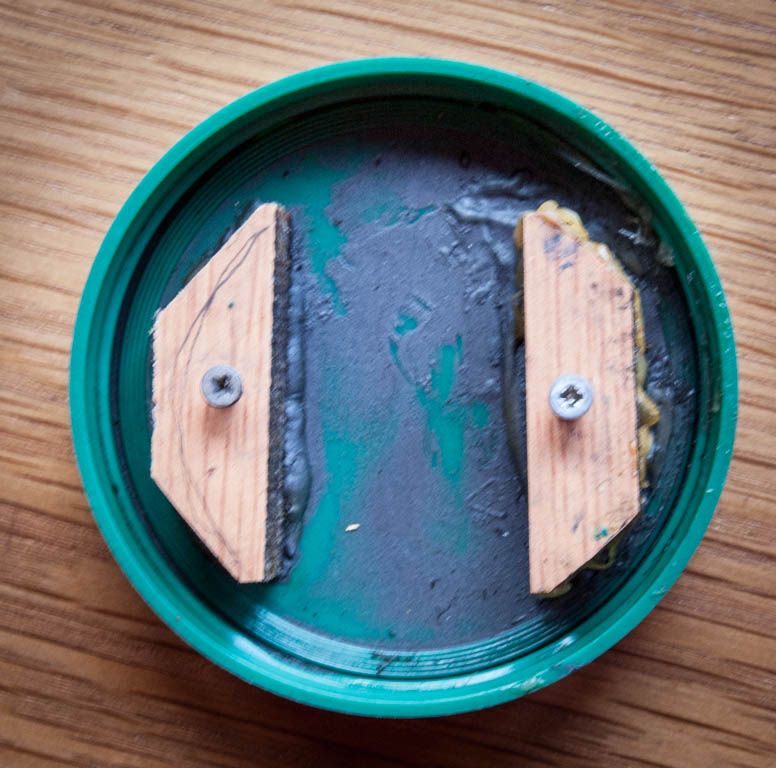
                                                The cylinder had a flange with mounting holes on the bottom. I fixed a couple of wooden blocks with screws and silicon sealant to the inside of the lid and screwed the cylinder to these blocks. I clamped my 4-jaw independant chuck to the drill table then adjusted the jaws to position of the cylinder in it until it was centred beneath the chuck. Popped on the cover with the previously cut hole and inserted the hone such that, with the quill fully retracted, less than 1/2 the length of the hone stones were out of the cylinder. I then lowered the quill such that, again, less than 1/2 the length of the stones were out of the bottom of the cylinder and then set the depth stop. Added honeing oil from squeezy bottle with fine spout and set drill running. Fairly slowly and steadily wound the hone up and down the bore adding more oil from time to time. I found it helped to count steadily to keep a steady rate of movement – an appropriate piece of music would be better! It does take qiute a time and is pretty tedious but you can always stop for a cuppa or indeed leave and continue another day! As said before a nice smooth bore results.

                                                Here is a pic of the inside of the lid.

                                                Base

                                                Good Luck !

                                                Norman

                                                #110929
                                                Trevor Wright
                                                Participant
                                                  @trevorwright62541

                                                  No matter how rigid a machine tool or boring bar is there will always be some form of spring and retracting the tool will always cut metal.

                                                  Even on industrial machines if a tight tolerance was required I would always cut to within 0.1mm of size, 2 spring cuts, measure then take the finish cut…….and probably another spring cut to finally hit the required size.

                                                  Using the spring to take a back-cut will usually leave a better finish as you are cutting with an edge of the tool that is still sharp, and is less likely to chatter as the tool is being pulled rather than pushed.

                                                  Trev

                                                  #110930
                                                  Joseph Ramon
                                                  Participant
                                                    @josephramon28170

                                                    The thing with a back cut is to remember to take it under self-act. All to easy to run back by hand far to fast and leave a 'spiral scratch'

                                                    Joey

                                                    #110939
                                                    john kennedy 1
                                                    Participant
                                                      @johnkennedy1

                                                      Thank you for that link Michael .. So a taper or bellmouth is down to the condition/allignment of the lathe and nothing to do with the tool springing.

                                                    Viewing 25 posts - 1 through 25 (of 29 total)
                                                    • Please log in to reply to this topic. Registering is free and easy using the links on the menu at the top of this page.

                                                    Latest Replies

                                                    Home Forums Beginners questions Topics

                                                    Viewing 25 topics - 1 through 25 (of 25 total)
                                                    Viewing 25 topics - 1 through 25 (of 25 total)

                                                    View full reply list.