Tapers

Tapers

Home Forums Beginners questions Tapers

Viewing 25 posts - 1 through 25 (of 35 total)
  • Author
    Posts
  • #160383
    Jack Foreman 1
    Participant
      @jackforeman1

      A very simple question with, I trust, a very simple answer. However ……

      If I wish to turn a taper of a given length (x) and a given magnitude (y) the trigonometry is very simple. But how do I translate the minutes and seconds divisions using the angles on the compound slide, which has only degree divisions?

      Am I missing the obvious? Or am I going about the exercise in the wrong way?

      Jack

      #7265
      Jack Foreman 1
      Participant
        @jackforeman1
        #160385
        Michael Gilligan
        Participant
          @michaelgilligan61133

          Jack,

          I'm afraid the degree divisions are only for very rough setting.

          To set a precise angle, you will need to adopt some approximation of a Sine Bar.

          … either that, or cut, try & adjust [loop until you cannot take any more]

          MichaelG.

          .

          Have a look at Post #19 here

          Edited By Michael Gilligan on 10/08/2014 17:25:08

          #160388
          frank brown
          Participant
            @frankbrown22225

            Put a bar in the lathe from centre to centre. With the lead screw mark of a pair of decently marked lines on it (4" ? = 16 turns on a 1/4" pitch lead screw). Move your compound roughly set to the angle so the tool touches one mark, wind compound back and measure the gap between the tool and the second mark. So now you know the length and the offset distance, so you can check if the angle is correct, adjust and repeat measurement.

            Frank

            #160391
            Jack Foreman 1
            Participant
              @jackforeman1

              Ah. So it is a trial and error means of attaining accuracy. Thank you Frank.
              Stay with the given x & y dimensions [or factors of them] and forget the minutes and seconds. That makes sense. Much appreciated.
              yes

              #160392
              Roderick Jenkins
              Participant
                @roderickjenkins93242

                My method is to use a plunger type dti in the toolpost to measure the Y and the dial on the top slide to measure the hypotenuse.

                HTH

                Rod

                #160393
                Jack Foreman 1
                Participant
                  @jackforeman1

                  I'll design a protractor which will fit onto my cross slide traverse, upon which I will be able to set my x & y dimensions, then rotate the compound slide until it touches the protractor face along its length.
                  Theoretically, that will eradicate the guesswork.

                  Is this concept what you refer to as a sine bar Michael?

                  #160394
                  Max Tolerance
                  Participant
                    @maxtolerance69251

                    Work out the maximum and minimum diameters. Turn a piece of steel between centres with the two diameters at the required distance apart. Put a DTI in the tool post and set your top slide to give the same readings on both diameters.

                    #160395
                    Michael Gilligan
                    Participant
                      @michaelgilligan61133
                      Posted by Jack Foreman 1 on 10/08/2014 18:00:38:

                      Is this concept what you refer to as a sine bar Michael?

                      .

                      Essentially, Yes, Jack

                      …. It's worth reading through the whole of thread that I linked, plus the onward links.

                      MichaelG.

                      #160398
                      Steve Withnell
                      Participant
                        @stevewithnell34426

                        Not sure if this is the correct way of using a sine bar to set up the compound to a precise angle, but it is the way I did it and it did work:

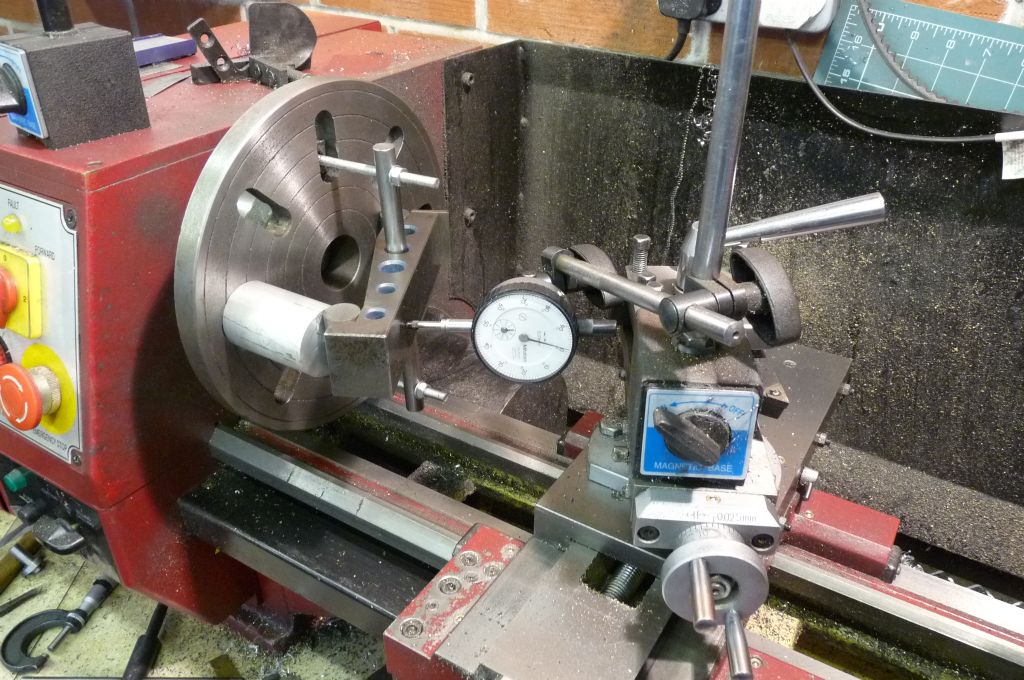
                        p1010305.jpg

                        The aluminium barstock was turned to the precise length for the sine bar to do its job. The clock is being used to set the compound to the same angle as the sine bar.

                        Regards

                        Steve

                        #160399
                        Ian P
                        Participant
                          @ianp

                          There is a very good description of how to create very accurate tapers in the current issue of Model Engineers Workshop (219) as part of how Darren Conway makes his Live Tailstock Spindle.

                          I found that article and Shaun Wainford's (Building a Special) as examples of the best content of MEW. Both are practical examples of how to make things set out in a real world manner. Thanks Neil, roll on more of the same!

                          Ian P

                          #160405
                          Les Jones 1
                          Participant
                            @lesjones1

                            Topslide fine adjustmentHi Jack,
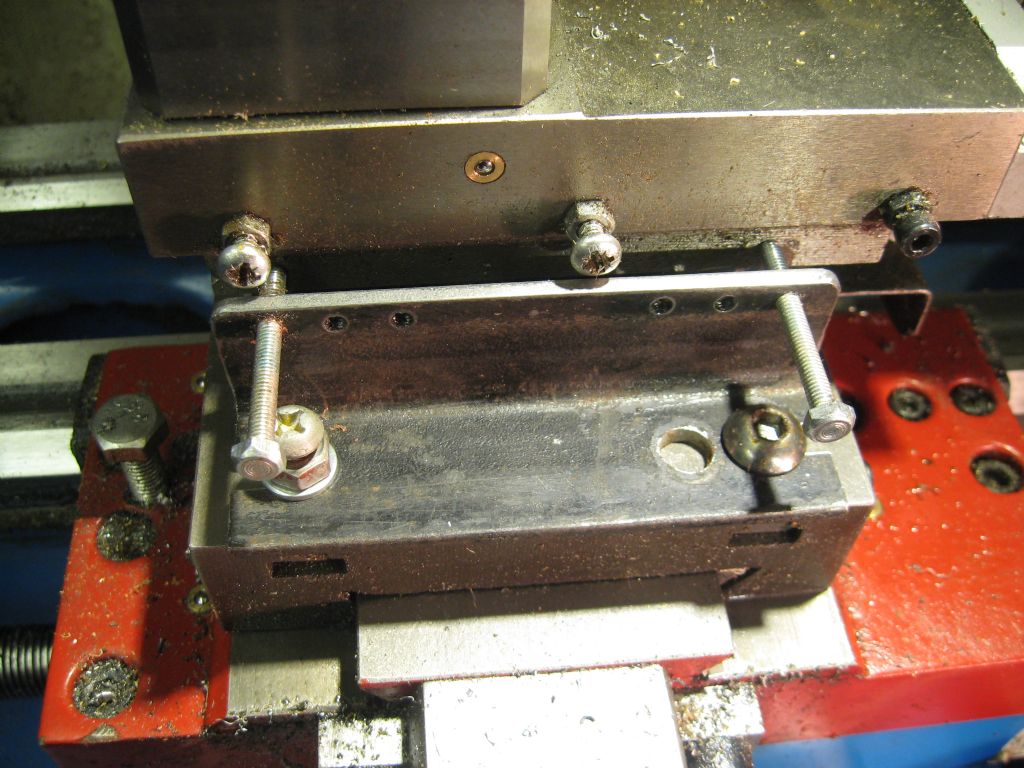
                            It may be worth making a simple tool to make it easier to make fine adjustments to the topslide angle. I made this out of an offcut of angle. You just slacken one of the screws and tighten the other a small amount. It should even be possible to work out how much one turn of the screw will change the angle. I used this to turn a taper to fir a drill chuck. If anyone is interested I have pictures of a novel way I measured the taper in the chuck. I could not get a reliable measurement using a DTI as the taper in the chuck was pitted with rust.

                            Les.

                            Edited By Les Jones 1 on 10/08/2014 20:09:31

                            #160423
                            Nobby
                            Participant
                              @nobby

                              If you have any items in the workshop with the taper required on. fit on lathe between centre.clock along with top slide until Zero then it is set at that angle .
                              Nobby

                              #160428
                              Jack Foreman 1
                              Participant
                                @jackforeman1

                                Thank you each, and all. For your wisdom, and patience
                                I have learned a great deal from your offerings.

                                I have, this evening, subscribed to the ME Workshop mag, having subscribed to the ME mag when I first registered. Hopefully, this will curtail my necessity to ask questions – though almost certainly, not entirely.
                                Both publications will provide some suitable work exercises for me to attempt – to gain practical experience/

                                #160430
                                I.M. OUTAHERE
                                Participant
                                  @i-m-outahere

                                  There is one small problem with using a dial indicator to set the cross slide to an angle like a morse taper and that is the plunger or stylus on the indicator must be precisely on the centre line of the taper you are using as a set up piece.

                                  even a couple of thou off centre will give an incorrect reading and the sharper the taper the worse it will get.

                                  i never payed much attention to this until i watched Tom Lipton on youtube explain the issues , you can check it out at OXTOOLS on youtube and they were only a few weeks back .

                                  Ian.

                                  p.s no connection to Tom just a happy viewer .

                                  #160433
                                  mick
                                  Participant
                                    @mick65121

                                    The sine of any angle is the vertical measurement over an inch, so if your compound has travel of say two inches, multiply the sine by two, zero the bezel and clock the fall over two inches of travel, using a DTI running along a freshly turned diameter, adjust the compound slide until the fall of a given distance equals the value of the sine.

                                    #160437
                                    NJH
                                    Participant
                                      @njh

                                      Oh I do like Michael's comment of:- " cut, try & adjust [loop until you cannot take any more] " !

                                      How many times have I been there in the workshop?!!!!

                                      Norman

                                      #160440
                                      Gordon W
                                      Participant
                                        @gordonw

                                        If you make or buy an elephant foot for the dial gauge getting it at center hight is not quite so important. Elephant foot- a shoe fitted over the end of the plunger, square and about maybe 6mm dia.

                                        #160441
                                        Roderick Jenkins
                                        Participant
                                          @roderickjenkins93242
                                          Posted by XD 351 on 11/08/2014 05:29:52:

                                          There is one small problem with using a dial indicator to set the cross slide to an angle like a morse taper and that is the plunger or stylus on the indicator must be precisely on the centre line of the taper you are using as a set up piece.

                                          even a couple of thou off centre will give an incorrect reading and the sharper the taper the worse it will get.

                                          i never payed much attention to this until i watched Tom Lipton on youtube explain the issues , you can check it out at OXTOOLS on youtube and they were only a few weeks back .

                                          Ian.

                                          p.s no connection to Tom just a happy viewer .

                                          George Thomas did the maths and showed that this is a myth. You can be 10 thou off the vertical and have no measurable error. I don't have access to the reference at the moment but the argument is reproduced in one of his anthology books. I only learned this after I'd made my own elephant's foot!

                                          Cheers

                                          Rod

                                          #160443
                                          Roderick Jenkins
                                          Participant
                                            @roderickjenkins93242

                                            I've found the reference:

                                            Model Engineer's Workshop Manual p 139. He shows that a 30 thou error on height gives an error on diameter of one end of the taper of 0.0005".

                                            Rod

                                            #160447
                                            Nobby
                                            Participant
                                              @nobby

                                              Hi
                                              Here we go . On a CNC lathe the finishing cut would only be a few lines position 1 linear move to position 2
                                              Nobby

                                              #160452
                                              Jack Foreman 1
                                              Participant
                                                @jackforeman1

                                                From a geometric and mathematical perspective, Ian's assertion is true. And becomes increasingly so proportional to the increase of the pitch if the taper. In the same way that a cutter not positioned exactly central on a 4" billet will not be adversely noticeable; whilst the same discrepancy applied to an 1/8" bar will be patently obvious, due to the failure to meet the perpendicular of the tangents at the intersection of the small circumference.
                                                However, I suspect that Rod and John's observations are equally valid The discrepancy will be much less than my present ability to perceive it.

                                                I have spent an enjoyable, educational and interesting morning working through a lot of the advice which so many of you kindly provided. And whilst certainly not in the 'expert' class yet, emotion I do feel that I have a 'competent' grasp of the matter now; including familiarizing myself with the set up for internal tapers. Thus, another part of the learning curve taken on board and available for practical development.

                                                Edited By Jack Foreman 1 on 11/08/2014 16:13:26

                                                #160454
                                                Roderick Jenkins
                                                Participant
                                                  @roderickjenkins93242

                                                  I and, I suspect, John are both fixated on shallow tapers. In my case Morse tapers as I am about to make some short 0MT. For much steeper tapers then the positioning of the DTI with respect to the centre line does become more critical.

                                                  If you are going to make matching internal and external tapers then the actual value will be immaterial since you will, presumably, make both at the same topslide setting. If making a taper to match something else then you will have that as a pattern. However accurately the top slide is set to the required angle, in my experience a little tweaking with the help of some engineers blue is required.

                                                  Rod

                                                  #160472
                                                  I.M. OUTAHERE
                                                  Participant
                                                    @i-m-outahere

                                                    The elephants foot on the indicator will fix the problem as the standard nib has a ball end and you essentially have one radius against another .

                                                    John ,

                                                    my comment was aimed at the layman or novice as they read about how this guy set up an old morse taper in the lathe ran a DTI along it and set his compound so he got a zero reading along the length of the taper then machined the new taper that was perfect .

                                                    in reality this rarely happens and they wonder why they can't get the set up right and the indicator set up is one of the reasons they fail .

                                                    How many machinist double check their setup after tightening down the compound slide nuts ? This can make the slide walk around a little on some lathes and all of a sudden without knowing it you're out of kilter !

                                                    I have seen some use a 123 block clamped to the side of the compound slide and the whole lot jiggled into position against the side of a morse taper held between centres to set the compound angle you would be surprised how close it got to spot on but i suppose it depends on how accurately the side of the compound slide is machined to the dovetails .

                                                    there's more than one way to skin a cat. The hard bit is catching the buggers !

                                                    #160490
                                                    Chris Denton
                                                    Participant
                                                      @chrisdenton53037
                                                    Viewing 25 posts - 1 through 25 (of 35 total)
                                                    • Please log in to reply to this topic. Registering is free and easy using the links on the menu at the top of this page.

                                                    Latest Replies

                                                    Home Forums Beginners questions Topics

                                                    Viewing 25 topics - 1 through 25 (of 25 total)
                                                    Viewing 25 topics - 1 through 25 (of 25 total)

                                                    View full reply list.