Taper turning

Taper turning

Viewing 19 posts - 1 through 19 (of 19 total)
  • Author
    Posts
  • #33739
    john fletcher 1
    Participant
      @johnfletcher1
      #510674
      john fletcher 1
      Participant
        @johnfletcher1

        Maybe, a year or two ago there was an article in MEW on making a taper turning attachment, for I think, a Myford lathe. Can any one tell me which MEW number it was, or am I dreaming. John

        #510681
        Ady1
        Participant
          @ady1

          I tried scribing a line on my cross slide with an engraver, for lining up my Drummond M topslide

          Didn't think it would work but it's been great for MT1 stuff

          Externals need a polish up with some metal sandpaper and internals need a reamer to finish

          Also done "extra big one off" jobs for when a bit more meat is better, just use a digital vernier and watch your width at the mouth of the taper

          So everything I have is an MT1 taper but some are fatter

          Edited By Ady1 on 29/11/2020 18:33:51

          #510690
          Sam Stones
          Participant
            @samstones42903

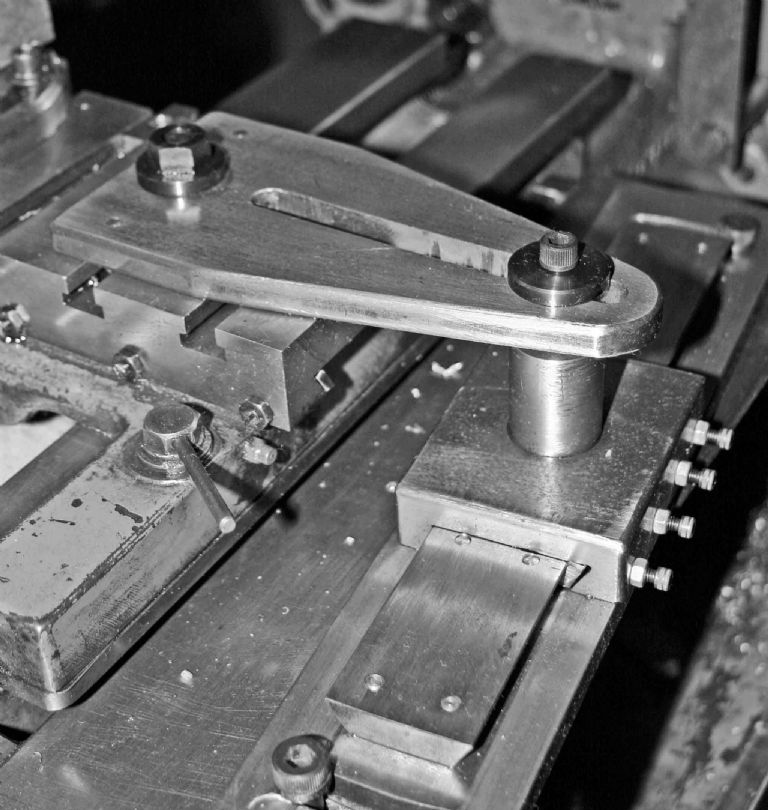
            Not much direct help John, but this home-made taper turning attachment came with my second hand lathe back in the 60's.

            A taper-turning attachment

            The original owner had used a piece of angle iron to bolt to the four 1/4" BSF screw holes in the back face of the ML7.

            Although I only used it once to its full extent for machining some stainless steel coffee table legs, I adapted it as a cam system while machining (and grooving) a brass fusee for my (John Stevens) skeleton clock.

            Regards,

            Sam

            #510700
            Martin Kyte
            Participant
              @martinkyte99762

              Maybe consider the use of linear rail bearings as per CNC practice instead of the dovetail slide ?

              regards Martin

              #510706
              David Davies 8
              Participant
                @daviddavies8

                John

                there were two articles in MEW a couple of years ago by Alan Hearsum about making a TTA for his Drummond lathe. This was based on the Myford design.

                I have the issue numbers but not to hand at the moment. Will post details tomorrow.

                Chris Heapy also described a Myford TTA many years ago.

                Cheers

                Dave

                PS:- issues 233 & 234 Autumn 2015

                Edited By David Davies 8 on 29/11/2020 19:57:24

                #510728
                old mart
                Participant
                  @oldmart

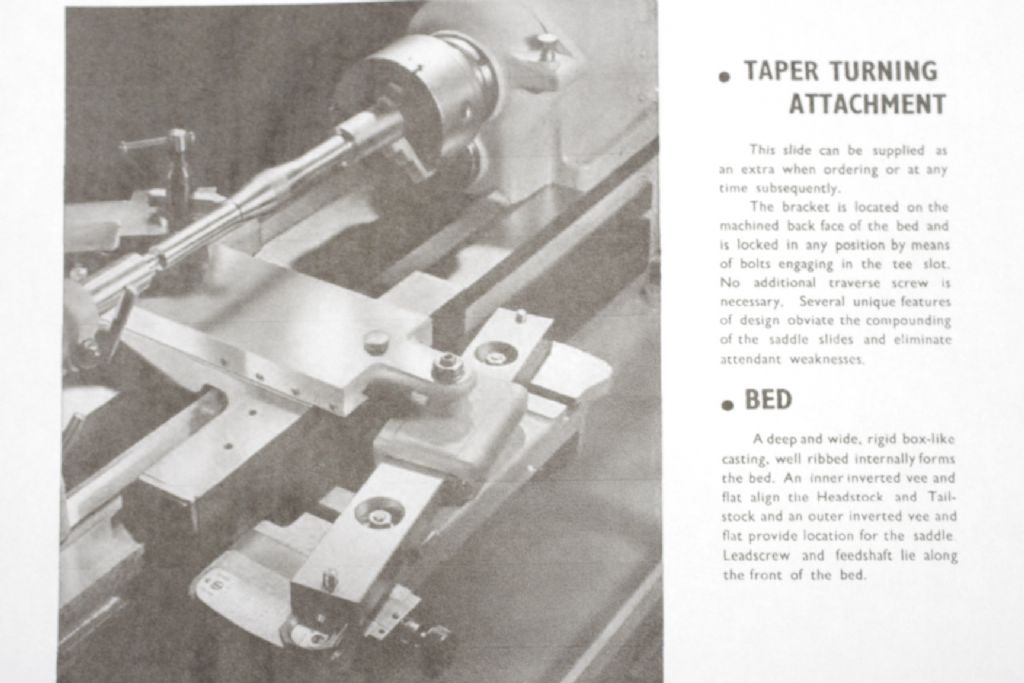
                  You could make the slide without the dovetails and just have square sides, I would think a milling parallel could be made to work if it was near enough the right size. Smart & Brown use a square sided slide rail with square sides, the sliding part can have square gibs to match. This poor photo shows the basic workings of the S&B model A taper turning attachment, possibly making an R8 arbor. Notice that the rail pivots at its centre.

                  Edited By old mart on 29/11/2020 21:16:21

                  #510732
                  old mart
                  Participant
                    @oldmart

                    My "camera" icon on the website is not working in my previous post as it is overlaid by the word "railways. This is why I have had to add a new post for the picture.

                    _igp2693.jpg

                    #510738
                    peak4
                    Participant
                      @peak4

                      It might be worth checking out this page for an index

                      I did a quick search and there are several taper turning articles, but the only construction ones I noticed at first glance were for Toyo, a mini lathe and a Myford 254.

                      Bill

                      #510761
                      Clive Foster
                      Participant
                        @clivefoster55965

                        As old mart says, if you are going to make one do not use dovetails.

                        A bad design concept at the best of times in this application and very demanding on alignment relative to both bed and cross-slide.

                        For perfect operation the dovetail way has to be parallel and perpendicular as appropriate to both lathe bed and cross-slide. On an affordable, lighter lathe, there is no guarantee the alignments are sufficiently good for the attachment to work properly unless the gibs are loose. Especially on an older machine with some wear or one not originally made to be capable of taking a taper turning attachment.

                        Systems using a square rail with a saddle riding on it or open topped trough with a shoe inside are free to self adjust vertically if mounted with an up hill or down hill error in relation to the bed saddel guides. Similarly the fixing pillar can be modified to accommodate any errors of cross slide alignment.

                        Ideally there won't be any errors but getting to within 10 thou or a degree or so its much much easier than getting the dead nuts right alignment needed to run a gibbed dovetail correctly set for free, shakeless movement.

                        When setting up to turn a taper its far easier to work in slope, thous per inch or whatever, than angular degrees. DRO systems and a dial gauge make this really easy. A couple of bed stops and a decently long length bar to define the travel works well enough. For imperial folks a 6" bar makes calculations easy.

                        Morse tapers are around 5/8" per foot, 50 thou per inch so getting real close with a 6" test length isn't hard. About 1.49° not so much. The old guys used inches per foot for a reason.

                        If you have nothing else a pair of toolmakers clamps gripping the edge of the bed will do for stops. But be gentle.

                        If you don't have a suitable dial guage fit a "bumper" in the tool post and use the cross slide dial to measure the offset at each end of the bar relative to a parallel test piece held true to the bed. Ideally between centres but holding in the chuck and turning in situ with the free end supported by a tailstock centre does well enough. Bumper needs a nicely curved end so t always contacts in the middle. A slim dowel pin driven vertically through a square bar with enough filed out of the middle so only the pin touches the test bar will do.

                        Clive

                        #510764
                        Alan Johnson 7
                        Participant
                          @alanjohnson7

                          I saw this taper turning attachment project for a mini lathe here:

                          https://www.gadgetbuilder.com/Taper.html

                          I never built it – so many projects – so little time!

                          No doubt the design could be adapted to other lathes.

                          #510794
                          john fletcher 1
                          Participant
                            @johnfletcher1

                            Many thank to all who have responded to my request. I now have plenty of sound ideas to go on. Keep safe, John

                            #510813
                            Oily Rag
                            Participant
                              @oilyrag

                              The Raglan Little John system uses two 7/8" bars – the lower one being the parallel support bar for the guide off the rear of the saddle at one end and the other the register from the shears clamped at the tailstock end. The upper control bar is angled as required and controls the movement of the de-coupled cross slide. A simple but efficient system. I took the opportunity to not only scribe angles but also put some pre-set pin registers into the swivel head to pick up MT1, 2, 3 and 4 tapers along with some other more esoteric tapers such as B&S for rotary table, and dividing head tapers. The biggest 'problem' I had was machining the 14 3/4" radius for the swivel head castings to match. But achieved it using a 6" rotary table and a fixed table pivot.

                              I made mine from original unmachined castings purchased from Myfords many years ago when they were having a clear-out of their Raglan spares. I had enough castings for about 4 sets. I can take and post some pictures if you are interested.

                              Martin

                              #510869
                              old mart
                              Participant
                                @oldmart

                                A point to factor in when thinking of designing a taper turning attachment, is the need to move the whole attachment axially along the lathe. This is easy with a lathe such as the Smart & Brown model A and the 1024 models. They have a tee slot running the whole length of the rear of the bed which the taper turning attachment can be set at the optimum distance from the end of the spindle. Not being able to move would severly limit the versatility of the attachment.

                                #510871
                                ega
                                Participant
                                  @ega
                                  Posted by old mart on 30/11/2020 15:49:36:

                                  A point to factor in when thinking of designing a taper turning attachment, is the need to move the whole attachment axially along the lathe. This is easy with a lathe such as the Smart & Brown model A and the 1024 models. They have a tee slot running the whole length of the rear of the bed which the taper turning attachment can be set at the optimum distance from the end of the spindle. Not being able to move would severly limit the versatility of the attachment.

                                  I recall that GHT said he would be unlikely to want to move his Myford TTA from its position and that he made a cover to protect it from chips so that it could remain there semi-permanently.

                                  #510882
                                  Martin Dowing
                                  Participant
                                    @martindowing58466

                                    For my ML7 I have bought original one from Myford on ebay and it works.

                                    Several years ago have paid 300 queeds, so not too bad but not cheap either.

                                    Second hand one is very good, because these are hardly ever used.

                                    The only real use where it is irreplaceable is making accurate internal tapers.

                                    Otherwise it is best to buy or make "tailstock set over attachement" or use boring head mounted in tailstock instead.

                                    I assume one hates meddling with setting over tailstock itself due to hussles with re-allignement for parallel turning.

                                    #510887
                                    Martin Dowing
                                    Participant
                                      @martindowing58466
                                      Posted by ega on 30/11/2020 15:55:1

                                      I recall that GHT said he would be unlikely to want to move his Myford TTA from its position and that he made a cover to protect it from chips so that it could remain there semi-permanently.

                                      My is fitted permanently.

                                      I did not find falling chips harming it at all and it helps to place clock used for example in alligning work in 4 jaw.

                                      Once oiled it will not rust either, albeit my machine is in nice, warm garage and nothing rusts there.

                                      All what I need for taper turning is to remove feedsrew from crosslide and then connect attachement with crosslide.

                                      #510893
                                      old mart
                                      Participant
                                        @oldmart

                                        If you look at my picture of the attachment on a S&B Model A, you will see that any taper turning close to the chuck, or in a collet would not be within reach of the toolpost. That is why some latitude in positioning is necessary.

                                        #510906
                                        Clive Foster
                                        Participant
                                          @clivefoster55965

                                          On "professional" machines typical taper turning attachment travel seems to be of the order of half the between centres distance or a little more. So its likely to be a fairly exotic job that demands it be moved from a generally satisfactory position. Such issues are most likely, for our classes of work at least, when its needful to accommodate both chuck held and collet held work. Chuck thickness being probably around 1/4 of the taper turner travel so proper allowance is needed.

                                          Were I to set up a taper turning attachment on either a lathe not designed to take one or a lathe whose factory attachment price significantly exceeds the depth of my pocket I would begin by fixing a stout, fiarly wide, L bracket along the whole length of the bed. Easily accessible vertical bolts would be used to fix the taper turning attachment to the bracket. Bolts in a Tee slot at the back of the bed are pretty effective but not easy to get at. Takes a fair push to move the attachment too.

                                          If fitting an L bracket its sensible to make it wide enough to carry a DRO scale. Odds are the job would stall out once the DRO scale was done. Serious consideration should be given to maximum simplicity for the taper turning attachment so it can quickly be made useable when the need arises. For the amount of use its likely to see a simple rectangular bar guide set in one of a selection of pivot holes spaced along the bracket with simple clamp on pusher scres for adjustment will most probably suffice. Ball bearings on eccentric pivots, bandsaw blade guide style would be simpler than gibs but potentially wide so a T section rather than rectangular bar would be preferable.

                                          Clivl

                                        Viewing 19 posts - 1 through 19 (of 19 total)
                                        • Please log in to reply to this topic. Registering is free and easy using the links on the menu at the top of this page.

                                        Latest Replies

                                        Viewing 25 topics - 1 through 25 (of 25 total)
                                        Viewing 25 topics - 1 through 25 (of 25 total)

                                        View full reply list.