Fuelling a Boiler using Electricity

Fuelling a Boiler using Electricity

Home Forums General Questions Fuelling a Boiler using Electricity

Viewing 25 posts - 1 through 25 (of 38 total)
  • Author
    Posts
  • #25888
    Graeme Parker
    Participant
      @graemeparker37577
      #346691
      Graeme Parker
      Participant
        @graemeparker37577

        Hi

        Here's my 1st question and I hope it's not too daft.

        I have an old DYAK (2 1/2" 2-6-0) loco that has working valve gear but needs a lot of work on the boiler. Actually, it probably needs a new boiler as the current one requires so many stays (as per the plans) that look impossible to add as the boiler is virtually finished.

        So it got me thinking. I know you can fire a boiler using gas rather than coal; which must be far cleaner, but that's not a discussion for here.

        But can you "fire" a boiler using an electrical heating element run from lead-acid batteries?

        I've done a quick Google and the energy in coal would be about 1MJ for 100g (I could be wrong here). That's about 240W/hr. So using a electrical heating element would need 10Amps at 24V for an hour of use – am I right? Oh, I don't know how much coal is needed to keep steam up in this gauge either, 100g was a guess as to what the firebox would hold.

        That's a lot of energy for an hour, but if running time was reduced and steaming up time was provided from mains power, is it possible?

        This would mean that my new boiler could just be a straight cylinder with the firebox just for show. No flue pipes, just some longitudinal stays, water gauge, pressure gauge, regulator, no blower – seems simpler.

        Yes I know it's not in the true spirit of live steam, but it should be quicker to produce such a boiler, and when time permits, I can get a proper one made.

        What do you knowledgeable folk think?

        #346716
        Anonymous

          I'm afraid you're not even in the right ball park.

          What you need to do is calculate the steam consumption and then work out the energy needed to produce that steam. At least for an electrically heated boiler, most of the electrical energy in goes into the water, unlike coal or gas where a good proportion goes up the chimney.

          Have a look at the first post in this thread to get an idea of the calculations:

          **LINK**

          Andrew

          #346719
          Trevor Crossman 1
          Participant
            @trevorcrossman1

            I know nothing about the energy requirements of a model live steam engine, but your thought of using lead acid cells to provide 10 amps at 24 volts and discharging at the 10hr rate would mean a rather large battery pack to squirrel away behind a 2 1/2" locomotive, well judging by the one's that I have seen. I would suggest that LiPo cells are a much more practical idea at this scale, that is, if electrically raised steam is a practical proposition. For 24v you would require a 6S pack of suitable capacity, but rather than building a tubular boiler, would it not be better to construct a flash steam generator to minimize the stored energy? An interesting project no less.

            Trevor

            #346721
            Carl Wilson 4
            Participant
              @carlwilson4

              Reminds me of a conversation I had with my brother about power plants for model boats.

              The conclusion we inevitably came to led to us researching (for purely academic purposes, you’ll be glad to hear) just how small you could build a working nuclear reactor.

              #346723
              Graeme Parker
              Participant
                @graemeparker37577

                Andrew: So that link gives a result of about 2 pints per minute of water for a cylinder diameter is 2", stroke is 3.75".

                Now my cylinder I think is only 1" and the stroke is also half the above, so the volume required must be 1/8th. The water capacity of my tender is about 2 pints, so that means I can run for only 8 minutes. I'll re-check those numbers, but it doesn't sound very long.

                Trevor: A flash steam generator you say. Thanks, let me Google that.

                Carl: If certain substances are so easy to get hold of from Russia, then maybe a little uranium or plutonium is not out of the question. Can YOU Google that for me

                #346724
                Carl Wilson 4
                Participant
                  @carlwilson4

                  I think in the current climate that I’d better not.

                  There was a story from the US many years ago about a young man who distilled some isotope or other from gallons of glow in the dark paint.

                  The story was called the Radioactive Boy Scout or similar. He understandably caught the attention of the authorities.

                  #346731
                  roy entwistle
                  Participant
                    @royentwistle24699

                    Graeme How many cylinders do you have ? If two then only a 4 minute run

                    Roy smiley

                    #346732
                    john fletcher 1
                    Participant
                      @johnfletcher1

                      At Doncaster show last year was an electrically heated water / steam powered railway system working up stairs. Perhaps it might be there again this year. I think it was picking up electric power via the track and if I remember correct, the owner told the audience that he made every thing including the immersion heater and at one time a well known train set company did market a few sets then lost interest, as they do, So might be possible. John

                      #346733
                      Maurice Cox 1
                      Participant
                        @mauricecox1

                        This thread reminds me of an idea I heard of many years ago. At the time I did some work for Mamod when they were based in Slough. The chap in charge of the model workshop was toying with the idea of "firing" the stationary engines electrically, using Diesel engine warming plugs as heating elements! I don't know if he ever tried it.

                        #346735
                        Graeme Parker
                        Participant
                          @graemeparker37577

                          Roy: Yes, 2 cylinders. So you're right, even less time running and more water stops.

                          Perhaps you can condense the exhaust steam back into the tender.

                          John: Picking up power from the track is cheating Hornby used to make OO gauge live steam engines for about £500. I saw a Youtube video which indicated that the steam pressure was up to 30 psi.

                          I'm not giving up with my (potentially) crazy plan yet.

                          #346745
                          Trevor Crossman 1
                          Participant
                            @trevorcrossman1

                            Yes Maurice, diesel induction manifold heater plugs work well as mini immersion heaters, though I used them for heating oil rather than spraying/dripping water on them in a closed volume to generate steam under pressure, but they should be okay as they get pretty arduous use in old tractor manifolds, especially in winter cranking up worn out engines. Some info here Graeme

                            https://www.picoauto.com/library/automotive-guided-tests/glow-plugs/#agt3

                            Trevor.

                            #346762
                            Muzzer
                            Participant
                              @muzzer

                              This is a good illustration of the relative energy densities of chemical vs electrical. There are about 2 orders of magnitude between coal and lead acid batteries. Even modern Li-Ion batteries are over one order of magnitude behind. This is why EVs are such a challenge to get right. And why snake oil salesmen claiming "breakthrough" battery technologies tend to be spouting BS.

                              Murray

                              #346768
                              Jon Cameron
                              Participant
                                @joncameron26580

                                Electricity to generate steam is not a new concept, the issue as already been mentioned to shoehorn some battery packs into the loco or tender, you will still require the tender for water but I think that the flash steam boiler may be the better way to proceed. It has been used in model boats before and releases a huge amount of power.

                                On the other end of the scale wasn't there a steam turbine loco trialed by one of the big four? Unfortunately this was a bit of a flop, but on a smaller scale, combined with the flash boiler and electric power could be an interesting model engineering concept. (Though the more learned amongst you all will no doubt rubbish thia idea for the same reason as the full scale turbine engine was a flop. Electrically generated steam turbine loco……. will be interested to see what if anything comes of this conversion discussed. Unfortunately the engineers of the hayday of steam had years to perfect the design, from the Rocket to engines like Mallard and everything in between, even fireless steam engines. All proving more efficient in their steam making capabilities.

                                Good luck and I'll be reading replies to this thread.

                                #346773
                                Anonymous

                                  Graeme: You are correct that your swept volume is 1/8 of mine. However, you need to double it if your cylinders are double acting, and double again for the two cylinders. Bear in mind the calculation is worst case; it assumes full pressure steam admission over the whole of the stroke.

                                  Sadly you cannot extrapolate to get water volume from my figures for your reduced volume, unless you happen to be working at 170psig. If we assume you're working at a different pressure then you need to do the full calculation. Having got the swept volume you need to use steam tables to find the specific volume of steam at the pressure you are using. Then, with a figure for rpm, you can calculate volume, and hence weight, of steam per minute. Which is equal to the weight of water used per minute. I expect you'll get rather longer operating than your figures suggest.

                                  You will also need some sort of control for the heaters. On the design I formulated the heaters were powered by mains voltage. So I simply bought a PID temperature controller, thermocouple and solid state relay via Fleabay. For a DC application a simple PWM controller would be fine. You don't need a fast response. The time constant from heater to change in water temperature is going to be pretty slow and there is no point in "controlling" the system faster than it can respond.

                                  Andrew

                                  #346777
                                  duncan webster 1
                                  Participant
                                    @duncanwebster1
                                    Posted by Jon Cameron on 19/03/2018 21:54:28:

                                    On the other end of the scale wasn't there a steam turbine loco trialed by one of the big four? Unfortunately this was a bit of a flop,

                                    LMSR Turbomotive was anything but a flop, it was a success, but didn't fit in with the policy of the BR standard designs. It was converted to conventional when the turbines wore out.

                                    on the subject of electric heated boilers, A medium size 5"g loco might have a 17 sq.in grate and would develop about 16kW heat input (35lbsof coal/sqft/hr). The efficiency is about 70% so for electric heating you'd need 11kW. A Dyak is a lot smaller, say 3kW, but still a lot of battery power. If you wanted to run for 1/2 hour with 12v battery you'd need 125Ah of battery, which is a lot

                                    #346778
                                    Jon Cameron
                                    Participant
                                      @joncameron26580
                                      Posted by duncan webster on 19/03/2018 23:30:47:

                                      Posted by Jon Cameron on 19/03/2018 21:54:28:

                                      On the other end of the scale wasn't there a steam turbine loco trialed by one of the big four? Unfortunately this was a bit of a flop,

                                      LMSR Turbomotive was anything but a flop, it was a success, but didn't fit in with the policy of the BR standard designs. It was converted to conventional when the turbines wore out.

                                      I had read somewhere that it used more coal and water than a conventional steam loco, and was only efficient when at full speed. It had ran for a short while but was converted to a conventional loco after a short spell, (say a year or two). I may be way far of the mark and if I am I apologise, as I said it was something I had read some 5years ago somewhere and I didn't do much more research on the subject.

                                      Anyhow not to divert too much, will go do a bit more reading on it.

                                      #346784
                                      Brian G
                                      Participant
                                        @briang

                                        The electrically heated locomotives used in Switzerland could operate for a limited time as fireless locomotives on non-electrified tracks leaving me to wonder whether it might be possible to use the boiler for energy storage instead of batteries. I wonder what the running time would be for a small-scale fireless locomotive where the water is heated electrically whilst stationary rather than fed in from a separate boiler?

                                        Without the need for a blastpipe the boiler (or accumulator) could be extended to the front of the smokebox, increasing its storage capacity. Power and water would come from a trackside plant (at its simplest a power supply, a tank and a hand pump) which could be mains, battery or generator powered, so there would be no need for the locomotive to have a tender, injectors, gauge glass or even an on board feed pump. A suitable heating element would be required, either one that could withstand the pressure, or less efficiently a heating ribbon between the boiler and its insulating jacket, which would simplify the boiler construction and perhaps make it easier to achieve the higher pressure necessary to maximise energy storage.

                                        Brian

                                        #346786
                                        Carl Wilson 4
                                        Participant
                                          @carlwilson4

                                          Alternatively one could use the electricity to drive an electric motor which would be coupled to the wheels through suitable gearing.

                                          I don’t mean to be sarcastic. Just playing devil’s advocate!

                                          #346788
                                          Journeyman
                                          Participant
                                            @journeyman
                                            Posted by Brian G on 20/03/2018 09:15:28:

                                            Without the need for a blastpipe the boiler (or accumulator) could be extended to the front of the smokebox, increasing its storage capacity. Power and water would come from a trackside plant (at its simplest a power supply, a tank and a hand pump) which could be mains, battery or generator powered, so there would be no need for the locomotive to have a tender, injectors, gauge glass or even an on board feed pump…

                                            Brian

                                            Certainly used similar in full size, simply a steam storage vessel which is topped up from the factory steam main. The engine just uses the stored energy, no fire no water just energy storage. I doubt whether this would work on a smaller scale, too many losses and not enough storage.

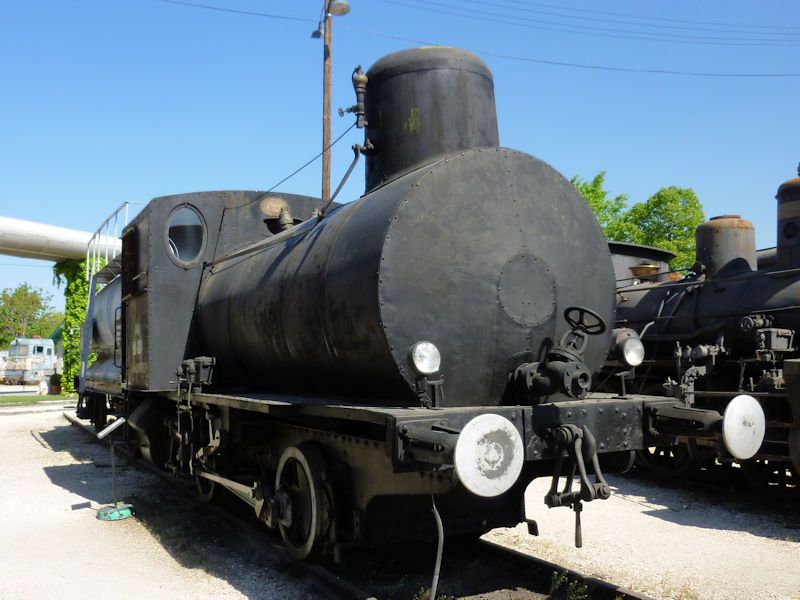
                                            bud91001.jpg

                                            Seen in the Budapest Railway History Museum ( Magyar Vasúttörténeti Park ) a couple of years ago this fireless 0-4-0 tank loco 91,001 (UIC B-f2t) is definitely different. Technically it probably isn’t a tank engine as it has no tank or firebox, just a large steam receiver. Designed for working in hazardous environments, the receiver was just filled from the factory steam main as required. Built by Lokomotivfabrik Krauss & Co. of Linz am Donau, Austria in 1915.

                                            John

                                            Edit: Typo

                                            Edited By Journeyman on 20/03/2018 09:44:08

                                            #346789
                                            Carl Wilson 4
                                            Participant
                                              @carlwilson4

                                              I saw a video of one of those in a chemical works in the 70s, think it was Runcorn. The tank was filled with steam from an external source.

                                              #346792
                                              Jon Gibbs
                                              Participant
                                                @jongibbs59756

                                                Instead of going all-out electric which would, let's face it, be the most efficient – How about running a 12V compressor and use the boiler as a compressed air tank?


                                                Edited By Jon Gibbs on 20/03/2018 09:57:47

                                                #346795
                                                SillyOldDuffer
                                                Moderator
                                                  @sillyoldduffer
                                                  Posted by duncan webster on 19/03/2018 23:30:47:

                                                  on the subject of electric heated boilers, A medium size 5"g loco might have a 17 sq.in grate and would develop about 16kW heat input (35lbsof coal/sqft/hr). The efficiency is about 70% so for electric heating you'd need 11kW. A Dyak is a lot smaller, say 3kW, but still a lot of battery power. If you wanted to run for 1/2 hour with 12v battery you'd need 125Ah of battery, which is a lot

                                                  Nice to see figures quoted but they have me thinking heresy! Converting electricity into heat to make steam to drive an engine isn't an efficient way to turn chemical energy into motion. It combines the inefficiency of a steam engine with the inefficiencies of battery power. Yuk. As Duncan's figures show, it could be made to work, but only at a hefty disadvantage. You would need a special reason for doing it that way.

                                                  My heretical alternative is to use the batteries in a fake electrically powered tender. Electric motors are massively more efficient than small reciprocating steam engines which would offset the shortcomings of the battery. My 'steam engine', also a fake, would be fitted with a small coal fire and low-pressure boiler used only to produce the authentic look, sound, and smell of steam. Actually, in this configuration, the boiler could be a mere kettle, not pressured at all. On the track the 'engine' is pushed by the electric tender which provides all the motive power. In doing so modified motion work would pump good looking wet-steam out of the boiler and up the chimney.

                                                  An electric "steam engine" of this type might be useful on a club track giving rides to the public because steam is far sexier than IC and electric. Safer and less technically demanding because the boiler isn't a pressure vessel; quick and easy because the engine doesn't have to be fired and controlled by a trained driver, nor does steam have to be raised before the engine starts work. Also reliable and low maintenance. Sustained running of the 'steam engine' could be managed with a back-up stock of pre-charged batteries or a fleet of electric tenders.

                                                  I expect it's already been done!

                                                  Dave

                                                  #346798
                                                  Carl Wilson 4
                                                  Participant
                                                    @carlwilson4

                                                    My earlier post refers.

                                                    #346801
                                                    Mike Poole
                                                    Participant
                                                      @mikepoole82104

                                                      Superheating the steam would be a bit of a problem but if the engine is not using superheaters then you won't have a problem.

                                                      Mike

                                                    Viewing 25 posts - 1 through 25 (of 38 total)
                                                    • Please log in to reply to this topic. Registering is free and easy using the links on the menu at the top of this page.

                                                    Latest Replies

                                                    Home Forums General Questions Topics

                                                    Viewing 25 topics - 1 through 25 (of 25 total)
                                                    Viewing 25 topics - 1 through 25 (of 25 total)

                                                    View full reply list.