Lathe installation

Lathe installation

Home Forums Beginners questions Lathe installation

Viewing 16 posts - 1 through 16 (of 16 total)
  • Author
    Posts
  • #492405
    Colin Kent 1
    Participant
      @colinkent1

      Hi I require advice on installing a Myford 7 and cabinet on a concrete floor, after levelling do I need to bolt it down or will the weight hold it in place. Thanks Colin

      #10403
      Colin Kent 1
      Participant
        @colinkent1
        #492406
        Grindstone Cowboy
        Participant
          @grindstonecowboy

          I fitted adjustable feet to my cabinet to make levelling that easier (builder's spirit level), then levelled the lathe on the cabinet (engineer's level). And before somebody says lathes don't need to be level, just not twisted, it does make it a lot easier to get in the right ball park.

          The weight should be plenty to hold it in place.

          Rob

          #492408
          Steviegtr
          Participant
            @steviegtr

            Did it come with the cast iron raisers that fit under the lathe bed at each end. If it did they can be used to get exact once the cabinet is levelled. I would fix the cabinet down with rawlbolts or those handy concrete fixers.

            Steve.

            #492418
            Bazyle
            Participant
              @bazyle

              If you screw it down tomorrow you will want it somewhere else. Shouldn't be necessary in an non-earthquake area.

              #492419
              Steviegtr
              Participant
                @steviegtr
                Posted by Bazyle on 25/08/2020 00:25:00:

                If you screw it down tomorrow you will want it somewhere else. Shouldn't be necessary in an non-earthquake area.

                Good point.

                Steve.

                #492425
                peak4
                Participant
                  @peak4

                  In my previous workshop the S7 was bolted down to the floor using Rawl anchors with the threaded stud sticking proud, as I had some in stock.
                  It was a real pain if I needed to move it away from the wall for any reason, so if you're going to bolt it down, I'd make sure you use fixed anchors and loose bolts, so you can unbolt it and slide it out of the way without having to lift the whole cabinet off protruding studs.

                  The new workshop has a Warco 720 (Myford copy) sitting on 4 adjustable levelling feet. The cabinet base is full of chucks, angle plates, magnetic tables etc, and the weight keeps it perfectly stable and seems to dampen vibrations just as well as bolting it down.

                  The old S7 is still on wheels, outboard from the cabinet rather than underneath it, and is also quite stable.

                  Bill

                  #492436
                  Howard Lewis
                  Participant
                    @howardlewis46836

                    However you secure the cabinet, the lathe bed needs to be free from twist.My ML7 was very sensitive about even the torque applied to the holding down nuts!

                    Howard

                    #492441
                    Martin Kyte
                    Participant
                      @martinkyte99762

                      If you are bolting down, I would do all your fine adjustment for turning parallel after.

                      regards Martin

                      #492443
                      Pero
                      Participant
                        @pero

                        Hi Colin

                        My ML7 has been sitting on a wooden bench not bolted to the floor for the last 30 years and is quite stable. My late father's lathe, a slightly heavier machine on a commercial sheet metal cabinet, was initially bolted to the floor and was an absolute pain when it had to be shifted. Subsequently it was left unbolted with no issues.

                        As an aside, my big lathe ( a bit under 2 tonne ) sits on six rubber loaded dampening feet, again not bolted to the floor and again quite stable. These feet ( not an inexpensive item ) are specially designed to reduce noise and vibration – good or me and good for the neighbors. Incidentally, the weight of this beast, distributed over its six feet works out to about 60 lbs per square inch – or about the same as me standing on tip toe on one foot. As the floor is a 125 mm thick reinforced concrete, I don't think there is a great risk of either the lathe or me sinking through!

                        I recommend the fitting of adjustable feet on any work bench, especially those feet with a rubber "sole" which helps iron out vibration. For smaller loads these are quite reasonably priced and, as Rob stated above, is helpful in leveling – both the bench and the lathe.

                        Pero

                        #492453
                        SillyOldDuffer
                        Moderator
                          @sillyoldduffer

                          Don't disagree with the other answers, but there are a couple of factors that might change your mind.

                          First is the stability of the stand. Lathes are notoriously top-heavy and the effect is multiplied if plonked on a stand with a narrow base. Some do. An ML7 completely safe on a typical workbench with wide apart legs becomes dangerous on a narrow steel stand, even if the steel stand is stronger than the workbench.

                          Second is the position of the machine relative to whatever else goes on in the workshop. If a machine on a narrow stand backs on to a wall, the chance of it toppling dangerously is much reduced. The same setup becomes a serious hazard placed in the middle of the floor and there's any chance of them being accidentally bumped, or grabbed on the way down by a tripped operator. More likely on a factory floor with passing trolleys and fork-lifts, but might also happen if a car and home workshop share a double garage, or if people have to squeeze past.

                          In case of doubt, ask 'how easily could I push this over?' If the answer is scary, bolt it down.

                          Dave

                          #492477
                          ega
                          Participant
                            @ega

                            My woodworking bandsaw has a rather narrow base and rather than bolt it down I opted to stay it to the adjoining wall via a simple bracket attached to the top of the machine.

                            I have always thought that the standard Myford stand was too narrow (the industrial one may be better in this regard).

                            #493429
                            Colin Kent 1
                            Participant
                              @colinkent1

                              Thanks all for the advice and the various options, my lathe is mounted on the industrial cabinet and will be against a wall. I will start by levelling the cabinet on pads with the option of using raw bolts if required, this cabinet has the option of fine adjustments to remove any twists in the bed. I am hoping this will work for me, thanks all

                              Colin.

                              #493452
                              Mike Poole
                              Participant
                                @mikepoole82104

                                Mine is on levelling feet and against a wall, the stuff stored in the stand is quite heavy which adds to the stability, the lathe is very top heavy with an empty stand. It will not fall backwards being against a wall but for peace of mind a strap to fix it to the wall would be simple fit to prevent it tipping forward. In normal use it will not fall over but you might be tempted to tilt it forward to access the motor or something at the rear, once it passes the tipping point you will not save it.

                                Mike

                                #493458
                                Niels Abildgaard
                                Participant
                                  @nielsabildgaard33719

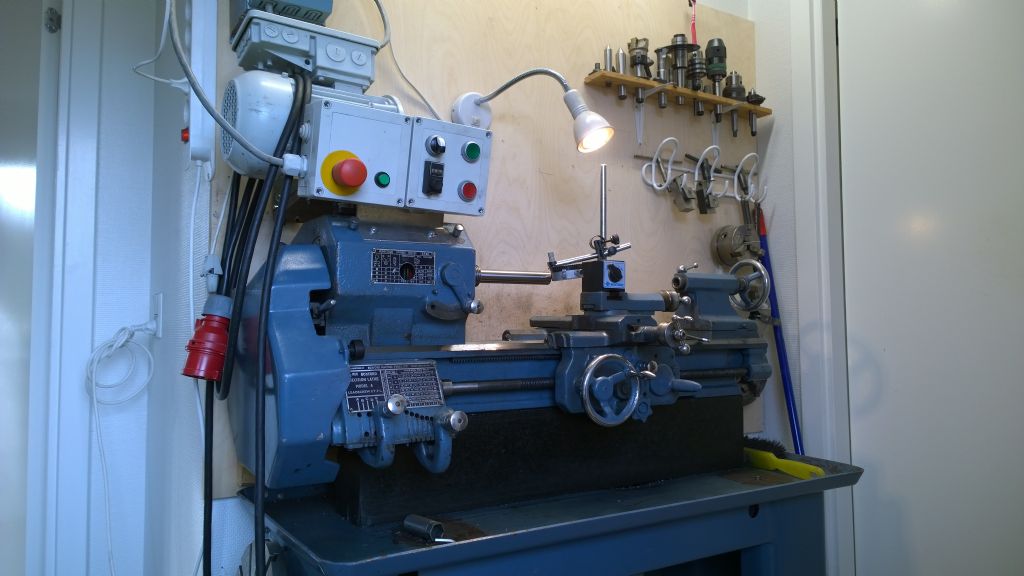
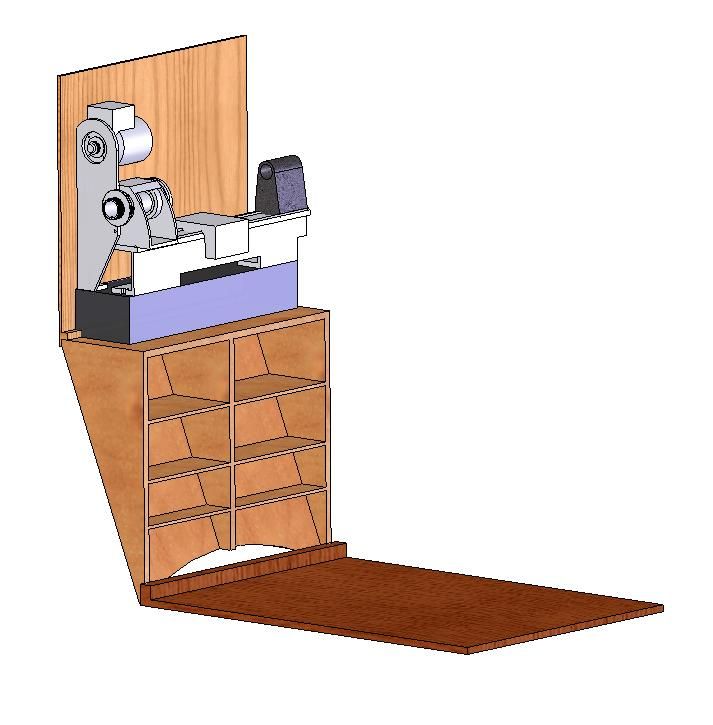
                                  If the wall is real heavy You can improve everything by only fixing the two front lower corners to the concrete floor and fix the two aft tray corners to the wall.

                                  I had my Boxford fixed that way but principle is better illustrated by second picture

                                  RockFord

                                  drejerej jpg.jpg

                                  Edited By Niels Abildgaard on 30/08/2020 18:00:06

                                  #493604
                                  old mart
                                  Participant
                                    @oldmart

                                    I would have some rubber pads under the feet and a safety strap attached to the wall behind. Lathes are top heavy and even a little clip on chain like gas cookers have would make all the difference.

                                  Viewing 16 posts - 1 through 16 (of 16 total)
                                  • Please log in to reply to this topic. Registering is free and easy using the links on the menu at the top of this page.

                                  Latest Replies

                                  Home Forums Beginners questions Topics

                                  Viewing 25 topics - 1 through 25 (of 25 total)
                                  Viewing 25 topics - 1 through 25 (of 25 total)

                                  View full reply list.