How do I ream a 15mm hole on a Unimat 3 ?

How do I ream a 15mm hole on a Unimat 3 ?

Home Forums Beginners questions How do I ream a 15mm hole on a Unimat 3 ?

Viewing 19 posts - 1 through 19 (of 19 total)
  • Author
    Posts
  • #862344
    paul1956
    Participant
      @paul1956

      As first proper project I’ve bought a Beng Danni stationary engine kit.

      From what I read before purchase everything ought to be able to be machined on my Unimat 3. Now the kit has arrived I see that the cylinder will need to be 15mmH7 finished in the brass bar stock.
      I think I can work up through drill sizes with what I have available to ½” (12.7mm) and then use a boring bar to get close to 15mm. That leaves the final reaming, but a 15mm reamer won’t fit in either my chuck or ER16 collet set.
      Do mount a 15mm reamer dialled into a 4 jaw chuck mounted on the tailstock ? Or is there another method that won’t involve great expense ?

      Thanks in advance for any suggestions.

      #862350
      ega
      Participant
        @ega

        Do you really need to ream? A bored hole can be as good as a reamed one.

        #862351
        Dusty
        Participant
          @dusty

          Paul

          Do not use a reamer, the chances are the bore will not be round. Bore to finished size. Your bore will be round and not threepenny bit shaped (slight exagaration) Reamers are sizing tools not boring tools.

          #862358
          JasonB
          Moderator
            @jasonb

            Even if you could hold the reamer chances are it will be too long. But for future reference I used to hold large drills etc in the 3jaw lathe chuck either on the tailstock or milling attachment.

            As others have said if you are set up to bore it out to reaming size you may as well just bore to final size. Use the piston to gauge the fit rather than working to actual measurements.

            #862360
            noel shelley
            Participant
              @noelshelley55608

              Assuming the reamer has a square shank and is centre drilled then using a large tap wrench and align with a tailstock centre ream out as needed. Rotate the work by hand in the chuck.  Noel.

              #862361
              Michael Gilligan
              Participant
                @michaelgilligan61133

                I don’t know the kit, so this may not be practical … But

                The job seems to cry-out for a between centres boring bar, and the component clamped firmly to the cross-slide


                MichaelG.

                #862365
                paul1956
                Participant
                  @paul1956

                  Thanks everyone for such quick helpful replies.

                  Rather nice that you think I should be able to bore to size without reaming. I’ll have to practice that before committing to the kit part.

                  On JasonB Said:

                  Use the piston to gauge the fit rather than working to actual measurements.

                  My reading so far has suggested to do it the other way, get a good parallel cylinder bore then machine the piston to fit. (There’s also enough material supplied to make two pistons, so room for one mistake).

                  #862366
                  ega
                  Participant
                    @ega

                    MichaelG:

                    Agreed, but the method may be more difficult for a beginner – OP says “first project”.

                    #862367
                    JasonB
                    Moderator
                      @jasonb

                      I did not know what material they supply for the piston. if it is nomimal 15mm stock then you would have to live with that.


                      But yes generally it is better to do a hole first as it is harder to adjust than an external diameter.

                      Tailstock ctr and a spanner won’t work on a U3, as I said there is not enough bed length on a little U3

                      #862368
                      paul1956
                      Participant
                        @paul1956
                        On JasonB Said:

                        I did not know what material they supply for the piston. if it is nomimal 15mm stock then you would have to live with that.

                        17mm dia bronze and more than three times the length needed, so allowance to work with and mount.

                        I think an appropriate size bore gauge will be needed… another new skill to learn…

                        #862369
                        JasonB
                        Moderator
                          @jasonb

                          In a way it will be a skill to learn but the other skill is one that comes with experience and knowing what is needed in the way of fits and tolerances.

                          To be honest a digital calliper will do just fine and aim for 15.00. Don’t stress and feel you need to make a new cylinder if it measures say 14.98 or 15.02. When the cylinder is complete make the piston and endcaps to suit.

                          Ideally you want to lap the bore for the smoothest finish so that would increase it from what an H7 reamer would produce anyway. lapping should also take care of any taper in the bore which is quite likely if the U3 us showing it’s age. As Micheal says boring with a between ctrs bar tend sto give more parallel bores but you would need the milling table to be able to clamp the cylinder to that as the cross silde is a bit small.

                          An H7 15mm hole can be anywhere from 15.000 to 15.018mm

                          #862387
                          Michael Gilligan
                          Participant
                            @michaelgilligan61133
                            On JasonB Said:

                            […]
                            As Micheal says boring with a between ctrs bar tend sto give more parallel bores but you would need the milling table to be able to clamp the cylinder to that as the cross silde is a bit small.

                            […]

                            Thanks for the sanity-check, Jason

                            … I feared that might be the case.


                            MichaelG.

                            #862416
                            Howard Lewis
                            Participant
                              @howardlewis46836

                              As Jason says, bore the hole first, and measureit.

                              Turning the piston to give the required fit will be a much easier task to perform and to measure.

                              Howard

                              #862447
                              Pete
                              Participant
                                @pete41194

                                And if your just learning, I would definitely do some or lots of practice cuts on cheap round stock first until you know you can do it well enough before risking what might be expensive castings. As others have already said, you would still be sizing the piston to fit the cylinder bore and whatever amount of clearance is required. So there’s some allowable + – variation without hitting that exact 15 mm dimension. Dead to size is always nice, but that sometimes takes a bit of luck, lots of practice and your tongue pointed just right. 🙄

                                #862452
                                Paul Lousick
                                Participant
                                  @paullousick59116

                                  If want to machine to the exact dimensions specified on the drawing and you do not have a bore gauge or internal micrometer for measuring the cylinder diameter, make a go/no go plug gauge from a piece of round bar. (Much easier to machine and measure the OD).  The fit for a 15mm H7 is 15.000 mm to 15.018.  

                                  #862492
                                  old mart
                                  Participant
                                    @oldmart

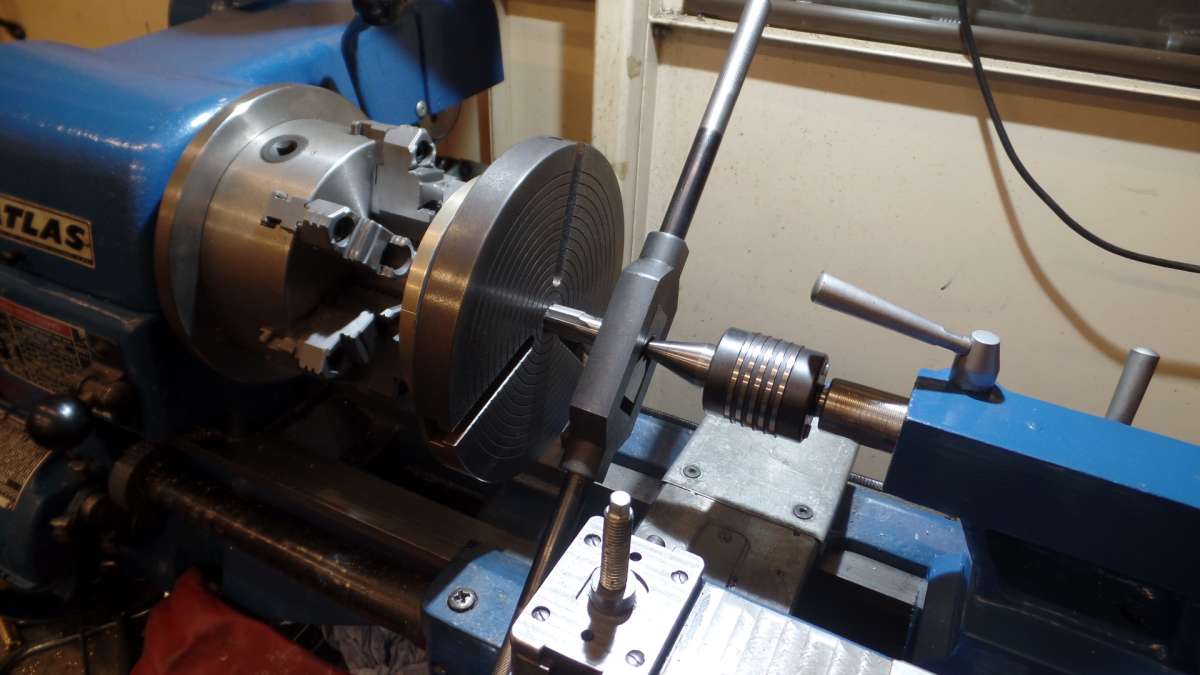
                                    I don’t know how big a Unimat 3 lathe is, but I used this method to ream a MT2 hole in an 8″ rotary table top. The lathe is an Atlas 12 x 24.

                                    As already mentioned, your bore would be better just finished by boring.


                                    SAM_1214

                                    #862498
                                    Michael Gilligan
                                    Participant
                                      @michaelgilligan61133
                                      On old mart Said:

                                      I don’t know how big a Unimat 3 lathe is […]


                                      Introduced in 1976 to replace the by then long-in-the-tooth Unimat SL1000/DB200, the 1.79″ centre height by 7.8″ between centres (46 mm x 200 mm) Unimat 3 had 8 spindle speeds of 130, 200, 350, 560, 920, 1500, 2450 and 4000 rpm. The headstock spindle was bored through a generous 0.4″ (10.2 mm)

                                      Ref. https://www.lathes.co.uk/emco-unimat-3-and-4/

                                      MichaelG.

                                      #862501
                                      JasonB
                                      Moderator
                                        @jasonb

                                        Yep and given that your average 15mm hand reamer is 165mm long and the cylinder approx 30-35, chuck thinkness say 25mm it will all bit a bit tight as I said early on.

                                        #862539
                                        old mart
                                        Participant
                                          @oldmart

                                          Mike and myself have been getting an early Unimat SL1000 in running order which belongs to the model club at the museum. It has the milling/drilling attachments and a 90 watt motor giving up to 5000rpm. After much messing about, I got a 10mm brass rod to turn with a taper of 1 micron in 45mm and decided to stop there, 20 microns would have been good enough. It now has a no volt safety switch and AC speed control to comply with a machine used in the museum which is not a home shed where anything goes. I would not chance reaming bigger than 3mm on that size of lathe.

                                        Viewing 19 posts - 1 through 19 (of 19 total)
                                        • Please log in to reply to this topic. Registering is free and easy using the links on the menu at the top of this page.

                                        Latest Replies

                                        Home Forums Beginners questions Topics

                                        Viewing 25 topics - 1 through 25 (of 25 total)
                                        Viewing 25 topics - 1 through 25 (of 25 total)

                                        View full reply list.