Dismantling an old machine – stuck bits

Dismantling an old machine – stuck bits

Home Forums Beginners questions Dismantling an old machine – stuck bits

Viewing 25 posts - 1 through 25 (of 30 total)
  • Author
    Posts
  • #354602
    Robin Graham
    Participant
      @robingraham42208

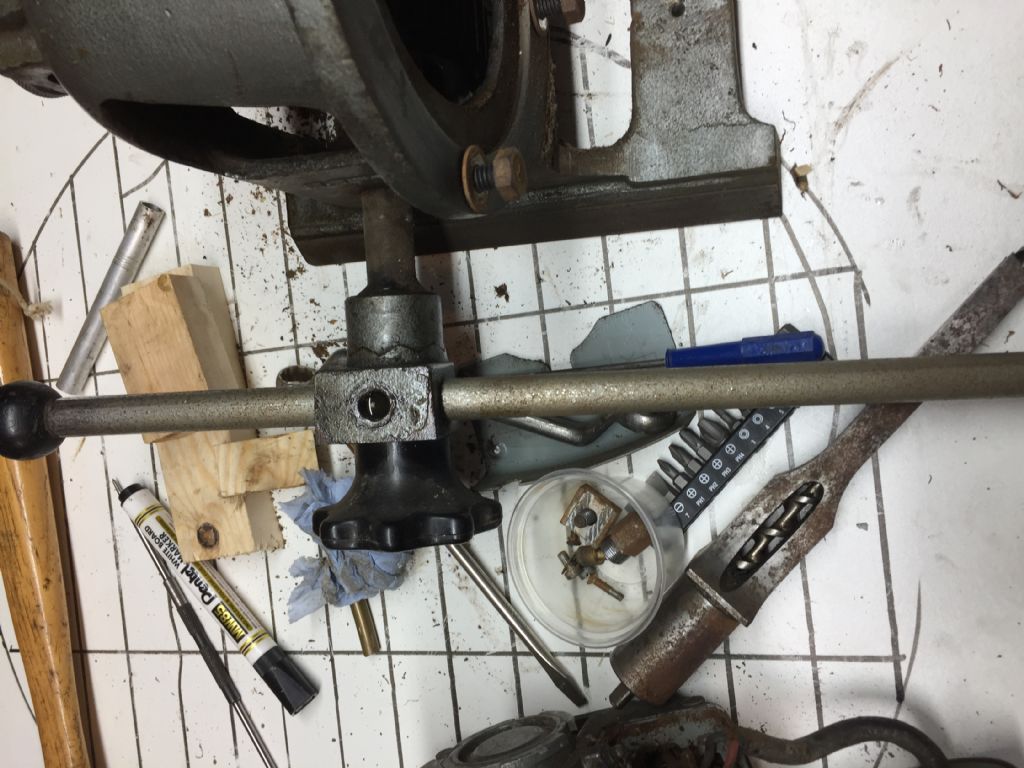
      I've bought an ancient Multico mortising machine – I've got it mostly reduced to parts for cleaning up and with help from people here I've got the electrics sorted, but I can't get this apart:

      multicolever.jpg

      The plastic knob just won't budge even after repeated blows from a hammer, nor will the lever bar move despite being soaked in thin oil for 48 hours. Any ideas?

      Robin


      Edited By Robin Graham on 19/05/2018 00:35:47

      Edited By Robin Graham on 19/05/2018 00:36:49

      #9191
      Robin Graham
      Participant
        @robingraham42208
        #354606
        Speedy Builder5
        Participant
          @speedybuilder5

          Just the usual, gentle heat so as not to damage the (bakelite ??) handle. Try twisting the handle in both directions, sometimes doing it up a bit more starts to release things. Also, can you twist the lever bar just a little to start things moving or take the knobs off the lever bar and tap the bar a little one way or the other (without damaging the threaded ends.

          #354607
          David George 1
          Participant
            @davidgeorge1

            Have you tried a strap wrench on the knob? I would apply a little heat remove the ball knobs from the shaft so you can knock it length ways.

            David

            #354610
            J Hancock
            Participant
              @jhancock95746

              Can you afford to file a hex on the open end to take a socket spanner ?

              Or, worst case, weld the end to a piece of flat bar.

              #354612
              Ady1
              Participant
                @ady1

                The whole thing is tight because of that knurled handle so unscrewing it seems the way to go

                Fill he box with penetrating fluid for a day or so and give it a few careful dings to help it along, some heat too if possible

                Two pins on a bar would spread the load across the knurl? a big stillson? kinda thing

                High risk stuff

                GL

                Aha!

                How about a big 3 or 4 jaw chuck?

                Clamp it to the knurl and use to apply careful pressure

                Edited By Ady1 on 19/05/2018 08:18:12

                #354619
                Martin Cargill
                Participant
                  @martincargill50290

                  The knob is a left hand thread.

                  #354620
                  Bazyle
                  Participant
                    @bazyle

                    Is the main bar straight through and was it locked by a screw in the hole visible in the block? This may have raised burs as well as the rust. If not perhaps they are separate bars screwed in as with a typical milling machine triple bar handle. With suitable support it should be ok to hammer the ends after removing the plastic balls.

                    Not obvious is that it is not symmetrical and the knob is on a shaft that goes through next to the big bar holds the outer block onto an inner round section. These two sections have a very course serration which you can just see as a wavy line. It is for adjusting the position of the bar handle.

                    One thing to do is to wash off the 'thin' oil with white spirit. Oil does not penetrate well. The white spirit will dilute it and help it run in. You want the consistence of 2 stroke oil for freeing things so that it is very very thin,

                    On second thoughts I think the bar is supposed to be straight. If it isn't make it so.

                    Edited By Bazyle on 19/05/2018 09:21:39

                    #354650
                    I.M. OUTAHERE
                    Participant
                      @i-m-outahere

                      Five parts kero to one part transmission fluid and heat it up to 50 deg c or so and dunk your parts in it and let it sit for a few days and repeat as necessary . The heat from the liquid will very slightly expand the metal parts allowing the kero oil mix to seep in . The timber that machine has worked with contains resins so as the dust has settled on the machine it has been drawn into the moving surfaces and has turned into to gum so mild heat and a solvent will help to break it down , the trans flluid leaves an oily deposit for lubrication .

                      #354651
                      I.M. OUTAHERE
                      Participant
                        @i-m-outahere

                        Five parts kero to one part transmission fluid and heat it up to 50 deg c or so and dunk your parts in it and let it sit for a few days and repeat as necessary . The heat from the liquid will very slightly expand the metal parts allowing the kero oil mix to seep in . The timber that machine has worked with contains resins so as the dust has settled on the machine it has been drawn into the moving surfaces and has turned into to gum so mild heat and a solvent will help to break it down , the trans flluid leaves an oily deposit for lubrication .

                        #354715
                        Robin Graham
                        Participant
                          @robingraham42208
                          Posted by Martin Cargill on 19/05/2018 09:10:39:

                          The knob is a left hand thread.

                          Do you know that for a fact Martin, or just speculation? If true, it would certainly explain a lot – I have actually moved the plastic knob a scant 1/16th of a turn by bashing and in my past experience (unless going the wrong way!) that's enough to free seized threads. I did wonder, but can't see any reason why it should be LH other than perversity on the part of the manufacturer?

                          Thanks for other suggestions.

                          Bazyle, you are quite right – the bar goes straight through and the threaded hole carries a locking screw, but the screw has a brass slug on the end so is unlikely to have raised a burr. I think it's just corroded in place. The saw-tooth union is clearly intended to separate to allow adjustment of the angular position of the bar when the plastic knob is undone.

                          Consensus seems to be a good soak in oil/solvent, followed by attack with more intelligently applied brute force (I like the chuck idea Ady1!) and heat so that's what I'll do . I'm not sure what the plastic knob is made from – Bakelite possibly, but It's tough stuff, and I remember Bakelite as being quite brittle. If it dissolves or decomposes it's not the end of the world – the machine isn't a museum piece, I can probably make a functional replacement, my concern is to get it working.

                          As an aside, this experience has made me realise why 'what machine should I buy' questions are so often met with 'buy second hand British'. This machine (OK, maybe I got lucky – it's ex-school) will still be going when I'm Hovis.

                          Regards, Robin

                          #354770
                          Martin Cargill
                          Participant
                            @martincargill50290

                            Stripped one about 4 months ago. Thread is left handed. I know because my colleague and I stripped the thread inside the knob (its a brass insert inside the knob). Luckily we had a suitable LH tap and were able to rethread a RH knob to make a replacement.  Like you we couldn't work out why it should be left handed – perhaps multico had a parts bin full of LH knobs

                            Martin


                            Edited By Martin Cargill on 20/05/2018 17:45:40

                            #354887
                            Robin Graham
                            Participant
                              @robingraham42208

                              Blimey. What are the odds against posting about a fairly obscure woodworking machine on an engineering forum and getting a reply from someone who's just stripped one down I wonder? LH thread it is – thank you very much Martin, that's saved me a lot of frustration! I had actually tried going that way but gave up too soon, This is madness I said to myself, no way is it LH, I'm just going to make things worse.

                              It came unstuck after a few more confident blows in the right direction then heat and a bit of brute force freed the lever bar from the block. Result!

                              Robin.

                              Edited By Robin Graham on 21/05/2018 23:02:56

                              #354888
                              David Standing 1
                              Participant
                                @davidstanding1

                                That is a result!! Well done both yes

                                #354894
                                Ady1
                                Participant
                                  @ady1

                                  Unbelievable

                                  Well done all

                                  #355080
                                  Robin Graham
                                  Participant
                                    @robingraham42208

                                    Nearly there – this question is less specific to the machine I hope. It's not absolutely necessary for me to strip the thing further but, well you know…

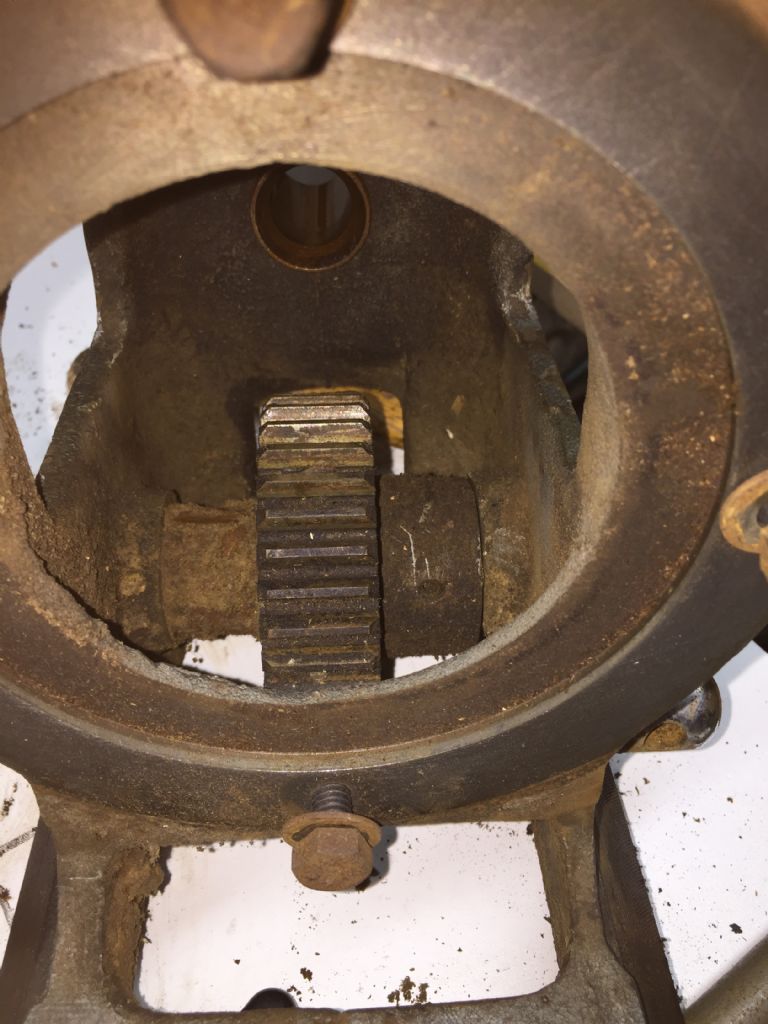
                                    To get the main pinion out of its housing:

                                    mainpinion.jpg

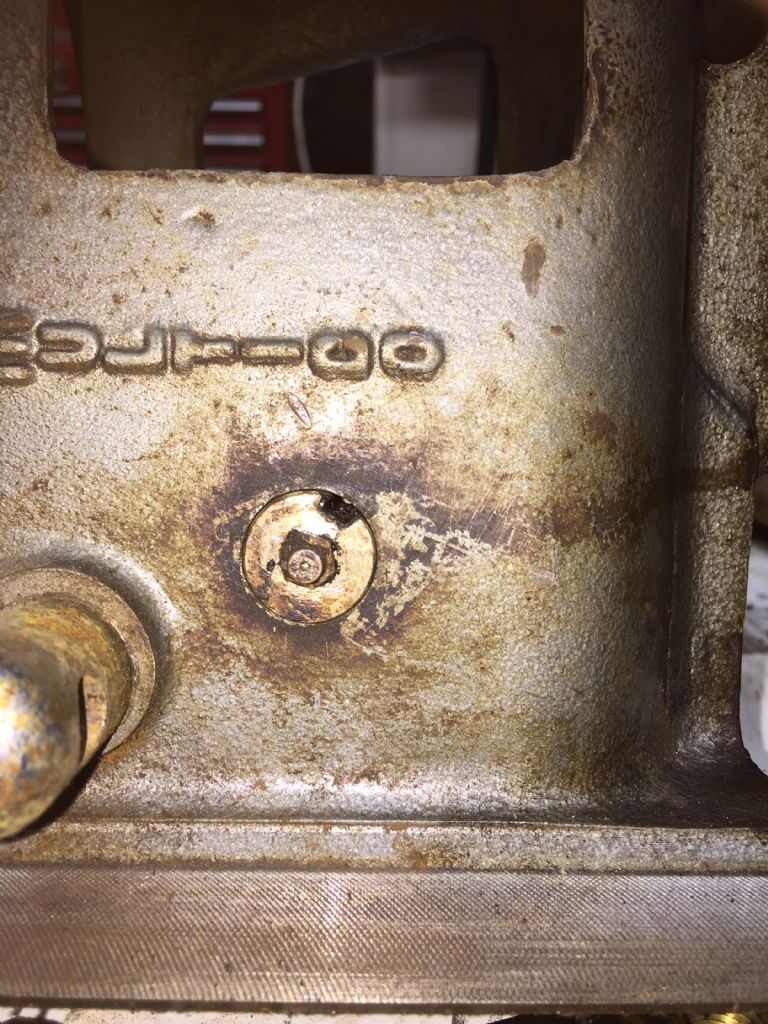
                                    it looks like I have to undo this fastener:

                                    mysteryfastener.jpg

                                    I've not come across such a thing before – can anyone shed light? The bit in the middle is an oiling nipple.

                                    Regards, Robin.

                                    #355089
                                    Speedy Builder5
                                    Participant
                                      @speedybuilder5

                                      It looks like the collar next to the gear has a pin (Tapered ?) holding it in position.

                                      #355092
                                      Jeff Dayman
                                      Participant
                                        @jeffdayman43397

                                        My hunch is there may be a pin of some kind in the hub to the right of the gear. If you can get that out, the shaft may pull out of the housing at the grease fitting end, maybe taking the grease fitting and a shallow head on the pin with it.

                                        Step 1 for me would be to get a small wire brush in there around the hubs to clear off the debris to see what you have.

                                        Good luck.

                                        #355297
                                        John Reese
                                        Participant
                                          @johnreese12848

                                          I agree it is pinned. One end of the pin is visible in the photo. Make sure you are attacking the small end of the pin! A punch slightly smaller than the end of the pin should do it. Start with light blows of the hammer. Sometimes there is not room inside the casting to drive the pin all the way out. You may have to rotate the shaft and cut bits off the pin as you drive it out.

                                          #355368
                                          Robin Graham
                                          Participant
                                            @robingraham42208

                                            Thanks for further replies. After cleaning off some crud it turned out that the what looks like a pin is a grub screw – and there is another the same at 90 degrees. I now strongly suspect that the pinion is keyed to the shaft – grub screws alone wouldn't give enough grip to transmit the torque. The bit to the left of the pinion is just a spacing collar which turns freely on the shaft btw.

                                            After loosening off the screws I could move the shaft enough in the casting to expose maybe 5mm of the fastener in the second pic – it looks as if a C spanner might shift it, but given that the mechanism is working sweetly now I've cleaned and oiled it I think I may just call it a day, put the machine back together and make some gates. Annoying in a way, I feel a bit defeated, but better that than risking cracking the casting to satisfy my curiosity.

                                            Thanks for all the help – my first go at restoring an old machine.

                                            Robin.

                                            #355387
                                            Michael Gilligan
                                            Participant
                                              @michaelgilligan61133
                                              Posted by Robin Graham on 25/05/2018 23:12:35:

                                              Thanks for further replies. After cleaning off some crud it turned out that the what looks like a pin is a grub screw

                                              .

                                              Coming to this 'after the fact' , I claim no credit … but; it is interesting to note that I find both of the photographs in Robin's last post more easily interpreted when viewed the other way up.

                                              MichaelG.

                                              #355392
                                              Farmboy
                                              Participant
                                                @farmboy

                                                Not always easy to be sure from one photo, but the 'fastener' in the second picture looks to me like the end of the shaft with a keyway in it . . . dont know

                                                #355522
                                                Robin Graham
                                                Participant
                                                  @robingraham42208

                                                  Farmboy – thanks for the suggestion, but the 'fastener' turns with the shaft and pinion, so the slot can't be a keyway. I was hoping that this was some standard sort of fixing that I'd not come across before myself, but it seems not..

                                                  MichaelG – interesting indeed that you would have found it easier to interpret picures the other way up – but why?

                                                  Robin


                                                  Edited By Robin Graham on 26/05/2018 22:57:11

                                                  #355523
                                                  Michael Gilligan
                                                  Participant
                                                    @michaelgilligan61133
                                                    Posted by Robin Graham on 26/05/2018 22:55:49:

                                                    MichaelG – interesting indeed that you would have found it easier to interpret picures the other way up – but why?

                                                    .

                                                    Just an experimental observation, Robin … the lighting seems to work better [shadows cast more appropriately].

                                                    MichaelG.

                                                    #355548
                                                    Farmboy
                                                    Participant
                                                      @farmboy

                                                      Robin,

                                                      I'm probably way off the mark, not seeing it 'in the flesh', but my impression was that the gear shaft had a keyway which runs right to the end of the shaft and is visible on the 'fastener' in the last photo. The gear is prevented from rotating by a key held in place by one of the grub screws. The other grub screw probably locates in a dimple on the shaft to prevent axial movement. The end of that shaft seems to protrude through the casting with a grease nipple in the end to lubricate the plain bearing hole in the casting. If that was the case, removing the grub screws should allow the shaft to be withdrawn from the handle end . . . with a little persuasion, such as tapping alternately on either end with a suitable soft hammer or drift after application of some penetrating oil.

                                                      Apologies if I have misinterpreted the photos

                                                      Mike.

                                                    Viewing 25 posts - 1 through 25 (of 30 total)
                                                    • Please log in to reply to this topic. Registering is free and easy using the links on the menu at the top of this page.

                                                    Latest Replies

                                                    Home Forums Beginners questions Topics

                                                    Viewing 25 topics - 1 through 25 (of 25 total)
                                                    Viewing 25 topics - 1 through 25 (of 25 total)

                                                    View full reply list.