Trouble getting started

Trouble getting started

Home Forums Beginners questions Trouble getting started

Viewing 25 posts - 26 through 50 (of 65 total)
  • Author
    Posts
  • #123258
    Chris Gunn
    Participant
      @chrisgunn36534

      Paul, good luck with your equipment, my comment concerns the choice of engine, I would recommend the 4" Garrett which was my introduction to traction engine building, for a number of reasons, first the drawings are among the best you will find, every part seperately detailed, second the supplier will supply raw castings or machined parts, with your choice of how far you want to go down this route, third the finished result is pretty robust, fourth the parts are bigger to handle making life easier if your eyes are getting worse, and last a 4" engine is much easier to run on all fronts than a 2" if you intend to rally it, and will handle a road run if you are that way inclined. Transporting the finished article will require a different approach than a 2", which may or may not be a problem for you, depending on your resources.

      Chris Gunn

      #123259
      Paul Harrison 5
      Participant
        @paulharrison5

        Well boys, thanks for all that input, but before I think of gear cutting, Andrew, a good finish on a parallel bar would be a nice starting point! I'm still working out which tool does which cuts and in which direction.

        Thanks also for reminding me that the expensive drawings I'm about to buy won't be accurate. I can't believe that nobody has managed to produce an upto date copy with all the errors taken out, hmm now there's an idea.

        Finally, Richard, is there a preferred CAD programme for model engineers or is that a matter of personal choice as well?

        Once again, many thanks to everyone taking the time to help me out with this, very appreciated.

        #123260
        GaryM
        Participant
          @garym

          Paul,

          Try this thread for CAD discussion.

          **LINK**

          Gary

          #123261
          Paul Harrison 5
          Participant
            @paulharrison5

            Thank you, Chris. I suppose being a bit of an extrovert I definitely lean towards the showmans engine. Regarding rallying, to be honest it doesn't really bother me that much, it will be being built to 'road' even if it goes to the shops, park etc. I just can't see the point of building something like that and then not using it. A friend of mine builds steam engines, but never ever steams them, just runs them on compressed air… madness. You need the heat, the steam and the smell!

            I think I sourced the Burrell plans from Live Steam Models; I would hope that tthey would be aware of any inaccuracies but I suppose I shouldn't expect perfection. The other thing of course is, until you start building something, how can you tell that the plans are wrong just by looking?

            #123262
            JasonB
            Moderator
              @jasonb

              It does depend on the chosen engine, My 2" Fowler only had a few errors and they are all known and noted on a sheet of paper.

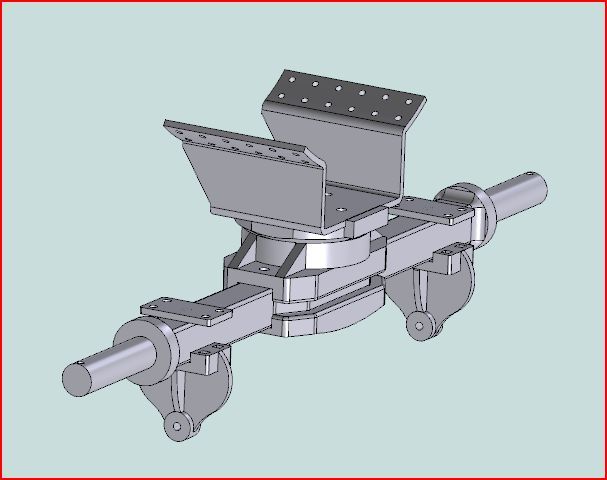
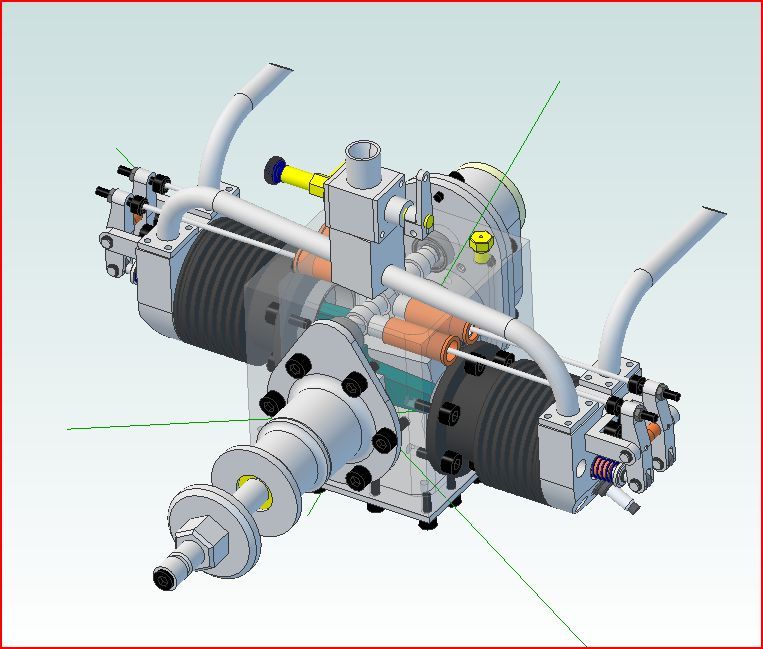
              The same can't be said for the 2" Superba which will likely be my next TE, although the basic parts are there they lack a lot of detail from teh original engine. I bought Alibra PE (Now Geomagic) just before christmas and have got on better with that than several 2D programmes I tried in teh past. You can assemble all your parts and if you alter one it will change on all the drawings, this is teh Superba front end and another little project.

              capture.jpg

              ne15ot.jpg

              #123265
              Paul Harrison 5
              Participant
                @paulharrison5

                Gary and Jason, this needs to be put on the back burner, trust me I have enough headaches with lathe tools and choosing a mill without all the CAD stuff.

                I'll get a couple of buckets of swarf out of the way first!

                #123279
                Anonymous

                  Paul: Like machinery, CAD is a personal choice; the only major decision is 2D or 3D. Professionally, and personally, I use 3D CAD (Alibre aka Geomagic) as it is easy to create assemblies and check that mating parts fit. One can also move parts and see how the other parts move in sympathy. It's much cheaper to eliminate errors on the computer than in metal.

                  If it's any encouragement my first attempts at turning with my current lathe resulted in an appalling finish, cue a major sulk. Turned out to be rubbish quality steel, even though it was bought from a 'professional' supplier.

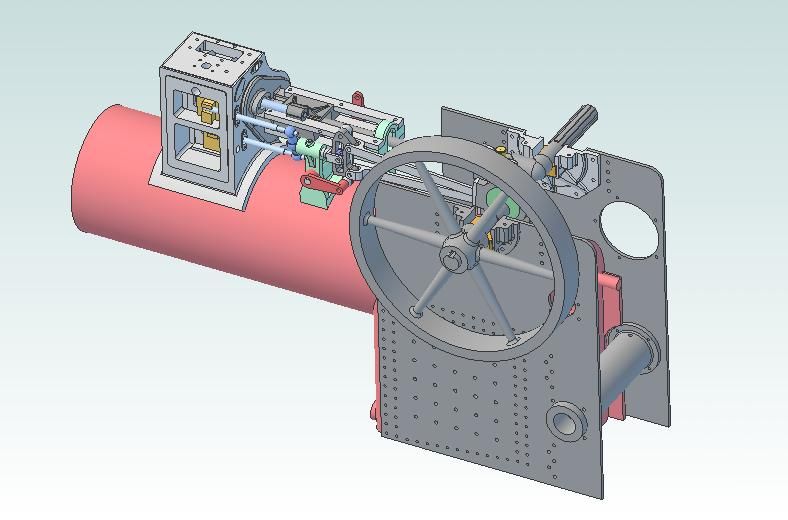
                  I'm working, rather loosely, to the LSM Burrell SCC drawings, but have sourced my castings and boilers from John Rex in Pontefract. Some of his castings do not reflect the drawings, but seem to be correct as far as my CAD models go. Here's my 'work in progress' model of the motion work of the Burrell SCC:

                  motion work assembly.jpg

                  One of the reasons for doing this, as well as checking fit and form, is that I'm likely to end up redesigning the valve gear.

                  Ah, yes the shaper. The attachment used to generate bevel gears on the shaper was patented by Bilgram in, I think, 1884. The process generates a true bevel gear tooth form, and unlike the Gleason planers does not require a template. The mechanism rotates the blank simultaneously in two axes to generate the side of a tooth, essentially creating a rolling cone. Two complete passes are needed, one for each side of the tooth. A former cone is required of the same angle as the conical pitch of the bevel gear, so different for each gear. I've never seen one in action, although I believe they were produced commercially.

                  Regards,

                  Andrew

                  #123309
                  Gordon W
                  Participant
                    @gordonw

                    I would advise to get a lathe, any lathe, and try making things. After a year or two you will have a much better idea of what you want. ForgetCAD etc. unless you want another hobby. BTW how does a CAD drawing find the mistakes in old drawings? A bit creepy I think.

                    #123312
                    Geoff Rogers
                    Participant
                      @geoffrogers81118

                      As with Andrew, I am using 3D CAD (TurboCAD Pro) to draw up the 4" Burrells I am constructing and I have found the need to 'refine' parts to make them fit properly. The CAD program made designing the hyrdraulic rivetter for the rear wheel strakes straightforward. So I find a CAD program is most useful and does not encroach on metal time, quite the opposite.

                      #123325
                      JasonB
                      Moderator
                        @jasonb
                        Posted by Gordon W on 28/06/2013 10:05:32:

                        BTW how does a CAD drawing find the mistakes in old drawings? A bit creepy I think.

                        It effectively allows you to make and assemble the parts which will then show up any clashes such as missaligned holes, not enough space to fit several parts into, etc. All before you cut into an expensive casting or large lump of metal.

                        CAD will also generate DXF files so you can just e-mail them to your chosen lazer or waterjet cutter for a quote or to order the parts.

                        #123326
                        Anonymous

                          I agree with Geoff, and disagree with Gordon; I find CAD to be a useful part of making an engine, which saves time in the long run. Here are a couple of examples of where it has helped on my engine.

                          First, on the drawings the hornplates are specified as 1/4" thick. However, it doesn't seem possible to buy 1/4" plate, so I used 6mm instead. This necessitated changing the length of the axle and second shaft tubes and altering the crankshaft bearing brackets to accomodate the difference in width. Drawing everything in CAD and creating an assembly allows dimensions to be altered and checked before spending time and money cutting metal.

                          Second, the assembly of the hornplates, crankshaft bearing brackets and bearings highlighted an anomaly. On my CAD model the distance between the inside of the crankshaft bearings was 7.25", whereas on the drawing for the crankshaft it is shown as 7.125". Having built and assembled the hornplates, crankshaft bearing brackets and bearings the distance is indeed 7.25". So had I machined the crankshaft to the drawings it would have been wrong. The location of the crankpin didn't line up with the cylinder either. It was exactly 1/16" out, which is suspicious. On the section drawing of the crankshaft/hornplate assembly you can add up different sets of dimensions, and get different answers for the between bearings dimension. So the drawings are inconsistent, even on the same sheet.

                          There appear to be loads of other errors in the motion work as well, but that's another story.

                          Regards,

                          Andrew

                          PS: I would agree with Gordon on the matter of buying a lathe and starting to cut metal though.


                          Edited By Andrew Johnston on 28/06/2013 12:45:54

                          #123328
                          Tony Ray
                          Participant
                            @tonyray65007

                            Paul,

                            Where are you based ? Perhap you might be lucky to find an adult education class near you offering metalwork. The one I attended in Eastleigh allows for turning milling and welding. You will learn so much faster with someone showing you the ropes.

                            I chose R8 on my mill – I have both R8 collets and an ER32 system on an R8 arbor but the R8 collets are so much faster to change.

                            CAD – down load Draftsight – its free and as easy to use as any of them once you have got your head around it – there is a Workshop Practise book – but I don't know if its any good – perhaps someone else can comment on it ?

                            Tony

                            #123341
                            Gordon W
                            Participant
                              @gordonw

                              I didn't want to get into yet another anti-CAD rant, Jason & Andrew. I really thought there must be some fancy program been invented since I last saw and used it ( 25 years now ) like watching paint dry compared to on the board. The checking you describe is just what would, or should, be done when hand drawing. Draw the assembly from the detail drawings, use only the information on the drawings, this will show errors and omitions. usually.

                              #123344
                              Bazyle
                              Participant
                                @bazyle

                                Are there loads of sheds with traction engine builders angrily hammering the badly drawn unobtainium parts to fit or are they all independintly reCADing the design?

                                Edited By Bazyle on 28/06/2013 16:54:46

                                #123345
                                RICHARD GREEN 2
                                Participant
                                  @richardgreen2

                                  Most of us traction engine builders have got a brain, and use the existing drawings , good or bad, and sort the problems out for ourselves,

                                  They are steam engines ! not rocket science, nothing too technical. just 19th Century engineering,

                                  They were built without CAD and computers, and thats exactly how I'm building mine.

                                  Richard,

                                  #123348
                                  Paul Harrison 5
                                  Participant
                                    @paulharrison5

                                    Well boys, first of all I absolutely see the CAD argument, but if it's that effective, why hasn't someone like Live Steam Models done this and made a fortune selling highly accurate plans at double the price of ones full of errors.. it doesn't make sense!

                                    Now I know that I've probably gone overboard with my first lathe, having a gear head, gap bed, coolant system, digital readout and power crossfeed, but I also have to strongly agree with Gordon, Tony, Ray and Richard, these engines were originally built before any of this technology and they're still running. Miniatures have been built on Drummonds and Myfords and the like and with the most basic of tooling.

                                    I intend to have a look at some of the CAD software, but my priority is learning to actually cut metal!

                                    It is a little amusing when people refer to building a first model and then moving onto something else. As a first project, if I start now it will be touch and go whether I have it finished by retirement!

                                    #123351
                                    JasonB
                                    Moderator
                                      @jasonb

                                      Its probably more profitable to do nothing and carry on selling what they have plaus the odd additional part.

                                      The newer designs on the market are being drawn in CAD such as the 6" GMT from Little Samson but even then the off little item crops up. Plus given the fact that a boiler can move not only during construction but expand as its heated all Traction engines need a bit of fitting, its all part of the fun.

                                      As you have the lathe I would decide on the engine you want to build and start with a few of the very basic bit like drag pins, drive pins, hub caps. These will get you into the swing of things and its no great loss if you scrap one.

                                      #123357
                                      Bazyle
                                      Participant
                                        @bazyle

                                        Paul, No need to worry about whether you will finish it before retirement – the retirment age will be raised again, and agian, and…..

                                        #123366
                                        Paul Harrison 5
                                        Participant
                                          @paulharrison5

                                          Good idea, Jason. I need to get myself some drawings and make a start. Off to the Little weighton rally this weekend to see a couple of lads from the Cheshire Group, so hopefully they will boost my confidence a bit. Only worrying thing at the moment is that our boss has just had to put in £50,000 of his own money to keep the firm going and today has issued an overtime ban from July 1. Still, like I said to the other engineers, no overtime is better than no job!

                                          Bazyle, you have no idea how many times I have said the same thing!

                                          #123385
                                          Anonymous
                                            Posted by RICHARD GREEN 2 on 28/06/2013 17:37:46:

                                            They are steam engines ! not rocket science, nothing too technical. just 19th Century engineering,

                                            Quite so, but due to circumstances beyond my control I find myself in the 21st century, so it seems sensible to make use of some 21st century techniques. smiley

                                            Andrew

                                            #123403
                                            RICHARD GREEN 2
                                            Participant
                                              @richardgreen2

                                              Andrew,

                                              With all respect, I cannot see why you need computers to carry out what is really basic 19th century engineering,

                                              On a traction engine there are no parts which cannot be made using simple turning and milling,

                                              I've been working professionally on full size traction engines, since 1975 , and problems arise because a traction engine is 1/2 blacksmith made and 1/2 engineered, when you try to fit a part that has been made to 1000th inch accuracy to a blacksmith made part , you will find they very rarely fit first time, and need to be fitted,

                                              This fitting process is where your computer stuff will not help at all,

                                              The old steam engine works were swarming with fitters, who were "master craftsmen" , fitting everything to everything else , and making it all work correctly,

                                              Will a computer set the valve timing ? It might help work it out, but it is a " hands on " job to set it all up, and tune it when in steam,

                                              Andrew, It boils down to this, "you build yours how you like, and I'll build mine how I like"

                                              There are no mass produced parts on any traction engine , so what's the point of setting up a computer ? surely everything is only a one or two off,

                                              But at the end of the day I'll be able to look at mine gently steaming away, and say "I made that " with my own hands and brain,

                                              Richard.

                                              #123513
                                              Paul Harrison 5
                                              Participant
                                                @paulharrison5

                                                Well, regarding this computer/CAD stuff, I really do welcome computers and technlogy. However I have to say that I won't be relying on them. I've decided to start a 4" Burrell single cylinder from John Rex. I'm sure I'll be asking for help and so this won't be the last you hear from me.

                                                So, to everyone who has taken the time to respond, a very big thank you!

                                                #123533
                                                OuBallie
                                                Participant
                                                  @ouballie

                                                  Paul,
                                                  May I, from experience, suggest that before you so much as think about making a start on the traction engine, you do the following;
                                                  1) Make a tailstock die/tap holder ala GH Thomas – this was my first project and used regularly.
                                                  2) Tapping tool ala GH Thomas – my second project and again used regularly – this can be made from bar stock to suite your needs, i.e. throat depth.
                                                  3) Start on the TE by machining the easy parts first to gain experience.
                                                  Welcome to the most enjoyable and at times frustrating and for me, until a few months ago, at times a nerve jangling hobby.
                                                  My nerve jangling times occured when parting off, but now banished since I started using the 'Q' Tip parting tool.
                                                  Another piece of wisdom from experience, when you get the plans and feint at the amount of work involved, have a cuppa, then go have another look and just think of every page as a single turning and/or milling operation, as looking at the whole can be overwhelming at first.
                                                  Geoff – "The bitterness of low quality lasts long after the sweet taste of low price has faded" – from experience
                                                  #123534
                                                  Andrew Evans
                                                  Participant
                                                    @andrewevans67134

                                                    On the CAD / computers debate – one way to look at it is that a set of CAD designs are simply an extension of a traditional paper based set of drawings. A set of master fitters could probably make a traction engine without any plans at all but it wouldnt be sensible, similarly if you have CAD available and know how to use it then its sensible to do so surely. On the other hand if you dont have CAD skills then you dont need them to build a traction engine (or probably anything else that model engineers would tackle).

                                                    Andy

                                                    #123557
                                                    Paul Harrison 5
                                                    Participant
                                                      @paulharrison5

                                                      Hello OuBallie and Andy.

                                                      I take on board fully the comments about starting off making the lathe tools and I happen to have the very book to which you refer. With regard to parting off, a friend of mine says that he cuts so far through and then retracts the tools, moves it along a couple of thou' and then takes another cut to reduce the chance of the work 'grabbing' the tool.

                                                      I also agree with the comments on CAD. You don't need a DRO or power feed to machine a part, but if you have it why not use it. I suppose it's the same as saying if you want to do woodwork, use a brace and bit rather than an an electric dril, just because it tradition.

                                                    Viewing 25 posts - 26 through 50 (of 65 total)
                                                    • Please log in to reply to this topic. Registering is free and easy using the links on the menu at the top of this page.

                                                    Latest Replies

                                                    Home Forums Beginners questions Topics

                                                    Viewing 25 topics - 1 through 25 (of 25 total)
                                                    Viewing 25 topics - 1 through 25 (of 25 total)

                                                    View full reply list.