Smoothing a bore.

Smoothing a bore.

Home Forums General Questions Smoothing a bore.

Viewing 23 posts - 1 through 23 (of 23 total)
  • Author
    Posts
  • #578124
    Steve Crow
    Participant
      @stevecrow46066

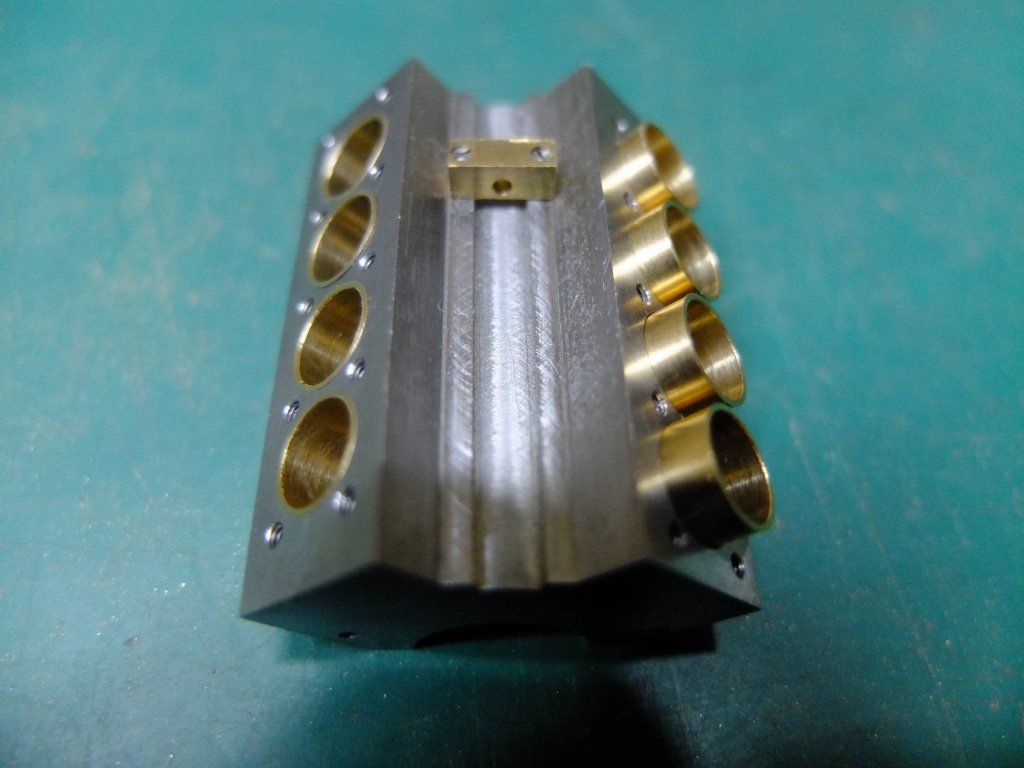
      I've just made the cylinder liners for my model V8.

      They are bored out to 7.2mm and the OD is just over 8mm for a nice friction fit in the block. I made go-no go gauges to keep the bores consistent to 0.01mm.

      liner1.jpg

      I am not happy with the finish of the bores. I am looking for someway of smoothing/polishing them while maintaining the "roundness" and "parallelness" of the bores.

      I am considering turning down a bar to a whisker under bore diameter, charging with an abrasive paste and polishing it that way.

      Is that a good idea? And if so, what material for the polisher? A softer metal like ali. or harder like silver steel?

      Also, would an axial or radial motion be the way to go?

      I was thinking of Eucryl mixed with light oil (a toothpaste powder, I've used it before) followed by Autosol.

      Any advice, suggestions or guidance would be much appreciated.

      Cheers,

      Steve


      Edited By Steve Crow on 02/01/2022 16:54:16

      #28496
      Steve Crow
      Participant
        @stevecrow46066
        #578126
        JasonB
        Moderator
          @jasonb

          A copper lap charged with 1000g silicon carbide powder/oil mix using a combination of axial movement as the lap spins round.

          Ramon has a good thread on lapping

          #578129
          SillyOldDuffer
          Moderator
            @sillyoldduffer

            Not my area of expertise – I've only done 5 small bores, max size 25⌀ x 25mm.

            The lapping rod should be softer than the cylinder. I used wooden and Aluminium rod turned to an approximate loose fit with a succession of fine emery papers wrapped round them. Started with 1000 grit, and moved up via 1500 and 2000 to 3000 or 4000. 4000 was probably overkill.

            The cylinder was spun in the lathe and the rod/paper combo was rotated slowly and slid to and fro slowly in the bore by hand. Fine papers remove tiny amounts of metal, basically polishing only, so I felt there's not much danger of spoiling a bores parallelism or circularity.

            I experimented with valve grinding paste and toothpaste once: in my hands seemed a lot more messy work than emery paper. Three grades of valve paste came in a kit. The coarse paste was too coarse, and the gap between fine valve paste and toothpaste is probably too big.

            Paper worked well enough for me, but I wouldn't bet the farm on it being the best answer: see what others say.

            Dave

            #578141
            Ramon Wilson
            Participant
              @ramonwilson3

              Steve – you do very nice workyes

              My thanks to Jason for pointing you in my direction but….

              You say you have sized the bores to .01mm and really only want to smooth them. My thinking in that case is that a lapping approach per se would possibly be too effective and may oversize the bores slightly.

              Personally I would approach it using fine wet and dry paper with paraffin and a drop of oil as a lubricant. I would use, say a 1/4" or 6mm dia ali rod with a neat slot cut down into the end to take a slip of wet and dry paper cut to the width you want and long enough once wrapped around the rod to just fit in the bore with ease, not too loose but not tight either.

              You should be able to polish the brass by hand but if not just use a light power source at low revs – always turn the way the paper is wrapped other wise it will tighten in the bore – if you do that with power you could quickly take it over size. I would think a minimum grit of 800 to begin with, certainly no coarser, going up to 1200 if desired

              The above is based on how I would approach the job based on treating bronze bearings that are tight.

              Hope that's of use to you

              Tug

              #578142
              Emgee
              Participant
                @emgee

                Steve

                If the liners are brass are you hard chrome plating them to run with a high silicon content ringless aluminium piston.?

                Viewing your Album it seems you only need one other gear to connect the 2 idlers for a complete train, are the gears fitted not up to the job ?

                Emgee

                Edited By Emgee on 02/01/2022 19:15:13
                typo again 


                Edited By Emgee on 02/01/2022 19:17:42

                #578143
                JasonB
                Moderator
                  @jasonb

                  Might be a bit OTT for an air engine?

                  #578154
                  Emgee
                  Participant
                    @emgee
                    Posted by JasonB on 02/01/2022 19:03:41:

                    Might be a bit OTT for an air engine?

                    Same could be said for twin overhead camshafts on an air engine I suppose, however that is the design of the engine so best to stick with it.

                    If indeed it is an air powered engine best guess is it will be a pistons with 1 "O" ring fitted, no doubt we will get some info on this from the OP.

                    Emgee

                    #578155
                    JasonB
                    Moderator
                      @jasonb

                      We have already had the info if you have been following along with Steve's other posts

                      Edited By JasonB on 02/01/2022 20:38:33

                      #578158
                      Tim Stevens
                      Participant
                        @timstevens64731

                        Whether an OHC, or DOHC design is 'appropriate' or 'over the top' depends on whether valve bounce is a limit to the output without this added cleverness. But it also depends on what the engine is for. If 'merely' to produce power, that is one question, but how about if it is intended to demonstrate the abilities of the designer, or maker, or both?

                        Cheers, Tim

                        #578167
                        ChrisLH
                        Participant
                          @chrislh

                          The usual advice for full size engines is to hone the bores with not too fine a stone. The idea is that the scratches retain lubricant which would be swept away if the finish were too good. I'm not able to put numbers to this which is just as well as measuring surface finish is not something us amateurs are usually equipped to do !

                          #578169
                          Emgee
                          Participant
                            @emgee
                            Posted by JasonB on 02/01/2022 20:35:05:

                            We have already had the info if you have been following along with Steve's other posts

                            Edited By JasonB on 02/01/2022 20:38:33

                            Hadn't seen the other posts.

                            Emgee

                            #578176
                            Ramon Wilson
                            Participant
                              @ramonwilson3

                              The OP states that the builder has made go/no go gauges to size the bores to a consistency of within 0.01mm – .0004 ins. To take such care is indication that the builder requires them to remain so.

                              Whilst the simplicity of wrapping of wet and dry around a mandrel may seem rather low tech and Heath Robinson and perhaps out of keeping with the work done so far it is suggested simply because it works – to the degree of the minimal metal removal required to polish the surface without increasing the size to any extent – not much point in working to 'four tenths' if you are going to increase it to six – or more.

                              From the image the liners appear to be brass – not something that stands up to lapping well from a metal wear perspective – though very efficient, brass piston laps wear rapidly on CI pistons for instance.

                              Tug

                              #578198
                              Neil Lickfold
                              Participant
                                @neillickfold44316

                                Flap rod polishing does work very well. So does making a spring lap out of something softer than the material of the liners. To polish liners but not alter the shape, I have used hard balsa wood to polish and it works amazingly well. I know people who have also used other materials like tufnol to make polishing laps. The Op wants to to keep the roundness, as well as the the bore being parallel . I have had some great success of making laps that resemble the geometry of a hone. It does not take much out, but will polish very well, especially if the lap is a charged lap, so no extra compound sitting in the bore.

                                There is lots of ways to polish things and seldom is there a wrong way when the method used achieves the end results that is required.

                                #578210
                                JohnF
                                Participant
                                  @johnf59703

                                  My two bits, if using paper wrapped on either a metal or wooden mandrel add a thin layer of “foam rubber” under the paper — acts as a spring keeping the paper in contact with the work. I have not used it on so small a bore but it works well on larger bores. The other is use a lead lap, cast some lead onto a metal bar and turn to size then load with abrasive, you can also use a wedge or D & T for a screw to adjust the size.

                                  John

                                  #578211
                                  Steve Crow
                                  Participant
                                    @stevecrow46066

                                    Thanks to you all for some very interesting suggestions.

                                    Ramon, your lapping thread looks really informative, I will look closely at it now I have time.

                                    I actually don't mind if the bores are increased slightly (I haven't made the pistons yet) as long as they are all consistently enlarged. I sort of took for granted that any polishing/smoothing/lapping would involve some sort of metal removal.

                                    The reason for the go/no go gauges was to ensure that all 8 liners had a consistent starting ID.

                                    If I go down the split lap route I assume that it will have to be made from something softer than brass, ie. ali?

                                    I am liking the idea of Ramon's mandrel and wet and dry method. I don't mind a bit of low tech if it works!

                                    I made a couple of liners with slightly under sized OD's which are now in the scrap tin. I suppose I could practice on these.

                                    Thanks again and any other advice is welcome.

                                    Steve

                                    #578234
                                    Ramon Wilson
                                    Participant
                                      @ramonwilson3

                                      Steve,

                                      Any form of lapping/polishing is going to remove metal by it's very nature. By doing it as suggested is nothing more than a form of lapping anyway but the metal removal is absolutely minimal. It's not going to remove deep tool marks of course but as you have made them to such limits I'm assuming those are minimal any way.

                                      As always there are lots of ways of skinning cats but the size of the rolled wet and dry method is controlled by the length of paper used – you can fine tune it to quite small limits to the right kind of fit. It itself it's flexible, even on a hard-ish mandrel, so acts more like a floating hone and so will follow the bore rather than be rigid like a lap – this also helps if bell mouthing is a concern. It certainly wont affect the roundness the amount you need to polish nor induce a taper unless you dwell in one spot.

                                      How ever you do it good luck – you have an impressive project there.

                                      Tug

                                      Edited By Ramon Wilson on 03/01/2022 13:33:00

                                      #578262
                                      Steve Crow
                                      Participant
                                        @stevecrow46066

                                        Thank you Ramon, I'm going to try your wet and dry method.

                                        A couple of questions- How wide should the paper be in relation to the bore length and should there be some axial motion as well as radial when polishing? Also, would WD40 be a suitable medium (I have no paraffin)?

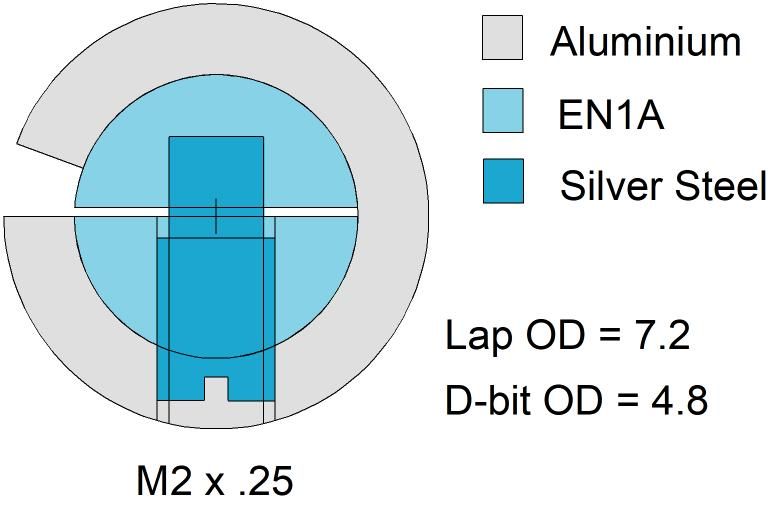
                                        I've got to thinking about making hones for future projects though. Do you think this would work?

                                        lap 1.jpg

                                        The idea is that the lap is superglued to the d-bit and then drilled and tapped through both materials. The grub screw combined with the glue should secure the ali lap enough during operation. The screw is fine pitched for small adjustments.

                                        Cheers

                                        Steve

                                        Edited By Steve Crow on 03/01/2022 15:44:21

                                        #578302
                                        Howard Lewis
                                        Participant
                                          @howardlewis46836

                                          Since the liners are brass, be very careful to clean thoroughly after lapping. mIf any abrasive remains in the brass, it will bvecome a lap for the piston running inb that bore.

                                          As to motion, linear, up and down the bore would be a NO NO, in my book.

                                          It will encourage leakage, providing a short straight leakage path.and not retain any oil.

                                          The practice used in full scale engines is a combination of rotary and linear to produce a spiral cross hatch.

                                          (This is honing the bore to size, and then superimposing a cross hatch to retain lubricant. )

                                          This will retain oil, and lengthen any leakage path. Strictly, the cross hatch angle should be related to the wall pressure of any metallic rings that are used. About 35 – 45 degrees should work well enough, to retain oil whilst preventing it being scraped up or down the bore in any quantity..

                                          HTH

                                          Howard

                                          #578343
                                          Ramon Wilson
                                          Participant
                                            @ramonwilson3

                                            Hi Steve – yes most definitely. Nearly all the laps I have made (quite a few now) have used copper as the wrapper but the principle is the same. I've not tried cyano as such but would think a gel type cyano best as only the leading edge of the wrapper should be fixed. Make sure the leading edge to the motion is the fixed edge – otherwise it tries to unwrap it i.e. the motion wants to be away from the fixed edge. The wrapper slowly looses its concentricity in it's thickness but the outside remains perfectly circular. I'd just use a 2mm grubscrew as the expander.

                                            This type of lap expansion works extremely well and I have used them for many projects – not my idea but one that came from Len Mason in his building the Mastiff series in ME if I recall correctly

                                            With regard to the wet and dry method make the paper width wider than the length of the bore but no more than twice the length of the liner as the more that's outside on axial movement the more it can loosen and expand and begin to lead to bell mouthing as it compresses going back in – yes axial movement should be used otherwise you will create rings but not excessively so compared to the radial movement – WD 40 will be a fine alternative to paraffin – I always have the latter on hand because of the diesels.

                                            As you have a couple of spare practice first as you suggest – I'm sure you'll soon see how little action is required to achieve the surface smoothness you are after.

                                            Regards – Tug

                                            Edited By Ramon Wilson on 03/01/2022 21:01:09

                                            #578373
                                            Former Member
                                            Participant
                                              @formermember37818

                                              [This posting has been removed]

                                              #578396
                                              Kiwi Bloke
                                              Participant
                                                @kiwibloke62605

                                                The success achievable with abrasive finishing, and the amount of resultant diametrical enlargement, will depend on the present state of the bore. How much material removal can be tolerated (how deep are the present scratches/imperfections)?

                                                A possible problem with abrasive finishing is the risk of embedding abrasive into the soft brass. Consider a non-embedding abrasive for lapping?

                                                You could consider 'Ballizing' (I think that was the name of the commercial process), in which a highly finished ball, very slightly larger dia than the existing bore, is pushed along the bore. In brass, it should work-harden the surface usefully. It will retain, or improve, circularity, but will not straighten a 'bent' bore. Parker Hale offered this process for gun barrels. Compacting the working surface of the barrel was said to prolong barrel life. Probably impossible to get a ball of the desired size – for a reasonable price.

                                                #580713
                                                Steve Crow
                                                Participant
                                                  @stevecrow46066

                                                  A quick update.

                                                  I've had a go with Ramon's mandrel and wet & dry method and it works very well.

                                                  As expected, as the liners are a tight friction/force fit in the block, the bores had "shrunk" slightly when fitted. This was soon fixed.

                                                  I started with 800 grit and worked up to 2000. I did it on the watchmakers lathe under power at about 200-300 rpm. It does remove metal quite quickly like this (the paper loaded up in no time) but it is very controllable. I was able to get all 8 bores to have the same "feel" with the plug gauge.

                                                  I'm half way through making the pistons now.

                                                  Thank you to Ramon and everybody else for the help and suggestions.

                                                  Steve

                                                Viewing 23 posts - 1 through 23 (of 23 total)
                                                • Please log in to reply to this topic. Registering is free and easy using the links on the menu at the top of this page.

                                                Latest Replies

                                                Home Forums General Questions Topics

                                                Viewing 25 topics - 1 through 25 (of 25 total)
                                                Viewing 25 topics - 1 through 25 (of 25 total)

                                                View full reply list.