ML10 – racking of carriage?

ML10 – racking of carriage?

Home Forums Workshop Tools and Tooling ML10 – racking of carriage?

Viewing 22 posts - 1 through 22 (of 22 total)
  • Author
    Posts
  • #481902
    Ignatz
    Participant
      @ignatz

      I’ve recently been doing some boring work on my (very) old ML10 and have noticed that when the boring bar is moving down the hole in the direction of headstock it cuts a little bit, but upon retracting the boring bar from the hole – the carriage now moving towards the tailstock – the boring bar inevitably takes another, slightly more generous skim cut on the way back out.

      Of course, this makes it more difficult to accurately bore out a hole to the desired size.

      I’m wondering if this indicates that the carriage is racking, first slightly one way when pushed towards the headstock and then back the other way when moving in the other direction?

      Admittedly the lathe is old and worn, but I’ve snugged up the gib on the carriage as much as I dare.

      Could it be that the gib has worn thinner on the outer ends through long use? Would this allow the racking movement? How much wear is considered normal?

      Any suggestions appreciated.

      #19838
      Ignatz
      Participant
        @ignatz
        #481903
        John Hinkley
        Participant
          @johnhinkley26699

          If it is racking ( rocking? ), why not just move the tool in away from the work on the retract pass? Then check that the lathe is cutting parallel. If it is, make further passes until the required size is acheived and Robert is your mother's brother.

          John

          #481907
          David George 1
          Participant
            @davidgeorge1

            Hi Ignatz the terminology I would understand as to the movement of the saddle in such a matter is called crabbing. I usually is caused by the jib strips being loose or curved by wear. if you put a dial indicator on the saddle with the pointer resting on the side of the bed and move the saddle backwards and forwards and note the movement as to direction. You can check if the gib strip is lose at the same time and repeat the check after tightening it up. if the saddle becomes to tight to traverse towards the tailstock after tightening the bed is worn and needs attention. if the gig strip is worn you can mill a small amount off to flatten it and possibly relieve the centre area a few thou may help as well. have a look at the bed thickness as well you cam measure the thickness at various places along the length to see if there is any difference. let us know if this helps please.

            David

            #481914
            Graham Meek
            Participant
              @grahammeek88282

              From what you say I would say the rear Dovetail of the Saddle that bears against the rear of the bed is worn such that the dovetail is higher in the middle of the slideway than on the two ends. This lathe comes with no felt wipers on the saddle to bed interface and with the ingress of debris the inevitable wear is a problem.

              To rectify the error the dovetail needs to be scraped in the central portion to remove the high spot. Preferably taken a little below. This will retain oil and allow the ends to wear down to the new surface.

              However if you are not experienced in scraping dovetails I would leave well enough alone and adopt a different style of working as John suggests above.

              Regards

              Gray,

              #481916
              Ignatz
              Participant
                @ignatz

                Thank you, guys.

                David, I'll trot out to my workshop and check it out directly as you suggest.

                If it involves the gib I guess I could try to mill it out as you suggest, or else purchase some precision ground flat stock and cobble up a replacement.

                As to a worn bed, well I've already inquired about the ML10 and was informed that unlike its larger brothers, the ML7 and the Super 7, the dovetail bed doesn't really lend itself to a regrind. …and even if he was willing to try, the price was rather steep… and what with the wear in the main spindle bearings and all, well…

                #481917
                Ignatz
                Participant
                  @ignatz

                  Graham, interesting point about the rear dovetail on the carriage. Is there any way to check that without disassembling and applying bluing?

                  #481920
                  J Hancock
                  Participant
                    @jhancock95746

                    That is the major shortcoming of a V bed , two directions of thrust are adjusted by one movement.

                    Adjust for wear close to the chuck will make the saddle so tight when it moves back.

                    #481924
                    Bazyle
                    Participant
                      @bazyle

                      I hasn't been made clear above that this is perfectly normal in all but the highest quality lathes or good quality new lathes. If you think about he asymmetrical forces during a cut on the outside of a bar you can see what wears and how that must affect a boring operation. You do have to move the tool before pulling it out. You will soon find it is second nature and you don't have a real problem.

                      #481926
                      Graham Meek
                      Participant
                        @grahammeek88282
                        Posted by Ignatz on 24/06/2020 15:48:13:

                        Graham, interesting point about the rear dovetail on the carriage. Is there any way to check that without disassembling and applying bluing?

                        You could start with a feeler gauge either side of the saddle, but do not move the carriage during the test as you may be rocking the saddle and get a false reading. If you cannot get a 0.0015" or 0.04 mm feeler gauge into any gap this can only be good news.

                        If the blade does enter, check if it goes in by the same amount each side. This will tell you if the wear is equal. I would expect the greatest wear on the right-hand side, but you might be lucky and have it symmetrical.

                        You can go to town with micrometer blue if you feel confident. Provided you have found wear then I would scrape the central portion before I put on any blue. Ideally setting the Saddle up vertically such that a short ground roller resting in the dovetail, can be used in conjunction with a clock to check where to scrape.

                        If the back face of the saddle is machined you could get away with a micrometer and a roller, after removing any paint.

                        Getting right into the corner can be difficult if the scraper is not thin enough. A lot depends on how big the flat is on the corner of the bedway dovetail.

                        Regards

                        Gray.

                        #481930
                        Ignatz
                        Participant
                          @ignatz

                          Just back in from running some measurements.

                          Big 'ouch!' here… crying

                          I pulled out the gib and measured it for wear. As expected, there is some difference in thickness along its length. The front end measures 0.1270" (both top and bottom), while the both the middle and back end measure 0.1255" on the top and 0.1260" on the bottom. So a maximum difference of 0.0015" which I suppose isn't too terrible considering the age of this machine.

                          Unfortunately, there is definite crabbing going on. A dial indicator held out against a ground and polished rod in the three-jaw chuck at about the distance of the end of a boring from the center of the carriage shows a total movement of almost 0.020" between forward vs backward motion (it was even worse before I removed, cleaned, measured and reinstalled the gib). That seems to be way, way more than the wear on the gib could account for and indicates wear at the back of the carriage dovetail.

                          In the short term, yeah, make boring cuts in one direction only, dial the tool away from the cut when withdrawing. Fussy, but should offer better results than what I'm currently getting.

                          Longer term fix would be to try to scrape the carriage and/or bed a little to try to get more accuracy into this thing. Of course, I have zero experience with scraping and the rest of the machine is also pretty worn (spindle, bed, etc.) so I do not know if it is worth my time… except as a learning experience. Honestly, I'm beginning to think I might have to rub some cash on this problem – meaning a new lathe – but if I go that route I could always hold onto this and try the scraping when I have nothing to lose.

                          #481953
                          Graham Meek
                          Participant
                            @grahammeek88282

                            You have to remember that you are exaggerating the error by having the clock extended.

                            There is a back up plan, and the lathe can always be salvaged. Odd items for ML 10's always appear for sale.

                            Regards

                            Gray,

                            #481957
                            Ignatz
                            Participant
                              @ignatz

                              Graham, it is true that the extended position of the clock does exaggerate the error, but as I said, the clock is in approximately the same outboard position as my boring bar. Thus, I expect that the clock is simply showing what is happening at my cutting tip in that position. A cutting tool held closer in to pivotal center of the carriage wouldn't show quite this severe difference.

                              Be that as it may, I'm going to have to continue to use the lathe as is at the moment (better to have something than nothing).

                              Nevertheless, when my courage is a bit more 'up' I'll start some inspections of the back dovetail on the carriage as you have suggested.

                              #482094
                              Ignatz
                              Participant
                                @ignatz

                                Had a good breakfast and then wandered out to the garage to run some measurements as Graham suggested.

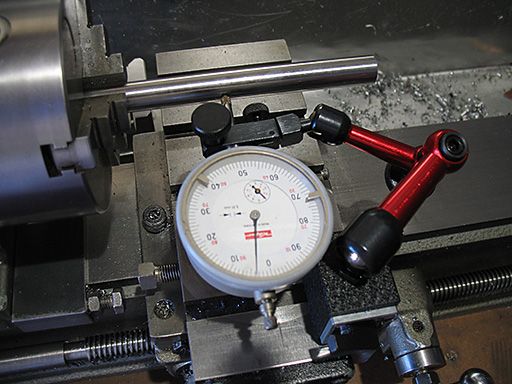
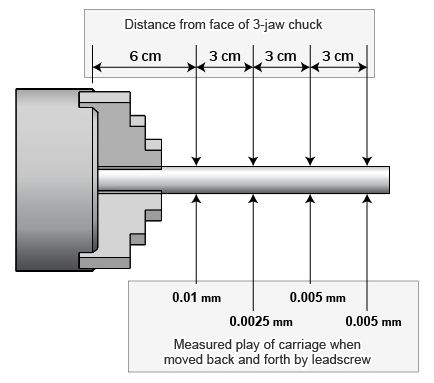
                                I once again measured the crabbing motion, this time with the dial indicator more central to the carriage.

                                clock_setup.jpg

                                carriage free play measurements.jpg

                                The measurements I obtained can be seen in the illustration above.

                                The free play listed was a little bit dependent on the speed with which I attempted to advance or retract the carriage.

                                The carriage could be made to move (almost) the length of the bed but the gib was really pretty tight for this – maybe a wee bit more than I would like. The motion of the carriage became tighter and more difficult as it approached the tailstock. In the other direction, toward the chuck, moving the carriage was very difficult approaching almost impossible when moving beyond its position as shown in the photo.

                                As a slight bit of good news there is not enough space on either the left or right side to insert a 0.04mm feeler between the rear dovetail of the carriage and the matching dovetail of the bed.

                                #482111
                                Nigel McBurney 1
                                Participant
                                  @nigelmcburney1

                                  Either too large a tip radius on the tool or tool is blunt,so instead of cutting ,the tool rubs,and then cuts a bit deeper when tool is run back out of the bore.

                                  #482113
                                  Bazyle
                                  Participant
                                    @bazyle

                                    I think you are chasing completely the wrong issue. If having to move the cross slide back at the end of each pass is your biggest problem in life you are truely a lucky man. The only thing that should matter in this area is whether your alignment of the headstock and lack of bed twist allows you to cut a parallel bore.
                                    The place where this movement matters is when the carriage is locked and you are facing off a big flat plate. You just need to determine a method for getting the carriage in the right poition for this operation to be true before locking.

                                    #482148
                                    Robin
                                    Participant
                                      @robin

                                      I have the same problem. I put it down to greater wear on the bed near the headstock because that is where most of the action is.

                                      If I am right then tightening the Gibb to lose the slop near the headstock means it will not want to go very far towards the right.

                                      #482150
                                      Graham Meek
                                      Participant
                                        @grahammeek88282

                                        Glad my advice worked out, with errors like that I would leave well enough alone and modify my method of working.

                                        A Clock (DTI) is truly a wonderful thing, as are feeler gauges which are very often over looked. A clock in skilful hands can save a lot of worry when it comes to machine tools and wear.

                                        One thing I would do is make some felt wipers with metal protectors for that bed. These will slow down any future wear and keep the bedway lubricated for longer.

                                        Regards

                                        Gray,

                                        #482152
                                        Peter Hall
                                        Participant
                                          @peterhall61789

                                          They look like good results to me.

                                          No-one has mentioned tool flex. When I bore on my Speed 10, (or anything else) it always cuts on the way out if I don't back the tool off. Boring aluminium last week (34mm dia x 60mm deep) I put the tool through 4 times at the final diameter, backing off each time. It still removed material on the fourth pass. Maybe you should figure this into the equation as well.

                                          Pete

                                          #482335
                                          Howard Lewis
                                          Participant
                                            @howardlewis46836

                                            Two comments.

                                            Firstly, moving the Cross Slide while making measurements along a bar introduces errors because of the backlash. So, my advice is don't introduce another variable and possible source of error. Lock as many movements as possible.

                                            Secondly, Boring bars are flexible, being long and slender and so deflect more easily than a short rigid external turning tool. What you are seeing is a "spring cut".

                                            Even if you stop the lathe and then withdraw the boring bar, restarting will show the tool taking another spring cut. probably, it will take three or four before it no longer cuts.

                                            So, if you want a precise bore size, it will pay to start taking spring cuts a couple of thou (0.05 mm) before you reach the desired finish size; with the Cross Slide locked.

                                            HTH

                                            Howard..

                                            #482342
                                            Baz
                                            Participant
                                              @baz89810

                                              Maybe I have missed it but what material is being bored and with what sort of boring bar, is it a HSS boring bar or a carbide tipped bar, is it set correctly and also what make of tips are being used, I would suggest the problem lies more in this area than in the carriage and bed of the machine, just my two cents worth.

                                              #482521
                                              Ignatz
                                              Participant
                                                @ignatz

                                                I absolutely agree that boring bars are to some degree flexible and thus have a certain amount of give.

                                                Nevertheless, the problem is increased by the crabbing on this old lathe. As I stated, the problem was reduced to a degree by cleaning and tightening up the gib, but that doesn't take away from the fact that this is an older machine with a certain amount of wear.

                                                I'll continue to use the machine until a better option comes along, being careful of how I use boring bars not forgetting (lots of) the spring passes. Too, I think that Graham's suggestion about making some wipers is well taken.

                                                Edited By Ignatz on 27/06/2020 14:48:12

                                              Viewing 22 posts - 1 through 22 (of 22 total)
                                              • Please log in to reply to this topic. Registering is free and easy using the links on the menu at the top of this page.

                                              Latest Replies

                                              Viewing 25 topics - 1 through 25 (of 25 total)
                                              Viewing 25 topics - 1 through 25 (of 25 total)

                                              View full reply list.