
Carbide hand files?

Carbide hand files?

Home › Forums › Workshop Tools and Tooling › Carbide hand files?

Viewing 20 posts - 1 through 20 (of 20 total)
  • Author
    Posts
  • #721986
    Rainbows
    Participant
      @rainbows

      After getting my own body weight in files I went down a bit of a file based rabbit hole.

      As a fun aside check out the steelworks of the well known P S Stubs files, don’t make them like that anymore (probably sensibly).

      https://www.ribapix.com/gateway-to-the-holmes-steel-works-rotherham-south-yorkshire_riba57685

      Between getting distracted by brand stamps I’d never heard of and the assorted history of 10 different Sheffield steelworks that were just 4 guys in a shed I pondered if anyone had made a carbide tipped file to do away with ever having to buy new files, or indeed to file through hardened steel. They’ve been made for die grinder burrs after all.

      At current for a mere £250-1000 Pferd will sell me some sort of very coarse file that bolts to I assume specialised production machines. In comparison the chinese will sell me a 2x20x200 bar of carbide for £15. Brazed to a steel backer that would make one face of a general purpose file.  8x8x100 for £12 would make a solid small detail file that you can snap in half by dropping on the floor.

      Brazing carbide to steel is fairly well documented. Grinding the teeth in is going to require some novel set up and fiddling with tooth geometry. Round and half round files are a mystery, god knows how they cut the teeth on those.

      Now with a material price equal or double that of a finished and delivered Vallorbe I don’t think this will take off any time soon. But I am curious if anyone on this forum with its millennia of combined experience has seen, used or tried to make their own carbide files?


      #721993
      Tim Stevens
      Participant
        @timstevens64731

        Diamond files may be worth looking at. Nowhere near as expensive as they sound, either.

        Observant readers will note the lack of vowels in the last sentence. My contacts with PS Stubbs were in Prescott, near St Helens.

        Cheers, Tim

        #721997
        Peter Cook 6
        Participant
          @petercook6

          A quick google got me

          Carbide – Flat File Cintride (alphacut.co.uk) at considerably less money, but they seem to be made the same way as the diamond files, with grains of carbide welded to a carrier. They also do round!

          #722046
          Macolm
          Participant
            @macolm

            Not carbide, but Valorbe have a process to increase the hardness of steel files.

            https://www.vallorbe.com/en-ch/products/files/valtitan

            #722048
            Bill Phinn
            Participant
              @billphinn90025
              On Macolm Said:

              Not carbide, but Valorbe have a process to increase the hardness of steel files.

              https://www.vallorbe.com/en-ch/products/files/valtitan

              I’ve got a half-round 6″ Valtitan file. It’s very good on harder materials.

              Presumably the niche for carbide files as opposed to diamond files is the same as the niche occupied by carbide burrs: they’re hard enough for any metal you’re likely to want to abrade and their typically coarser  cut means they remove material faster than a diamond burr.

              #722052
              Grindstone Cowboy
              Participant
                @grindstonecowboy

                Would they not be liable to chip?

                Rob

                #722079
                jaCK Hobson
                Participant
                  @jackhobson50760

                  Carbide is probably only available as an abrasive file because of cost of machining and brittle: small file teeth are formed hot, not machined. small features need to be reasonably tough.

                  File steel is designed to be hot-workable and fine grained (tough for small features).

                  Some files are machined – the surform/plastic files – which do cut metal well.  I got some ‘plane floats’ recently that might be machined.

                  Valtitan will not cut full martensite steel – don’t try as you will mess up your expensive file quickly 🙁

                  Very Coarse carbide file (intended for ceramic tiles) doesn’t work well on full martensite.

                  Very Coarse diamond does but not for long (maybe because I press too hard… but I always repeat that mistake if that is the case). (light gray DMT, and black DMT have short life).

                  I think waterstones are the fastest way I have found to remove hardened steel by hand. Soft and very coarse. They don’t last long but cheap and very fast.

                  In the trip down the rabbit hole… did you find any full size left handed files? I wish they existed.


                  How about a ‘show us your files’ thread. Two of us might be interested!

                  #722083
                  JasonB
                  Moderator
                    @jasonb

                    The Tome files that ARC sell are all cold worked to cut the teeth and then induction heated and quenched. They have whole rows of those machines that cut the teeth into the cold steel. See the video

                    The Permagrit files are probably a better bet than those rather coarse files linked to earlier, certainly if you want a fine finish

                    #722123
                    Rainbows
                    Participant
                      @rainbows

                      I don’t know how true it is but someone somewhere told me that diamond coated abrasives wear quite fast in steel because the carbon dissolves into the steel. Interestingly the permagrit files stop short of saying they will work on steel though they do mention carbon fibre which I hear is get at abrading tools to bits.

                      As Bill says the argument for carbide teeth would be faster stock removal compared to grit, but then again can a person apply enough horsepower to a file on hardened steel to make use of that. I suppose compared to some smaller and finer files a lump of carbide is as big as their teeth anyhow.

                      Not a clue if they would chip fast or not. Modern scrapers use a carbide tip and get donked by hand onto steel. CNC  tools take tremendous forces but in a very controlled environment.

                      I have access to an old benchtop file cutter, I have hoped to one day measure it up and create a working replica for myself. Looking at the size of them in the Tome video it must have been suitable only for needle files. During the rabbit hole I think it was Nicholson who cut/sharpen their files by blasting them with high pressure steam and a media I can’t remember. Reached in to undercut the tooth for a sharper rake better than a chisel could and cheaper than a milling cutter.


                      Shall we make files.co.uk as a sister site to lathes?

                      #872118
                      jaCK Hobson
                      Participant
                        @jackhobson50760

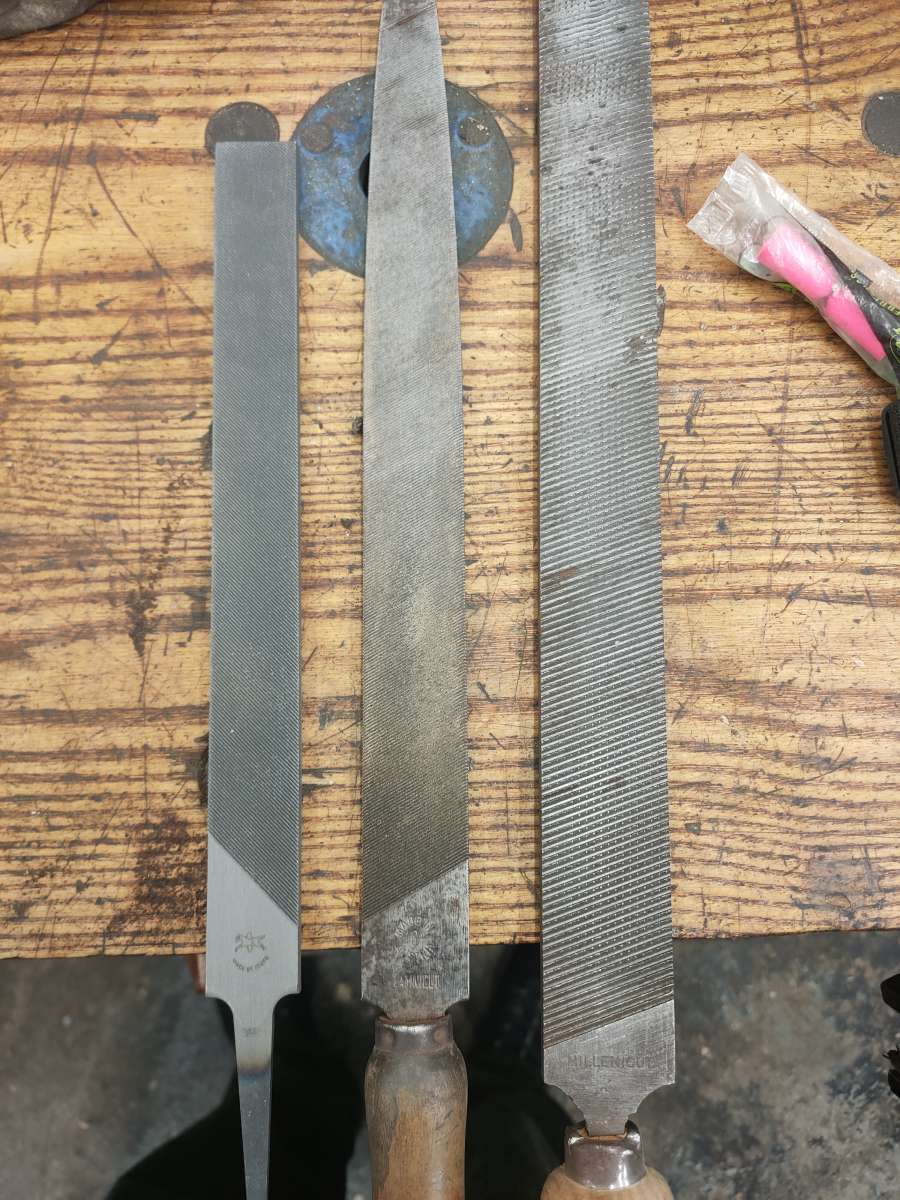
                        Hurrah!!!! Look what I got = the one on the left!!!!IMG20261030173740

                        It is a real left-handed lathe file. I once got a lathe file from ArcEuro once that looked left handed in the picture but wan’t upon arrival so I’ve always been wary of trying again. In a moment of bordom I found myself search amazon and came across this pferd – amazon returns are just soooo good I decided to take the chance.

                        #872131
                        JasonB
                        Moderator
                          @jasonb

                          To be fair to ARC they sold them as “LONG angle lathe files” not left hand. Mine works well and looks just like the one in the ARC photos.

                          The “hand finishing” files show the cut in the opposite direction to the low angle.

                          #872138
                          Fulmen
                          Participant
                            @fulmen

                            Ooooh, that’s a nice find, Jack.

                            As for carbide files I think cost and brittleness makes it less than ideal in real life. I have seen coarse carbide files made for restoring brake calipers, but never actually looked at them:

                            https://www.biltema.no/en-no/car—mc/car-spare-parts/brake-system/brake-friction/brake-pads/brake-calliper-file-2000064408

                            But if it’s too hard for a steel file it’s not really practical to hand file anyway, and I’m not fast enough to benefit from the increased cutting speed.

                            Diamonds will wear fast in steel, that’s well known. That’s what CBN is for. It is not quite as hard as diamond but has better heat resistance.

                            #872155
                            Mark Rand
                            Participant
                              @markrand96270
                              On Fulmen Said:


                              Diamonds will wear fast in steel, that’s well known. That’s what CBN is for. It is not quite as hard as diamond but has better heat resistance.

                              Diamond doesn’t seem to be absorbed/wear at low cutting speeds and heats. The various plated-on diamond abrasives do seem to suffer from high pressure when used, but that’s probably due to the weak bond with the nickel plating.


                              Having said that, CBN ought to work at least as well as diamond in pretty much any ‘file’ related activity. 🙂

                              #872177
                              Dave S
                              Participant
                                @daves59043

                                There is a theory that carbon is soluble in steel and diamonds are carbon therefore diamond tools will dissolve into steel if they are used on them.
                                It has some truth, but the diffusion process is extremely slow – how long does a case hardening process take? Hours and hours for any appreciable depth (not certain offhand but 0.001”per hour is a figure I seem to remember) at a decent temperature.

                                Hand use of diamond tools on steel will never in a normal lifetime be an issue.

                                I often use diamond wheel to grind HSS tools – the finish is easier to lap to a mirror (also with diamond, on a powered lap).

                                The wheel I use most is worn, as any abrasive wheel gets, but it’s also best part of 20 years old.

                                Dave

                                #872189
                                jaCK Hobson
                                Participant
                                  @jackhobson50760
                                  On JasonB Said:

                                  To be fair to ARC they sold them as “LONG angle lathe files” not left hand. Mine works well and looks just like the one in the ARC photos.

                                  The “hand finishing” files show the cut in the opposite direction to the low angle.

                                  I probably got the hand finishing file then. To be fair to arc, i emailed and asked if they had, or could source, left handed files and they told me no. I bought the left handed image even so, just in case they handn’t checked (can you have too many files?), and didn’t blame arc for the mistake. I also tried to contact their supplier with same request. I put a bit of time into trying to find one hence I’m quite chuffed now.

                                  FYI, my search for best file for left handers up to now was nicholson ‘magicut’ intended for plastics. I reccomend for right handers on steel.

                                  #872196
                                  JasonB
                                  Moderator
                                    @jasonb

                                    Out of interest jack what effect does the hand of the file make in use? The only thing I can think of is that there can be a slight tendancy for mine to want to move towards the chuck if you don’t hold it firmly.

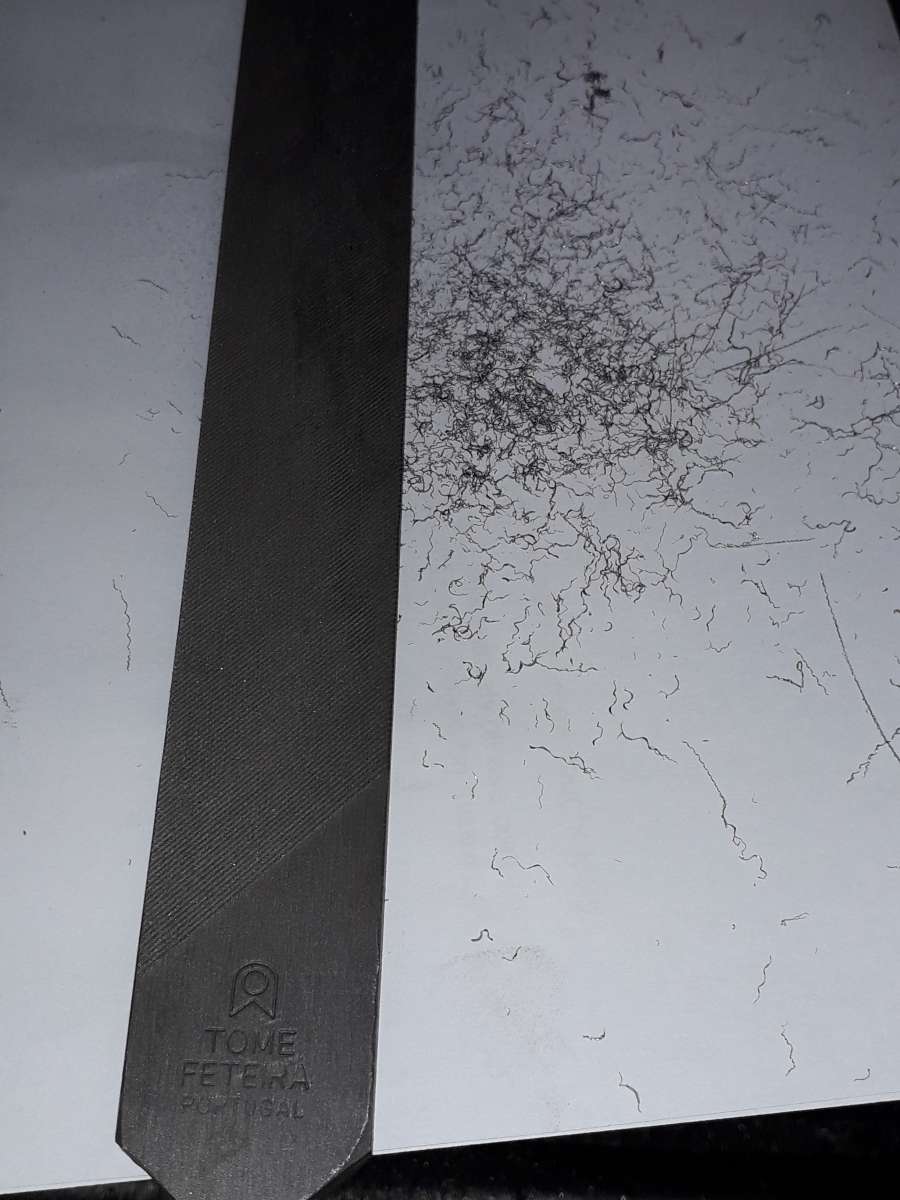
                                    20191214_084717

                                    #872197
                                    jaCK Hobson
                                    Participant
                                      @jackhobson50760

                                      On a lathe you might want left or right handed files depending on whether you want to use the file on the top or bottom of the workpiece. That is why they sell both right and left handed pivot files. Underneath – you can see what is happening betterl on top seems more natural. And yes, the file diagonals make it ‘pull into’ the shoulder (or push away from it.

                                      This lathe file I have has both safe edges (although better to give them a bit of a grind if you want them truely safe).


                                      If a left hander uses a normal file the same way as a right hander does then there is a tendancy for the angle of the teeth to line up with the direction of cut and then they tend to sink into the previous groove = you get a checkering file effect with very deep grooves so very poor surface finish. To combat this, as a left hander, you have to almost perform a reverse stroke compared to right handers.

                                      No problem if direction of cut is straight along the file (e.g. planing a hand scraper edge) or draw filling. If you want to push when draw filing then the handle has to be in the right hand ?! So maybe it should be called push filing. OR maybe lefties inveted it because of the frustration with normal filing.

                                      I may now concentrate on getting left handed digital calipers – much easier to find, but what a mark up!!


                                      #872198
                                      jaCK Hobson
                                      Participant
                                        @jackhobson50760
                                        On Peter Cook 6 Said:

                                        A quick google got me

                                        Carbide – Flat File Cintride (alphacut.co.uk) at considerably less money, but they seem to be made the same way as the diamond files, with grains of carbide welded to a carrier. They also do round!

                                        On Fulmen Said:


                                        As for carbide files

                                        https://www.biltema.no/en-no/car—mc/car-spare-parts/brake-system/brake-friction/brake-pads/brake-calliper-file-2000064408


                                        I’m very dubious that that is made of carbide. I was initially excited but most ‘brake caliper’ files I find are just narrow and coarse ordinary files… and far too cheap to be solid carbide. But, you do get solid carbide burrs so maybe a file is possible. Pretty sure they would have to machine each tooth in the hard state and I would expect it to cost north of £100. I’d love to be proved wrong and be able to add one to my collection.

                                        #872199
                                        Fulmen
                                        Participant
                                          @fulmen

                                          I’ll be sure to look at it next time I’m there.

                                          #872201
                                          JasonB
                                          Moderator
                                            @jasonb

                                            Thanks Jack, similar to what I thought. I do sometime suse mine under the work holding it with the handle facing away from me but not reaching over to the back, it is easier to see if shaping a convex profile.#

                                            I suppose a length of studding and stack up 50 or so inserts and you would be well on your way to a carbide file. I use dto get through quite a few 50mm wide  x 12 deep ones that were 1.5mm thick and had two holes😊😊😊

                                            Thinking of something like a carbide burr it should be possible to cut file teeth in a similar way but as you say it is not going to be cheap.

                                          Viewing 20 posts - 1 through 20 (of 20 total)
                                          • Please log in to reply to this topic. Registering is free and easy using the links on the menu at the top of this page.

                                          Latest Replies

                                          Viewing 25 topics - 1 through 25 (of 25 total)
                                          Viewing 25 topics - 1 through 25 (of 25 total)

                                          View full reply list.