If it ain’t broke don’t fix it – or should I?

If it ain’t broke don’t fix it – or should I?

Home Forums Beginners questions If it ain’t broke don’t fix it – or should I?

Viewing 17 posts - 1 through 17 (of 17 total)
  • Author
    Posts
  • #419731
    Robin Graham
    Participant
      @robingraham42208

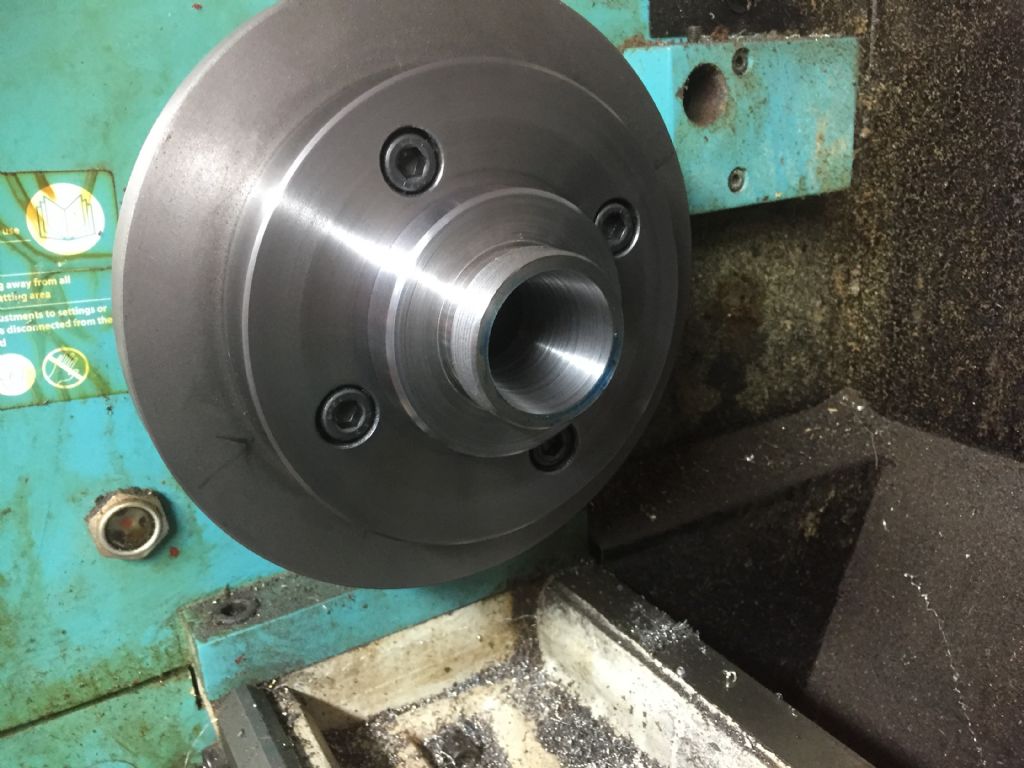
      I've made an ER40 chuck for my lathe. It works well enough – I'm getting a TIR of better than 0.008mm (if my dial indicator is to believed) using 'standard precision' collets, which is more than OK for what I do. However, a blush rises to my cheeks when I look at the finish on the the internal taper:

      img_2061.jpg

      Not a great pic, but the finish is somewhat less than superb. I'm not sure what went wrong – maybe swarf rattling round as happens when boring – I cut it dry.

      Should I just say that it works for now and leave it alone or attempt to shine it up? If the latter how would folk go about it?

      Robin.


      Edited By Robin Graham on 19/07/2019 01:18:42

      #9756
      Robin Graham
      Participant
        @robingraham42208
        #419732
        Mark Rand
        Participant
          @markrand96270

          Don't worry too much what it looks like. Is it actually rough when you drag a fingernail along it or it is just an optical effect?

          Either way, unless it has been hardened, it'll eventually wear smooth.

          #419733
          Robin Graham
          Participant
            @robingraham42208

            Thanks Mark, it's 'slightly rough' to the fingernail but hard to quantify. Not hardened so probably best to leave as is and let it bed in. Just annoyed that I didn't get a better finish and wondering why.

            Robin.

            #419736
            Kiwi Bloke
            Participant
              @kiwibloke62605

              Probably would have been better with lubricant, assuming tool geometry and all other variables were OK. It's often helpful to bore with the tool 'upside down', working on the 'back' of the bore – the surface furthest from you (perhaps you did…). That reduces the risk of chips getting dragged between tool and work and spoiling the finish. Also, the feed is applied by conventional and familiar use of the dials, rather than having to subtract. But if it works OK, why bother?

              #419747
              Michael Gilligan
              Participant
                @michaelgilligan61133
                Posted by Robin Graham on 19/07/2019 01:05:30:

                … It works well enough – I'm getting a TIR of better than 0.008mm (if my dial indicator is to believed) using 'standard precision' collets, which is more than OK for what I do.

                [ … ]

                Should I just say that it works for now and leave it alone or attempt to shine it up?

                .

                I think you answered your own question, Robin

                Unless and until the time comes that it is not "more than O.K." … Just use it.

                MichaelG.

                #419748
                not done it yet
                Participant
                  @notdoneityet

                  Question might be: What difference would it make if you simply improved the finish with a fine abrasive? Likelihood is that there would be a good deal more collet contact with very little change in diameter or taper.

                  A test with engineer’s blue might be enlightening, just to check the contact between collet and holder.

                  #419759
                  Mick B1
                  Participant
                    @mickb1

                    You're not worrying about the dried-up oil stains on yer headstock.

                    It works well. Why fuss about unseen cosmetics – this is engineering, not fashion?

                    If you hadn't put it on this forum, only you, and perhaps He Who Sees All Things would know.

                    laugh


                    Edited By Mick B1 on 19/07/2019 09:25:25

                    #419760
                    pgk pgk
                    Participant
                      @pgkpgk17461

                      I'm sure I'm not the only one that has trouble getting the best finish when hand turning the top slide on a blind taper. I made an ER32 holder and used emery wrapped round a collet to improve things.

                      pgk

                      #419771
                      Baz
                      Participant
                        @baz89810

                        Leave it! If you re machine it you may make it worse, angle wise or finish wise, use it until it needs re machining, which will most probably be ten years time with the amount of use model engineers stuff has.

                        #419773
                        SillyOldDuffer
                        Moderator
                          @sillyoldduffer
                          Posted by not done it yet on 19/07/2019 07:45:09:

                          Question might be: What difference would it make if you simply improved the finish with a fine abrasive? Likelihood is that there would be a good deal more collet contact with very little change in diameter or taper.

                          The smoother the mating surfaces the better the grip, which – in theory – is a 'good thing'. Whether Robin's taper need improving is a much harder question. Depends how rough it is. I've often found feel to be better than a visual inspection. Running a finger or finger nail lightly over an object can detect invisible defects.

                          So I'd compare the feel of the new taper to that of another. If the new taper feels markedly rough in comparison, I'd polish it gently with a fine paper. (With care – overdoing metal removal could spoil the taper.)

                          There's a difference in my mind between the miniature screw-thread type of rough finish with pronounced peaks and troughs due to severe tearing, or wrong feed-rate, and the spoilt look you get when swarf is caught by the cutter and smeared over an otherwise flat surface. Ideally tapers should be polished, but I suspect smears matter less than ridges.

                          If the taper slips due to poor contact there's a high risk of damaging both male and female tapers, making them even more likely to slip in future. I suspect it would take a lot of time for such damage to become bad enough to matter in a home workshop. But it depends on how hard the taper is worked.

                          Some much for theory. In practice, I wonder if dirt getting into the tapers might be more serious than a mildly poor finish? Despite wiping off before each insertion, I've still found swarf crushed on the male. As well as reducing the grip, presumably dirt must also tilt the taper slightly. But I've not noticed dirt in the taper causing a real-world problem with a cut.

                          On balance, if the taper works and doesn't feel awful, I'd leave it alone.

                          Dave

                          #419774
                          Howard Lewis
                          Participant
                            @howardlewis46836

                            Like pgk pgk, I used fine emery wrapped around a collet to polish the internal taper.

                            BUT, do not press too hard, or it will grab and snatch things out of your hand, if you are lucky.

                            Putting some oil onto the emery tape, will soften the cut slightly and improve the finish.

                            This technique has worked for ,e, for the five or so times that it has been used.

                            Gently does it!

                            Howard

                            #419789
                            larry phelan 1
                            Participant
                              @larryphelan1

                              Let sleeping dogs lie !!

                              #419791
                              mechman48
                              Participant
                                @mechman48

                                An old engineering adage … 'if it aint broke don't fix it'. So if it runs accurately enough for you … 0.008mm is pretty damnm good so…

                                George.

                                #419807
                                Clive Foster
                                Participant
                                  @clivefoster55965

                                  Time to blue up and twist collet in the taper to see how good the fit really is. The look at and finger it test is remarkably sensitive and often something that doesn't seem to be as wonderful as you wanted is actually pretty good.

                                  Which seems to be the case here.

                                  However there is considerable potential friction involved in finally snugging down a collet so things generally go better with smooth polished contact surfaces. The contact area on ER systems is relatively large leading to potentially more friction. Which is why the published tightening torque figures are so high. My guess is that a less than smooth but still accurately shaped, surface will limit the maximum grip of the collet at sensible tightening torques. We Home Shop and ME types generally don't tighten the things up to full rated torque anyway and, usually, do just fine even tho' the grip in practice is less than book.

                                  So long as the blue test shows 50% or more coverage and no shape errors, as in sorta like crappy thread, just surface finish I'd say you are good to go. If blue coverage is bit low then best to make a matching plug and lap these surfaces to improve the contact area.

                                  Sounds like you re doing just fine but if you do do a blue test you will know.

                                  Clive

                                  #419812
                                  old mart
                                  Participant
                                    @oldmart

                                    Have you tried all of your collets for consistency using undamaged drill shanks, or milling cutters? If the average is only 8 microns, then its best to leave well alone. If you have a longer test bar, and that is ok with several successive fitting and refitting, turning the collet in the nut each time, then what you have is as good as it gets.

                                    #419921
                                    Robin Graham
                                    Participant
                                      @robingraham42208

                                      Thanks for replies. It seems that the consensus is to leave well alone and not risk compromising the accuracy I have achieved (probably more by luck than skill). Because I don't have any training in machining I just bash on, make mistakes and try to learn from them. In this case I seem to have achieved one goal (making an accurate chuck) but but failed on another (using the topslide to bore a taper with a decent finish). Hence the tension!

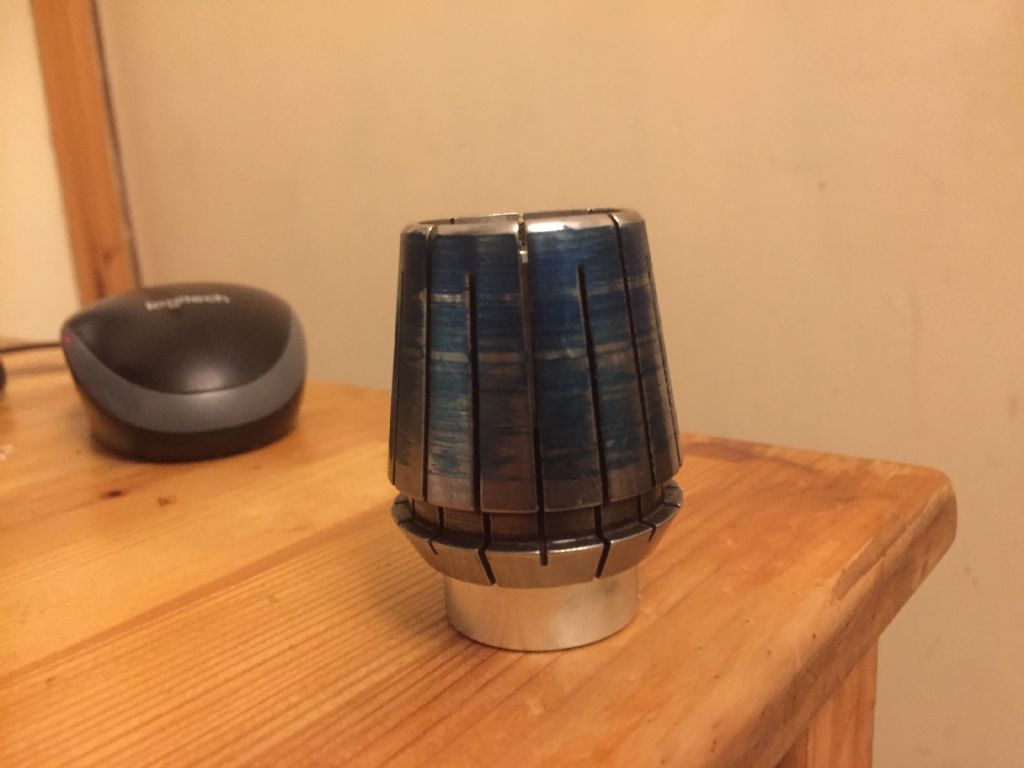
                                      I tried bluing (with the right stuff, not layout!):

                                      er40blue.jpg

                                      This was with a minimal wipe of blue on the internal taper, then rotating a 28mm collet supported by a nominal 28 mm bar (it was actually 27.85mm, which gave a light push fit) with hand pressure. I don't know how to interpret that though, other than it shows that the surfaces are in contact along the length of the taper.

                                      I'll probably try a light skim with suds – my boring tools have through coolant holes, but I hate the stuff, wet, smelly, goes everywhere and leaves horrid dried oil stains on the headstock. But it clears the swarf.

                                      Regarding torque, I first tested the chuck with what seemed normal force for tightening something like this and the TIR was a depressing 0.04mm. It was only when I really leaned on it that it went down to 8 microns.

                                      Robin

                                    Viewing 17 posts - 1 through 17 (of 17 total)
                                    • Please log in to reply to this topic. Registering is free and easy using the links on the menu at the top of this page.

                                    Latest Replies

                                    Home Forums Beginners questions Topics

                                    Viewing 25 topics - 1 through 25 (of 25 total)
                                    Viewing 25 topics - 1 through 25 (of 25 total)

                                    View full reply list.