Making spokes into spokes

Making spokes into spokes

Home Forums Locomotives Making spokes into spokes

Viewing 17 posts - 1 through 17 (of 17 total)
  • Author
    Posts
  • #351723
    RichardN
    Participant
      @richardn

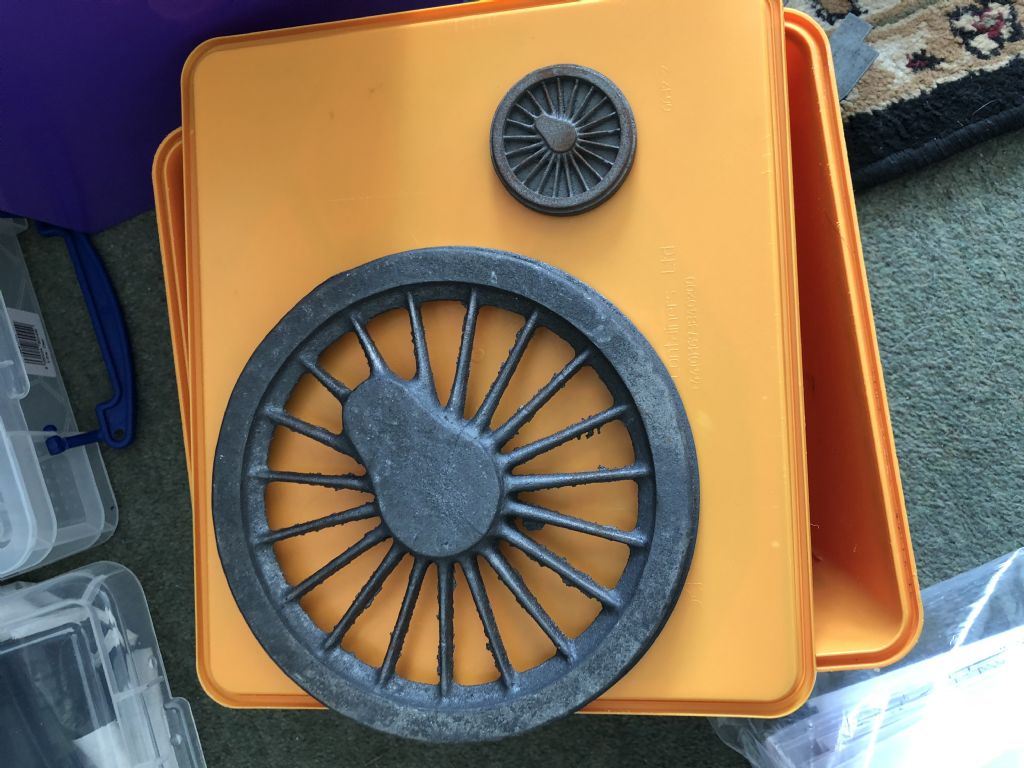
      I am working on an 0 Gauge 4-4-0, for which I have wheel castings, where the spokes aren't truly spokes as they are all joined by a complete cast disk at the back. the photo shows a driving wheel to machine (dwarfed by a 5" black five driving wheel, where the spokes are true spokes, if that makes any sense?)

      img_0821.jpg

      I suspect drilling and filing each would send me crazy, but if machining the back solid portion off the centre on the lathe, as I break through the load on the spokes would potentially shatter them?

      Is patient fettling the answer, and I should be thankful it only has 4 driving wheels?

      thanks,

      Richard

      #1706
      RichardN
      Participant
        @richardn
        #351732
        Nigel Bennett
        Participant
          @nigelbennett69913

          As far as I'm aware, the intention is that you machine the back away as a last operation – very carefully and gently – to expose the spokes. I imagine they're cast that way because the spokes on the 0G wheel would be so thin that they'd be impossible to cast otherwise – or at the very least they'd be chilled and be very fragile. If it was a split pattern – like the 5"G one – than getting the two halves of the mould to line up within a thou or two would be another problem.

          Just take it steady!

          #351737
          richardandtracy
          Participant
            @richardandtracy

            If you are really concerned about ham-fisted machining shattering the spokes, heat up & flow soft solder into the recesses between the spokes, machine the spokes free and then melt out the soft solder.

            The chances are that if you have a really sharp tool and take tiny cuts, you'll get to the point where you have foil between the spokes and it will deflect out of the way. At that point a penknife blade will act as a deburrer to cut the last bits away.

            Regards,

            Richard.

            #351738
            Brian G
            Participant
              @briang

              Have a look here, Mark Wood gives instructions for gauge 0, 1 and 3 wheels: **LINK**

              Brian

              #351742
              Baz
              Participant
                @baz89810

                Not only O gauge wheels done that way, I have got 3.5 gauge wheels with solid backs, I think they are for Don Young’s Derby 4F, about 4” diameter, can’t remember if I got them from Reeves or Blackgates. One day I might get round to machining them.

                #351746
                IanT
                Participant
                  @iant

                  I think Richard (andTracy) has it right RichardN – very sharp tool and light cuts will do it – that's how they are made to be turned.

                  On wheel castings I generally use a tipped tool to take the top surface off and then a HSS tool for a good finish – so don't try the whole work with a HSS tool without giving it a quick 'hone with a stone'. This was required for sand castings but may be less so for lost-wax castings (Mark Woods wheels for instance) which will not have sand embedded in the top surface.

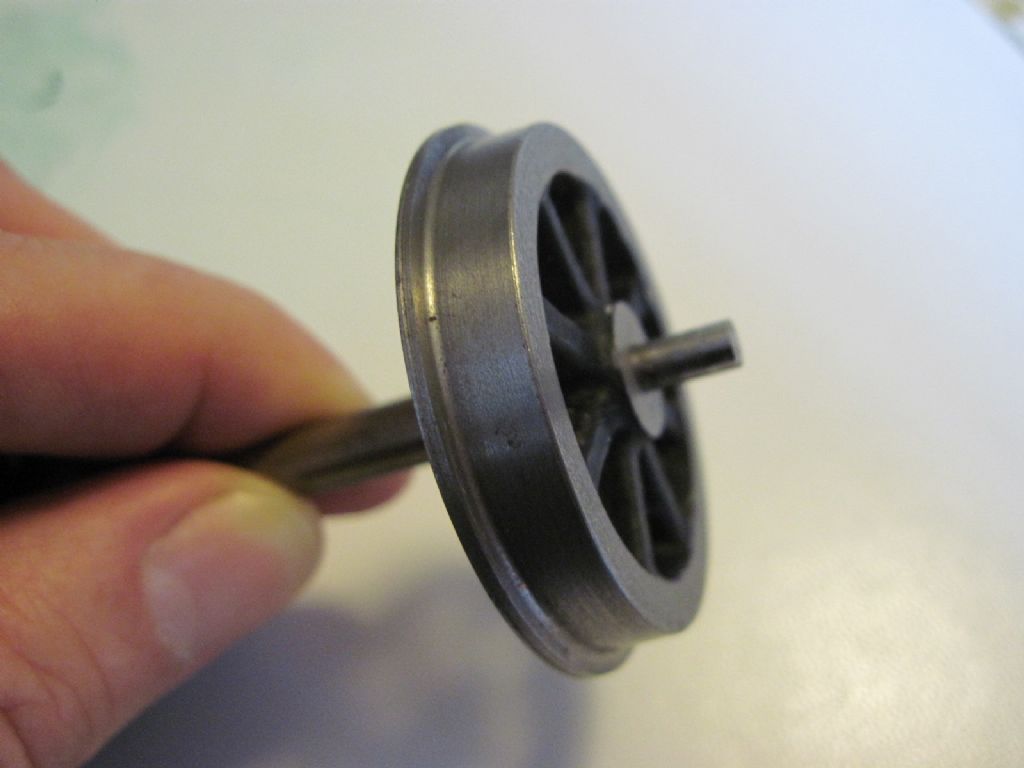
                  BTW – Mark Wood has some very fine wheel castings but (looking at his 'turning' advice) frankly I've never used a form tool to finish wheel flanges in G3 (and would not pay a toolmaker £100+ to make me one either). My usual practice is to turn all wheels on a fixed mandrel [square] to nominal size and then use a round nose tool to put on the cone angle (3 degrees in the G3S standard). This rounds the base of the tread nicely. The final 10 degree flange angle (at the top of flange) is simply done with a file. Never had a problem doing wheel castings like this.

                  Regards,

                  IanT

                  G3 wagon wheel rim.jpg

                  #351748
                  Bazyle
                  Participant
                    @bazyle

                    Nigel was correct above. I have machined G1 wheels like that. Note you don't machine straight across you leave the rim full thickness otherwise you will lose part of the flange. They aren't as fragile as you think if they casting is sound. A purist will then file the rear of the spoke to profile.

                    #351783
                    RichardN
                    Participant
                      @richardn

                      Thanks for the replies- sounds like I’m overly worrying, and will have to just jump in and try to follow the advice with sharp fine cuts- might try supporting with soft solder, for peace of mind… and filing the rear of the spokes- I genuinely hadn’t thought that people could leave them as machined- I was aiming for the same profile as the front, I was thinking.

                      #351789
                      Sam Stones
                      Participant
                        @samstones42903

                        This anecdote won’t be much help to you Richard, but …

                        My first or second visit to the Model Engineer’s Exhibition at the Manchester Corn Exchange as a young apprentice was back in the early 50’s. A railway layout being exhibited was so small it must have preceded ‘N’ Scale. The lengthy layout was small enough to fit in three banjo cases.

                        My chaperone Bill, an outstanding toolmaker in the shop where we worked, began asking various questions about the layout, but especially the engines themselves. So that he could inspect them more closely, they handed him one of the engines. Sitting in the palm of his hand it was quite an outstanding piece of workmanship.

                        They told us they wound the motors themselves. There was nothing else available.

                        “But how did you make the spokes in the driving wheels?’ asked Bill.

                        “Oh, we just made a tool and bashed them out!”

                        Sam

                        #351790
                        Michael Gilligan
                        Participant
                          @michaelgilligan61133

                          Richard,

                          Now you've pondered what's ahead of you: Imagine the work that goes into finishing the three-spoke 'balance bridge' on Frodsham's new watch !

                          Have a look at the final two photos in this story: **LINK**

                          Charles Frodsham Introduces the Long Awaited Double Impulse Chronometer Wristwatch

                          surprise MichaelG.

                          #351801
                          RichardN
                          Participant
                            @richardn

                            Thanks Michael, always good to remind myself of just how little talent I have! wink 2 0 gauge is quite fine enough for me, and I won’t need to use polished gemstones for bearing surfaces!

                            Although, the watch is quite nice…

                            #351811
                            Michael Gilligan
                            Participant
                              @michaelgilligan61133

                              No comparisons were intended, Richard … I just wanted to share the beauty of that work.

                              They have finally launched the [unaffordable by me] watch; but my fond memory dates back to March 2011 when I attended their lecture about the prototypes, in Birmingham. They showed us several videos, including one which demonstrated the hand-working of those spokes; and it was a joy to see how this dedicated team combines ancient and modern techniques.

                              MichaelG.

                              Edited By Michael Gilligan on 27/04/2018 08:28:21

                              #351837
                              Nealeb
                              Participant
                                @nealeb

                                I have had the great pleasure of demonstrating a home-built wire EDM machine on the SMEE stand at a few exhibitions lately, and one of the delights is the number of "professional" users who stop to chat, and pass on some of their experience with the "big boys" versions of our little machine. At Alexandra Palace in January, someone was telling me about the Swiss watch industry that is now adopting wire EDM as a manufacturing technique for watch parts – you can pre-harden, machine to tight tolerances, and need virtually no finishing when making small detent springs and other tiny parts. I'm sure that Frodsham would turn their noses up at that, but as far as the Swiss are concerned, quality and yield go up and hence costs come down – and not many of us can afford a "hand-finished" watch…

                                However, I'm not sure that I would want to set up the wire EDM to cut the spokes in RichardN's wheels!

                                #351844
                                Michael Gilligan
                                Participant
                                  @michaelgilligan61133

                                  Neale,

                                  Frodsham actually rebuilt and customised a Swiss multi-axis machine to produce parts … As I mentioned, they excel in combining ancient and modern techniques. All of the close-tolerance work for that Bridge is done on the CNC machine; but the final shaping of the spokes is done by hand. … I really wish I had access to the videos that they showed us.

                                  MichaelG.

                                  .

                                  P.S. You might like this, from McGonigle:

                                  https://www.facebook.com/note.php?note_id=426265650801

                                  Edited By Michael Gilligan on 27/04/2018 11:37:59

                                  #351904
                                  Michael Gilligan
                                  Participant
                                    @michaelgilligan61133

                                    A quick footnote, for Neale: **LINK**

                                    http://www.machinery-market.co.uk/news/11251/Benefits-of-automated-video-measuring

                                    It appears that Frodsham contacts-out its EDM requirements.

                                    MichaelG.

                                    #351916
                                    Sam Stones
                                    Participant
                                      @samstones42903

                                      Metal 'stamping and forming' in miniature?

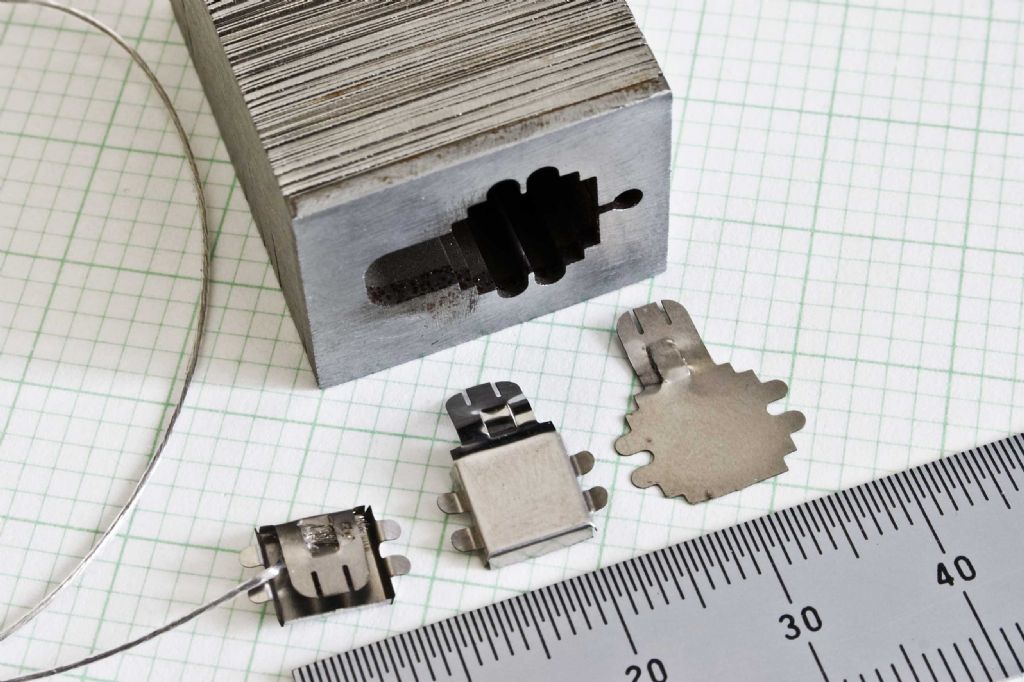
                                      While designing and building a 'bundle' of quite small prototypes, it was necessary to make about 300 stainless steel electrodes 7x7mm square by 1mm thick. First thoughts were to just chop up some 1mm stainless sheet and machine them as blanks.

                                      Attaching stainless (suture) wire for electrical (and other) purposes presented a few difficulties, as did securing the electrodes in place. Then I discovered a process that would allow me to profile them from much thinner material, SS 0.07mm shim to be exact.

                                      As you can see here …

                                      electrodes.jpg

                                      the electrodes could feature tabs as a means of attachment together with a (rather crude) means of attaching the wire.

                                      The block in the picture, now more of a desktop novelty is 25x20mm. The stack height of about 300 shims measures 35mm. Gauge steel pieces 1.5mm thick riveted through the length provided support hold the sandwich together.

                                      Held tightly in this sandwich arrangement produced clean blanks with no need for deburring.

                                      Although the wire EDM process was developed in the 60’s, it was about 1990 at a company somewhere south east of Melbourne when these particular electrodes were ‘burned’. Clearly from the literature and links, significant advances have taken place since then.

                                      The process might prove useful to Model Engineers!?

                                      Sam

                                    Viewing 17 posts - 1 through 17 (of 17 total)
                                    • Please log in to reply to this topic. Registering is free and easy using the links on the menu at the top of this page.

                                    Latest Replies

                                    Home Forums Locomotives Topics

                                    Viewing 25 topics - 1 through 25 (of 25 total)
                                    Viewing 25 topics - 1 through 25 (of 25 total)

                                    View full reply list.