Weird mill problem.

Weird mill problem.

Home Forums Help and Assistance! (Offered or Wanted) Weird mill problem.

Viewing 19 posts - 1 through 19 (of 19 total)
  • Author
    Posts
  • #32961
    MW
    Participant
      @mw27036
      #295921
      MW
      Participant
        @mw27036

        Hey,

        I've had to drill a lot of holes recently on my WM16, I use a glass scale DRO system from ARC.

        And I've noticed that if I centre my work on the middle of a centre bore on a work piece, if I move, say 15mm to the left, considering the radius of the centre bore too. drill a hole, then move back 15mm to the right without changing the setup, i'm always 1-1.5mm out. Meaning, it will be 13-13.5mm on the right. 

        When technically, I should still be using the same datum from the middle of the bore. Am I not including the radius of the centre drill? Is this what's going wrong?

        I was trained on a lathe and only had to find my feet with a mill. So i'm pretty sure theres something i'm doing wrong. 

        Michael W

        Edited By Michael-w on 01/05/2017 22:08:02

        #295926
        SillyOldDuffer
        Moderator
          @sillyoldduffer

          One way to eliminate operator / equipment error is to test with a pointer in the spindle against a steel rule laid on the the table. With the DRO zeroed at the end of the rule, crank the table at least 150mm along the rule as indicated by the DRO. Check the spindle pointer is at 150mm on the rule. Then, again using the DRO, return back to zero and check the pointer really is at the start point.

          It the test passes, the DRO is OK and you need to check how you're driving it. More likely is that the DRO is misbehaving. Nearly flat batteries cause odd jumping, and I once had trouble with a loose USB connector. Also, make sure that the head moves smoothly along the track and that the track is parallel and true to the table. Mine shifted after a while and the resulting binding caused readings to jump when the direction was reversed.

          Dave

          #295927
          John Rudd
          Participant
            @johnrudd16576

            Security of scale fixings? Is anything loose?

            My Arc glass scales are pretty repetitive…( touch wood!)

            #295929
            Martin Connelly
            Participant
              @martinconnelly55370

              If you are moving 15mm based on the scale on the handwheel then moving back 15mm based on the handwheel scale what you have is backlash. The point of the DRO is to allow you to make movements using the DRO not the handwheel scale. Backlash is not usually a problem on a lathe as you only work from one direction.

              Is this what you are doing?

              Martin C

              #295931
              MW
              Participant
                @mw27036

                No i'm pretty sure the DRO isn't at fault, it is reading correctly and it doesn't measure the handwheel,

                but i'm thinking maybe a couple of the bolts on the home-made register plate might be loose enough for the scale on the table to start moving before the DRO pick-up unit kicks in. I can't check it now but i'll look at it tomorrow. 

                I checked the table for backlash by rocking it as hard as I could and I didn't get anything like 1.5mm out, more like 0.1-0.2mm 

                Good way to test this might be on a piece of scrap, moving incrementally in the same direction, check to see the distances are the same, then move in the opposite direction and see if theres a difference. 

                Michael W

                Edited By Michael-w on 01/05/2017 23:19:45

                #295936
                Ady1
                Participant
                  @ady1

                  Sounds like backlash because the DRO tracks the worm, not the table

                  With a really cheap system like the one below backlash is "irrelevant" because the DRO tracks only the saddle movement, not the worm drive

                  dscf1113.jpg

                  Edited By Ady1 on 02/05/2017 00:30:54

                  #295937
                  Ady1
                  Participant
                    @ady1

                    Another weird thing I found was "stickyness"

                    Maybe the table sticks or the moving part of the DRO sticks when moving in a certain direction

                    If I tapped the top of saddle with a spanner my table would "spring" up to 0.1mm

                    #295941
                    Enough!
                    Participant
                      @enough

                      All this talk of "worms" has me totally confused. Where's the worm on a WM16?

                      The two component halves of the scale – glass or otherwise – should be fitted one half rigidly attached to the table, the other half rigidly attached to to the machine part that the table is sliding in. Provided this is true and the two parts of the scale are correctly aligned to each other, then the DRO reading is dependent only on the relative displacement of the scale halves.

                      Any error is due either to a mounting that allows one part of the scale to move or deflection of the mount. In some cases you can get jumps in DRO reading due to poor electrical connections or grounding problems but those are usually not repeatable.

                      (Of course if you are comparing the change in the DRO reading to the change in the feedscrew dials, then just about anything goes unless you make corrections for backlash. But why bother? The DRO is supposed to replace the dials. I probably haven't looked at the dials on mine in 7 or 8 years).


                      Edited By Bandersnatch on 02/05/2017 01:48:24

                      #295950
                      JasonB
                      Moderator
                        @jasonb

                        As John says sounds like the brackets for the DRO are moving, if using teh DRO you should not see any backlash as it measures actual table movement.

                        Fit a plunger type dial gauge to a non moving part of the mill and the plunger against say the side of your vice and compare DRO reading with plunger.

                        "And I've noticed that if I centre my work on the middle of a centre bore on a work piece"

                        The other question is how are you indicating the centre of your first bore? 1-1.5mm error sounds very much like half the dia of an edge finder.

                        Edited By JasonB on 02/05/2017 07:31:58

                        #296077
                        Neil Wyatt
                        Moderator
                          @neilwyatt

                          Sounds like a loose sensor bracket to me.

                          Not that it;s ever happened to me. Oh no sir, not to me…

                          Neil

                          #296161
                          Ian S C
                          Participant
                            @iansc

                            Is there play in the head of the mill, or is it a round column and not quite locked up.

                            Ian S C

                            #296185
                            KWIL
                            Participant
                              @kwil

                              Ady1

                              I have never seen so much swarf between the shears, must have been a very big and long job!wink

                              #296451
                              Michael Briggs
                              Participant
                                @michaelbriggs82422

                                Any progress from the OP ?

                                #296456
                                Fowlers Fury
                                Participant
                                  @fowlersfury

                                  I found with my cheapo, add-on Chinese scales that it was easy to move the mill table too fast leading to false measurements being shown on the LCD. Not when actually milling but rather moving the table say to a new position for the next cut.There seems to be a maximum "speed" which these scales can tolerate without errors.

                                  OK ~ the OP is using glass scales which are undoubtedly better in that regard yet the reproducibility with my cheap scales is surprisingly good if the hand wheels are turned at a steady, slow rate.

                                  #296535
                                  Enough!
                                  Participant
                                    @enough
                                    Posted by Fowlers Fury on 04/05/2017 23:42:17:

                                    I found with my cheapo, add-on Chinese scales that it was easy to move the mill table too fast leading to false measurements being shown on the LCD. Not when actually milling but rather moving the table say to a new position for the next cut.There seems to be a maximum "speed" which these scales can tolerate without errors.

                                    Seems surprising considering these are the same scales used for calipers. And it's unlikely that you could move a milling table – even on power feed – at anything like the speed that you could move a caliper head. Although I switched to optical scales some years ago, I started with (Chinese) caliper-type capacitive scales (not actual calipers) and never had that problem.

                                    #296595
                                    Fowlers Fury
                                    Participant
                                      @fowlersfury

                                      Re: "Bandersnatch & fast traverse with Chinese scales"

                                      After fitting those scales searching online kept recommending this website:-

                                      **LINK**

                                      It's detail is impressive but being "electronically challenged" I couldn't understand much therein. However it does refer to such scales being able to operate at a fast or slow sampling speed. Further searching found another website where the user of a Dore-Westbury mill reported "One problem was that the scale unit update was not very fast – only about 3 times a second. This was OK for co-ordinate drilling but was a problem when taking a continuous cut. The update was simply not quick enough to give a real-time position. However it was discovered that the scales could be switched into a faster mode by shorting out the clock signal with the +V signal. However this had problems too because in this mode the scale would not zero. In the end 2 momentary contact buttons were added to the remote readout to enable it to switch the scales between fast and 'zeroable' modes." Link here>

                                      **LINK**

                                      I don't have the courage to install his "momentary contact buttons" especially as he wrote "The original system eventually got damage and so some replacement units were purchased ensuring that they looked the same and had the same contacts. These were wired in and worked OK, but unfortunately the additional fast/slow modification no longer worked."

                                      So I just rely on slow & steady handwheel turns instead. My Chinese scales must be about 20 years old anyway !

                                      I have though installed a stabilised power supply for the 3 scales to replace the batteries and this improved things a lot. Again to quote from the 2nd url "Other engineers have been in touch to report problems obtaining a stable reading from these systems, particularly when batteries were anything but fully charged".

                                      #297547
                                      MW
                                      Participant
                                        @mw27036

                                        Ok I think I may have gotten to the bottom of this. and the problem isn't the scales it's me! or very likely so. My test couldn't get it to go wrong a second time so I am going with that verdict. Anyway, i'll show below..

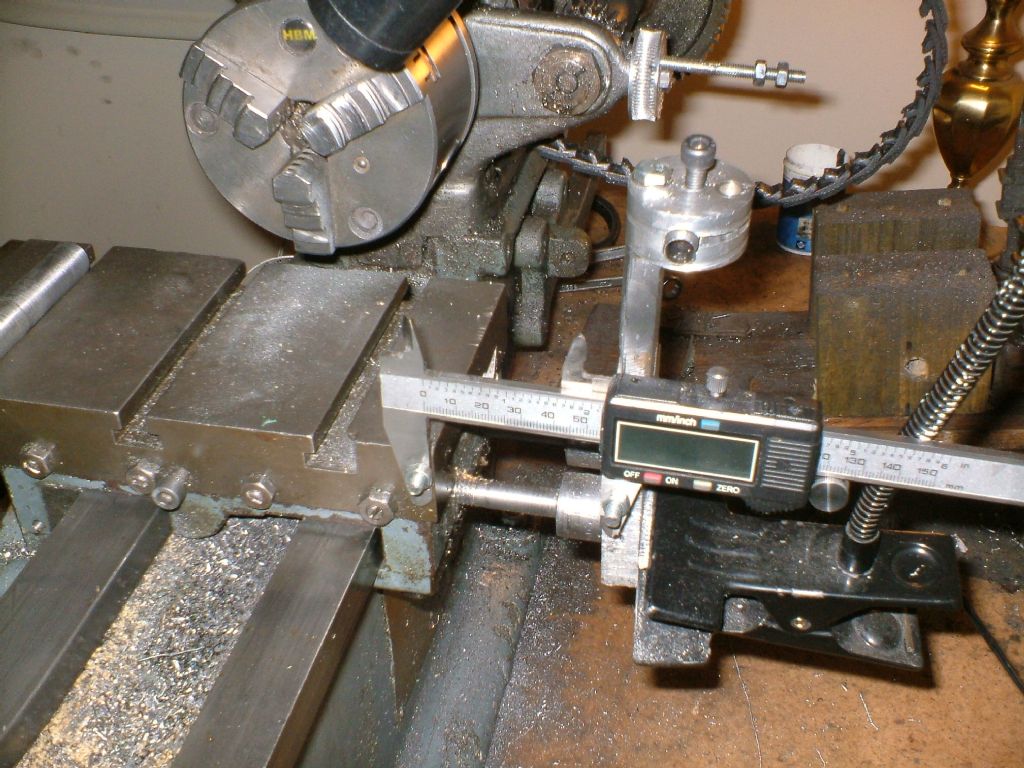
                                        ml1.jpg

                                        ml4.jpg

                                        This is the machine in question, You can see where the horizontal (x) scale is on the bottom front of the first picture, luckily that one and the only one, that required virtually zero mounting effort as the tapped holes just so happened to be in the right places, so it's all directly bolted to it. On my initial investigation, I noticed there was bit of play on the main scale body, but not an awful lot, after tightening up I couldn't get it to wiggle more than .05mm forcefully. So I ruled out that causing it. Backlash, if it could "somehow" affect the reading, wasn't the culprit either, I couldn't get the table to move by more than 0.1mm side to side, so that's nothing like a 1.5mm error. So I'm not left with a lot as to what could cause this so I decided to do a test.

                                        (You can see why I call this machine "the frankenwarco" because the motor died sometime ago and it now uses a 750W 3 phase induction motor bolted directly to it. Believe it or not it's actually been a far better experience with this one over the original!)

                                        ml3.jpg

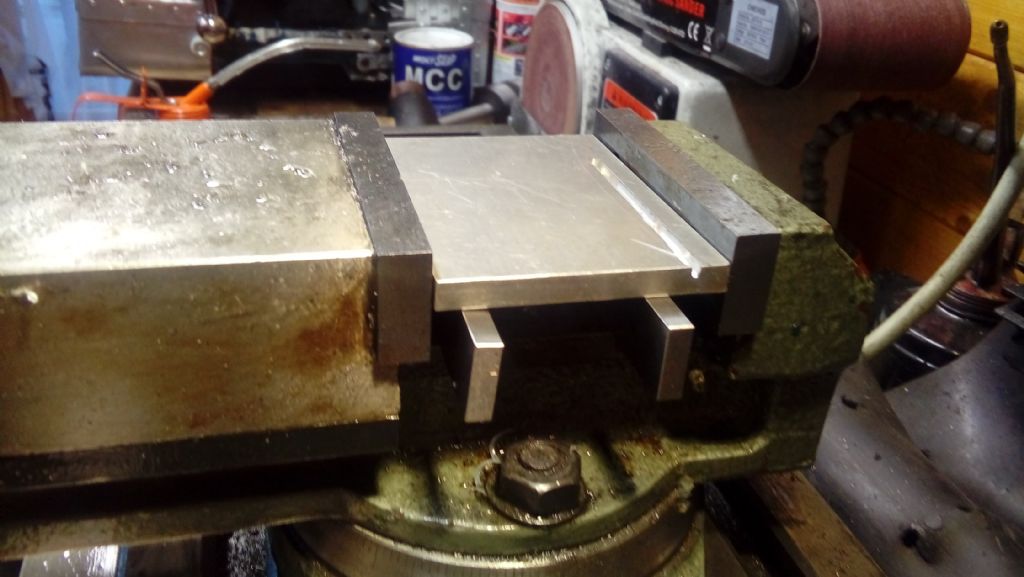
                                        Ok so I took a scrap piece of aluminium plate, big enough to get at with a ruler and plenty of space to run, ignore the mark on the metal in that picture, hence why it is scrap. And I basically repeated what went wrong before, I took a small centre drill 2.2mm Dia. or number 3 BS centre drill. drilled one hole, moved 10mm to the left including the diameter of the head of the drill, and did the same again to the right, to test the repeatability. In theory, this should give me exactly 10mm between holes either side.

                                        ml2.jpg

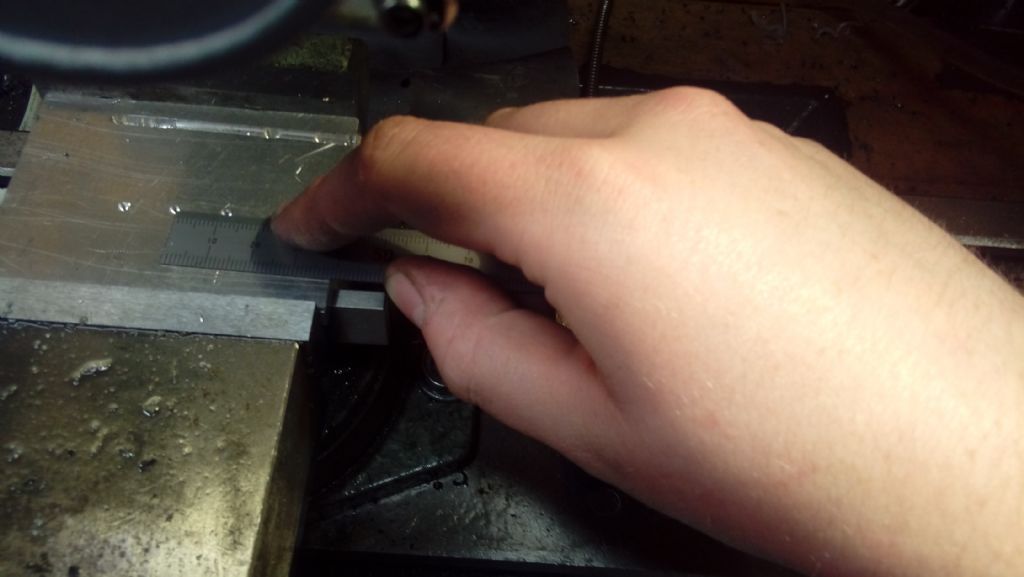
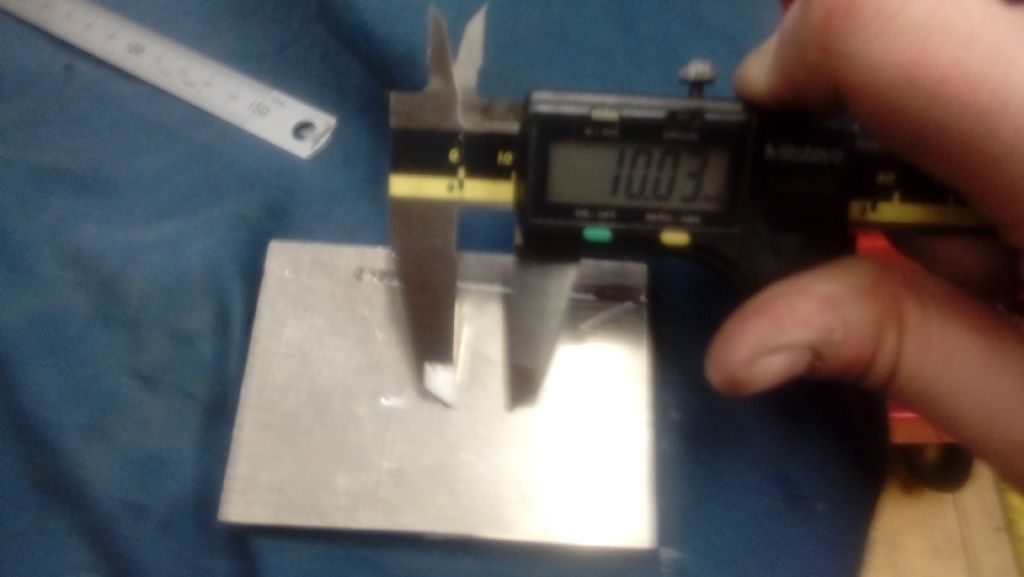
                                        Now just to make sure I used a ruler first, because my old tutor once told me, it cant tell lies and he's right, there's almost no way that scale is going to go anywhere, appears to be working. So now the Vernier test. on each side of course,

                                        ml5.jpg

                                        Bit of a blurry one but that is the Vernier as is clamped down on the edges of the holes, with a reading of near as dammit 10mm. So my scales appear to have passed the test, and there was no fault in my counting,always good to know, but so what went wrong the first time?

                                        I'm not really sure, but I suspect that I wasn't actually on the centre of the centre bore, when I clocked it up, you see, I have a coaxial indicator but I think the head was set askew slightly, so it would read perfectly one side, and not the other and this would explain it, so my equipment is only ever as good as the operator, always be sure you're doing the right thing before you assume the reading is correct!

                                        Michael W

                                        #297552
                                        Ed Duffner
                                        Participant
                                          @edduffner79357

                                          I have a couple of the small LCD-display scales with the USB type plug and recently found that if the cables connecting the sensors to the readout are touching the 'mains' cable at 90° to it, the scale will adjust erratically and go out of calibration when power is switched on to the spindle. So I think they are susceptible to electrical interference and may require some shielding (or better shielding).

                                          Ed.

                                          Edited By Ed Duffner on 11/05/2017 00:42:55

                                        Viewing 19 posts - 1 through 19 (of 19 total)
                                        • Please log in to reply to this topic. Registering is free and easy using the links on the menu at the top of this page.

                                        Latest Replies

                                        Viewing 25 topics - 1 through 25 (of 25 total)
                                        Viewing 25 topics - 1 through 25 (of 25 total)

                                        View full reply list.