Screwcutting Crashes –

Screwcutting Crashes –

Home Forums Beginners questions Screwcutting Crashes –

Viewing 25 posts - 1 through 25 (of 35 total)
  • Author
    Posts
  • #297517
    SillyOldDuffer
    Moderator
      @sillyoldduffer

      I'm back at the bottom of the class again.

      Whilst screw-cutting on my metric WM280 I crashed the saddle into the headstock. (Actually the end of the spring guard over the leadscrew,) Again!

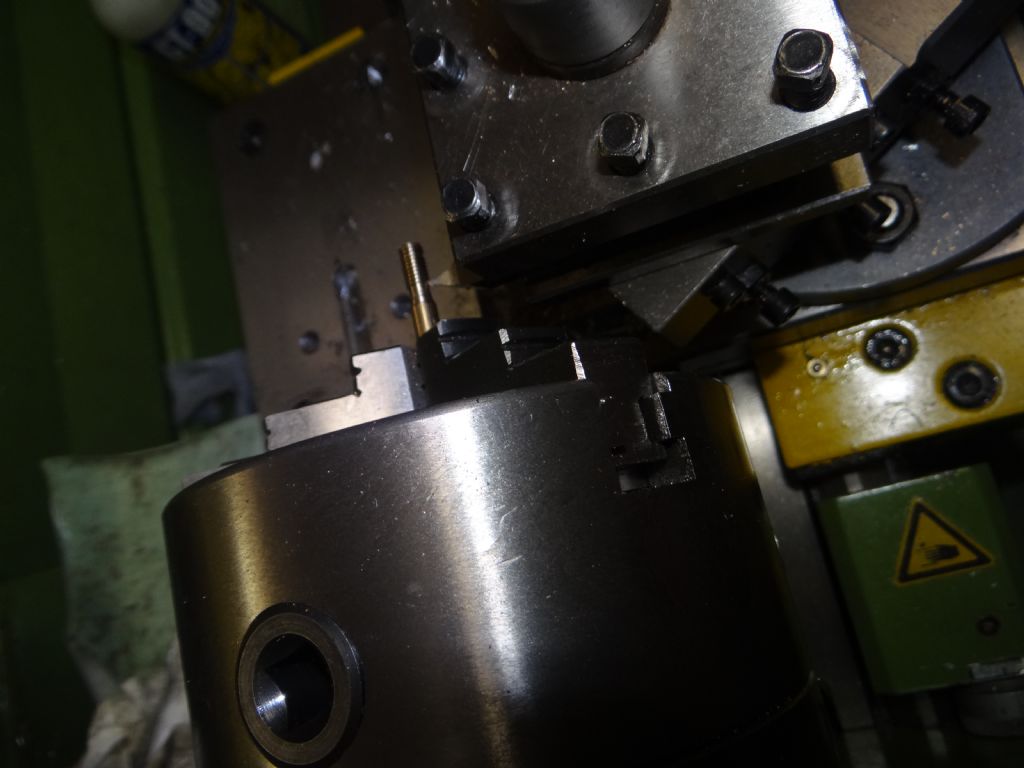
      I've set the top-slide at 60° (to give a 30° approach with the top-slide) as shown in the picture. With a 4-way toolpost you can see this means that it's very difficult to get the tool close to the chuck without hitting something.

      dsc04393.jpg

      What I don't like:

      • The rod being threaded has to be further out from the chuck than normal
      • The end of the top-slide is close to outside of the chuck jaws
      • The square top of the tool-post is close to a the inside of the jaws
      • The saddle is very close to the lathe stop, or, if this is removed, to the end of the telescopic lead-screw protector. Which is the same size and the lather-stop
      • The 4 way tool-post is clamped down with the indexing lock inoperative.
      • It's only a matter of time before something breaks!

      I find threads cut with the top-slide at an angle are much less likely to tear than when I wind the tool in at a right-angle with the cross-slide. But the downside is that I crash if I'm slightly late disengaging the half-nut.

      This isn't ideal! Am I doing something wrong?

      Dave

      PS. Sorry about the sideways photo. I can't work out how to rotate pictures once they're on the forum.

      #8710
      SillyOldDuffer
      Moderator
        @sillyoldduffer
        #297524
        Roger Williams 2
        Participant
          @rogerwilliams2

          Dave, have a look on utube for Joe Pieczynski, hes done a video about screwcutting the other way round, ie, from headstock outwards . Saves crashing ! I think its called, " Threading, best teqnique ever "

          Edited By Roger Williams 2 on 10/05/2017 21:04:54

          #297527
          Gray62
          Participant
            @gray62

            I've rotated the pic so it's a bit easier to see what is going on. I don't have any suggestions to help other than to say that on my WM250V and on my bigger GH1330 gear head lathe, I removed the leadscrew covers as I found that because of the way they are mounted, they prevent working close to the headstock, particularly when working on thin pieces mounted on the faceplate. ( in fact on both lathes it was impossible to skim the faceplates without having a ridiculous tool overhang.)

            screwcuttingpic.jpg

            #297529
            Russell Eberhardt
            Participant
              @russelleberhardt48058

              A quick change toolpost would move the tool further left or you could make an extension piece to fit your existing four way toolpost.

              Russell.

              #297530
              Anonymous

                I always screwcut with the topslide parallel to the lathe axis and locked, so clearance isn't a problem. I've not generally had a problem with tearing, but find that a spring pass or two can get rid of any roughness. Mind you I tend to use inserts for standard threads. It might be worth looking at an insert and trying to grind a HSS tool copy.

                Andrew

                #297533
                Tony Pratt 1
                Participant
                  @tonypratt1

                  Do a 'dry run' without the spindle moving to check for possible collisions, slow your rpm to allow more time to react.

                  Tony

                  #297537
                  SillyOldDuffer
                  Moderator
                    @sillyoldduffer

                    Many thanks for the replies and to Graeme for rotating the photo. (Makes a big difference!)

                    I've just watched a couple of Joe Pieczynski videos – very interesting. He made cutting threads out from the headstock in reverse look dead easy so I shall give that a try tomorrow. I'm almost convinced I need a quick-change tool-post as well, gosh they're handy. Shame about spending money – I have deep pockets and short arms. I shall see if extending the tool-post can be done out of my junk box.

                    Despite being very mean careful with money I think I ought to try carbide for threading. I get on well with inserts and, at the right speed, find they produce a good finish. That might fix the tearing problem.

                    Ta,

                    Dave

                    #297538
                    Clive Foster
                    Participant
                      @clivefoster55965

                      There are a number of less costly ways than a QC tool post of getting round this problem. Here are three examples:-

                      1) Revise the tool grind so that the tool post can be set square to the top slide. Essentially you move the tool shape round by 30° instead of the tool post. Disadvantage is that the tool post is no longer parallel to the lathe axis so the overhanging corner could come into contact with the job on longer threads.

                      2) Make an offset carrier for the threading tool. Basically a slotted block with a bar on the back to clamp in the tool post slot. Similar to the common carrier for insert parting tool blades.

                      3) Make a larger tool post with its base reaching out to the corner. This is the way I'd go having used a bunch of 4 way posts as a poor boys QC substitute in SouthBend driving days. Built up construction from two plates and a centre block glued'n screwed together is quite satisfactory so relatively simple to do using stock materials. Ideally you need something faster than the usual nut holding everything down. Especially if you find, as I did, that a fully loaded four way tends to have unacceptable vampire, or even carnivorous, inclinations so a two slot block is much safer.

                      There are several other perfectly acceptable methods but those are enough for a forum post. I started to do an article for Neil on various less costly and easily made methods of adding most of the virtues of a QC system to a basic top slide. Nearly all the concepts covered would have solved your problem. Unfortunately it got a bit out of hand. Maybe I'll finish it and do as serious edit this winter!

                      Clive

                      #297542
                      JA
                      Participant
                        @ja

                        Dave

                        The only reason for going to the bottom of the class is that you failed to check the clearance between the chuck and everything else through the whole machining operation before starting the lathe.

                        I do not know the lathe you are using but you need more space. As far as I can see from the photograph there are two ways of doing this:

                        1. Increase the overhang of the tool. One is advised to keep the overhang small but the cuts during thread cutting are light and any roughness can be removed by using a die as a thread chaser.
                        2. Move the work further away from the chuck. This will probably necessitate the use of a centre in the tailstock which may give you a few difficulties.

                        I have frequently cut threads, externally and internally, and always quite a bit of thought is required in setting up the job. As you have done I have always angle the top slide.

                        I feel that the successful cutting of an external thread is the second right of passage with a lathe (the first being setting up a round bar in an independent four jaw chuck).

                        You won't be bottom of the class for long.

                        JA

                        #297562
                        Thor 🇳🇴
                        Participant
                          @thor

                          Hi Dave,

                          Sorry to hear about your crash. I have a 290 lathe with a 3-phase motor and inverter. I made some special toolholders for my simple QCTPwith a narrow slot so the HSS toolbit just fit. I can also turn down the speed as I am approaching the end of the thread, if I am very close to the chuck I stop the lathe and turn the chuck by hand for the last turn or so, at least for small diameter work.

                          Thor

                          #297564
                          not done it yet
                          Participant
                            @notdoneityet

                            Yet another couple of possible alternatives.

                            Use a smaller chuck or thread with a die.

                            #297565
                            Speedy Builder5
                            Participant
                              @speedybuilder5

                              Suggestions:-
                              1/ Don't use the 4 way post, use a single tool mount (in this case)
                              2/ Extend the tool further away from the tool post, giving more clearance from the chuck
                              3/ Use a handle attached to the mandrel and turn the spindle by hand (Useful for short threads right up to a face). (Don't forget to remove the handle once the thread is cut)
                              4/ Buy a set of thread chasers from tracy Tools and use them at 90 degrees to thread axis – super finish every time.
                              5/ Use a smaller chuck (If you have one) or better still, collets.
                              6/ Ignore suggested cutting speeds for the material, because you and the lathe can't stop quickly enough to miss the chuck.
                              Don't get despondent, as others have said, once you have mastered this, you will look back and wonder what the fuss was all about. Its a bit like parting off – scary at first.
                              BobH

                              #297567
                              JasonB
                              Moderator
                                @jasonb

                                You could get yourself a 5Ccollet chuck then the topslide will pass under it, also puts the work slightly further from the headstock/screw cover.

                                I use the left to right method quite often as when working to a step you can run the lathe as fast as you like without having to wory about disengaging the feed in a split second.

                                #297569
                                john carruthers
                                Participant
                                  @johncarruthers46255

                                  How about using an L shaped tool, like an internal threading tool?( the cutting tip would be at the top of the L from above).
                                  Or the work could always be pulled round by hand but it would be laborious?

                                  #297574
                                  richardandtracy
                                  Participant
                                    @richardandtracy

                                    Thanks Jason, you have just helped me hugely.

                                    My WMT300 has no half nut, so there is no way I can release it coming up to a shoulder. Means I have always done threading by turning the spindle by hand and the cutter moving towards the headstock, which takes ages. Never occurred to me to do it the way that you showed in your photo. May have to return it to position by hand for subsequent cuts, but that's a 50% time saving.

                                    Now, if I put a cam lever on the end of the spindle handle I made up to make it 'very quick release', that'll be it sorted both ways.

                                    Regards,

                                    Richard.

                                    #297587
                                    SillyOldDuffer
                                    Moderator
                                      @sillyoldduffer
                                      Posted by JA on 10/05/2017 23:03:08:

                                      Dave

                                      The only reason for going to the bottom of the class is that you failed to check the clearance between the chuck and everything else through the whole machining operation before starting the lathe.

                                      You won't be bottom of the class for long.

                                      JA

                                      Might be worse than that! I did check the clearances before starting. I also managed to cut the first thread without getting it wrong and was in a state of unjustified confidence.

                                      The cutting towards the chuck method goes horribly wrong for me because I'm likely to be too slow disengaging the lead-screw when the tool reaches the end slot. When that happens the half-nut is milliseconds away from a jam after which the only way out is to hit the big red button whilst praying that nothing has broken.

                                      I can disengage reliably with the lathe screw-cutting at 30rpm but not at 150rpm. The higher speed makes a cleaner cut as well as being faster. (In one of Joe Pieczynski's Youtubes he screw cuts in towards the chuck at 235rpm, his fault is to disengage too early, for which reason he recommends cutting out left to right. )

                                      Anyway, lots more suggestions to think about were posted whilst I was asleep. I'm starting to understand why people invest in 'luxuries' like 5C collets and quick change tool-posts. Many thanks chaps, now I'm more educated I should do better this morning.

                                      Ta,

                                      Dave

                                      #297598
                                      Hopper
                                      Participant
                                        @hopper
                                        Posted by SillyOldDuffer on 10/05/2017 20:43:23:…

                                        …I find threads cut with the top-slide at an angle are much less likely to tear than when I wind the tool in at a right-angle with the cross-slide. But the downside is that I crash if I'm slightly late disengaging the half-nut.

                                        This isn't ideal! Am I doing something wrong?

                                        Dave, there is no need to angle the topslide. You can leave it at a right-angle to the cross slide but still not have to feed the tool straight in. All you do is advance the top slide by half the amount you wind the cross-slide in. EG, if you take a .010" cut by winding the cross slide in by .010", you wind the top-slide toward the chuck by .005".

                                        This moves the tool .010" inwards and .005" sideways, resulting in a tool movement equivalent to just under 30 degrees and results in the tool cutting on the one edge only, with a super light clean up cut on the other edge.

                                        Using this method also means that once you get to full thread depth with your cut, but the nut still won't screw on, you can take a clean up cut or two by advancing the top slide a thou or two, then pulling it back a thou or two, so the both flanks of the thread are cleaned up without increasing depth. This method is commonly used in industry.

                                        No, you dont have to calculate exact ratios to suit BSW profile etc. 1 unit inwards, half a unit sideways will work perfectly for both 60 degree and 55 degree threads. For Acme threads, you advance the top slide one quarter of the amount you wind in the cross slide.

                                        #297605
                                        duncan webster 1
                                        Participant
                                          @duncanwebster1

                                          +1 for Hopper's method, just remember that on a metric lathe the crosslide reads diameter (ie twice the slide movement) whereas the top slide reads actual movement. Set top slide to zero, move cross slide till tool just touches job, set to zero, back off saddle clear of job, advance cross slide say 0.4mm, advance topslide 0.1 mm and take first cut, repeat ad nauseam. By initially setting everything to zero, the topslide reading keeps track of where you are, Oh yes I can forget!

                                          I grind screwing tools so that the point is to the left of centre, and unless you're mass producing I wouldn't bother with carbide

                                          Edited By duncan webster on 11/05/2017 11:44:31

                                          #297606
                                          JA
                                          Participant
                                            @ja

                                            Dave

                                            Is this a first attempt or is for a specific job?

                                            If it is the first, it would be far better to start with a something like a 1/2" mild steel bar. Put it in the chuck, face and centre drill the end. Then turn down the bar to the core thread diameter for a short distance. Next Release the bar and move it about to give about six inches of length, reclamp the chuck. Support the free end with a centre in the tailstock. Using a parting off tool at low speed cut a groove to the same diameter as the thread core close to the chuck.

                                            Now everything is of a sensible size and you will have a run-out at either end of the thread for the tool.

                                            Quick comment after reading Duncan's reply. If numbers are involved write them down on a piece of paper first.

                                            JA

                                            Edited By JA on 11/05/2017 11:49:36

                                            #297613
                                            Hopper
                                            Participant
                                              @hopper
                                              Posted by JA on 11/05/2017 11:47:04:….
                                              ..If numbers are involved write them down on a piece of paper first….

                                              Felt pen marks on the graduated handwheels work well too. Be sure to rub them off afterwards so they don't cause confusion on the next job.

                                              #297626
                                              SillyOldDuffer
                                              Moderator
                                                @sillyoldduffer

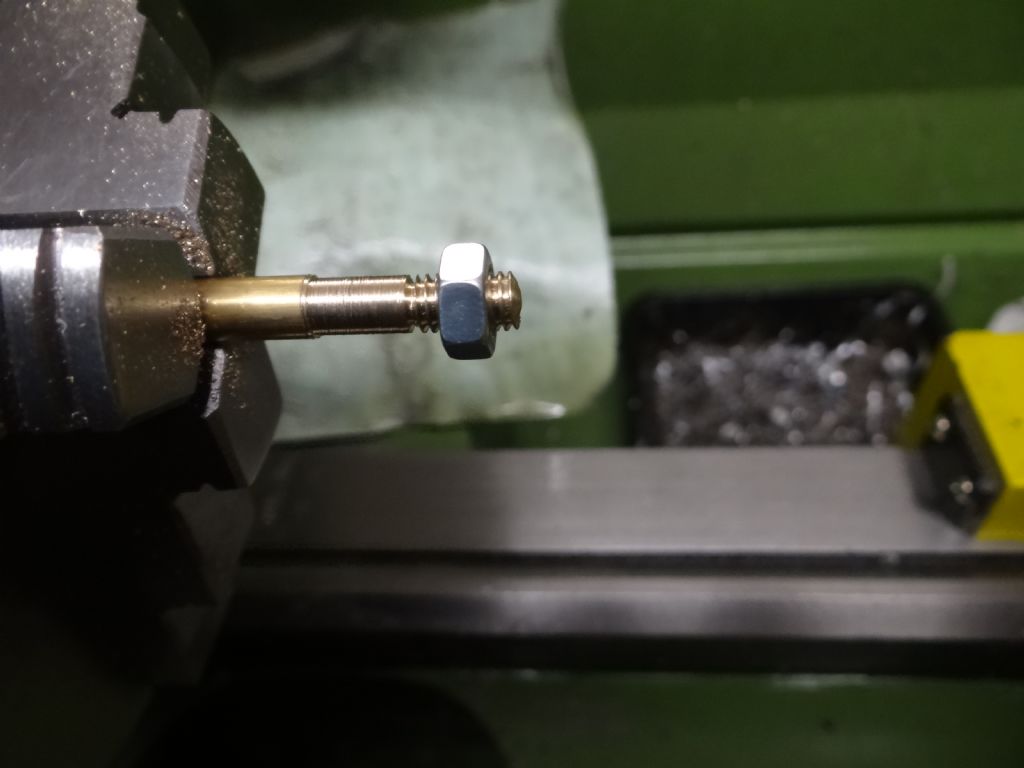
                                                To answer JA's question, I'm doing advanced junior training rather than a real job at the moment. I'm experienced enough to cut threads the right size (mostly, ahem) but not experienced enough to get a good finish without failures, and the odd crash. I started threading 20m diameter aluminium rod, which is rather easier to learn on, and now I'm trying 6mm brass. To keep things easy I'm cutting 1.0mm threads because all the thread dial increments work at that pitch. Reducing diameter caused the latest outbreak of mistooks and made me question what I'm doing.

                                                I initially plunged in at right angles and found that the cut is often poor. Then I tried the top-slide half-angle method; this improved the quality of the cut enormously but, especially with small diameters, brings the saddle, top-slide. tool-post combination dangerously close to crash point.

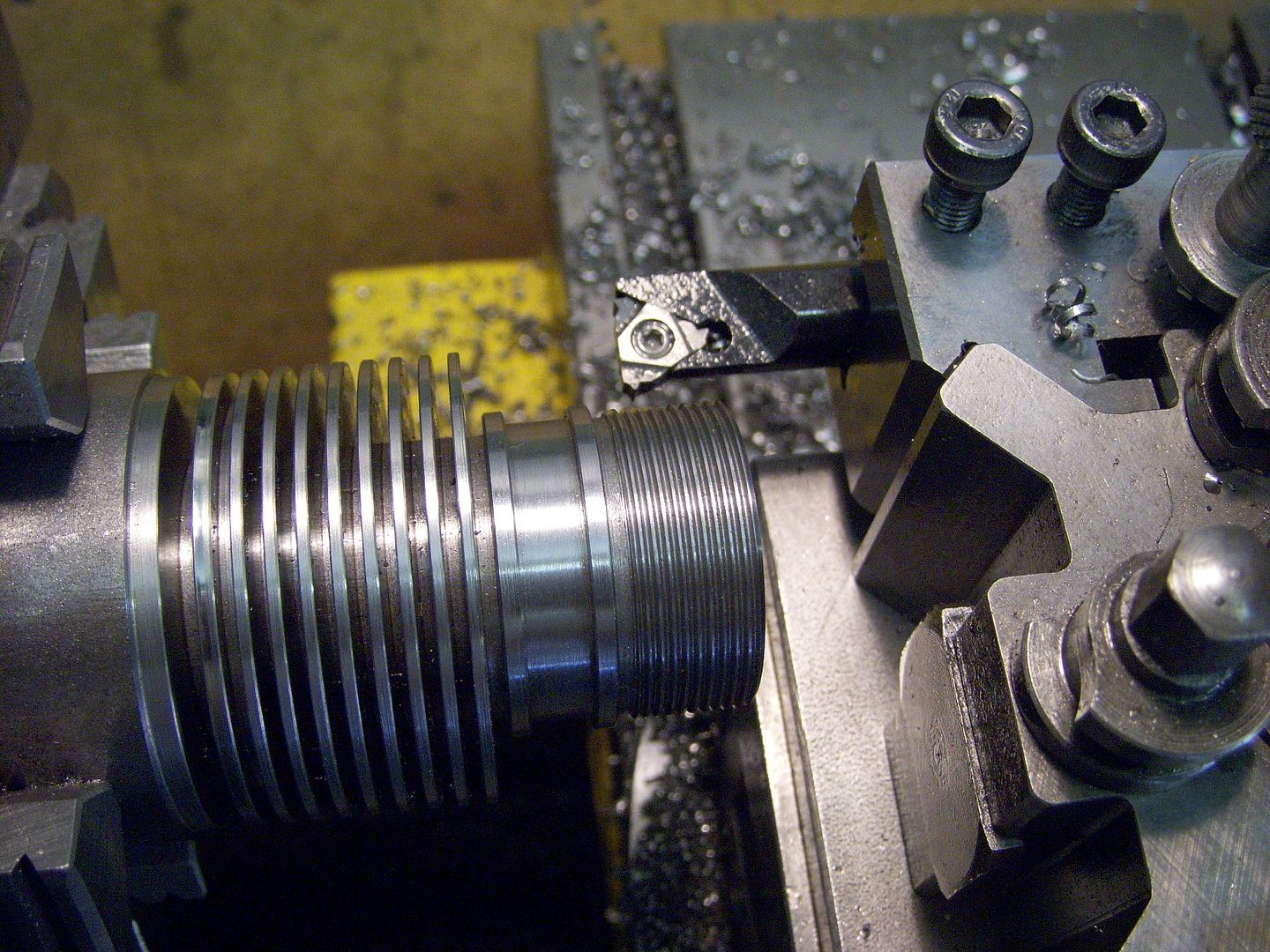
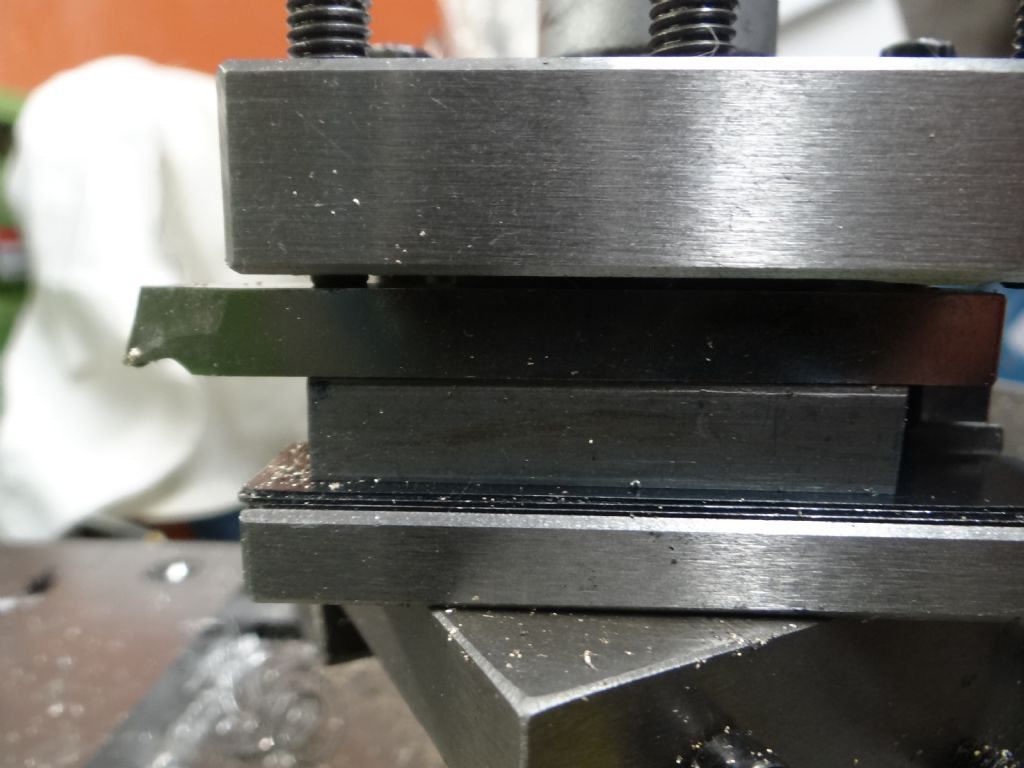
                                                This morning I tried cutting the thread from left to right. To do this the lathe is run in reverse (no problem on a Chinese Lathe with a flange mounted chuck) with the tool upside down.

                                                dsc04397.jpg

                                                The main problem with this is the limited space for the tool in the 4-way. With the point at centre height, a 6mm tool only just fits. I couldn't fit a larger threading tool upside down in this tool-post.

                                                Being unfamiliar with working in reverse meant I had to think hard at every step. With practice it would become routine. Results were good and there's no chance whatever of a crash. I'm still not too happy about the amount of overhang needed, and it's all too easy to leave the lathe in reverse!

                                                dsc04396.jpg

                                                A disadvantage of owning an affordable lathe has become very apparent. Turning down the 1/4" brass rod to 6mm really needs the lathe set up with the fast belt and fine-feed gears. (See how crudely the rod in the picture was turned down!) Cutting the thread needs the lathe to be set-up with the slow belt plus gears to produce the desired pitch. Although not difficult to change over, it takes at least 10 minutes. It must be wonderful to own a lathe with a full gearbox!

                                                Agreed about writing the numbers down, and marking the dial with a Sharpie would have helped too. After lunch I'm going to try doing that with Hopper's method.

                                                Thanks again,

                                                Dave

                                                #297638
                                                Anonymous

                                                  Posted by SillyOldDuffer on 11/05/2017 13:45:17:

                                                  A disadvantage of owning an affordable lathe has become very apparent. Turning down the 1/4" brass rod to 6mm really needs the lathe set up with the fast belt and fine-feed gears. (See how crudely the rod in the picture was turned down!) Cutting the thread needs the lathe to be set-up with the slow belt plus gears to produce the desired pitch. Although not difficult to change over, it takes at least 10 minutes. It must be wonderful to own a lathe with a full gearbox!

                                                  +1 takes me a few seconds to change spindle speeds or select most feeds or threads. The longest time is taken getting the old eyes focused on the thread/feed chart.

                                                  Where's the smiley for a smug barsteward?

                                                  Andrew

                                                  #297641
                                                  Martin Kyte
                                                  Participant
                                                    @martinkyte99762

                                                    The disadvantages of owning an affordable lathe are far outweighed by the disadvantages of not being in possession of an unaffordable lathe. Basically, not having a lathe.

                                                    You just have to cut according to your cloth and get on with it.

                                                    regards Martin

                                                    #297653
                                                    richardandtracy
                                                    Participant
                                                      @richardandtracy

                                                      The worse the equipment, usually the better the operator has to be to get the same results. Think of it as a 'skills enhancement' machine. An amazing machinist will get good results off the worst form of treadle lathe… Wish I could.

                                                      Regards,

                                                      Richard

                                                    Viewing 25 posts - 1 through 25 (of 35 total)
                                                    • Please log in to reply to this topic. Registering is free and easy using the links on the menu at the top of this page.

                                                    Latest Replies

                                                    Home Forums Beginners questions Topics

                                                    Viewing 25 topics - 1 through 25 (of 25 total)
                                                    Viewing 25 topics - 1 through 25 (of 25 total)

                                                    View full reply list.