BA threads. Why the tpi?

BA threads. Why the tpi?

Home Forums General Questions BA threads. Why the tpi?

Viewing 14 posts - 51 through 64 (of 64 total)
  • Author
    Posts
  • #323039
    Tim Stevens
    Participant
      @timstevens64731

      I guess that the angle was decided on the same principle that Whitworth used. Look at what others are doing and try to arrive at a sensible all-round compromise. The whole business of thread sizes is a jumble of current practice (good and bad), logical thought (relevant or not), and a good dollop of 'We must have our own system that is better than – or at least different from – all the others'.

      Tim

      #323046
      Andrew Tinsley
      Participant
        @andrewtinsley63637

        Several of the well known Gurus, blithely talk of screw cutting threads presumably large (greater than 5mm). They then have a throwaway line about finishing off the thread with a die!

        So it would seem that some of our revered experts (no names, but anyone who have read their published work , know who they are!) are not overly good at screw cutting threads.

        Or am I missing something here?

        Andrew.

        #323048
        Chris Trice
        Participant
          @christrice43267

          The biggest advantage I can see for screw cutting in the lathe, even if followed up by a die to completely the thread form, is to ensure the pitch remains constant along long lengths and to keep the die from "wandering". For most minor tapping or thread cutting, I tend to reach for the taps and dies. It's only the more exotic threads or spindle nose threads when I tend to screw cut in the lathe.

          #323050
          Bazyle
          Participant
            @bazyle

            Since every thread has different details of root and crest radius, depth etc you 'should' have a different tool for cutting each one. Easier to take off 90% of the material with the lathe then a finishing cut with the die to sort out those details and it also reduces the wear on the die which is more expensive than the single point tool. The people using the special carbide screwcutting tips won't need to do that though.

            #323060
            SillyOldDuffer
            Moderator
              @sillyoldduffer
              Posted by Andrew Tinsley on 23/10/2017 12:35:57:

              Several of the well known Gurus, blithely talk of screw cutting threads presumably large (greater than 5mm). They then have a throwaway line about finishing off the thread with a die!

              Or am I missing something here?

              Andrew.

              Only missing perhaps that a lathe isn't a particularly good way of making screw-threads in the first place! Most of the world's threads are rolled, not cut, and all the better for it. (Cut metal is weakened, squeezed metal is strengthened.) Precision threads like those on a micrometer are ground, not cut or rolled. Lathes are in trouble making small threads too.

              What the lathe does offer is superb flexibility. Within reason, it can cut any thread, or at least a good approximation of it. Although the pitch will always be good, some threads forms are hard to do perfectly on a lathe, for example one with rounded tops and valleys. You can make your own lathe form tools to finish such threads to spec, but its very much easier to run a die over them. (Or in my shameless case, to not bother beyond a dirty touch up with a file!)

              Cutting a big thread directly with a die is hard work, wears out the die, and the resulting thread may not be straight. It makes a lot of sense do the donkey work on a lathe and finish off with a light cut from a die. If you've got one.

              Dave

              #323141
              Anonymous
                Posted by SillyOldDuffer on 23/10/2017 13:45:52:
                Most of the world's threads are rolled, not cut, and all the better for it. (Cut metal is weakened, squeezed metal is strengthened.) Precision threads like those on a micrometer are ground, not cut or rolled.

                It's interesting to note that really cheap threads (because it is fast and cheap) and expensive aircraft threads (for the reasons given above) are rolled. There has been at least one fatal aircraft accident because cut threads were used instead of rolled.

                Having said that, I've been cleaning up the bolt that holds the tailplane onto my glider this evening; and the thread is cut as far as I can tell. smile o It was a replacement bolt bought at much expense from the aircraft manufacturer.

                Andrew

                #323145
                Anonymous
                  Posted by Andrew Tinsley on 23/10/2017 12:35:57:

                  So it would seem that some of our revered experts (no names, but anyone who have read their published work , know who they are!) are not overly good at screw cutting threads.

                  Not guilty m'lord!

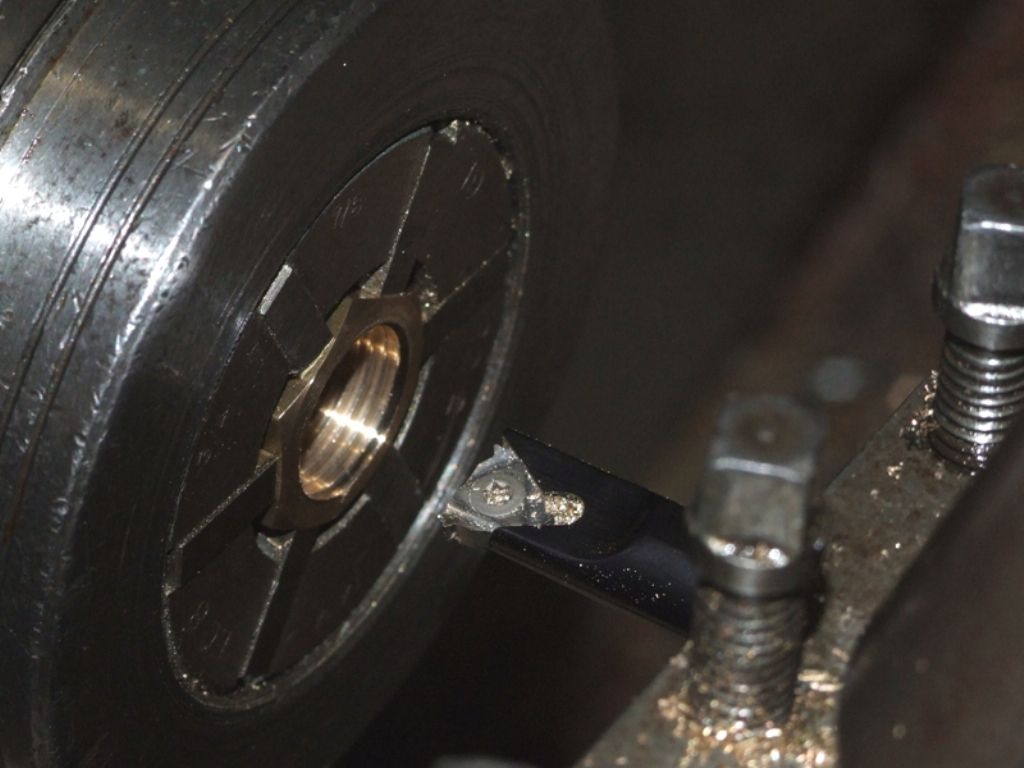
                  I don't use dies that frequently. I either screwcut, use a Coventry diehead or use off-the-shelf fasteners for external threads. Here's an internal 3/8" BSP thread being screwcut; about a 2 minute cycle time at 260rpm and with 4 thou clearance at the end of the blind hole:

                  screwcutting_bsp_me.jpg

                  Andrew

                  #323165
                  Neil Wyatt
                  Moderator
                    @neilwyatt
                    Posted by Andrew Johnston on 23/10/2017 11:14:21:

                    What's the rationale for a 47½° flank angle?

                    Andrew

                    48° is too weak and 47° is too shallow, but to be honest they could have got away with anything between 47.25° and 47.75°.

                    Thew Paewdia of Wick says:

                    "The Thury thread was different in that it went both positive and negative all the way up to a size of -20 which was 75.2mm diameter by 8.23mm pitch. The Thury numbers were rounded to three significant figures. The Thury thread form had the crests rounded at 1/6p and the roots rounded at 1/5p so the thread angle was close to 47.5 degrees but not exactly. This was simplified in the BA thread definition by defining the thread angle to be 47.5 degrees exactly and the thread form to be symmetrical with a depth of 0.6p."

                    Neil

                    #323166
                    Neil Wyatt
                    Moderator
                      @neilwyatt
                      #323214
                      SillyOldDuffer
                      Moderator
                        @sillyoldduffer

                        Woe is me. I was baffled by Andrew's "why 47.5°" question and tried to look it up. Both the Internet and my collection of Engineering textbooks dance around thread angles without being specific. Other aspects of thread design are described in detail, but not how thread angles are decided.

                        The best I found was the statement that the thread angle is basically a compromise between holding power and ease of assembly, but other factors matter too. For example, you wouldn't want a thread that wore out because because the friction was very high.

                        The maths isn't overtly explained, but it's revealed that thread angles were originally derived by averaging the pre-standard values used by the trade. Whitworth got 55° by averaging thread angles used in British Industry for holding Cast and Wrought Iron; Thury got roughly 47.5° by averaging threads used in Swiss Clock and Instrument making.

                        There were plenty of different threads to average. Russell's first link includes the statement: 'One instance was brought to the attention of the committee, by a manufacturer who had to execute an order for railway signal apparatus, in accordance with three sample instruments, containing among them twenty-one screws of different threads, not one of which happened to be in use in his shop.'

                        Anyway, early on in my researches I read the Wikipedia article on Thury Threads mentioned by Neil. What's sad is that I completely missed the significance of 'The Thury thread form had the crests rounded at 1/6p and the roots rounded at 1/5p so the thread angle was close to 47.5 degrees but not exactly.' I suspect there were similar clues in the other stuff I'd waded through. It makes me wonder just how much I read sails clean over my head? Most of the maths for sure, but now I'm wondering if I ever really understood the works of Enid Blyton!

                        Dave


                        Edited By SillyOldDuffer on 24/10/2017 10:29:26

                        #323229
                        Chris Trice
                        Participant
                          @christrice43267

                          I can't help feeling the the best current thread angles and tooth forms including radius peaks and troughs are determined by a number of parameters including thread strength/shear figures and core strength of the screws. Trial and error testing on a rig should be able to determine the optimal form for any given material. The archaic threads are likely to have become popular or fallen out of use through similar trial and error learning.

                          #323246
                          jimmy b
                          Participant
                            @jimmyb

                            “J” series threads,(UNJ/MJ), have larger rads on the crests of external threads, I’m told it’s a stronger thread

                            Jim

                            #323981
                            Michael Gilligan
                            Participant
                              @michaelgilligan61133
                              Posted by Andrew Johnston on 23/10/2017 11:14:21:

                              What's the rationale for a 47½° flank angle?

                              Andrew

                              .

                              Delayed response, due to having misplaced my reference book:

                              MichaelG

                              .

                              The following are the forms of threads adopted in the Swiss system :

                              (a) For screws made by the screw-plate, and intended for use in wrought-iron or brass :

                              1st. The depth of the thread is 3/5 the length of pitch.

                              2nd. The top of the ridge is formed by a circular arc, the radius of which equals 1/6 of the pitch.

                              3rd. The space between two consecutive ridges is formed, at the side next the core, by a circular arc, the radius of which equals 1/5 of the pitch.

                              4th. To complete the generating figure of the thread, the two circular arcs, exterior and interior, are joined by straight lines tangential to the arcs, and which consequently form between them an angle of about 47 1/2 deg. The space between two ridges is therefore a little greater than the solid ridge.

                              5th. The positive generating figure of the thread should be considered as being the result of the figure above defined, slightly modified by the work of compression which occurs in threading with a screw plate. It is thus that the circular arcs are changed into parabolic curves more suitable than the circular arc itself.

                              (b) For screws made by means of the lathe, and intended for use indifferently in steel, in wrought-iron, in brass, and in cast-iron the outline of M. Steinlen, of Mulhouse, is recommended. […]

                              Screws and Screw-Making

                              The Britannia Company, Colchester. 1891

                              #324055
                              Anonymous

                                Michael: Thanks for the notes. Later this evening I might work out the exact flank angle. Of course the next question is why on earth they chose different radii for the crest and root. Ah well, you know what they say about committees; may be the BA thread system is the equivalent of a camel. smile

                                Andrew

                              Viewing 14 posts - 51 through 64 (of 64 total)
                              • Please log in to reply to this topic. Registering is free and easy using the links on the menu at the top of this page.

                              Latest Replies

                              Home Forums General Questions Topics

                              Viewing 25 topics - 1 through 25 (of 25 total)
                              Viewing 25 topics - 1 through 25 (of 25 total)

                              View full reply list.