‘Squareness’ of jaws in 4 Jaw chuck,

‘Squareness’ of jaws in 4 Jaw chuck,

Home Forums General Questions ‘Squareness’ of jaws in 4 Jaw chuck,

Viewing 12 posts - 1 through 12 (of 12 total)
  • Author
    Posts
  • #22270
    Ian P
    Participant
      @ianp
      #101159
      Ian P
      Participant
        @ianp

        Whilst its preferable to do all machining without taking a part out of the chuck its common practice to re-chuck parts in an independent 4 Jaw.

        With care its easy to centre parts very accurately, but thats really only at the point where the dial indicator is used. Moving the indicator along the length of a part might show that the axis of the part is describing a cone.

        Alignment depends on how square or unworn the jaws are, the only adjustment I can think of relies on a small hammer.

        I have read many articles and books where a stage of machining calls for rechucking but I don't recall ever reading any warnings or advice given about ensuring concentricity over the length of a part, it seems to be assumed that the jaws just hold the job square. I think that if I needed to make a machine spindle I would find another way of doing it.

        Ian P

        on putting a little thought to the subject I realise that the

        #101174
        roy entwistle
        Participant
          @royentwistle24699

          If machining a machine spindle, consider doing it between centres

          #101176
          Ian P
          Participant
            @ianp
            Posted by roy entwistle on 17/10/2012 22:04:38:

            If machining a machine spindle, consider doing it between centres

            I certainly would do it between centres, aided and abetted by fixed steady and/or end plugs if the spindle is hollow.

            My enquiry was just a general one regarding the assumed reliance on the jaw squareness.

            Ian P

            Edited By Ian Phillips on 17/10/2012 22:16:08

            #101178
            Nobby
            Participant
              @nobby

              Hi Ian
              I agree with Roy turn your spinle between centres . The job can be removed for checking etc & put back dead true . may be for second operation ie screwcutting a thread .
              Nobby

              #101185
              MICHAEL WILLIAMS
              Participant
                @michaelwilliams41215

                Hi Ian ,

                Its common practice to clock in two locations when settingup work in four jaw chuck . Most commonly at two places axially from chuck when setting round bars and at one place axially and one on the face when setting up a disc . Within small limits work can be nudged a bit to get it running true at all locations but the standard method where this is not enough is to use shims .

                Generally speaking neither ordinary three jaw nor ordinary four jaw chuck are all that good for real precision work and there are better methods available .

                Turning between centres has been mentioned and this is always a good method . Purely as matter of interst there are two ways of turning between centres – between live and dead centres in the conventional way and between two dead centres . The latter is rarely seen but is the only unconditional way to get absolute accuracy . Sometimes used for watchmaking and more often for between centres grinding .

                Regards ,

                Michael Williams .

                #101188
                MICHAEL WILLIAMS
                Participant
                  @michaelwilliams41215

                  Even more rarely seen is turning between two steadies ie with shaft effectively running in bearings .

                  A slightly more common method is to run a partly finished shaft in the actual bearings and housing where it will be used .This method is used in manufacture of super precision lathes for final grinding of bores and registers ..

                  #101189
                  NJH
                  Participant
                    @njh

                    Hi

                    | "Alignment depends on how square or unworn the jaws"

                    I'm sure that I read of a method for correcting worn / out of true chuck jaws by mounting a small grinder in the tool post and traversing the saddle whilst running the lathe at slow speed .Can't put my hand upon it just now though .

                    Agree with the between centres method for spindles though.

                    N

                    #101204
                    JasonB
                    Moderator
                      @jasonb

                      Well you all seem to be assuming its a spindle not an odd shaped item with a hole in it, so if its not a spindle….

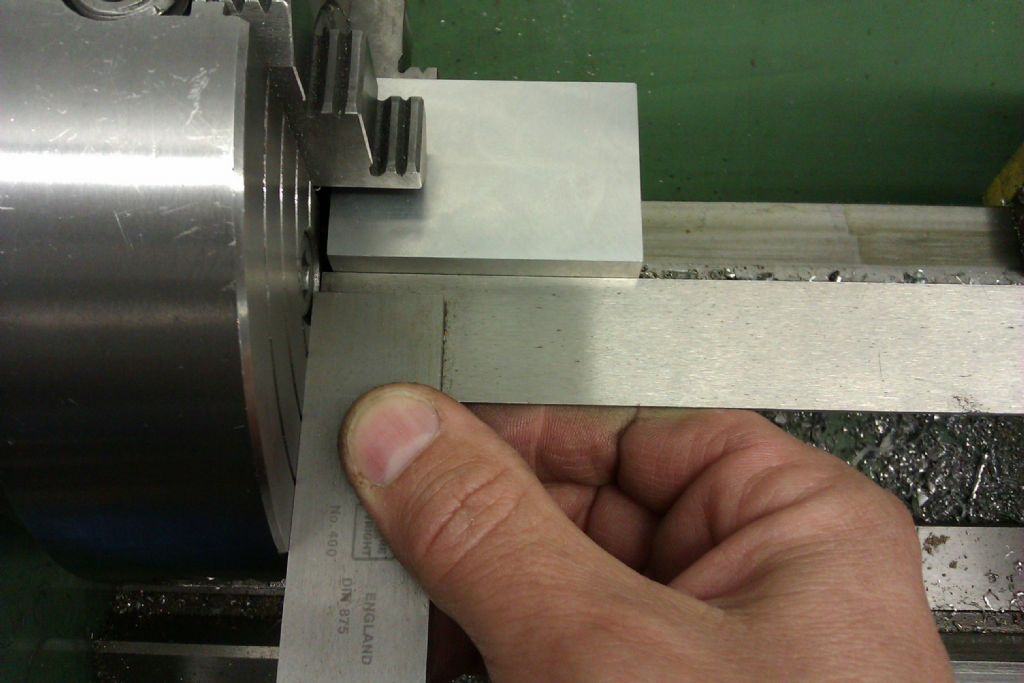
                      If the back of the item is machined then you can reference it off the chuck body, either buy putting the work against it, packing off the body.if its thin. If teh back is unmachined you can use a square against the body. (I did put this little tip into my Firefly build) And if its too small then clock it down its side with a DTI.

                      Firefly46

                      J

                      #101217
                      Ian P
                      Participant
                        @ianp
                        Posted by Bogstandard2 on 18/10/2012 07:33:06:

                        N,

                        What you said can be done, but only really on self centering chucks, you would need to really get the jaws very accurately centred first if trying to do it to an independent chuck.

                        The normal method for four jaw independent jaws is to remove them from the chuck, and gang grind them on say a surface grinder. I have done many sets using this method, and have had very good results.

                        John

                        NJH (post preceding yours) mentioned using a toolpost grinder with the lathe running slowly. I don't see any reason why the same method couldn't be used for an independent jaw chuck with the lathe spindle stationary. It would not matter if the four jaws were different 'lengths' they would at least be square.

                        I trued up (for squareness and concentricity) a three jaw self centering chuck by doing a set of tests and then taking out each jaw and truing the end using a diamond 'oilstone'. It can get a bit laborious but I think the final accuracy could be as good or even better than the 'gripped ring' and toolpost grinder method.

                        Its not difficult to make extremely small adjustment to each jaw, the hard bit is making sure you don't take too much off and end up with the 'short legged chair' scenario!

                        Ian P

                        #101224
                        MICHAEL WILLIAMS
                        Participant
                          @michaelwilliams41215

                          Grinding out the jaws of any self centering chuck while the jaws are loose will give uncertain results at best since the jaws are not loaded and the clearances not biased in the same way as when gripping a workpiece .

                          Any self centering chuck can have jaws corrected simply by putting a round aluminium bar lap in the tailstock , covering it with grinding paste and working it back and forth through chuck jaws . Jaws are gently and progressively closed down onto the lap as work proceeds . All loads and clearances of jaws during lapping process are the same as when gripping so maximum accuracy is achieved .

                          For best results turn down most of the aluminium bar slightly leaving just about one inch long as the actual lap and in the final stages of lapping run the lap almost completely out of the jaws at both ends of stroke .

                          Takes about twenty minutes .

                          Michael Williams .

                          #101275
                          chris stephens
                          Participant
                            @chrisstephens63393

                            Hi Guys,

                            Truing up a 3 jaw is easy, just hold a washer in the chuck at the very (inner) edge of the jaws, then bore using a good quality tip. Once all evidence of bell-mouthing and out of roundness have been removed, and no more, take out the jaws and hand finish the small area that you missed because of the washer.

                            Yes, you heard me right turn not grind, even on a Pratt-Burnard, they are not as hard as you would hope. Or it could be that the tip was very special? Anyway, it is a joy to use a chuck that is pretty damn close to true and lack of bell mouth helps with parting or should that be parting is a problem if the chuck is bell mouthed.

                            chriStephens

                          Viewing 12 posts - 1 through 12 (of 12 total)
                          • Please log in to reply to this topic. Registering is free and easy using the links on the menu at the top of this page.

                          Latest Replies

                          Home Forums General Questions Topics

                          Viewing 25 topics - 1 through 25 (of 25 total)
                          Viewing 25 topics - 1 through 25 (of 25 total)

                          View full reply list.