Centre drilling long length, small diameter bar

Centre drilling long length, small diameter bar

Home Forums Beginners questions Centre drilling long length, small diameter bar

Viewing 25 posts - 1 through 25 (of 33 total)
  • Author
    Posts
  • #8824
    David Cambridge
    Participant
      @davidcambridge45658

      Centre drilling long length, small diameter bar

      #310747
      David Cambridge
      Participant
        @davidcambridge45658

        Hello All

        I’ve got a 10 mm diameter threaded steel bar that’s 800 mm long, and I want to turn the last 40 mm of it down to 8 mm diameter.

        I’m aware that just mounting it in the chuck with most of it sticking out of the end of the lathe is really dangerous ,so I thought maybe I can turn it between centres . But, turning between centres comes back to the same problem because I need to centre drill one end – and to do that I end up with a couple of feet sticking out the other end of the spindle again.

        Is there a way to do this this safely , or maybe it just can’t be done ?

        Thanks

        David

        #310749
        Anonymous
          Posted by David Cambridge on 06/08/2017 21:07:11:

          Is there a way to do this this safely , or maybe it just can’t be done ?

          Run the spindle slowly and you'll be fine.

          Andrew

          #310751
          David Cambridge
          Participant
            @davidcambridge45658

            Thanks Andrew – what do you think the safe limit is ?

            David

            #310752
            Bizibilder
            Participant
              @bizibilder

              You could rig up a piece of plywood (or similar) with a "V" cut in it as a steady and position it to stop the long end whipping about while you work.

              Edited By Bizibilder on 06/08/2017 21:14:29

              #310753
              David Standing 1
              Participant
                @davidstanding1

                Quite a common issue with rifle barrel work, check out YouTube for 'spiders'.

                Here's just one example:

                **LINK**

                #310757
                Mike Poole
                Participant
                  @mikepoole82104

                  Capstan lathes have a tube that long lengths are fed through to prevent any problems with the long length whipping round. Anything can be used to control the overhanging length, a few bits of wood will do just lashed in with a hole for the rod.

                  Mike

                  #310759
                  John Baron
                  Participant
                    @johnbaron31275

                    Hi David,

                    For doing the sort of thing that you want to do, I use a length of plastic water pipe over the end hanging out. Two G clamps, a length of wood and a stool.


                    Edited By John Baron on 06/08/2017 21:20:30 "Spelling"

                    Edited By John Baron on 06/08/2017 21:21:52

                    #310763
                    Neil Wyatt
                    Moderator
                      @neilwyatt

                      I would set up a bit of wood with a 15mm hole clamped to anything suitably solid to keep the far end from whipping.

                      Neil

                      #310767
                      David Cambridge
                      Participant
                        @davidcambridge45658

                        Thanks everyone. My lathe is next to my mill, so I can probably take advantage of that fact by rigging something up on the milling table with the block of wood idea – i.e. sorting out the below:

                        (If that’s a really stupid idea please shout before I start – it won’t be for a couple of weeks!)

                        David

                        #310775
                        Anonymous
                          Posted by David Cambridge on 06/08/2017 21:13:28:

                          Thanks Andrew – what do you think the safe limit is ?

                          Probably below 100rpm. Given that the mill is conveniently placed a wooden steady would be better.

                          #310786
                          Rainbows
                          Participant
                            @rainbows

                            A friend wanted me to turn some features on a 3mm, 350mm long aluminium rod. Drilled a 3.5mm hole in an offcut bar and made them hold it.

                            #310793
                            Ady1
                            Participant
                              @ady1

                              When I do it I use a cheap bearing with an internal diameter which fits on the bar

                              Then I put the bearing into a decent fixed steady or a block of wood

                              simples

                              #310803
                              Hopper
                              Participant
                                @hopper

                                Whatever you use, block of wood, metal or whatever, make sure the thin rod passes through a hole in it, not an open-topped V notch or similar. You want the end of the rod to be captive so it can not possibly bend and whip around, turning into a meat shredder.

                                I saw this happen once when an apprentice put a four foot length of 5/16 rod in a 9" Hercus lathe (same as Boxford or South Bend) without the correct stand in place. (This was a heavy tripod with a piece of 1' pipe welded at rightangles on top of it for the thin bar to pass through.) Another Einstein apprentice walked past as the unsupported bar was spinning around at 1,000 rpm and seeing the end was gyrating around in a small circle, say 4" diameter, gave it a whack with his hand to try to set it on centre.

                                Instead, the bar bent at 90 degrees at the point where it came out of the lathe spindle and we had a three-foot long propellor blade whizzing around at 1,000 rpm. The end of that bar would have been travelling at about 20,000 feet per minute. Over 220 miles an hour. Luckily none of the half dozen apprentices working within a few steps' distance, including Einstein, was injured. But that was purely good luck. Could have been a fatal or a terrible maiming for life.

                                If you have a milling table right there, I would drill a 3/4" hole in a stout piece of 4" x 2" wood and clamp it to the milling table, set at the lathe centre height of course. Set this up well in from the end of the bar so it can't flex and escape under rotation.

                                Edited By Hopper on 07/08/2017 04:41:36

                                #310805
                                jimmy b
                                Participant
                                  @jimmyb

                                  I like the idea of bearings on the bar. You could even use 4 or 5 and run decent speeds.

                                  #310810
                                  JasonB
                                  Moderator
                                    @jasonb
                                    Posted by David Cambridge on 06/08/2017 21:07:11:


                                    Is there a way to do this this safely , or maybe it just can’t be done ?


                                    With 600mm between ctrs on your lathe you could just use the fixed steady, have about 500mm sticking out the chuck and 300mm inside the spindle, support end of rod with steady.

                                    Could also clamp the fixed steady to the mill if you wanted which will be a bit more rigid setup as the turning will be near the chuck.

                                    Edited By JasonB on 07/08/2017 08:05:11

                                    #310814
                                    John Haine
                                    Participant
                                      @johnhaine32865

                                      Of course, if you manage to mount it safely in the chuck with a small length projecting to centre drill, you won't have to! I'd guess that 40mm would be rigid enough to turn without support provided you take light cuts with a sharp tool, at least for finishing. I guess that the 8mm is to fit a bearing? I have turned 12mm threaded rod down to (I think) 8mm to fit a bearing without T/S support.

                                      One trick is to wrap thin steel wire around the rod so it fills the thread and provides something to grip with the 4 jaw without marking the thread. Wire needs to be slightly smaller diameter than the thread pitch.Wind the wire into a tight coil a bit smaller that the thread dia first then screw the coil onto the bar. Garden wire is OK, but if it's galvanised you may need to burn the zinc off with a torch first as it can be a bit "blobby" (do this outside!). To centre the rod I rested a small flat bit of steel between a boring tool shank and the top of the rod and took a DTI reading from that.

                                      #310829
                                      Neil Wyatt
                                      Moderator
                                        @neilwyatt

                                        I don't like the setup in the video, it's asking for the bar to roll off the top of the block and start something nasty.

                                        Minimal effort to use a block with a hole in it and MUCH safer.

                                        <edit> or you could fit a g-clamp to the top of the block to surround the bar.

                                        Neil

                                        Edited By Neil Wyatt on 07/08/2017 10:51:47

                                        #310834
                                        David Cambridge
                                        Participant
                                          @davidcambridge45658

                                          Neil – I think I must have been a bit slap dash with my explanation and you've got hold of the wrong end of the stick (bar!). The plan to date is to somehow clamp a wooden block to the milling table, drill a hole through it (the block that is), then pass the bar through the block. The video is just to show the layout of stuff – I wasn't planning on running it like that

                                          #310835
                                          ega
                                          Participant
                                            @ega

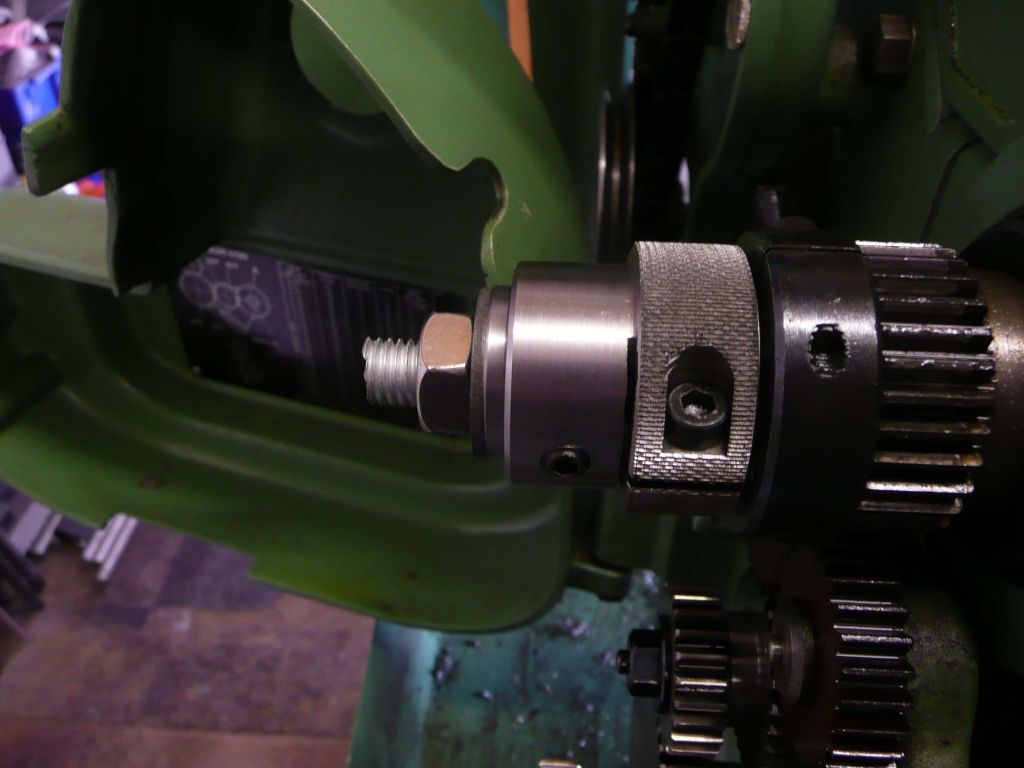
                                            If doing this job I would grip the studding in the chuck (preferably collet) and support the tail end in a bush. JAR described a way of doing this in his book. This photo shows the tool in use:

                                            p1030537.jpg

                                            Please ignore the nut on the studding which was there as part of a temporary drawbar.

                                            #310841
                                            larry Phelan
                                            Participant
                                              @larryphelan54019

                                              Just set up a stand to take a length of plastic pipe and pass the rod through it,no big deal.

                                              The important thing is that the overhang must not be allowed to thrash around free,good way to get a free haircut,never mind the style.

                                              #310930
                                              MadMike
                                              Participant
                                                @madmike

                                                Well lot's of advice here but really chaps. The answer is so easy, and I know because I have been doing something similar this weekend.I was producing a 6mm diameter with a length of 70mm on one end of a piece of 10mm stainless steel. The length of the stock I was using was 1250mm overall. I simply put it in a 3 jaw chuck and fitted 3 very roughly carved wedges in the tail end of the spindle, just to assist in stopping too much flex in the exposed bar. Then I just turned the end to size at a reasonable speed. In this instance 400RPM. The wedges didn't stay in place but it made no difference to the process. I also do the same on 0.445, 0.525, 0.600 and 0.710 A/F hexagon stainless steel bar when making stainless bolts etc for my motorcycle restorations. Of course I do then part off the bolt length including the head, at the same speed, but until that point the process is the same. Again I buy 1000mm and 1250mm lengths. In reality it would only be necessary to fit the kinds of supports that you guys have been talking about if the length was over 1800mm on a small lathe. HTH

                                                #310931
                                                BW
                                                Participant
                                                  @bw
                                                  Posted by ega on 07/08/2017 11:20:17:

                                                  If doing this job I would grip the studding in the chuck (preferably collet) and support the tail end in a bush. JAR described a way of doing this in his book. This photo shows the tool in use:

                                                  Please ignore the nut on the studding which was there as part of a temporary drawbar.

                                                  What is JAR's name and what is the book called please ?

                                                  #310985
                                                  SillyOldDuffer
                                                  Moderator
                                                    @sillyoldduffer
                                                    Posted by MadMike on 07/08/2017 23:55:58:

                                                    Well lot's of advice here but really chaps. The answer is so easy, and I know because I have been doing something similar this weekend.

                                                    In reality it would only be necessary to fit the kinds of supports that you guys have been talking about if the length was over 1800mm on a small lathe. HTH

                                                    Apart from the wedges I'm not sure I go along with MadMike's advice. My experience of whipping is that it's unpredictable. It depends on many different factors: overhang length, diameter, material, rpm, lathe rigidity, resonances, and chance of accidental contact etc. Rather than take the risk of being injured alone in my workshop, I just use a length of 2 by 4 with a suitable hole in it to constrain the overhang. The 2 by 4 is held in a portable workbench and it's very easy to set up. I am a Cowardly Lion though!

                                                    Dave

                                                    #310992
                                                    Muzzer
                                                    Participant
                                                      @muzzer

                                                      Certainly, just resting the end of the rod on a support won't do much to prevent the end whipping about. You need to constrain it in all radial directions, ideally by means of a firmly anchored tube. But even more ideally you'd stay below the critical speed.

                                                      Some theory here to estimate the critical speed – look for "cantilevered shaft".

                                                      Murray

                                                    Viewing 25 posts - 1 through 25 (of 33 total)
                                                    • Please log in to reply to this topic. Registering is free and easy using the links on the menu at the top of this page.

                                                    Latest Replies

                                                    Home Forums Beginners questions Topics

                                                    Viewing 25 topics - 1 through 25 (of 25 total)
                                                    Viewing 25 topics - 1 through 25 (of 25 total)

                                                    View full reply list.