Twin start threads

Twin start threads

Home Forums Beginners questions Twin start threads

Viewing 25 posts - 1 through 25 (of 51 total)
  • Author
    Posts
  • #8621
    Allan B
    Participant
      @allanb
      #289622
      Allan B
      Participant
        @allanb

        as you will notice from my other threads I am at present trying to get my head round screw cutting, not for any other reason than I am just one of those people who has to do and learn things because they are there.

        I have just about got my head round single start threads, although I am waiting for some new gears to be delivered so I can do metric threads on my Myford super 7, but to do this I angle the compound slide to half the thread angle, and use the compound slide to advance the cut into the work piece, hence I am only then cutting on the front edge of the tool, and I can get a very respectable finish.

        so next is to try and do multi-start threads, I have got myself a tread counter, I thought I would start on a simple one, being an 8TPI thread, so with the twin start I could use a 16TPI gauge to check it.

        I got the first bit done, and cut a 8TPI thread into the work piece, at the correct depth, and this is where the issue started, the advice I had been given was to use the thread counter to advance by the 180 degrees needed, so if the first thread was set to number 1 on the thread counter, the next thread should be set to number 3 on the thread counter. I have tried this this morning, and it just seems to cut in the same thread, I have hunted youtube with no success.

        here is where I pass on to the collective knowledge of the forum for advice on how I can do this.

        thank you in advance for any hints of a way forward

        Allan

        #289627
        Tony Pratt 1
        Participant
          @tonypratt1

          Hi Allan,

          You will need to advance the tool horizontally by .0625" or rotate the work 180 degrees, it's a while since I did multi start threads but from memory that's correct.

          Tony

          #289628
          “Bill Hancox”
          Participant
            @billhancox

            You may wish to have a look at the 2 very good videos on double start by Tubelcain. Very helpful in understanding the processes. He demonstrates how to use a 4 jaw chuck for indexing.

            **LINK**

            Cheers

            Bill

            #289629
            larry Phelan
            Participant
              @larryphelan54019

              Hi Allan,

              You want to cut twinstart threads just because they are there? I thought I was the only one like that around !.

              I came across two ways to do this [have,nt tried either yet ]

              1 This is from a book by Laurence Sparey,written in the 1930,s,but still a great read,I use it all the time.

              The way he gives is to cut the first thread in the usual way and when you come to cut the second thread,use your TDI to move the topslide back by the amount required to give the correct spacing. Then cut the second thread.

              2 This is something I saw on Utube,I think. This guy was cutting a thread on a bar mounted between centers,the bar being driven by a lathe dog engaging with a pin on a faceplate. Having cut one thread,he just rotated the bar by 90* and cut the second thread.

              Never saw it done this way before. One of these days,I will try both ways

              In passing,I must say that I have never known Sparey to be very far wrong. I have his book nearly worn out from use.His method does seem quite simple,and I prefer to have my workpieces mounted in the chuck.

              Giive it a bash and let us know what happens.

              #289631
              richardandtracy
              Participant
                @richardandtracy

                The video in Bill's link is the way I do it. Done 2, 3 & 4 start threads that way. It's a lot more tedious when you have no half nut.

                Regards,

                Richard

                #289632
                Jon Gibbs
                Participant
                  @jongibbs59756

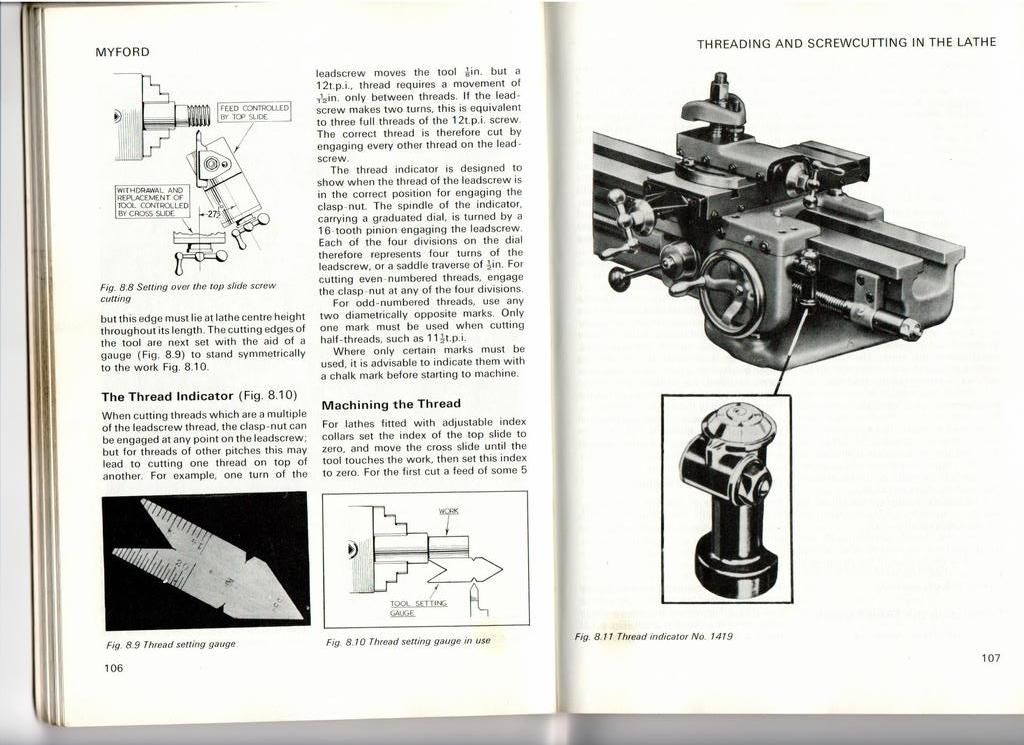
                  Being an even thread pitch, picking up the thread on any of the four numbered divisions on the threading dial will give you the same engagement. So, just going 180 degrees on the dial is never going to give you what you want.

                  If you want to go in between the pitches on a 16 TPI thread you need to go 1/8th out of phase on the threading dial i.e. switch from numbers to spaces.

                  Here's a link to an extract from Ian Bradley's book Myford Series 7 Manual which is invaluable IMHO.

                  http://i1298.photobucket.com/albums/ag49/jonathanagibbs/Bradley%20-%20threading%20dial_zpspx05mkzn.jpg

                  HTH

                  Jon

                  Edited By Jon Gibbs on 20/03/2017 14:00:55

                  #289633
                  Neil Wyatt
                  Moderator
                    @neilwyatt

                    Assuming you have an 8tpi leadscrew, 1,2,3,4,5,6,7 & 8 will all engage with the existing thread and you need to engage half way between two of the markings on the dial.

                    Edited By Neil Wyatt on 20/03/2017 13:58:08

                    #289635
                    vintagengineer
                    Participant
                      @vintagengineer

                      Also you will need cut the thread to the depth of a 16tpi thread.

                      #289640
                      Allan B
                      Participant
                        @allanb

                        thank you all for your replies, I will get my head round all this one day laugh

                        starting from the top

                        the video was very helpful, it did show a couple of methods, the first being to advance the cross slide with the use of a DTI, and using a plunge cut to make the thread, I haven't had much luck cutting a thread using the plunge cut method, it comes out looking like it was chewed by a beaver rather than actually cut, the other method which he shows is to turn the cross slide to just under half the angle of the thread (0.5-1 degree under) then advance into the cut using the cross slide, I have had much more luck with this method and can at least get something that looks like a thread, but this then means that you can not advance with the aid of a DTI, he then turns between centres and uses a face plate/4 jaw/3 jaw to do the indexing.

                        this then comes to the issue of how to then turn the internal thread to match what I am making.

                        Larry, no you are not the only one who dose things just because they are there, I come from a family of people who do just that laugh

                        Jon and Neil not a great picture but

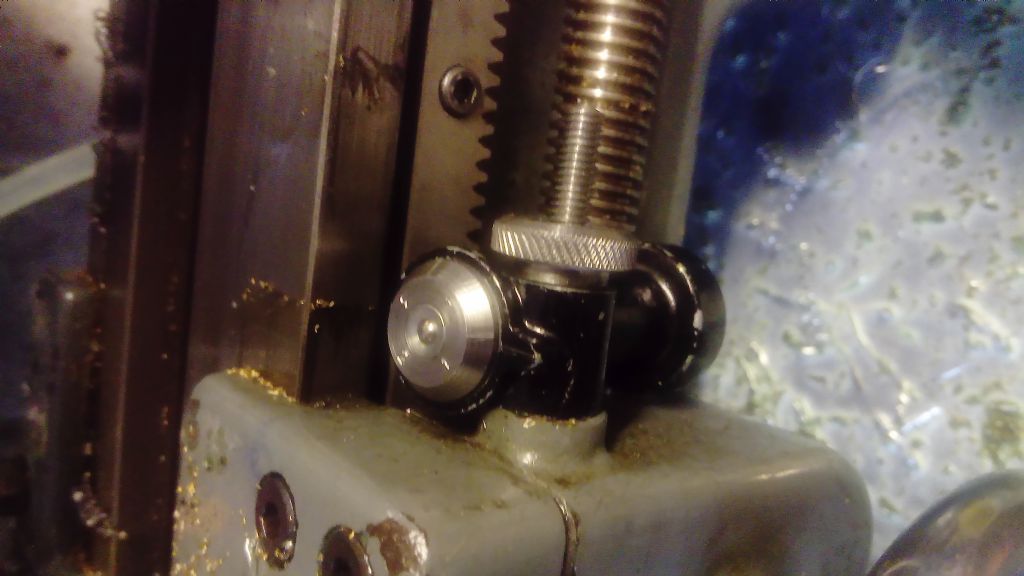
                        dsc_0348.jpg

                        so to advance using the tread counter I use the little dash between the numbers? and yes it is an 8 TPI lead screw.

                        Allan

                        #289643
                        Jon Gibbs
                        Participant
                          @jongibbs59756

                          Hi Allan,

                          Yes, I believe if you engage the half-nut on the dashes between the numbers it should be plumb in between the threads you already cut.

                          Jon

                          #289651
                          Jon Gibbs
                          Participant
                            @jongibbs59756

                            Another way is to set the topslide in line with the bed.

                            Now when cutting your thread you put on the depth with the cross-slide and increment the topslide with half the same value. This is still only cutting on ones side but is equivalent to an approximate setting of arctan(0.5) = 26.56 degrees so it works for 55 degrees and 60 degree threads. It also allows you to broaden the thread when at full depth which is the direct reading of the cross-slide – no trig required. This is the method Martin Cleeve advocates in his book.

                            Anyway when cutting your intermediate thread you can advance the topslide by half the pitch i.e. 0.063 before starting your cuts again and voila a half pitch offset for an 8 TPI double start thread.

                            HTH

                            Jon

                            Edited By Jon Gibbs on 20/03/2017 15:15:55

                            #289653
                            SteveW
                            Participant
                              @stevew54046

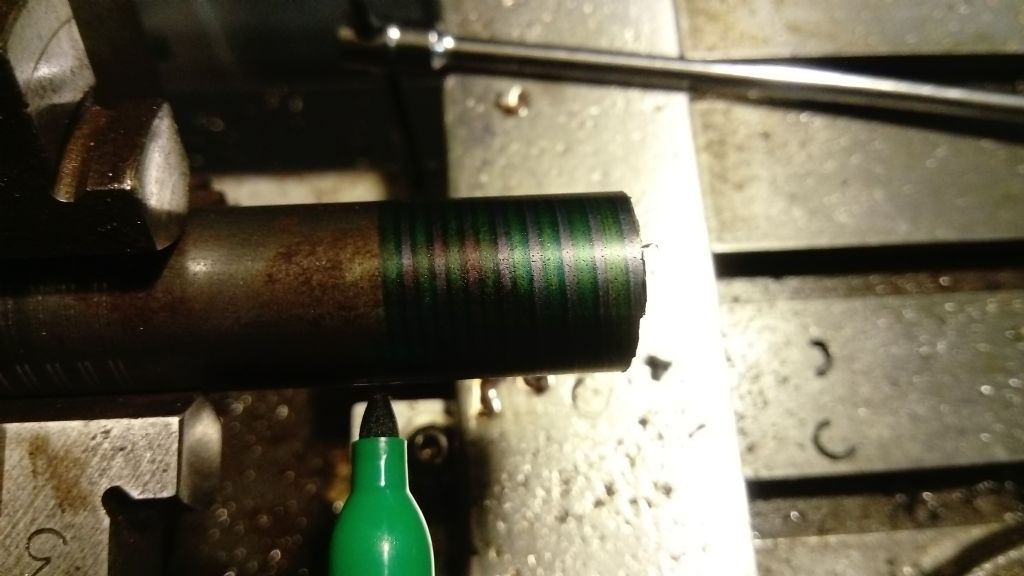
                              I'd experiment using a nice clean bit of bar and two coloured felt tips. Replace tool with first colour and 'cut' first thread. Change colour and 'cut' second. With a fine 'sharpy' type pen you should be able to see two clear 'threads'. No metal gets wasted… no tools get blunt!

                              #289656
                              Martin Connelly
                              Participant
                                @martinconnelly55370

                                If your tumbler drive gear is an even number then just turn the chuck to get one jaw horizontal, disengage the tumbler gears, rotate the chuck 180° so that the horizontal jaw is horizontal on the other side and re-engage the tumbler gears.

                                Martin C.

                                #289660
                                JasonB
                                Moderator
                                  @jasonb

                                  Another option if you have an even number of teeth on the leadscrew gear is to mark opposite teeth, cut first thread then disengage banjo and rotate gears until the leadscrew has turned 180deg and then re engage the banjo. You can then use same number on teh dial but tool will be half a turn of teh leadscrew (0.0625) further along.

                                  If the work can be driven between centres then turn up a soft ctr in the 4 jaw and use a cranked dog against 1 jaw to cut first thread then move dog to jaw 3 to cut second pass.

                                  Or get a Hardinge that allows easy multi starts

                                  Don't forget your cutting tool will need more clearance due to teh steeper helix angle of teh cut

                                  Edited By JasonB on 20/03/2017 15:34:01

                                  #289661
                                  John Stevenson 1
                                  Participant
                                    @johnstevenson1

                                    100 ways to do it.

                                    It all depends on what way suits you and the equipment you have – simples.

                                    #289666
                                    Clive Foster
                                    Participant
                                      @clivefoster55965
                                      Posted by John Stevenson on 20/03/2017 15:32:33:

                                      100 ways to do it. – simples.

                                      Yup. Its bringing thread dial rotation in that gets folk mixed up.

                                      Rule for two starts is :-

                                      either

                                      180° rotation of the work without longitudinal shift of the tool tip along the bed

                                      or

                                      1/2 pitch longitudinal shift of the tool tip without rotating the workpiece.

                                      Thread dial rotation actually measures longitudinal shift. Effectively the thread dial is a big, coarsely calibrated dial caliper. Need an absolutely clear understanding of that and how things tie together in practice if you want to use the thread dial to set multiple starts. Matin Cleeve goes into some detail on this concept in his book "Screwcutting in the Lathe". Sent me straight to the aspirin bottle! I mark the gears or chock the 4 jaw chuck as the effects of both are easily visualised.

                                      Clive.

                                      Edited By Clive Foster on 20/03/2017 16:06:12

                                      #289695
                                      Allan B
                                      Participant
                                        @allanb

                                        looks like I have put the cat amongst the pigeons with this question lol

                                        I have got Martin Cleeve's book in the workshop practice series, I have tried reading it, I am not the best at reading at the best of times, that is some serious heavy writing, and being dyslexic , having to read each bit twice for it to make any sort of sense made it a very long process to get anywhere in the book.

                                        allan

                                        #289724
                                        Allan B
                                        Participant
                                          @allanb

                                          ok so I thought I had this sorted, but maybe not

                                          as per advice I tried setting with the tread gauge using the 1/8 marks, and it just ran the pen along the same line, even tried in-between the 1/8 marks and it still followed the same line sad

                                          so next I tried just indexing round the spindle by 180 degrees, I dis-in-gauged the back gear, and the tumblers so the spindle could move independantley of the screw cutting gearbox, moved it round the 180 degrees and then in-gauged everything again and this was the result.

                                          dsc_0349.jpg

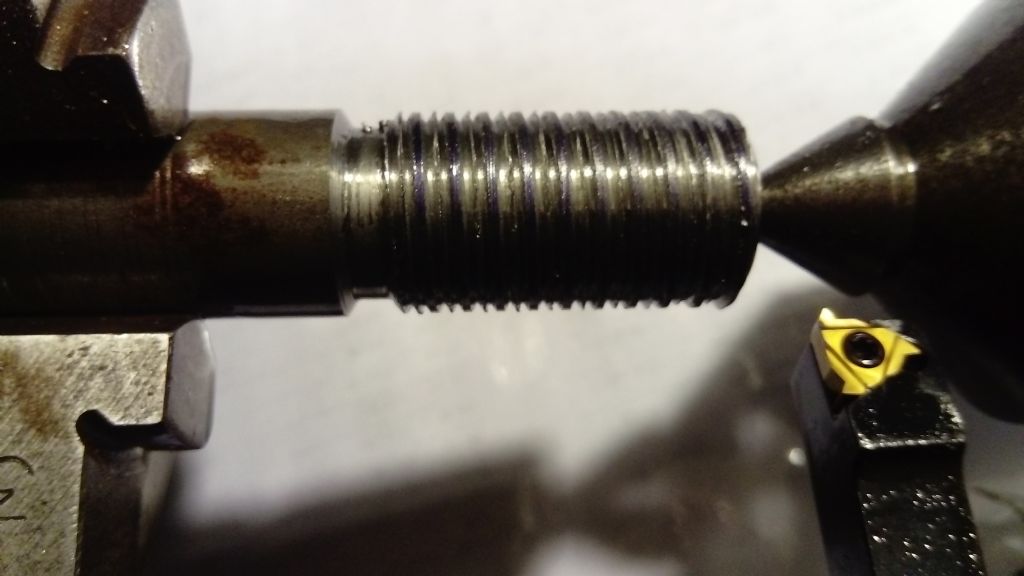
                                          a nice even twin lines, so I thought I would have a go, I turned a bar down to 19.4mm, cut the first thread in, then reset everything back to zero, turned the spindle 180 degrees as per the attempt with the pen, and this was the result.

                                          dsc_0351.jpg

                                          maybe not the clearest of pictures, but you can see that I have got one thread as you would expect, but then a flat before you start the next pair of threads.

                                          any clue what I have done wrong this time?

                                          Allan

                                          #289731
                                          JasonB
                                          Moderator
                                            @jasonb

                                            You need the leadscrew to move 180degrees not the spindle. Or move the work 180deg in the chuck

                                            #289734
                                            Allan B
                                            Participant
                                              @allanb

                                              by dis-in-guaging all the back gear ect, it allowed me to manually turn the chuck and spindle the 180 degrees without the tool moving with it still inguaged with the lead screw, so I thought that is what I had done.

                                              #289735
                                              Clive Foster
                                              Participant
                                                @clivefoster55965

                                                Did you make sure that the backlash was properly taken out of the system when switching things round. Seems to me that with such a fine thread it might be possible to have enough backlash in the gears to let you effectively reconnect one tooth out which would offset the second thread enough to leave a flat between the two starts.

                                                Some years since I did one so no longer fully up to speed without the machine in front of me. usually my hands remember better than my brain for this sort of thing.

                                                Think I'd go back to the pen with a bigger simulated workpiece and set a coarser thread then try the effect of deliberate errors. Like what a happens if I set up one tooth wrong. Maybe wrap a piece of paper round the inner cardboard tube left when the kitchen roll is used up for a simulated workpiece.

                                                Clive.

                                                #289736
                                                JasonB
                                                Moderator
                                                  @jasonb

                                                  Depends on the gear train.

                                                  Although the overall ration is 1:1 for 8tpi thread with an 8tpi leadscrew. The first driver and driven gear are unlikely to be the same.

                                                  #289737
                                                  Allan B
                                                  Participant
                                                    @allanb

                                                    I have a sort of photographic memory for practical tasks, so once I have done something once I can recall it years later, but yes I normally do have to have the objects in-front of me.

                                                    I can see this being a long process this one

                                                    #289784
                                                    “Bill Hancox”
                                                    Participant
                                                      @billhancox
                                                      Posted by "Bill Hancox" on 20/03/2017 13:25:41:

                                                      You may wish to have a look at the 2 very good videos on double start by Tubelcain. Very helpful in understanding the processes. He demonstrates how to use a 4 jaw chuck for indexing.

                                                      **LINK**

                                                      Cheers

                                                      Bill

                                                      I really should have posted both links. This link takes you to video number 2. If anyone is interested in the theoretical basics demonstrated in video number 1, here is the link: http://www.youtube.com/watch?v=sbcH4Jg0HIs

                                                      Bill

                                                    Viewing 25 posts - 1 through 25 (of 51 total)
                                                    • Please log in to reply to this topic. Registering is free and easy using the links on the menu at the top of this page.

                                                    Latest Replies

                                                    Home Forums Beginners questions Topics

                                                    Viewing 25 topics - 1 through 25 (of 25 total)
                                                    Viewing 25 topics - 1 through 25 (of 25 total)

                                                    View full reply list.