Setting up shop

Setting up shop

Home Forums Beginners questions Setting up shop

Viewing 18 posts - 1 through 18 (of 18 total)
  • Author
    Posts
  • #296743
    Jon Cameron
    Participant
      @joncameron26580

      Hi guys,

      For those that haven't read my introduction, ive recently acquired a ML4 lathe and tooling, I don't have welding gear and was planning on making a bench from 4×2" and 3" square post, with a 1/2" MDF top. Will that be sturdy enough for this lathe? Also what electrics will I need, like emergency stop buttons ect. Its a single phase 1/2 horsepower motor.

      ​They'll be more questions to come

      #8705
      Jon Cameron
      Participant
        @joncameron26580
        #296746
        Journeyman
        Participant
          @journeyman

          Jon, the 4×2 will be fine for the frame and the legs as well. The top needs to be thicker, a piece of kitchen worktop is ideal and easy to clean but make sure the ends are well sealed. Try not to use new timber from Wickes or similar, find a good timber yard or look for some nice clean old timber from a reclaimation yard, it will be well seasoned and won't shrink or warp as much.

          Have a look **HERE** at my set up, a heavier lathe than yours on a wooden bench, has worked well for years.

          John

          Edited By Journeyman on 06/05/2017 18:39:37

          #296747
          Eugene
          Participant
            @eugene


            Hi Jon,

            I travelled the same road a couple of years ago, and using timber of similar dimensions to you, made a sturdy bench that has served me well. The 1/2" MDF is in my view a bit weedy, I'd want something better.

            You could laminate two sheets of 1/2 MDF if if you already have it to hand; but I used 18mm ply well supported with cross members and never regretted it. Take advantage of the bespoke bench to store tools and instruments in draws.

            My 1/2 horse motor is powered from a standard 13 Amp socket with its own earth leakage circuit breaker; the emergency stop plus start / stop switch came from Axminster, from memory about £25.00. If you do weld up a stand, or buy a metal one in, bond it to the lathe and earth. I installed a dedicated earth spike especially for the garden workshop..

            Eug


            Edited By Eugene on 06/05/2017 19:17:53

            #296748
            Bikepete
            Participant
              @bikepete

              Second the vote for kitchen worktop as a surface. Won't soak up oil, easy to wipe clean. Offcuts or slightly damaged lengths are frequently available for not much money at all via Gumtree or Ebay… but make sure you get the thicker 38mm type – some cheap ones are 28mm – and that it has never got damp.

              Edited By Bikepete on 06/05/2017 18:54:21

              #296750
              Jon Cameron
              Participant
                @joncameron26580

                Thanks, ill have a scout for some 38mm worktop, id only need a piece 1.2metre long, its going in the old outhouse, so wont need much of it. I'll have a look for a MCB too.smiley

                #296754
                Howard Lewis
                Participant
                  @howardlewis46836

                  Jon, If the lathe is going "in the old outhouse", DO safeguard against rust!

                  Would suggest:

                  Vents at high and low level, can be quite small, as long as weatherproof.

                  NO combustion heaters to produce water vapour

                  If need be, be prepared to run a low power electric heater, (60 watts will keep a shop reasonably dry, although may take a couple of days to take effect. If the outhouse is larger than say 10 feet by 8 feet, (or very high)you may need more than one heater, or a higher powered one.

                  If you can insulate the walls and ceiling, this will help. The object is to avoid sudden changes of temperature, and to keep the temperature above the dew point.

                  (In a former workshop, everytime that I went in, the copious oil on the Myford had gone grey to match the paint!)

                  Enjoy yourself, you have the means of tackling a host of jobs. You'll wonder how you managed before!

                  Howard

                  #296762
                  John Purdy
                  Participant
                    @johnpurdy78347

                    Jon

                    For the top of my lathe bench (Super 7B) I used two thickness of 3/4" particle board glued and screwed together (from the bottom) laminated with Arborite (or similar laminate) on top and the sides. The particle board is harder, stiffer, and more moisture proof than MDF. It has served well for 40 years. The only time I have had to re-level the lathe was after two moves. I check it occasionally and it doesn't change.

                    John

                    #296763
                    Jon Cameron
                    Participant
                      @joncameron26580

                      Hi Howard, I hadn't considered heating, and the outhouse i refer to has a 130×90 footprint, but is a full night workshop meaning I can't bang my head, it'll be a very tight fit to get the lathe in, and it has a wooden door which has an open lip at the bottom,if its too tight it'll be plan B and a new shed will have to be built to house the lathe and tools. There's going to be a few shelves for the different tools, shelving will be my only real option to get what I need into the space.

                      John, apologies I've only just seen the link to your workshop, I must say that the conduit clips for the screwdrivers is extremely clever. Its a nicely laid out and neat workshop smile d

                      #296770
                      Bazyle
                      Participant
                        @bazyle

                        Timber legs and frame are so 20th century!. Use proper ply sheets not OSB in the style of a kitchen cabinet This gives you the same cross sectional areas as solid legs but also the bracing to prevent racking. Then the flat sides give you a surface to fix shelf or drawer runners, A thinner sheet across the back also provides the same function. Composites like mdf and chipboard have no place in a workshop with weight on them as they can give way suddenly. Top it with 18mm ply two layers.The weight of a ML4 is all on that middle foot so put a cross brace there.

                        You can actually make this from a single 8×4 sheet of 18mm ply plus an 8ft length of 4×1 and 8ft of 2×2.

                        This is what I was going to do for my Drummond if I hadn't happened upon a metal stand instead.
                        Two sides 3ft x 20 ins not 24 leaves a bit 3ft x 8in for bracing. Then a top full sheet width of 4ft x20 in two layers This leaves 20in x 4ft to go along the back. Use a bit of 4×1 along the front, notched into the ends and the rest of the 8ft length plus the bin bit of ply saved above to cross brace under the lathe foot. The 2×2 runs along front and back between the sides at ground level

                        #296799
                        JA
                        Participant
                          @ja

                          For my first lathe, a Myford M3, I made a wooden bench with 4"x4" corner posts and two layers of 1" ply wood top. This supported the lathe and a counter shaft with the motor below on a hinged 1" ply wood board. One thing I did do was to put a front board immediately below the top boards and between the from posts to stiffen everything.The whole structure worked very well and if I had to I would use exactly the same construction again.

                          Unfortunately I don't think I have an photographs of the set up (before the days of digital cameras).

                          I kept the electrics as simple as possible, a proper on/off switch (from Axminster Tools, RS etc) and a big red panic button.

                          JA

                          #296805
                          Hopper
                          Participant
                            @hopper

                            When you build the frame, put plenty of 4×2" cross braces across the top to support the MDF or countertop or whatever you finally choose for the top. Otherwise it tends to flex and "drum" under vibration and will eventually sag under the weight of the lathe.

                            #296818
                            Bazyle
                            Participant
                              @bazyle

                              forgot the electrics question.

                              no volt release switch at about £28

                              also about £14 without a box.

                              (tried editing but something funny going on with second link. just search for "no volt release switch&quot

                              Edited By Bazyle on 07/05/2017 09:17:30

                              #296825
                              ega
                              Participant
                                @ega

                                It might help the OP to track down Tubal Cain's detailed description of his wooden bench building method – my best guess is it appeared in ME.

                                Large DIY stores ["sheds"] occasionally have worktop offcuts, etc at low prices and it is also worth looking in the bargain section at IKEA.

                                PS There are photos of the TC shop at the end of his book Simple Workshop Devices [WPS 28]

                                Edited By ega on 07/05/2017 09:54:00

                                Edited By ega on 07/05/2017 10:12:41

                                #296836
                                Jon Cameron
                                Participant
                                  @joncameron26580

                                  Thanks all for the replies. Plenty to think on.

                                  JA why did you mount the motor on a hinged base, is that so belt tension could be adjusted? I think ill be sticking with a 4×2 frame, I have also been told to make a cover for the back gears, and change gears as my lathe doesn't have these yet, does anyone have a link to a thread where these covers were made? The change gears could be boxed in with a hinged wooden cover but the back gears will need a more profiled solution. Are these something that are available commercially, (I doubt it for a 60+ year old lathe but thought id ask)

                                  #296924
                                  JA
                                  Participant
                                    @ja

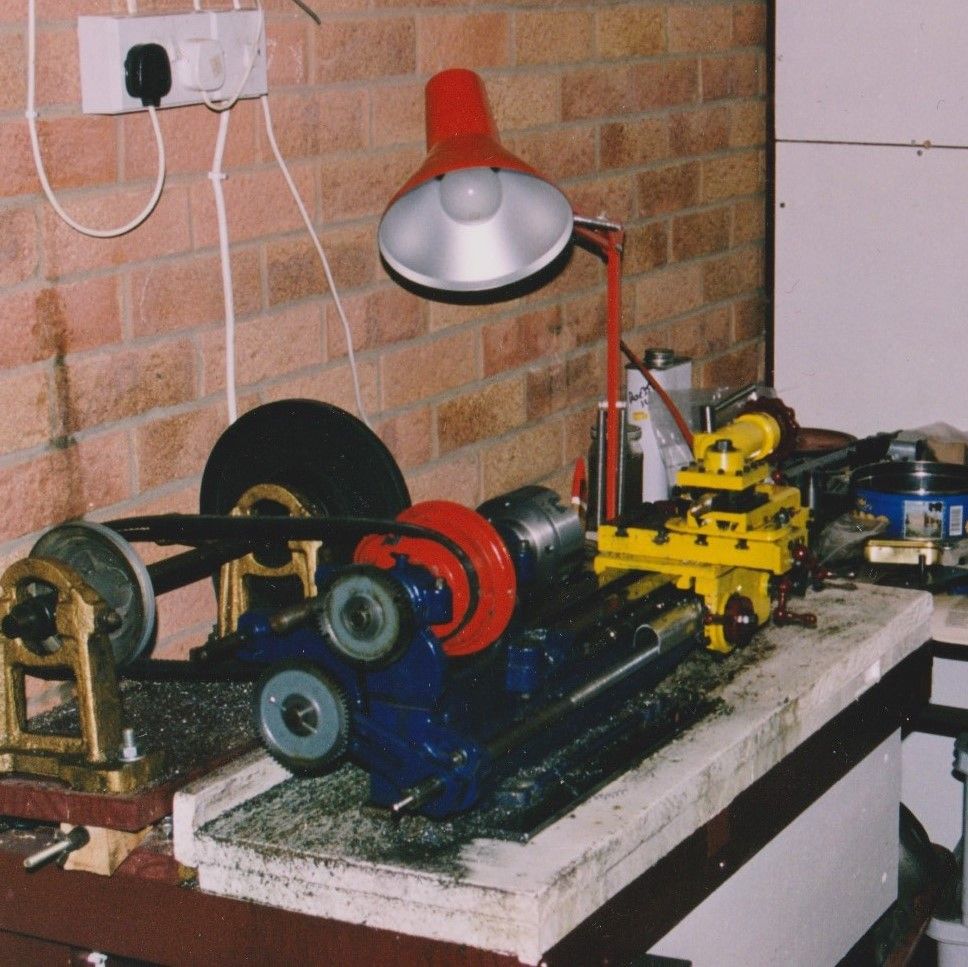
                                    I mounted both the counter shaft and the motor on hinged bases so that I could control belt tensions. The counter shaft board position was control by wedges either side of the board on a length of studding. The motor was below the counter shaft and its weight tensioned the belt with a length of studding between the two boards to control its tension.

                                    To my surprise I have found a photo of the lathe (please don't laugh at the colour scheme). One of the side wedges can be seen but unfortunately the motor belt adjustment is obscured by the lathe.

                                    scan_20170507a.jpg

                                    JA

                                    #296926
                                    Jon Cameron
                                    Participant
                                      @joncameron26580

                                      I can understand what you mean about the adjuster, now ive seen it on the woodn base. I wont laugh at the colours (because I have another question for you), the guard for the leadscrew, is that a piece of pipe opened out or just thin sheet formed to shape, I think its quite a clever solution to the chips falling down onto the leadscrew, and causing damage.smiley

                                      #296977
                                      JA
                                      Participant
                                        @ja

                                        The lead screw cover was a thin sheet of aluminium. It seemed like a good idea and on such a lathe cannot do any harm. On an M7 or S7 Myford it would have to be cut back if a gearbox was fitted.

                                        JA

                                      Viewing 18 posts - 1 through 18 (of 18 total)
                                      • Please log in to reply to this topic. Registering is free and easy using the links on the menu at the top of this page.

                                      Latest Replies

                                      Home Forums Beginners questions Topics

                                      Viewing 25 topics - 1 through 25 (of 25 total)
                                      Viewing 25 topics - 1 through 25 (of 25 total)

                                      View full reply list.