Gauges & Things

Gauges & Things

Home Forums Beginners questions Gauges & Things

Viewing 13 posts - 1 through 13 (of 13 total)
  • Author
    Posts
  • #165150
    Jack Foreman 1
    Participant
      @jackforeman1

      I was recently at Chronos in Dunstable, and spotted two books.
      One by Harold Hall – A Complete Lathe Course.
      One by Stan Ward – Seven Useful Things To Make

      Harold Hall has a Chapter specifically entitled Gauges.
      And he talks of hole gauges and dimension gauges.
      In common with many technical authors, he assumes that his reader will know what he is talking about when he refers to an item by its technical term.

      I assume that a hole gauge is used to determine the exact diameter of a given hole. But why not use a vernier? Likewise, I assume that dimension gauges are used to determine the length of something – by using multiple of component gauges. But again, why not use a vernier?

      Are my assumptions about the gauges correct? Or have I missed the point completely? emotion

      Finally, how useful, in everyday practice, is a scribing block?
      Is it worth me making one?
      I understand that making one would be a useful exercise from an engineering point of view – but I have a couple of projects in hand [for my wood-turning lathe and bench grinder] that would provide a similar range of activities and experiences.

      I'm going to the Midland Eng Exhib at Leaminton on either the 16/17 Oct, with an experienced engineer – so hope to do some shopping and pick up some useful tips too, whilst I'm there.

      Edited By Jack Foreman 1 on 30/09/2014 19:26:35

      Edited By Jack Foreman 1 on 30/09/2014 19:27:29

      #7319
      Jack Foreman 1
      Participant
        @jackforeman1
        #165162
        Neil Wyatt
        Moderator
          @neilwyatt

          Try measuring a hole's diameter with a vernier, note the result and try again. Now repeat with very small and very large holes. How repeatable are your results? You should do better with a decent set of hole gauges, a micrometer and bit of practice.

          Gauge blocks are much more accurate than a vernier and have the benefit of a high level of repeatability, which is often at least as important than absolute accuracy.

          Which you use depends mostly on what you are attempting to do; I have and use bore gauges, ideal for matching a piston and rings to a cylinder. I don't have gauge blocks.

          Scribing blocks are simple but priceless,with a decent flat surface, a 90–degree angle plate and a rule holder you can mark out most things to a decent of accuracy (a few thou, good enough for many purposes). I used one today to mark out small squares of brass for beam engine column tops, the first work on this engine for over a year!

          Neil

          #165166
          Max Tolerance
          Participant
            @maxtolerance69251

            The answer is one word "accuracy" A vernier caliper is just that, a caliper and should not be confused with a Gauge. Many beginners (and unfortunately some who should know better) are confused by the difference and are under the impression that a modern electronic caliper is the last word in accuracy. However they are making some serious errors with this. First off the resolution of a caliper whilst useful for determining the general size of something is nowhere near the standard required for truly accurate sizing. Do not be taken in by the apparent ability of these instruments to read to two or three places of decimals, simply put they don't. There are fundamental design faults involving bending, contact area and pressures that preclude these instruments from "accurate measuring tools". In industry gauges are used. These range from adjustable units e.g. Micrometers which are designed to mitigate the worst of the drawbacks mentioned and can measure to reasonable standards of accuracy if used correctly. Through to go-nogo gauges which are unadjustable being made to exact size and to traceable standards. The way these work is that a part should fit in the Go part but not in the nogo part, if it fits neither then it is too big if it fits both it's too small. The above is a simple example and with modern methods it is possible to use lasers etc. to measure to accuracies undreamed of by Mr Vernier. Who incidentally only invented the scale not the caliper.

            #165175
            Nobby
            Participant
              @nobby

              Hi Jack and Guys
              I always make a rule to use a micrometer where possible if I can ….A vernier caliper if in a awkward place A scribing block toolmakers use a lot with a DTI fitted for use with slips / gauge blocks to transfer to the job. No and no go gauges i found useful. For measuring holes. our firm had a DEA machine on a granite surface plate with a probe
              For example touch the inside of a hole in 3 or more place.s and read the result . You could also print out the result.
              Nobby

              #165180
              Jack Foreman 1
              Participant
                @jackforeman1

                Thank you, each. I stand admonished. emotion
                I see that I need to gain a new perception of 'accuracy'. I will always use a micrometer where it is possible, but confess to using a vernier to determine the diameter of a hole. I possess only external micrometers. o-1" & 0-2"

                I will return to Mr Hall's exposition on hole and dimension gauges, and re-read with a fresh insight.

                #165231
                Nobby
                Participant
                  @nobby

                  Hi Jack
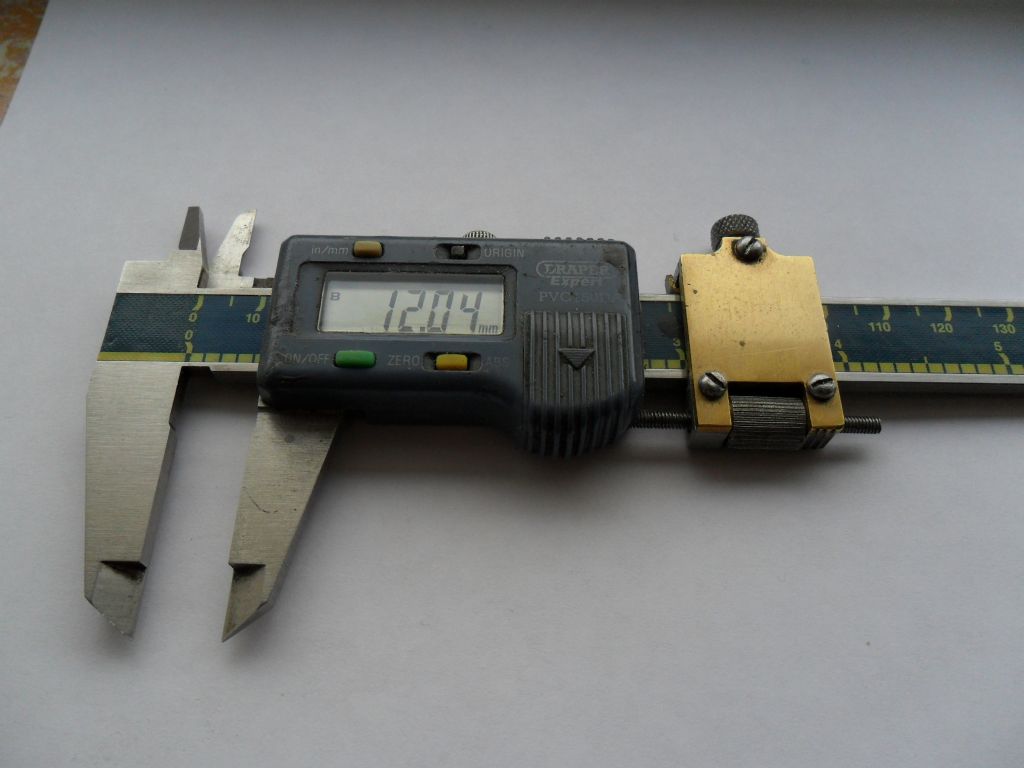
                  I added fine adjustment to my digital caliper
                  Nobbycaliper

                  #165246
                  Jack Foreman 1
                  Participant
                    @jackforeman1

                    Did you make that with a UNF thread Nobby ?

                    #165276
                    Nobby
                    Participant
                      @nobby

                      Hi Jack
                      If I recall it was 6 BA / the pitch is no problem as its just for adjustment. If I was marking out a job against an angle plate on a surface plate as Neil says I'm lucky I have a 10 inch Mitutoyo height gauge
                      Nobby

                      #165277
                      Robert Dodds
                      Participant
                        @robertdodds43397

                        Does anyone practice the art of using simple internal calipers and a micrometer to measure hole size?
                        Your vernier caliper is all well and good but it will only give you the "max metal condition". You won't detect that a hole is big at the back edge, it is not easy to find a bell mouth hole with the vernier caliper and its unlikely that you will spot any out of roundness with the vernier caliper.
                        OK the spring bow caliper requires a bit more practice and feel to transfer the size to a micrometer but once mastered it can be as consistent as your typical digital caliper and more importantly tell you a lot more about the geometric shape of the hole.
                        Gauges, plug gauges, ring gauges, gap gauges etc. all need calibration and in some instances, setting on a regular basis to be meaningful but are really intended for use in volume production environments rather than for use in model shops or toolrooms. The toolroom is where many are made for use on the production line.

                        Bob D

                        Edited By Robert Dodds on 01/10/2014 22:57:52

                        #165349
                        Nobby
                        Participant
                          @nobby

                          Hi Guys
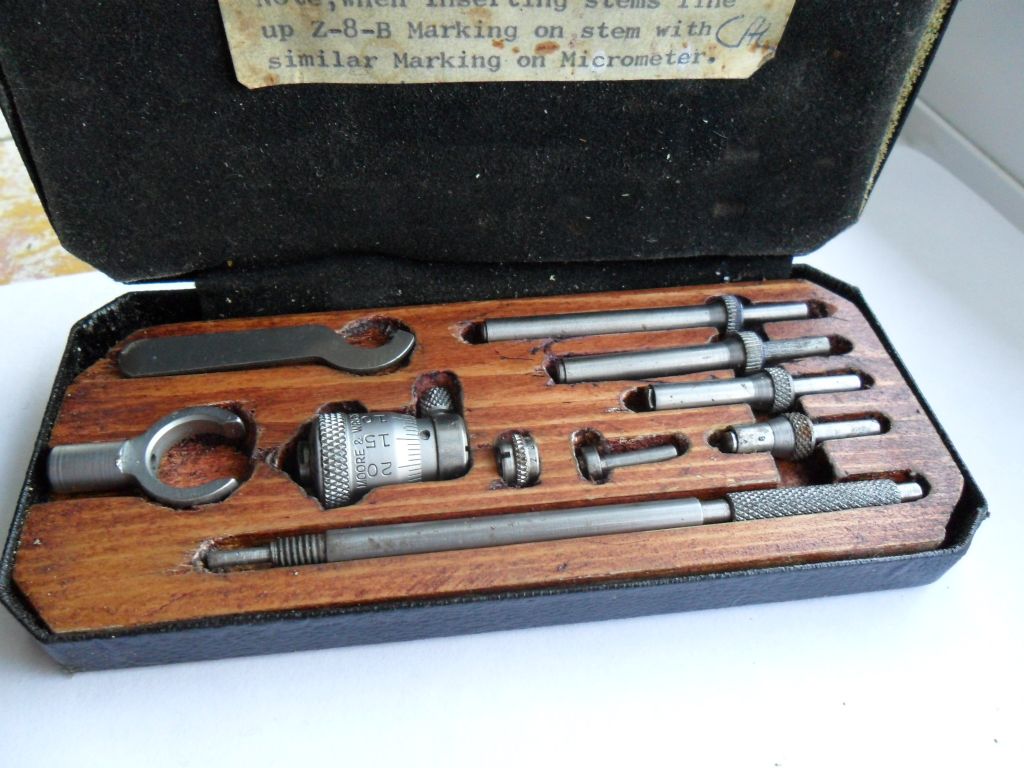
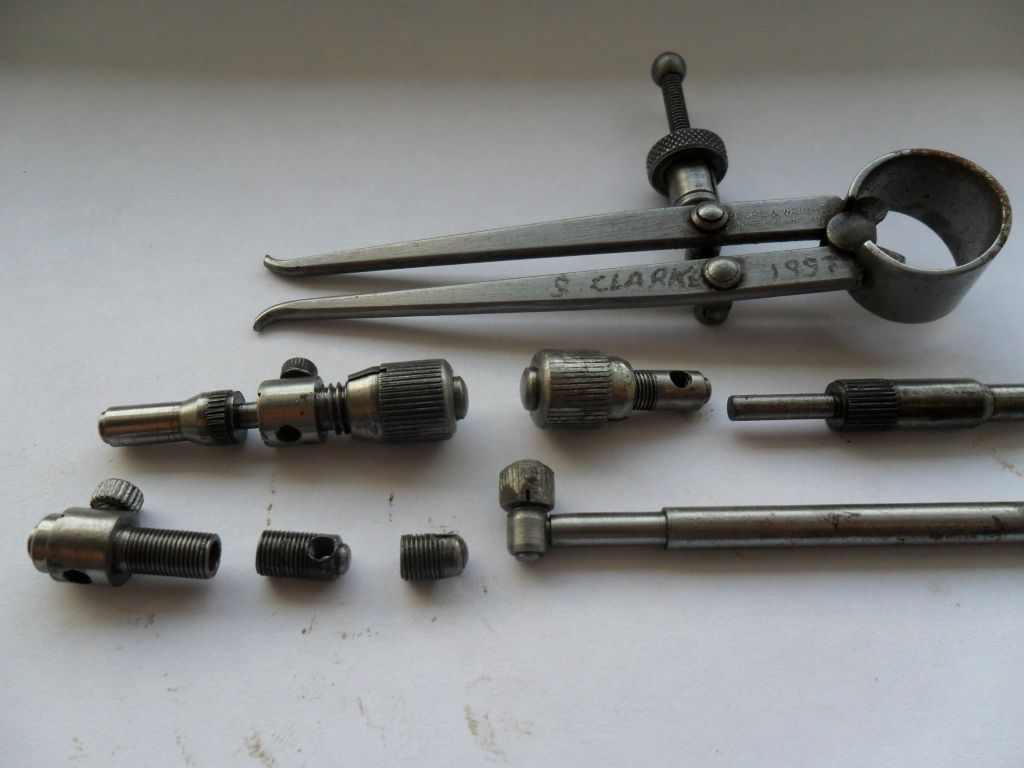
                          As Bob says .you may wont to check holes for roundness, bell mouthed etc inside calipers are tended to be forgotten in this digital age . I always talk now about the home shop machinist not industry . you can measure deep into the hole you are boring . I have also made some gauges similar to inside micrometers but have to be measured with a micrometer I also have a metric M&W set Nobbymoore wright
                          measure bores

                          #165375
                          Harold Hall 1
                          Participant
                            @haroldhall1

                            Thanks Jack for purchasing the book, I do hope you will find it useful.

                            Regarding the gauges, I would not suggest they serve no purpose but as far as the book is concerned they are there to provide exercises in working to very close diameters and lengths.

                            For me, I only used the hole gauges very occasionally, that is when I need to get a hole diameter as close as I can to the gauge diameter. To do this, I set my top slide at about half a degree off of parallel with the lathes axis so that a 10 thou feed of the top slide will result in radial movement (depth of cut) of nominally 1/10th of a thou.

                            By this method I can take very shallow cuts as I arrive near to the required diameter for the bore, doing this until the gauge just enters the hole. Of course the tool has to be honed to a very fine edge for these depths of cut to be taken. You do also need to clean the hole completely to make the test.

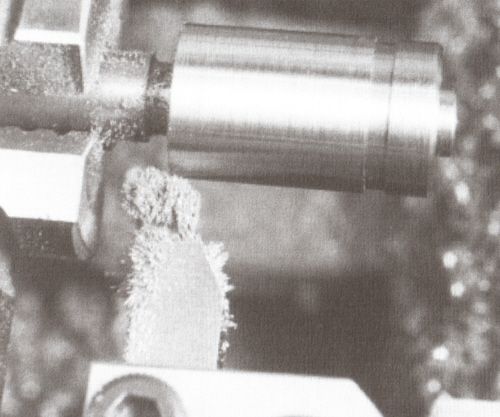
                            This is basically the method I use in the book to arrive at very precise diameters and lengths. The following, scanned from the book, shows a round nose tool that has become magnetised and producing swarf almost like grinding dust. It shows a hole gauge being made with a chamfered leading edge to give early warning that one is approaching the required diameter and then a very slightly reduced diameter to show you are very close.

                            fineswarf.jpg

                            The distance gauges however I make considerable use of, typically for setting my saddle stop as can be seen by photos 1 and 2 here

                            Harold

                            #165384
                            Jack Foreman 1
                            Participant
                              @jackforeman1

                              Harold, I have indeed already found your book very informative, and useful. It has explained many things of which I had only a very vague idea. I do not come from a mechanical engineering background.
                              I will, as you advise, certainly make a set of hole gauges; as much for the technicality of the exercise, as for the usefulness of the items. Your 'photos 1& 2' depict the distance gauge being used in a practical manner which makes clear the sort of function they would be used for. So a set of these will also be made.

                              Thank you for the book, and for you comments here.

                            Viewing 13 posts - 1 through 13 (of 13 total)
                            • Please log in to reply to this topic. Registering is free and easy using the links on the menu at the top of this page.

                            Latest Replies

                            Home Forums Beginners questions Topics

                            Viewing 25 topics - 1 through 25 (of 25 total)
                            Viewing 25 topics - 1 through 25 (of 25 total)

                            View full reply list.