Boring axle boxes

Boring axle boxes

Home Forums Beginners questions Boring axle boxes

Viewing 19 posts - 1 through 19 (of 19 total)
  • Author
    Posts
  • #9092
    Peter Simpson 1
    Participant
      @petersimpson1

      BR Standard class 2

      #341835
      Peter Simpson 1
      Participant
        @petersimpson1

        I have just got my axle boxes ready to bore out, Don Young suggests in his build manual that the pairs of axle boxes should be bored out together in the 4 Jaw chuck. None of my 4 jaw chucks are large enough to hold both axle boxes together. Is there any other way to hold two axle boxes. Should I do the boring on the milling machine as I could clamp them together using an angle plate and G clamps ?

        #341847
        bricky
        Participant
          @bricky

          Peter,if you have a face plate you can clamp both to it so long as the plates miss the bed you can centre and bore.

          Frank

          #341854
          julian atkins
          Participant
            @julianatkins58923

            Hi Peter,

            I think you have misinterpreted Don's writings. Just do each axle box in turn in the 4 jaw slackening off the same 2 jaws and turning around the L-H axlebox when compared to it's corresponding R-H axlebox.

            Cheers,

            Julian

            #341909
            Peter Simpson 1
            Participant
              @petersimpson1

              Julian, Don Young says "We now have to bore out the axleboxes, still in pairs, so mark out the axle centre on one box and chuck as a pair in the 4 jaw then centre and drill right through to around 11/16". I understand what you are suggesting but I do not read Don's explanation as that. I do not trust a 4 jaw chuck to be truly repeatable by just releasing two jaws.

              #341913
              norman royds 2
              Participant
                @normanroyds2

                I do not now don young design so I might be of no use to you but have thought of soldering them to together and machine them has a pair regards norm

                #341915
                Anonymous
                  Posted by Peter Simpson 1 on 17/02/2018 11:30:33:

                  ……………..I do not trust a 4 jaw chuck to be truly repeatable by just releasing two jaws.

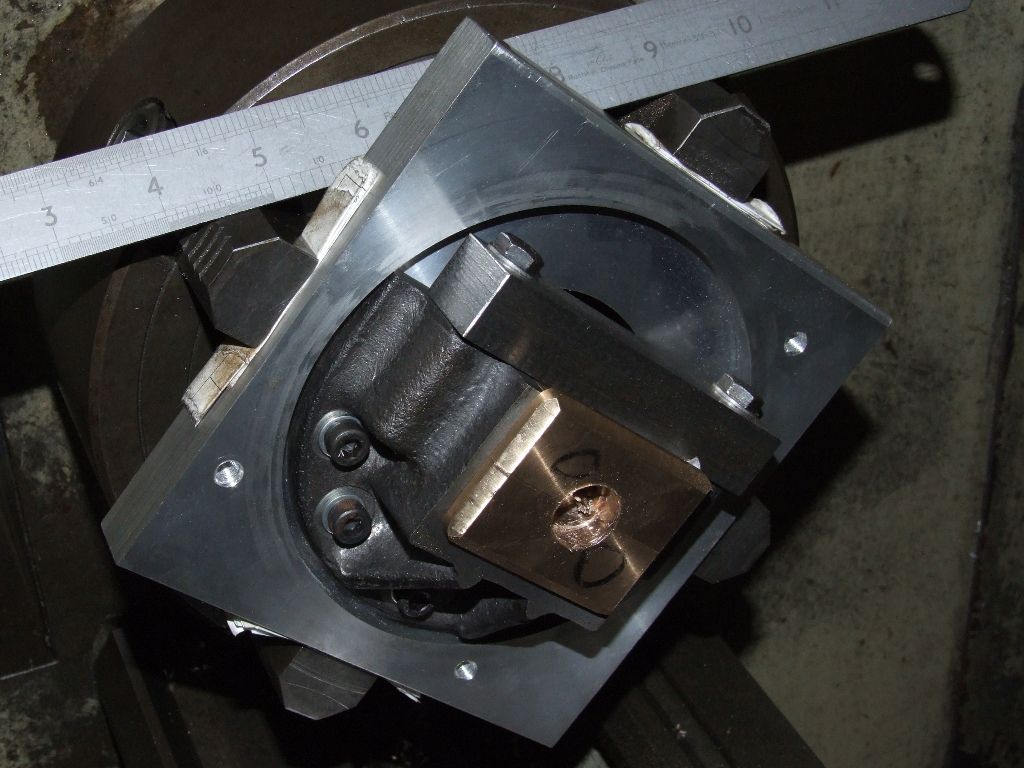
                  Correct, it won't be. You won't be a mile out, but it's not going to hold a thou or so. Best thing is to make a simple jig to hold the individual axleboxes for boring. This is what I did for my traction engine crankshaft beaings:

                  boring crankshaft bearings.jpg

                  Of course it's a bit more complex as it also utilises the bearing housings, but it shouldn't be difficult to come up with a simplified design.

                  Andrew

                  #341918
                  duncan webster 1
                  Participant
                    @duncanwebster1

                    Andrew's method is best, but simpler is:

                    Drill and tap a small hole on the axle centre, then make a disc say 6mm thick same diameter as axle. Screw this disc to the axlebox using packers to set it the right distance from the datum faces. You can then set the axlebox in the 4 jaw with a DTI against the disc. Just remember they are handed.

                    I did my latest set the other way round, bore the hole first then machine the faces with the box set on a spike on an angle plate, but it's too late for that in your case

                    #341922
                    Raglan Littlejohn
                    Participant
                      @raglanlittlejohn

                      I would do as Duncan suggests, but I would make the coupling rods first. Next make the discs the same diameter as the coupling rod bearing holes. The axle boxes can then be fitted on the locomotive packed up to the same height. The discs can then be adjusted on the axle boxes so that the coupling rods fit . On an 0-6-0 I would fix the discs for the middle axle in the correct position relative to the frames etc, then adjust the first and third axle discs to fit the coupling rods. The discs can then be used to align each axle box for boring as mentioned before. I think I saw this method in a book by Ivan Law.

                      #342015
                      julian atkins
                      Participant
                        @julianatkins58923

                        Hi Peter,

                        I would agree that Don's description is not clear except I have most of his construction notes for his many designs both in LLAS and ME, plus knew Don, and I think my interpretation is the correct one, even if there may be better (but far more complicated and time consuming methods). I haven't had any problems doing the axleboxes as per my interpretation of Don's description for your design, which is much clearer in his other construction descriptions.

                        Obviously you need to know your 4 jaw chuck well.

                        I think the other suggestions are serious overkill.

                        Cheers,

                        Julian

                        #342026
                        Derek Drover
                        Participant
                          @derekdrover32802

                          Not having a clamp for a faceplate I recently machined my axleboxes thus:- Clock on the mill to locate centre point and centredrill deep enough for a pointed wobbler to locate. Place onto lathe in the 4-jaw with wobbler in the tailstock and a dti measuring the movement on the wobbler. Adjust till the wobbler says you're on the hole.

                          Once one is done and removed, even if you retighten the same jaws as loosened the next will require some reclocking, but with practice its pretty quick and accurate (so long as you were accurate to begin with).

                          #342033
                          JasonB
                          Moderator
                            @jasonb

                            I'd go with derek's method, mark them out accurately with a height gauge or using the mills DRO then clock each one into position in the 4-jaw and bore away. Done plenty of crankshaft bearings that way and all my cranks turn round OK

                            #342055
                            IanT
                            Participant
                              @iant

                              Yes, second for Dereks advice too – my 4-jaws will not provide repeatability by the "loosen two jaws" method.

                              This method may be OK for 'near enough' work (if you don't need absolute accuracy) but it won't give you 'spot on' – the work does need re-checking again for truth. This could be down to my 4-Jaws (or it might be me over-tightening) but either way, it didn't give me good results. So I don't use this method now and personally I consider it bad practice.

                              Regards,

                              IanT

                              #342069
                              Derek Drover
                              Participant
                                @derekdrover32802

                                I did it 6 months ago on my L1 axleboxes.. came out spot on !

                                #342079
                                richard 2
                                Participant
                                  @richard2

                                  What about a Keat's angle plate on the faceplate?

                                  If only the clamp plate is moved each time surely the axle-box should be square?

                                  Richard2.

                                  #342084
                                  IanT
                                  Participant
                                    @iant

                                    A Keats wouldn't be the first thing to come to my mind for doing axle-boxes Richard (although mine are probably smaller than other peoples) – but it does have 'fixed' faces (unlike the four 'movable' chuck jaws) – and provided the part can be 'seated' accurately – I guess one could be used.

                                    I have an axle-box jig somewhere – it has a 'backing' plate with two fixed guides at right angles, plus two moving clamps to hold the boxes against the fixed guides. A 'cover' plate holds the box flat against the rear and also has a hole in the middle to drill/bore through. Once the jig (and the first box) has been set-up on the face-plate – you can drill and bore any number of axle-boxes with very good repeatability. So not so different I guess. But this was designed for a much larger engine than the G3 ones I build these days…

                                    Regards,

                                    IanT

                                    #342147
                                    Neil Wyatt
                                    Moderator
                                      @neilwyatt

                                      Here's an approach I haven't used but should give a very accurate result.

                                      Drill and ream four oversize blank axle boxes.

                                      One at a time, stick a (relatively small) round bar in the blanks and use bar across the top of the milling vice.

                                      Use this set up with each block in turn to skim the TOP dimension of the boxes.

                                      Now use a square on the top surface as a reference, to reset each box in turn at 90-degrees each way using the same bar and setting the cutter taking a cut at the appropriate height for the sides of the boxes. If set accurately the boxes will all be parallel with the hole central and sizes the same.

                                      Now reset the cutter height and do the bottoms.

                                      Finally groove or step the sides of the boxes as required.

                                      I have found the bar in a hole method to give cuts to a very high level of repeatability from a hole.

                                      This is also a very easy way to mill a round surface concentric with a hole, by taking multiple cuts.

                                      Neil

                                      #342289
                                      duncan webster 1
                                      Participant
                                        @duncanwebster1

                                        Neil's way is a poor relation of the way I tried to describe. I did an article on it for ME a few years back, but don't have the reference. No doubt someone with ME index can find it. Basically, bore first, then bolts a close fitting spike to an angle plate and mill all 4 or 6 reference faces, then you can use vice and packers to do the rest. Can't go wrong he said (famous last words)

                                        #342298
                                        Raglan Littlejohn
                                        Participant
                                          @raglanlittlejohn

                                          I've looked up Ivan Laws method of doing this job. It is described in chapter 10 of 'Measuring and Marking Metals' one of the Workshop Practice Series from Tee Pubishing. I'd be interested to hear what people think of this method.

                                        Viewing 19 posts - 1 through 19 (of 19 total)
                                        • Please log in to reply to this topic. Registering is free and easy using the links on the menu at the top of this page.

                                        Latest Replies

                                        Home Forums Beginners questions Topics

                                        Viewing 25 topics - 1 through 25 (of 25 total)
                                        Viewing 25 topics - 1 through 25 (of 25 total)

                                        View full reply list.