spindle bearings re chatter cutting steelcantstop

spindle bearings re chatter cutting steelcantstop

Home Forums Beginners questions spindle bearings re chatter cutting steelcantstop

Viewing 15 posts - 1 through 15 (of 15 total)
  • Author
    Posts
  • #164164
    stewart wood
    Participant
      @stewartwood82335

      Hi i have a Drumond M TYPE and i have removed and checked the head stock bearings and spindle ,when i reassemble them and try to machine say EN 1A i cant get a good finish . i have tried and checked all the usual things , tool geometry ,slide play , speeds etc, I have a Rohm chuck dia 6 inch and a 3 inch sharp both tried to same effect, i can machine Brass and Aluminium no problem . I think perhaps i am missing some thing when setting up the head bearings . All advice and thought s would be appreciated thanks . Stewart

      #7310
      stewart wood
      Participant
        @stewartwood82335

        DROMOND LATHE

        #164241
        JohnF
        Participant
          @johnf59703

          Stewart, Many years ago I used to rebuild and sell on old lathes, 1960's, now I am not just sure how the head bearings on these machines are adjusted ora if they are tapered or a straight journal? However one thing I learned was that with straight journals you can have the too tight! I.e. No room for the oil and this causes chatter, I found that by allowing a little clearance for the oil, we are talking a minimal amount here the machine would cut just fine, tighten up and it nearly jumped of the bench with chatter.

          Try it and see how you get on, hope this helps. John

          #164247
          Ady1
          Participant
            @ady1

            Theres a bit on headstocks here

            #164285
            Eugene
            Participant
              @eugene

              Hi Stewart,

              I've just gone through exactly the same experience with my own M type; no matter what I did the chatter would occur on anything but the finest of fine cuts.

              Adjusting the bearings wasn't as simple as the manual suggests. I found that when I pulled up the big bronze nuts to the point where the spindle wouldn't revolve and tightened down the adjusting screw / oiler I'd got just one shot at it, the process isn't reversible so I couldn't fiddle about looking for perfection. It's because when you ease the screw back, the little lozenge piece it bears on doesn't recoil, it just stays put. So lesson one is to get it right first time and then leave it alone.

              Even when I'd done that the chatter was still all too apparent. I eventually worked out by (tedious) elimination that it was caused by a sort of concealed end float. The spindle in mine was scored; not badly but enough to be concerned about.  On the shaft near the oiler holes I suspect cast iron or something had found a way in down the oiler hole and done the damage. When I adjusted the end float with the ground collar that bears on the exterior of the headstock spindle nut, I found two conditions; chatter or overheating. Loosely finger tightened gave chatter, a bit tighter gave rapid heating and squeally noises.

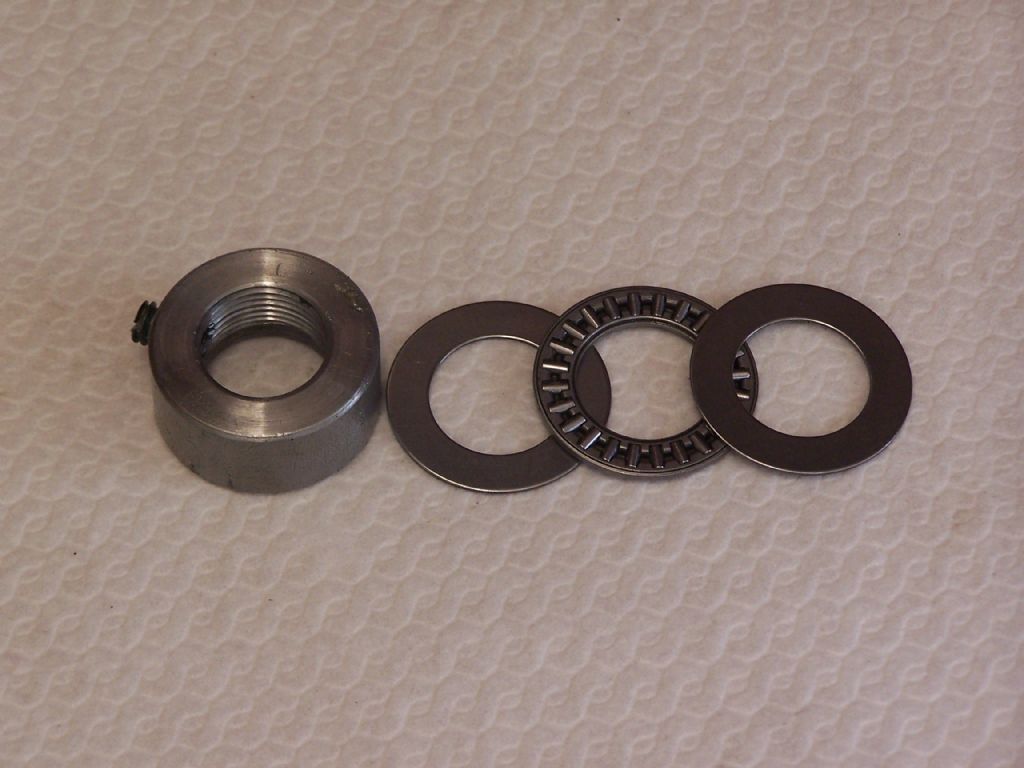
              My conjecture was that the scoring was enough to resist movement from a finger tight collar, but not enough to stay put under the pressure of the cutting tool. There isn't any much lubrication between the collar and the bronze bearing so when they are brought together under pressure there's a lot of friction. My solution was to place a small needle roller thrust bearing between the two, (ie the bronze bearing nut and the ground collar).

              Result …… chatter gone never to return. If you think this dodge might help let me know, and I can steer you to the bearing supplier. The one I got is an imperial size and a dead fit, no fiddling about required at all, and cost buttons from a UK source.

              After I fitted it the note / noise from the spindle rotation was quite different from what it was before which was a bit off putting but it works well enough; I'm turning silver steel at 1050 rpm with a positive rake carbide insert nae bother.

              Eug


              Edited By Eugene Molloy on 22/09/2014 16:47:25

              Edited By Eugene Molloy on 22/09/2014 16:49:02

              Edited By Eugene Molloy on 22/09/2014 16:51:57

              #164297
              stewart wood
              Participant
                @stewartwood82335

                Thanks to you all for your advice, the bearings on my machine are the later type, tapered bush into tapered casting with the small tapered block under the lube screw and the C spanner nut on each end of the casting. Eug you are probably right with your idea of one shot at getting it free of play ,sometimes when I set it up its been better than others.I will get back to you on the thrust bearing if I am still struggling .Ady thanks for the link. Another thought ,,could the 6 inch chuck be to heavy ? its got to be 5/6 kgs or more. Stewart

                #164317
                Ady1
                Participant
                  @ady1

                  No. Drummond M's are one of the best hobby units you can get, good enough to run all day on mini production runs

                  The headstock bearings are definitely a pain to set, but it's well worth the effort

                  This is 36mm rebar I did on my M series, loads of intermittent cuts and a nice finish


                  Edited By Ady1 on 22/09/2014 21:07:31

                  #164323
                  Eugene
                  Participant
                    @eugene

                    Stewart,

                    The supplier is "Simply Bearings", the part number is NTA1220 + TRA1220 @ £6.41 ex VAT, and it only takes thirty seconds to fit. I have another M type, a long bed ,wanting some TLC and I'm going to do the mod willy nilly.

                    NTA1220

                    If you are going to go through the fag of getting the spindle (and the cursed backgear) out, slip the thrust bearing in immediately you get the spindle back in and before you do any adjusting. End float needs to be done after the bronze bearings have been taken care of.

                    Best of luck,

                    Eug

                    #164326
                    Eugene
                    Participant
                      @eugene

                      Ady1

                      Thats very impressive, can I ask a beginners question; what is "blue carbide" and what speed and feed do you use?

                      My carbide inserts would be in a zillion shards trying that. I'll be turning some interrupted cuts on cast iron before long; would you recommend blue carbide?

                      Eug

                      #164327
                      Eugene
                      Participant
                        @eugene

                        duplication

                        Edited By Eugene Molloy on 22/09/2014 23:12:34

                        #164331
                        Ady1
                        Participant
                          @ady1

                          what is "blue carbide" and what speed and feed do you use?

                          They seem to be standard carbide tools, but they definitely aren't as brittle as the red painted carbide tools which chip if you look at them harshly

                          I just experiment, break some, and figure it out as I go along.

                          I'm using one very successfully in my newly acquired shaper at the moment, carbide tools are fabulous because they go for so long between sharpening

                          Speed isn't fast, about 3-400 rpm and I listen to the cut as far as feed is concerned, no violence, it should be a soft hissing type noise. The relief angles are very shallow to maximise tool tip support and done by eye

                          The key to successful carbide work on a hobby lathe for me seems to be stiffness, everything I do is geared towards maximising stiffness and I have made a pretty massive toolpost to help

                          edit: which reminds me. You don't need to use the top slide unless you are doing tapers

                          I use a muckle toolpost on the cross slide

                          Edited By Ady1 on 23/09/2014 01:00:19

                          #164333
                          Ady1
                          Participant
                            @ady1

                            I'll be turning some interrupted cuts on cast iron before long; would you recommend blue carbide

                            I would do cast iron on the backgear and use an upside down blue carbide tool on the rear of the cross slide

                            The parting tool is my favourite, with a tidy up on the green grit wheel to give it reasonable sharpness

                            You can see in photo 2 the swarf is in front of the toolpost because I do a lot of work with an upside down tool (which saves me worrying about the tool setup height)

                            If you cut from the rear side on the backgear the amazing mess cast iron makes is largely eliminated and you have a neat pile of iron filings down the back of the lathe which can be sucked up with a vacuum

                            #164339
                            stewart wood
                            Participant
                              @stewartwood82335

                              Thanks again for your help , my enthusiasm as been re ignited . I was given this lathe a couple of years ago and spent a few quid on a motor and lead screw nut [I had made ],a complete strip down paint and rebuild only to find I couldn't stop the chatter .I will have another go re armed with new info . Stewart

                              #164348
                              Ady1
                              Participant
                                @ady1

                                You need to sort that chatter out first before using any carbide. Use HSS until you can do a constant cut which gets blunted by the amount of work the lathe can do. That's what made me go for the switch to carbide, I realised I was spending a lot of time tidying up HSS tools and wondered if I could use a longer lasting material.

                                GL

                                Edit: The key for me has been practice

                                Practice practice practice practice

                                I have turned a load of material from the scrapyard into buckets of swarf to get a bit of experience

                                That lathe you have is one of the best hobby lathes ever made, which is why the Ministry of Defence churned them out during WW2

                                BTW You will find the leadscrew clutch hugely useful once you get going because it allows you to semi automate your work

                                Edited By Ady1 on 23/09/2014 10:05:43

                                #164357
                                Eugene
                                Participant
                                  @eugene

                                  Stewart,

                                  When I was playing chase the lady with the chatter the decision was to start at the cutting tool and work back down the drive train from there looking for problems; dead logical. Tool holder, tool post, topslide gibs, crosslide gibs, carriage lock, carriage fit, bedways, bearings, spindle, Uncle Tom Cobbleigh and all. The final thing to check, and thus the very last link in the chain was the end float adjustment, and guess what? That's what being logical does for you.sad

                                  As Ady1 recommends I even ditched the topslide altogether and finagled a tool post to sit directly to the cross slide; it didn't help me with the problem in hand but it's not a bad move if you aren't turning tapers and such.

                                  Eug

                                Viewing 15 posts - 1 through 15 (of 15 total)
                                • Please log in to reply to this topic. Registering is free and easy using the links on the menu at the top of this page.

                                Latest Replies

                                Home Forums Beginners questions Topics

                                Viewing 25 topics - 1 through 25 (of 25 total)
                                Viewing 25 topics - 1 through 25 (of 25 total)

                                View full reply list.