Machining a Washer – Procedure

Machining a Washer – Procedure

Home Forums Beginners questions Machining a Washer – Procedure

Viewing 23 posts - 1 through 23 (of 23 total)
  • Author
    Posts
  • #291912
    Roger Hulett
    Participant
      @rogerhulett83124

      I have a piece of 4mm steel 80mm x 80mm. I have to form a 4mm thick washer, 80mm od x 72mm id. What is the correct procedure to do this ? Thankyou

      #8645
      Roger Hulett
      Participant
        @rogerhulett83124

        Correct procedure

        #291913
        John Rudd
        Participant
          @johnrudd16576

          I would hold in a 4 jaw chuck, centre it up. Bore the central hole, cut the corners off then hold the plate in the centre hole using the outside of the jaws, then machine the outside to finished diameter….

          Others may have their own preferred method

          #291915
          Clive Foster
          Participant
            @clivefoster55965

            Roger

            You don't say what lathe you have but if its one of the lighter variety its worth knocking the corners off first with a hacksaw or angle grinder to reduce the clunk, clunk, clunk when you start machining down to round. Not good for the machine especially if its an older one with many hours on the clock and inevitable wear / slackness.

            Clive.

            #291916
            Brian Oldford
            Participant
              @brianoldford70365
              Posted by Clive Foster on 03/04/2017 12:34:34:

              Roger

              You don't say what lathe you have but if its one of the lighter variety its worth knocking the corners off first with a hacksaw or angle grinder to reduce the clunk, clunk, clunk when you start machining down to round. Not good for the machine especially if its an older one with many hours on the clock and inevitable wear / slackness.

              Clive.

              Or don the tin hat and trepan them off.

              #291927
              Emgee
              Participant
                @emgee

                Hi Roger

                If you want the 4mm thick washer to be faced on both sides and parallel to each other I suggest you need to start with say 5mm thick plate, in any case plate thicker than the washer final thickness to allow for facing.

                Emgee

                #291938
                ega
                Participant
                  @ega

                  Facing washer probably best done with suitably shaped soft chuck jaws.

                  #291941
                  MW
                  Participant
                    @mw27036

                    I'd go for trepanning, less waste involved and can use the corners for bits and pieces.

                    The only thing you have to be careful of when trepanning large diameters is one can get a bit carried away with the speed and burn the tool.

                    Michael W

                    Edited By Michael-w on 03/04/2017 17:45:01

                    #291962
                    Neil Wyatt
                    Moderator
                      @neilwyatt
                      Posted by Emgee on 03/04/2017 14:57:16:

                      If you want the 4mm thick washer to be faced on both sides and parallel to each other I suggest you need to start with say 5mm thick plate, in any case plate thicker than the washer final thickness to allow for facing.

                      Surface finish depends on what the washer is for…

                      As the washer will only be 4mm by 4mm in section, I strongly advise against boring it out before knocking the corners off. Unless you approach it very slowly, it will distort, slip and may twist off the chuck. held by the outside or teh inside a 4mm wide washer of that diameter will distort if held by a chuck.

                      Drill a hole dead in the middle and fit it on a mandrel and turn to the OD. Use an M8 or M10 thread and a big nut/washer to hold it nice and tight so it doesn't spin.

                      Then make a simple trepanning tool like a flat ended d-bit from 3mm or 1/8" HSS or silver steel hardened and tempered, and use this to cut a groove to remove your washer. Take it very easy near the end and when it starts to break through you may want to break the washer free and debur rather than trying to cut it completely free.

                      Neil

                      #291979
                      Tim Stevens
                      Participant
                        @timstevens64731

                        A silversmith would bend a ring from square steel wire and weld/braze the join. Much less waste, see. A blacksmith might do the same if the wire was 10mm or more …

                        Cheers, Tim

                        #291992
                        Bob n About
                        Participant
                          @bobnabout

                          Perfect excuse to buy a plasma cutter.

                          #292006
                          MadMike
                          Participant
                            @madmike

                            80 x 80 square material and you want an 80mm diameter washer with presumably a concentric 70mm hole?

                            You will almost certainly end up with a washer with 4 flat faces on the OD. So start with a larger piece of material.

                            Frankly I wouldn't do any of the dangerous, haphazard or frankly odd practices described. Sorry if that offends chaps but really.

                            Treat yourself to a piece of larger diameter bar. Face it off, drill and bore the 70mm hole, turn the OD to the required 80mm and then simply part it off at the required thickness. Undoubtedly others will disagree but that frankly how I would do it

                            #292008
                            John Stevenson 1
                            Participant
                              @johnstevenson1
                              Posted by Michael-w on 03/04/2017 17:43:33:

                              I'd go for trepanning, less waste involved and can use the corners for bits and pieces.

                              The only thing you have to be careful of when trepanning large diameters is one can get a bit carried away with the speed and burn the tool.

                              Michael W

                              Edited By Michael-w on 03/04/2017 17:45:01

                              Why go to the trouble of trepanning the corners ?

                              You will have 4 interrupted cuts every rev getting an 80mm circle out of an 80mm square plate and just to save 4 tiny triangular bits of steel that will never get used again ?

                              So for saving 4 silly corner chances are you break a trepanning tool or rip it out of the chuck and you have to start again.

                              #292012
                              Clive Foster
                              Participant
                                @clivefoster55965

                                Posted by John Stevenson on 04/04/2017 00:17:12:

                                just to save 4 tiny triangular bits of steel that will never get used again ?

                                Like you are going to find 'em in the chip-tray anyway.


                                Saving tiddly "useful" bits is something I need to get over. Probably 'undreds of small but too big to bin bits around my place that I really need to go through, man up and (mostly) bin. Example just been doing an 1" (ish) angle iron job maybe 50 offcuts in the 1" to 2" long range. OK keep a few for diddy brackets but there are already 40 or 50 similar size in t'box.


                                Getting back to the original job I'm with MadMike and would start off with a bigger bit of material. Preferably round so no worries about corners. Last time I did similar I hole sawed it out of flat bar and cleaned up to size. But that was in alloy and about 130 mm diameter.

                                Clive.

                                Edited By Clive Foster on 04/04/2017 01:05:37

                                #292016
                                MW
                                Participant
                                  @mw27036
                                  IPosted by John Stevenson on 04/04/2017 00:17:12:

                                  Posted by Michael-w on 03/04/2017 17:43:33:

                                  I'd go for trepanning, less waste involved and can use the corners for bits and pieces.

                                  The only thing you have to be careful of when trepanning large diameters is one can get a bit carried away with the speed and burn the tool.

                                  Michael W

                                  Edited By Michael-w on 03/04/2017 17:45:01

                                  Why go to the trouble of trepanning the corners ?

                                  You will have 4 interrupted cuts every rev getting an 80mm circle out of an 80mm square plate and just to save 4 tiny triangular bits of steel that will never get used again ?

                                  So for saving 4 silly corner chances are you break a trepanning tool or rip it out of the chuck and you have to start again.

                                  I've looked at the size again and realized you can't do it without an interrupted cut simply due to the size of the plate, in this case you're better off hacking the edges off and turning the o.d with a turning tool.

                                  Michael W

                                  #292029
                                  Dusty
                                  Participant
                                    @dusty

                                    Sounds like a faceplate job to me. You have four corners to clamp it by and providing the 4mm plate is flat it should be good enough. If it is just a washer, then I am sure a few thou shy on the dia will not matter. Set up on the faceplate, you will need to make sure it is accurately centered, hack out the middle, and bore to size. Saw the corners off and as much waste as you can. Ideally a four jaw self centering chuck can be used to turn the O.D.

                                    #292033
                                    peak4
                                    Participant
                                      @peak4

                                      I made a large stainless washer yesterday, albeit of different dimensions to fit a Belfast sink in the new garage.

                                      Inner was hole cut undersize with normal hole saw in pillar drill running slowly with lube.

                                      Outer diameter was then cut with small hand guillotine oversize. I then place the rough washer in the 3 jaw, in expansion mode, and sized the outer rim, swapped the jaws over, and held the now finished outer in order to bore to size.

                                      In my case the washer was thinner (so I could use a guillotine) and larger, but I've used a similar method by clamping the donor plate to a sheet of plywood and used two different sized holesaws to get the starting annulus, still all done in the bench drill.

                                      Obviously cut the inner hole first, so you can still hold the blank; the drill centre hole in the plywood is enough to guide the bore for the larger hole saw. Just replace the drill bit in the hole saw with a suitably sized length of plain rod to run in the hole in the plywood sheet.

                                      I can't remember what it was for, but I've done similar with 4 or 5mm stainless plate in the past to make something similar to what you're trying to achieve; it would have been a spacer for one of the motorbikes or the Marlin.

                                      Regards

                                      Bill

                                      #292072
                                      MadMike
                                      Participant
                                        @madmike

                                        Roger M-Machine in Darlington advertise 80mm bright steel bar for around £4.00 per inch or, if you want to turn the OD to size, 90mm for around £4.50 per inch depending upon the metal spec. Full price list is on line. Hope this helps.

                                        Edited By MadMike on 04/04/2017 16:07:07

                                        #292127
                                        John Stevenson 1
                                        Participant
                                          @johnstevenson1

                                          Was going to put this in the "What did you do today" post but decided it would do better here.

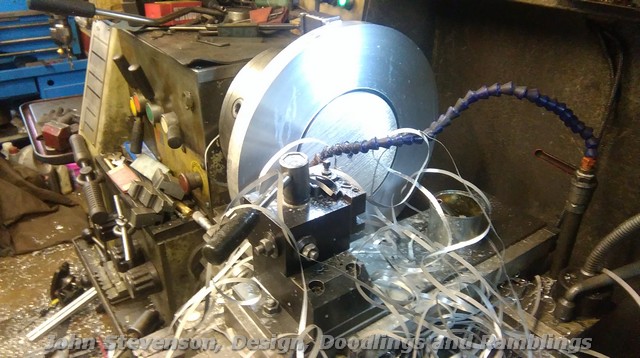
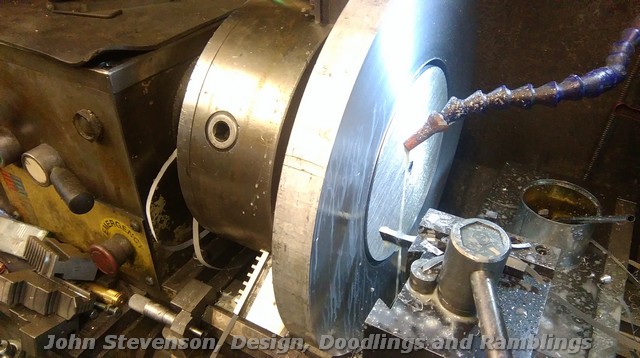
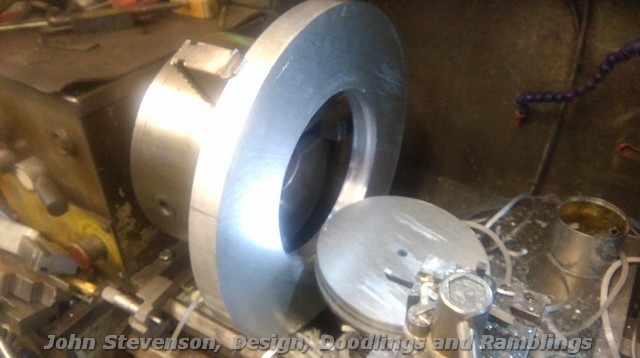
                                          THIS IS A WASHER.

                                          16" diameter with 7" hole being trepanned out, 30 mm deep.

                                          Tool is approximately 6mm wide x 12mm deep. 250 rpm, power feed set at "steady as she goes"

                                          I don't know what the feeds are on this machine as all the number have worn off the feed plate.

                                          Now that bit IS worth saving.

                                          #292132
                                          MW
                                          Participant
                                            @mw27036

                                            Now all you have to do is make the nut and bolt and youll have the full set

                                            Edited By Michael-w on 04/04/2017 23:03:50

                                            #292133
                                            Emgee
                                            Participant
                                              @emgee

                                              JS, looks like your'e pushing that chuck beyond it's limit !!!!!

                                              Emgee

                                              #292138
                                              John Stevenson 1
                                              Participant
                                                @johnstevenson1
                                                Posted by Emgee on 04/04/2017 23:04:26:

                                                JS, looks like your'e pushing that chuck beyond it's limit !!!!!

                                                Emgee

                                                Good job you can't see what's actually holding the disk on.

                                                It's three M10 nuts welded to the soft jaws and machined back. Saves wasting a set of soft jaws, I can grind these off and replace them with other bits of metal wink

                                                #292140
                                                MalcB
                                                Participant
                                                  @malcb52554


                                                  1. With precision mark out centre of 80mm square and centre pop.

                                                  2. Faceplate or turning plate, clamp back on 4 corners

                                                  3. Set true with wobble bar setting true twixt pop mark and dead centre.

                                                  4. Trepan and bore out about 66mm diameter ( left undersize to facilitate clamping for intermittent cutting ).

                                                  5. Reverse/transfer clamping to I.D. one clamp at a time to retain trueness

                                                  6. Finish turn O.D.

                                                  7. Again, one at a time reverse/transfer clamping back to O.D.

                                                  8. Finish bore

                                                  Dependant on marking out and setting will be how many flats you end up on O.D.

                                                  Avoid any 3 or 4 jaw chucking, you will likely end up with 3 or 4 lobing or coining

                                                Viewing 23 posts - 1 through 23 (of 23 total)
                                                • Please log in to reply to this topic. Registering is free and easy using the links on the menu at the top of this page.

                                                Latest Replies

                                                Home Forums Beginners questions Topics

                                                Viewing 25 topics - 1 through 25 (of 25 total)
                                                Viewing 25 topics - 1 through 25 (of 25 total)

                                                View full reply list.