Milling facility on my Myford ML7?

Milling facility on my Myford ML7?

Home Forums Beginners questions Milling facility on my Myford ML7?

Viewing 18 posts - 26 through 43 (of 43 total)
  • Author
    Posts
  • #247299
    Paul Lousick
    Participant
      @paullousick59116

      Hi Choochoo-balloo,

      Check the for sale adds in MEW. There is a Myford vertical slide for sale. A useful accessory for your lathe at the price.

      Paul

      #247301
      Ajohnw
      Participant
        @ajohnw51620
        Posted by Hopper on 19/07/2016 04:39:05:

        Posted by Ajohnw on 18/07/2016 16:42:07:…

        I'd guess you may be asking because there are some Amolco units on ebay at the moment. There is also a Rodney. That might be a hernia device to fit to the lathe. To compare with the Amolco I would look at the SIEG Super X1LP and ask myself which is most likely to be more rigid.. I'd hope that has 2 belt set speeds.

        John

        575 pounds for a used Amolco head on Ebay – not a cheap bit of kit. And it does not look overly heavy duty, round column and all. It's a rather expensive punt to find out.

        And I don't know about the Sieg X1 as being any more rigid than a verical slide, if even as rigid. I looked at a used X2 for sale locally and from the demo run I had on it, I would not rate it any more rigid than my vertical slide. In fact, from what I saw I am pretty sure it would not drive a 1" cutter along 1" plate as my lathe would in the pic I posted above. From having a look at a mate's X3, that seems to be a serious bit of kit suited to milling tooling and motorbike parts, ie that next size bigger than brass model parts etc.

        So Choochoo-balloo, you perhaps might want to condsider saving yourself 500 pounds and buy a nice used non-swivelling vertical slide to get started with. The matching Myford vice is handy for small stuff but mostly you will be clamping direct to the slide's table. So you will need to buy cutters, clamps, bolts and so forth. All of which will be of use later if you graduate to a milling machine or head.

        Personally, I am saving my pennies for an X3 and learning lots of innovative set ups on the vertical slide in the mean time! (That's the vertical slide on the left.) As Ajohnw said above, frequently the innovative set ups are more interesting than the piece being made. A job that would be a no-brainer on a Bridgeport or Cincinnatti in the toolroom can take some real working out at home with limited resources.


        Edited By Hopper on 19/07/2016 04:41:03

        Edited By Hopper on 19/07/2016 04:45:49

        Edited By Hopper on 19/07/2016 04:50:40

        I'd expect a basic Myford vertical slide to be more rigid than a number of millers Hopper and the lathe itself more powerful as well.

        What I was sort of asking is the X1 the same or more rigid than the Amolco. I'd guess little difference. The X1 may be stiffer.

        I had a Chinese miller at one point. It seems to be a cross between the X2 and the X3. A column size in between the two and a counter weight running up and down in the column to balance the head. Once set up it wasn't too bad. I bought it off some one who couldn't use it and blamed the machine. Slides were loose especially the head. The person that bought it off me said it's ok with a happy tone to his voice when I asked several days later. The nearest to it I can see is this one

        **LINK**

        They have increased the cross slide travel since then. The fine feed was a bit naff and it spent it's time in low gear. They may be pushing their milling specs a bit but what depth of cut and what feed rate. I don't think I used anything over 1/2" on it.

        John


        Edited By Ajohnw on 19/07/2016 23:41:11

        #247324
        MW
        Participant
          @mw27036

          Ajohnw,

          I actually have a bigger (similar-ish)  variant of that machine, the motors really let down what is essentially a good frame, mine had a variable DC which i eventually chucked and fitted an induction motor to the frame and now it's fantastic.

          Michael W

          Edited By Michael Walters on 20/07/2016 09:43:13

          #247359
          John Haine
          Participant
            @johnhaine32865

            I used to have an Amolco, complete with coordinate table. I've also briefly had an X1, bought for a CNC conversion but sold on. In my view the Amolco was vastly better than the X1, though slightly let down by the amount of Z travel, which I fixed at each end! The only drawback was that the only Z feed was by leadscrew which was slow, a quill would have been nice for drilling. Also a wider speed range would have helped. If you can get a complete Amolco mill I'd recommend it.

            #247367
            Michael Gilligan
            Participant
              @michaelgilligan61133
              Posted by John Haine on 20/07/2016 16:57:21:

              If you can get a complete Amolco mill I'd recommend it.

              .

              Nice looking specimen on ebay at present … With free postage from the Netherlands.

              Worth looking-at just to understand the construction.

              MichaelG.

              #247386
              Ajohnw
              Participant
                @ajohnw51620

                There is also a complete Rodney milling machine on ebay at the moment with it's x-y table. Looks like it might need it's motor attaching. They don't have much capacity though.

                I assume this could be attached to the lathe as well if needed.

                John

                #247419
                jwb
                Participant
                  @jwb

                  I have a Rodney milling attachment which saw considerable use on my well-worn ML7 (now replaced). It would effortlessly produce a good finish on work, far better than similar work done on a Chinese mill, then a Wabeco. I put this down to quality of construction and the combined rigidity of the lathe and mill.

                  The limitation with such attachments is the lack of travel on the axes, but for small work this is not important. The attachment is still used occasionally on a Super 7. Handling is done safely and easily with an in situ block and tackle.

                  #248354
                  choochoo_baloo
                  Participant
                    @choochoo_baloo

                    Thanks all for the input – most helpful.

                    I have a related question: in browsing standalone compound tables, e.g. http://www.axminster.co.uk/proxxon-kt-150-aluminium-die-cast-compound-table-474334 , I don't know what die cast aluminium is.

                    How common is it to use instead of steel for a milling table? Wouldn't being aluminium seriously limit its performance?

                    #248358
                    Martin Connelly
                    Participant
                      @martinconnelly55370

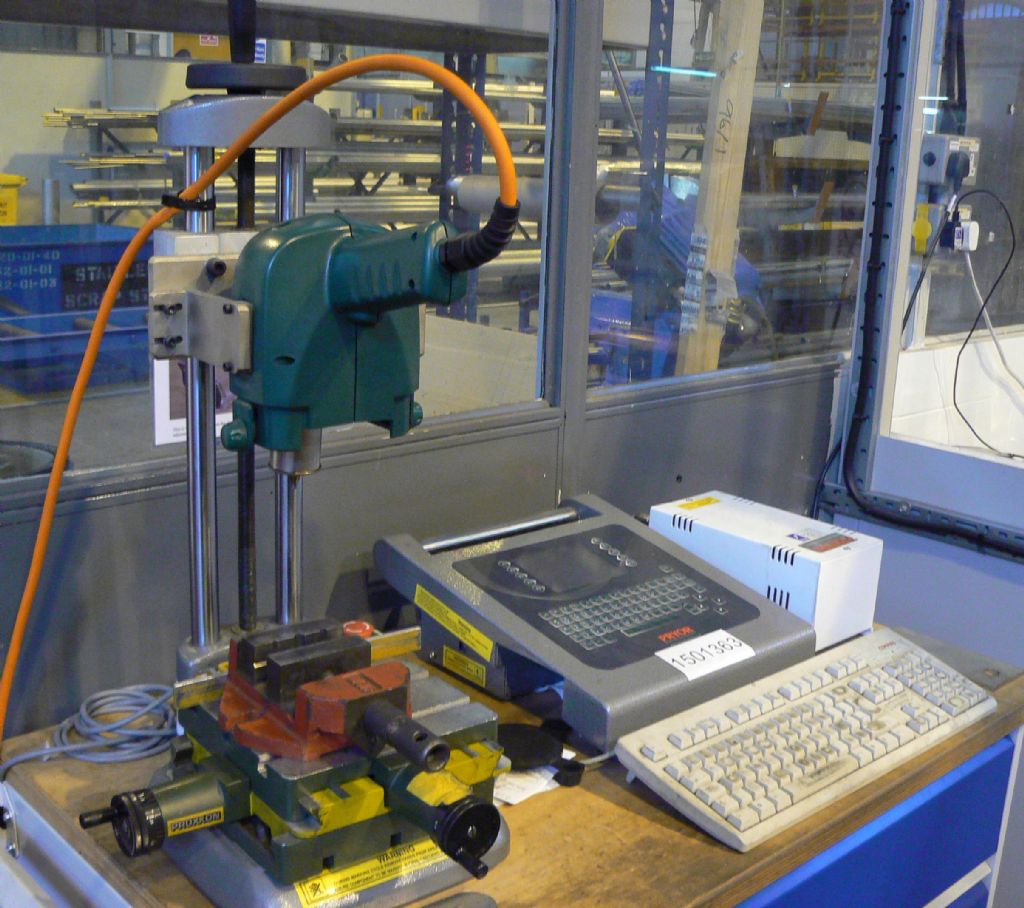
                      I bought one of these at work for positioning items under a dot matrix marker.

                      **LINK**

                      It is well made and suits the purpose it is being used for here. For milling it may be too weak for working with steel. The problem with the material it is made from is that it is easily marked and I can imagine getting some debris into the slides and causing damage. Cast iron will be far more resilient. The leadscrews are not acme style, just basic 60°. The leadscrew nuts are short and made of brass, the operating knobs are plastic and there is no way to reduce backlash without modifying the table.

                      I would look for a suitable cast iron option.

                      Martin

                      picture1.jpg


                      Edited By Martin Connelly on 28/07/2016 14:59:30

                      #248378
                      Howard Lewis
                      Participant
                        @howardlewis46836

                        When i had a ML7, I used a swivelling Vertical Slide., (Single Bolt version) but found that it would stay as set.

                        So I bought a Rodney Milling Attachment. This was a nice piece of kit. It allowed me to find that the ML7 was not rigid enough for Milling. At least, not the way I used it, even with light cuts and find manual feeds.

                        Because I could not tolerate the wear and tear on the ML7 I bought a Warco Economy Mill/Drill. This is a much more rigid machine, but, being an old design with a round column, not infallible. Now, I would definitely buy a machine with a dovetail column.

                        This is a definite improvement on a co ordinate table under a pillar drill.

                        For Milling, rigidity is ESSENTIAL. Any flexing will at least cause, inaccuracy, at worst, damage to tooling and work, possibly the machine.

                        I now have a ETR BL12/24 (Think Warco BH600 or Chester Craftsman; 300Kg machines), and for one special job, bought and adapted to the 12/24, a Vertical Slide intended for a Seig C6, (about as heavy an accessory as you would want to carry for more than a few yards). For the little that it has been used in this configuration, it has been sufficient, but for everything else, I use the Mill Drill.

                        If in any doubt, go for the most rigid configuration that you can! Brick mausoleums are superior to tin sheds.

                        Howard

                        #248532
                        choochoo_baloo
                        Participant
                          @choochoo_baloo

                          I have been browsing the secondhand small knee supported table type of milling machine, and want to ask what is a feasible method for collection and delivery to a domestic address.

                          For example there's a 25" by 25" footprint machine, that weighs 28 cwt (=1400 Kg)…..

                          Is arranging a HIAB lorry the only way to go? I have no idea about this sort of thing.

                          #248534
                          Anonymous
                            Posted by choochoo_baloo on 29/07/2016 16:23:31:

                            For example there's a 25" by 25" footprint machine, that weighs 28 cwt (=1400 Kg)…..

                            What on earth is it made of, tungsten? A Bridgeport is only about 1000kg. That's approaching the weight of my horizontal mill, and that's a lot bigger footprint than 25" x 25".

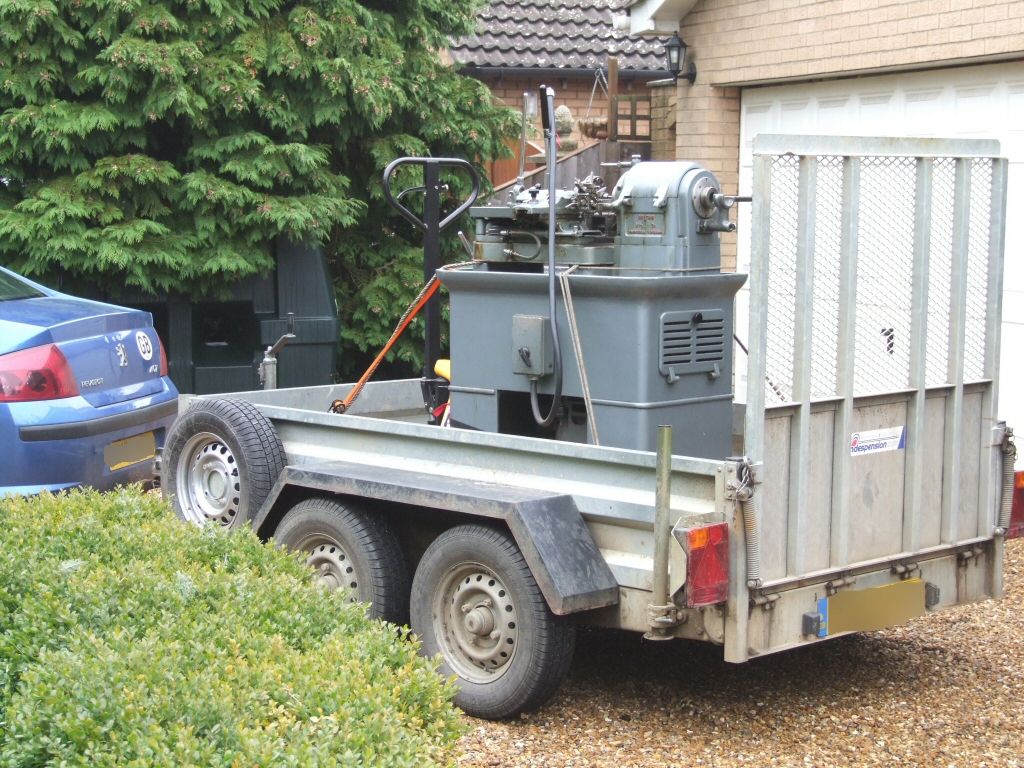
                            I work on the basis that I can move up to 1000kg by myself with a trailer and an engine crane. Over that you really need the professionals with a hiab. I moved this lathe with just a pallet truck; not sure of the weight but probably about 500kg:

                            back_home_sized.jpg

                            A caveat is that some machine tools are top heavy. Even if they weigh well under 1000kg if they start to go over you ain't gonna stop it! And worse, it ain't gonna stop just because you're in the way.

                            Andrew

                            Edited By Andrew Johnston on 29/07/2016 16:41:56

                            #248553
                            choochoo_baloo
                            Participant
                              @choochoo_baloo
                              Posted by Andrew Johnston on 29/07/2016 16:41:29:

                              Posted by choochoo_baloo on 29/07/2016 16:23:31:

                              For example there's a 25" by 25" footprint machine, that weighs 28 cwt (=1400 Kg)…..

                              What on earth is it made of, tungsten? A Bridgeport is only about 1000kg. That's approaching the weight of my horizontal mill, and that's a lot bigger footprint than 25" x 25".

                              Lol no, it is just a beast of a machine, and realised that I got the footprint very wrong – specifically a Denbigh Model D mill (whose dimensions according to lates.co.uk are: Model D machines weighed between 25.75 cwt and 32.75 cwt and required a floor space of 70" x 60&quot

                              So the 28 cwt/1400 Kg still stands unfortunately! So would a multi axle trailer be required – as I say I'm clueless about such matters?

                              #248559
                              Nick_G
                              Participant
                                @nick_g
                                Posted by Michael Walters on 19/07/2016 09:55:15:

                                a cast iron base with a dovetailed slide is rigid enough for the work we do.

                                .

                                Michael W

                                .

                                Michael, what is it you do …………… do.? (besides break taps and butcher copper. wink .)

                                The saying "anything is better than nothing" I suppose applies and lots of hobbyist machinists have produced truly excellent work on milling slides. But they will never be as rigid, have the capacity and be as adaptable as a dedicated milling machine.

                                At one stage I considered buying a milling slide. Then I read the reviews of those that had. The percentage of very, very disappointed purchasers was very, very high. – I thus decided I would wait until I had enough coins to buy a proper mill.

                                Nick

                                Edited By Nick_G on 29/07/2016 20:39:04

                                #248564
                                Ajohnw
                                Participant
                                  @ajohnw51620

                                  Some people use a Transit car transporter and a pallet truck. Both can be hired. Things tipping over is a big risk when moving machine tools. It doesn't do them any good. I favour dismantling when it's feasible as many parts can be handled easily with a sack truck.

                                  Things can be jacked up in stages with long levers such as a rather big wrecking bars to get the pallet truck under them.

                                  indecisionThe one you mentions seems to be a bit of a big jump from milling on a 7. Maybe you should look at something a little more modern and lighter weight such as Boxfords and Myfords offerings. There are others. With a bit of luck on those you may just find bearings need adjusting or maybe new one fitted. Old heavy stuff may be well worn in all sorts of ways who ever made them. Tom Seniors seem to be popular. I use a Dore Westbury. Not everybody's cup of tea but capable and a decent capacity for it's size. The MK2 castings look more rigid to me. The difficult bits on these were generally supplied pre made.

                                  One thing I would strongly suggest is don't rush and if at all possible do see it working. On the other hand 2 millers I have owned looked useless just because the person who owned them didn't set them up correctly. That aspect is far more important on lighter weight machines. Buying machines like this is a risky proposition for some people though as they need to be sure that this aspect really is the problem.

                                  John

                                  #248568
                                  Anonymous
                                    Posted by choochoo_baloo on 29/07/2016 19:39:39

                                    Lol no, it is just a beast of a machine, and realised that I got the footprint very wrong – specifically a Denbigh Model D mill (whose dimensions according to lates.co.uk are: Model D machines weighed between 25.75 cwt and 32.75 cwt and required a floor space of 70" x 60"

                                    Oeeeer, I'd recommend getting the professionals involved with a hiab. Even a multi-axle trailer might have some problems at that sort of weight. Another factor is the towing vehicle – ordinary family cars are not going to cut it. At that sort of weight you're into horsebox territory and will need a commensurate vehicle – think Discovery, Range Rover or similar. It will also need strapping down properly and bolted to anti-roll timber. Think what will happen if you need to stop in an emergency. You don't want the machine coming in the back window. An engine crane doesn't really work for these weights either. A 2 tonne engine crane will obviously lift 2 tonnes, but on the shortest arm setting, where it is unlikely to have the reach to get high enough to lift the machine in the first place.

                                    Another consideration is getting the machine from the delivery point to the workshop. Although I have a gravel drive there is access to the garage, so with a bit of twiddling with a hiab it is possible to get a heavy machine onto the concrete floor of the garage. Once on concrete it is possible, if tedious, to jack up the machine with a crowbar and spacers onto rollers and move it around. If just dumped on the gravel, as one driver wanted to do, it would have been darn near impossible to move.

                                    Sound planning is the key; think ahead and make sure you have the strapping, wood, rollers and whatever to hand. These machines are very heavy and if things go wrong somebody can get seriously hurt.

                                    Andrew

                                    #253936
                                    Nick Hulme
                                    Participant
                                      @nickhulme30114
                                      Posted by Michael Walters on 19/07/2016 09:55:15:

                                      your milling machine breaks and you need to make a new part, what do you do?

                                      Use the other mill

                                      It's when the lathe breaks and I need to turn a part that concerns me! 😀

                                      – Nick

                                      #253938
                                      Muzzer
                                      Participant
                                        @muzzer

                                        For anything much over 500kg and certainly 1000kg and above, I'd strongly recommend use of a Hiab or similar. Apart from making the job quicker and easier, it's got to be considerably safer, not least due to the trained and experienced operator and equipment that comes with it. Here's my workshop being transferred from a shipping container to a garage. The boys that did the job were a fine bunch of Scousers and we had a great laugh along the way.

                                        In contrast, here's some pics of moving a Bridgeport clone (1000kg) using a 7.5t tail lift lorry, a helpful work colleague and a so-called "2 tonne" engine crane. Those laughable "2-tonne" cranes are made of a special alloy of rubber and steel and aren't really up to moving anything over 500kg or so, IMHO. The big blue crane in the second last pic is actually a "proper" machine but too big for taking out on the road. This exploit took several hours (on top of the driving) and we had a few fraught moments along the way. I certainly won't be repeating the experience.

                                        Next time, if there wasn't a Hiab available, I'd probably use a car trailer and a proper engine crane. There are quite a few examples if you Google "moving a Bridgeport" or similar.

                                        Murray

                                        Edited By Muzzer on 03/09/2016 22:06:23

                                      Viewing 18 posts - 26 through 43 (of 43 total)
                                      • Please log in to reply to this topic. Registering is free and easy using the links on the menu at the top of this page.

                                      Latest Replies

                                      Home Forums Beginners questions Topics

                                      Viewing 25 topics - 1 through 25 (of 25 total)
                                      Viewing 25 topics - 1 through 25 (of 25 total)

                                      View full reply list.