feed speed

feed speed

Home Forums Beginners questions feed speed

Viewing 7 posts - 26 through 32 (of 32 total)
  • Author
    Posts
  • #249177
    Sam Longley 1
    Participant
      @samlongley1
      Posted by Howard Lewis on 02/08/2016 23:50:04:

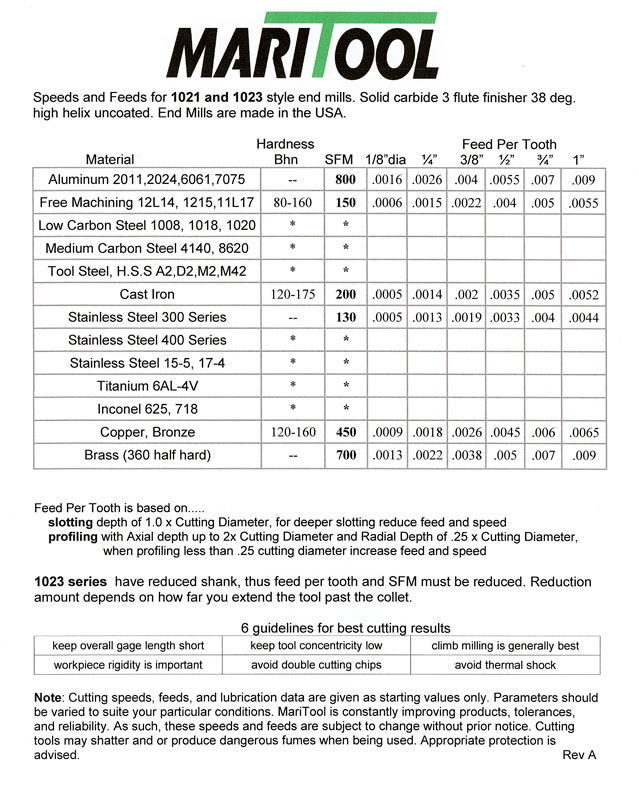
      On anther thread, (Power Feed to Milling Machine Table) I have, today, posted the figures given, in the late 1950s, by a manufacturer of Industrial Milling machines for the Feed per Tooth for various cutters, on low carbon steel. These figures (in Imperial units) are for Industrial machines and so should be drastically reduced for our less rigid hobby machines and fixtures.

      For Aluminium, the figures would be roughly double those for low carbon steel.

      For the example quoted, the Depth of Cut would be a MAXIMUM of 0.75mm (0.25 Cutter Diameter) and a Feed per Tooth of 0.05mm. At 1125 rpm this should result in a feed rate of 225mm per minute for a four flute end Mill, obviously, a Slot Drill would be half of this. To me, this seems a bit much for a 3mm dia End Mill, which as we all know breaks quite easily!

      Since the workpiece is Aluminium, kerosene would be the recommended lubricant. And without a pumped continuous supply, my suggestion would be to reduce the feed rate further, whilst dribbling on a supply from a squeeze bottle. The feel on the Handwheel, and the surface finish will give an indication of when you are overdoing things, hopefully before another cutter failure.

      Howard.

      Edited By Howard Lewis on 02/08/2016 23:54:23

      That seems odd, because some are saying I should be using a 2 flute slot cutter & you are suggesting from the above figures that a 4 flute would – in theory- cut at a faster feed speed. Does that not ignore the build up of swarf that others have mentioned?

      Actually I was cutting at more like an inch a minute so a lot slower, but from comments made clearly too deep & too slow revs, plus I failed to lubricate the cutter. Although the broken part had no sign of material build up on the cutter I have been told that it probably was the problem & it came off as the part broke

      I still do not get the difference between end milling & slot cutting on such small cutters because the change from surface cutting to slotting must be very close.

      However I will get a couple of new cutters ( end & slot) & treat with a lot more caution. I have to research what type I should get. Do I go for HSS again or look for a different type on such a small cutter? If it is likely to break so often is it worth paying any more for something else. I have not looked at prices yet but I am sure they must vary widely.

      All part of the learning curve!!! Just wish I did not have to learn via my wallet

      Edited By Sam Longley 1 on 03/08/2016 07:16:49

      Edited By Sam Longley 1 on 03/08/2016 07:17:02

      #249181
      Michael Gilligan
      Participant
        @michaelgilligan61133

        Sam,

        Without wishing to add to your confusion:

        … May I suggest that you also try a three flute cutter ?

        I have found these to be an ideal compromise, especially in the smaller sizes.

        MichaelG.

        .

        Some useful comments in this old thread

        http://www.model-engineer.co.uk/forums/postings.asp?th=54583

        Edited By Michael Gilligan on 03/08/2016 08:50:00

        #249182
        not done it yet
        Participant
          @notdoneityet

          Just wish I did not have to learn via my wallet

          Sam,

          A fact of life, on occasions, I'm afraid. Nobody but the user knows what their machine is capable of. Large rigid machines will always cope with higher feed rates than a flimsy chinese hobbyist import which may not even be adjusted optim

          ally.

          25mm per minute would likely be OK, but selection of cutter type is covered, no doubt, in many tomes.

          There are well documented surface cutting speeds for machines, but many machines are unable to achieve the advised cutting speeds. Yours did have a higher speed, which you apparently forgot about. Cutting speeds assume the optimum for everything else on the machine.

          Different materials have variable cutting characteristics. Aluminium is well documented as requiring much faster surface cutting speed (than steel) and possible difficulties. One is the recommendation for use of some cutting fluid – like WD40 as a popular choice.

          Melting point of the mateial being cut is yet another factor. Cutting dry requires steadier progress than lubed cooling. Aluminium, while having a good heat conduction rate will still have a higher temperature at the cutting/shearig point. one possible reason for it 'weldig' to the cutter tip.

          I have often made mistakes, sometimes to the detriment of the cutter, sometimes of the manufactured item. It costs time, if not money.

          I keep bees and find it soo easy, but many (mainly those with insufficient learning and non thinking) struggle and call it a 'dark art'. But machining metal is far more challenging than wood, per eg.

          Think yourself lucky that it only cost you a 3mm cutter. It could have been far more costly!

          I went to the show at Donny, this year. The one thing that struck me was the load of cheap unbranded cutters available at supposedly bargain rates. I know that buying cheap often means buying twice, so ignored these so-called 'bargains'. From my woodworking experience, I know that the right tool made of the best material and sharpened properly will work so much better, and longer, than lower quality tooling.

          Many will claim high cuttig speeds, deep cuts and/or high metal removal rates. Most of us are much more conservative because our kit is less sophisticated, not so perfectly set up or we are not so highly experienced in selection and operation of tooling and kit. I have long used carbide router cutters for timber, but recognise that not all carbide cutters are equivalent. I bought this my first solid carbide milling cutter at Doncaster and I will use it very carefully, given the cost differential to other similar cutters in other materials.

          Experience does cost. Learn from it and move on. On your last posting, consider what might have happened if your 3mm cutter had, say, twenty cutting edges instead…… would it have been better, faster, etc? I think not.

          #249232
          JasonB
          Moderator
            @jasonb

            Sam Theory from a book is only a starting point, better to start there and then find out what actually works on your maqchine and for that particular job..

            Like Michael, I also mentioned the 3-flute cutters in my first reply and that is also what I said in his link. Have a look at the JL-3 cutters top left of page 10 from this sales flyer. The uncoated short series ones will do you nicely, under 6mm I find these as good buy.

            J

            #249283
            Sam Longley 1
            Participant
              @samlongley1
              Posted by JasonB on 03/08/2016 14:47:14:

              Sam Theory from a book is only a starting point, better to start there and then find out what actually works on your maqchine and for that particular job..

              Like Michael, I also mentioned the 3-flute cutters in my first reply and that is also what I said in his link. Have a look at the JL-3 cutters top left of page 10 from this sales flyer. The uncoated short series ones will do you nicely, under 6mm I find these as good buy.

              J

              Jason

              A good link

              Thanks

              #249288
              Roy M
              Participant
                @roym

                I would recommend Clarkson FC3 cutters, I have used them professionally for donkeys years especially small diameters.There are some on EBay now for less than a fiver. They are short series and offer rigidity and accuracy, they also last well. Roy M.

                #249309
                Ajohnw
                Participant
                  @ajohnw51620

                  There is another problem with aluminium that sometime isn't mentioned. Aluminium oxide is extremely abrasive and forms virtually instantaneously. This is what stops it from corroding easily. Net effect is more friction than the softness of the material might suggest. One method of getting round this problem on lathes is to use micro polished carbide tips. They are used because it will wear off coatings pretty quickly. I was surprised how quickly tips coated for stainless and gp wore off. Once this happens the finish drops off as a well.

                  When industrial figures are quoted they are likely to assume flood cooling of some sort as they are more aimed at production work rather than one off machining. As Neil pointed out earlier cutting oil will help. Just a light coating of it. It also usually produces a better finish on all metals.

                  I've come across some people of late that feel we should all be using this sort of thing as they give a better finish

                  All I can say on that is if aluminium is cut at that speed without flood lubricant it's bound to cause problems. These tools shouldn't wear so quickly as HSS. Better worse, don't know I haven't had the urge yet. The max cutting depths are what I would normally assume. Feeds pass as I do that by feel.

                  John


                  Edited By Ajohnw on 03/08/2016 20:48:28

                Viewing 7 posts - 26 through 32 (of 32 total)
                • Please log in to reply to this topic. Registering is free and easy using the links on the menu at the top of this page.

                Latest Replies

                Home Forums Beginners questions Topics

                Viewing 25 topics - 1 through 25 (of 25 total)
                Viewing 25 topics - 1 through 25 (of 25 total)

                View full reply list.