Spindle? deflection

Spindle? deflection

Home Forums General Questions Spindle? deflection

Viewing 25 posts - 1 through 25 (of 45 total)
  • Author
    Posts
  • #24738
    Dan Carter
    Participant
      @dancarter89683
      #256251
      Dan Carter
      Participant
        @dancarter89683

        Hi All,

        Was just indicating something in the chuck of my Warco 290VF and noticed the needle moving when I lent on the bar. After a bit of testing I get about .02mm of deflection 1 cm from the chuck, by pushing not terribly hard on the chuck itself (more if I push on the end of the bar)

        I tightened up the spindle bearings with no effect, and then noticed I can get the same effect by pushing or pulling on the headstock. If I mount the indicator on the headstock, there is almost no movement pushing the chuck, which seems to imply the movement is either between the headstock and the bed, or the bed itself twisting. (I can still see movement between headstock and chuck if I pull the bar end).

        Is this amount of deflection to be expected ?

        Dan

        #256263
        mechman48
        Participant
          @mechman48

          Hi Dan

          When you got your machine did you get a 'Test certificate' wink which should show you what their inspection tolerances checked out as. You could always Google 'Schlesinger' & see what inspection certification for machines he devised… in fact in this months MEW… # 246, there is an article on him & his testing procedures/methods & standards he devised.

          You could also check in your manual for bearing identity & check with bearing suppliers SKF / FAG / NSK et al, as to what their tolerances are. If as you say you are only getting .02mm movement… that's only .0007 thou, that may well be within manufacturers acceptable tolerances. I wouldn't be unduly concerned with that minuscule amount.

          George.

          #256299
          not done it yet
          Participant
            @notdoneityet

            Headstock to bed(?) deflection does not seem promising, but the rest need qualifying. How long was this bar, its diameter, and material? All bars will deflect given sufficient force.

            #256305
            MW
            Participant
              @mw27036

              "Was just indicating something in the chuck of my Warco 290VF and noticed the needle moving when I lent on the bar. After a bit of testing I get about .02mm of deflection 1 cm from the chuck, by pushing not terribly hard on the chuck itself (more if I push on the end of the bar)"

              Can you replicate this movement on another piece of bar? Have you tried using a big piece of stock as smaller ones will be more flexi.

              M W

              #256310
              Dan Carter
              Participant
                @dancarter89683

                The 0.2mm deflection was measured on the bar about 10mm from the chuck, but by pushing on the chuck, not the bar, so not likely to be the bar bending.

                Fwiw the bar was 40mm en3b maybe 200mm long. Measured deflection at the same point was a lot higher tugging on the end of the bar, but I don’t remember what.

                I understand something is going to move with enough force applied, it was the fact that it did so with a relatively small force applied at the chuck that surprised me

                #256311
                Mark C
                Participant
                  @markc

                  Not done it, MW, Unless I am mistaken, if you read Dan's post he answered those questions already, the movement is not in the bar.

                  Dan, I expect you will find that you are measuring the castings distorting (probably too strong a word as the movement will minute). Your machine is a little larger than my Boxfords but not massively so and my machines will move if you load the head or bed with any external force. The head may be loose and you should be able to check it is tight but 20 microns is a small amount, I would just get on with using the machine (and avoid leaning on it when chucking work).

                  Mark

                  #256314
                  Dan Carter
                  Participant
                    @dancarter89683

                    Mark, that was my suspicion – I did check the headstock casting was bolted down tight.

                    A Google for spindle deflection had thrown up some American results suggesting that essentially zero deflection (measured in tenths) should be expected, but maybe the southbends etc are just built more heavily

                    #256317
                    Mark C
                    Participant
                      @markc

                      Dan, the spindle deflection will be deflection of the spindle relative to the head casting – you might expect to have difficulty measuring it there (but it will move I am certain – just not very much).

                      Boxfords are essentially the same as Southbends and I guarantee that all machines move if you push and shove them. The degree of movement will be relative to the size and mass of the machine along with the specific design. What I am saying is, unless you have a machine that has used up half the years steel production or has a nameplate with DSG on it, it is going to be possible to measure some movement with ease.

                      Mark

                      #256321
                      Dan Carter
                      Participant
                        @dancarter89683

                        Thanks Mark (and other responders). Will attempt to stop obsessing now

                        Dan

                        #256337
                        Hopper
                        Participant
                          @hopper
                          Posted by Dan Carter on 16/09/2016 23:19:34:
                          The 0.2mm deflection was measured on the bar about 10mm from the chuck, but by pushing on the chuck, not the bar, so not likely to be the bar bending.

                          This could include any movement of the chuck backing plate mounting to the spindle or the chuck mounting to the backing plate. Better to try to get the dial indicator reading on the actual spindle (or at least the back plate), then grab the end of the bar and see how much movement of the actual spindle you have.

                          Depends too on what type of headstock bearings you have. Ball bearings, even with preload, will always have a bit of clearance and thus a bit of movement. If you want to really tighten it up, fit opposed taper roller bearings in place of the ball bearings, which should give you movement of zero.

                          But if your lathe has been turning well, to size and parallel and not chattering like an old fishwife (sexism alert!) then probably not worth worrying about.

                          #256342
                          Raymond Anderson
                          Participant
                            @raymondanderson34407

                            Dan, Don't be unduly concerned about that small deflection. Every lathe will deflect by a certain amount. I am fortunate enough to own a DSG and when the brother tested the machine before I bought it when he pushed down on the 12" chuck it showed a very slight movement [ If I remember correctly it was something like 0.003mm] I took a lot of weight to show that figure,but movement none the less.

                            My other lathe a Warco GH 750 also shows movement when pushing down on the chuck even more than the DSG. which I would expect, although it is less the 0.02 mm you are seeing. So as Mark C suggested, If it turns parallel and accurate then use it, and don't concern you're self with it..

                            As far as the yanks go with their Southbends ect and essentially "zero deflection " no chance, every machine tool will deflect some more than others. Rigidity, Mass, and Design have the most say in the matter. So go ahead and enjoy your lathe.

                            cheers.

                            #256447
                            MW
                            Participant
                              @mw27036

                              Ray is correct, Deflection is simply part of physics, if something pushes hard enough it will repel whatever is in the way.

                              If you put a long bar into the lathe and clock up the deflection on the end of the rod, it will be greater and greater the further away it gets from the chuck. What you're observing is completely natural. Put a center on the end of it or a steady, and the deflection will be lessened. This physically demonstrates the advantages of turning with support on two points when using material over a given length.

                              There is no such thing as zero deflection or perfection for that matter. You are always turning or making something within limits of error from forces beyond practical control. Even if you put a heavy piece of stock in a vice, i'm sure with enough leverage you could get it to move a bit.

                              If your machine is doing this under the slightest touch, something hasn't been secured properly. I take it this chuck has a backplate mounting, are those bolts firmly holding the chuck and seated in its register?

                              Without actually seeing this machine i could spout a boatload of advice that has nothing to do with your particular problem, but if it seems something is integrally wrong with the machine, such as movement of the bearings in the headstock, you need to talk to warco about it.

                              Michael W

                              #256492
                              Mark C
                              Participant
                                @markc

                                Michael, did you read the original post and the subsequent messages regarding the deflection measurements?

                                It is not the chuck or anything else hanging out the end of the spindle, it is the head and bed that is moving.

                                Mark

                                #256504
                                JasonB
                                Moderator
                                  @jasonb

                                  Just put a dti on my 8yr old WM280 (6yr old FAG bearings) and could not measure any movement with dti on the head.

                                  On edge of chuck pulling on a 5" long bar with all I could muster I got maybe 0.0003" and with the dti on the bar about 5mm out of the chuck 0.0005-6". Which would suggest some movement in the chuck jaws, its a fairly new Bison not the supplied chuck.

                                  #256508
                                  Mark C
                                  Participant
                                    @markc

                                    Jason, try mounting the dti on in the toolpost or on the saddle with the stylus on the side of the head casting or spindle etc (anything convenient will do) and give the head a shove – you will get some movement. The 20 microns would be about typical from my experience.

                                    Mark

                                    #256509
                                    JasonB
                                    Moderator
                                      @jasonb

                                      Mark, that was with the mag stand on the cross slide.

                                      As I said no movement of the headstock and that was pulling the bar sticking out of teh chuck which should have given me more leverage than pulling just the headstock.

                                      #256511
                                      Dan Carter
                                      Participant
                                        @dancarter89683

                                        Clearly some movement is inevitable – but the actual amount is the key issue. What I was hoping to learn from this posting was whether what I was seeing was reasonable or not. Consensus seemed to be yes, BUT ……

                                        Thanks for your test Jason – I will have to wait till tomorrow to check, but I am certain I will get much more deflection than you under the same conditions – I fear it might be 10 times as much.

                                        Mark – the difference here seems to be that Jason gets less movement than me "with all I could muster", whereas I wasn't pushing particularly hard.

                                        For the sake of completeness:

                                        Headstock to bed bolts are tight, Backplate to chuck is tight, backplate to spindle is tight, spanner nut on back of spindle is tight, spindle runs in taper roller bearings, spindle is if anything a bit too tight (hard to turn) after adjusting spindle nut.

                                        #256522
                                        JasonB
                                        Moderator
                                          @jasonb

                                          Her you go, I was not going to bother uploading it but this shows the mag base on the cross slide, indicator against rear of chuck, bit of 3/4" bar in teh chuck and pulling back and forth. Not easy to hold camera still and pull at the same time.

                                          0.01" per div and needle moving about 1/3rd so 0.0003" this would be a total of head/bed flex, spindle play and any chuck/backplate play. This is what the tool will be acting against so more meaningful than just headstock movement which I could not see on teh needle.

                                          #256524
                                          MW
                                          Participant
                                            @mw27036

                                            You should let us know of any developments Dan, since if it is serious, it may come creeping back, as these problems often do. Just for clarity here, i take it this lathe is a recent purchase and so you've only just noticed this?

                                            Michael W

                                            #256529
                                            Dan Carter
                                            Participant
                                              @dancarter89683

                                              Michael,

                                              Will update. It is a few days short of a year old (assuming you count from the replacement after the first duff one), but had either never noticed this or just not thought anything of it until now – I have just bought a new indicator holder and was messing about with it (Before anyone asks, the problem is not the holder, once I noticed I checked with several others)

                                              (On a completely unrelated note, the new holder is a noga with the fine adjustment at the bottom and it is really excellent compared to the generic chinese one I have)

                                              Dan

                                              #256540
                                              Mark C
                                              Participant
                                                @markc

                                                Right, just went down in the workshop and measured both of mine. They both show about 1/2 thou (1 division on my 0.0005 Batty clock) with the stylus pressing on the back of the chuck near the mounting plate and at center height. i have to apply a decent bit of a shove to get movement here but it is clearly moving.

                                                Note to self; check head clamp bolts are tight as there appears to be some hysteresis in the readings….

                                                Mark

                                                #256541
                                                Mark C
                                                Participant
                                                  @markc

                                                  I should have added that I am pushing the top of the head casting – so no direct contact with the spindle assembly..

                                                  Mark

                                                  #256544
                                                  Muzzer
                                                  Participant
                                                    @muzzer

                                                    A really useful tool for this situation and also for measuring the rigidity of machine tools as a whole (from work piece all the way around the machine tool and back through the tool) would apply (and actually measure) a representative force (some 10s of kg) and measure the resulting deflection, hopefully not many thousandths. Ideally it would be able to do so in each of the 3 orthogonal directions.

                                                    I suspect this would be quite revealing, not least when we start to dig into the old chestnut that is rear parting tools, upside down and reverse operation etc. Judder / chatter is dependent on stiffness (linear) and backlash (nonlinear).

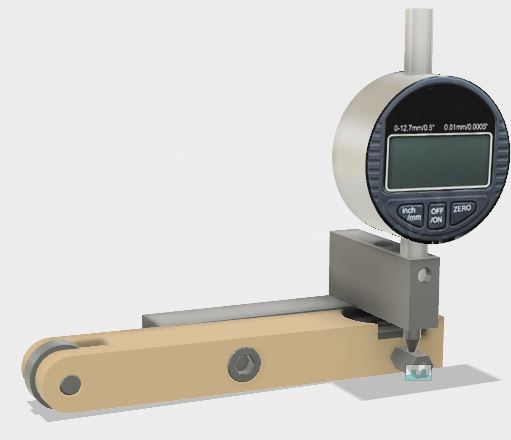
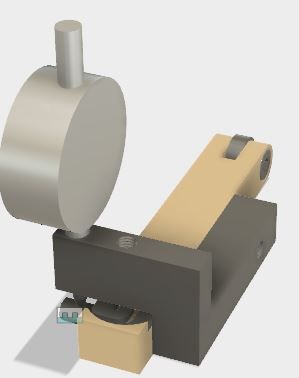
                                                    Something like this, drawn up in Fusion 360:

                                                    Stiffness gauge

                                                    stiffnes gauge 2.jpg

                                                    The grey bar is clamped in the tool post, the cylinder is a ball bearing that pushes up on the workpiece or spindle, the fawn coloured bar is a swing arm and the thing in the pocket under the DTI is a 40kg load cell from a digital luggage scale (available at pound shops etc). Missing is a thumb screw in the threaded hole behind the DTI that applies the required load between the grey bracket and the load cell. The resulting deflection can be read off the DTI. Ideally the DTI would show no movement as the load is applied but in reality it is likely to be quite readable.

                                                    I hope to get around to making this soon but my armchair workshop currently lacks the capability.

                                                    Murray

                                                    Edited By Muzzer on 17/09/2016 22:49:53

                                                    #256546
                                                    Mark C
                                                    Participant
                                                      @markc

                                                      Murray, you can get a nice flexible amplifier for load cells (resistive) from RS. I don't have the number to hand but they are very good and easy to use. they are very stable and will work in a number of bridge modes (full, half and quarter if I remember).

                                                      If you get to experimenting with load cells, you might find it better to use the thin film elements RS also sell to compliment the amps, you would be surprised at how much output you can get from a lump of 25 x 6 GP with just the lightest touch!

                                                      Mark

                                                    Viewing 25 posts - 1 through 25 (of 45 total)
                                                    • Please log in to reply to this topic. Registering is free and easy using the links on the menu at the top of this page.

                                                    Latest Replies

                                                    Home Forums General Questions Topics

                                                    Viewing 25 topics - 1 through 25 (of 25 total)
                                                    Viewing 25 topics - 1 through 25 (of 25 total)

                                                    View full reply list.