Should I fix my lathe stand to a concrete floor?

Should I fix my lathe stand to a concrete floor?

Home Forums Beginners questions Should I fix my lathe stand to a concrete floor?

Viewing 13 posts - 1 through 13 (of 13 total)
  • Author
    Posts
  • #152243
    Tony Payn
    Participant
      @tonypayn24819

      Hi,

      I have a Clarke CL500 lathe which sits on the stand (also provided by Clarke and the right one for this model) on a concrete floor. I've been trying to eliminate twist in the bed by shimming up one corner of the lathe. The stand is made from sheet steel with welded and bolted construction.

      my problem is that when the corner of the lathe is shimmed up, the stand rocks on the concrete floor. The stand sits pretty flat, without rocking, when there are no shims used, but then there is a slight twist in the bed.

      Should I bolt the stand to the concrete floor? Has anyone any recommendations of the best way to tackle this? I had thought of adding weights to the stand, might this be enough?

      i think the twist is quite small but as the corner of the stand lifts, it needs a big shim to affect the lathe bed by a small amount.

      the lathe is firmly bolted to the stand, and I have slackened/re-tightened all of the bolts in the stand itself.

      thanks!

      Tony

      #7157
      Tony Payn
      Participant
        @tonypayn24819

        How to remove twist in bed when stand flexes

        #152250
        Michael Gilligan
        Participant
          @michaelgilligan61133

          Tony,

          Sorry, I can't remember the name of the material; but hopeully someone else can …

          Years ago I used some "felt- like" material that came coiled in a can filled with some resinous fluid.

          This material was put under the machine cabinet and it conformed nicely to the concrete floor before he resin hardened. … Worked a treat !!

          Here's hoping someone knows it, and where to buy.

          MichaelG.

          .

          Edit: Corrected a couple of typos

          Edited By Michael Gilligan on 12/05/2014 18:39:13

          #152258
          John Haine
          Participant
            @johnhaine32865

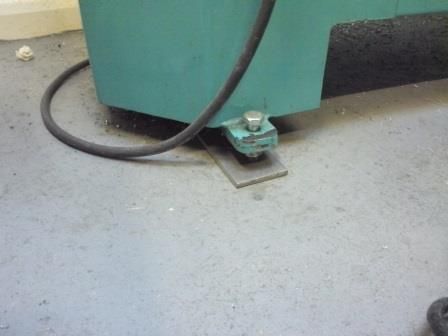
            myford_foot.jpg

            This shows how I have dealt with the problem with my S7 on the Myford stand. The stand has 4 lugs with bolt holes. Through each I have put an M10 bolt with a nut and washer just underneath the lug. Under the end of the bolt, on the wooden floor, is an ali plate to spread the load a bit – you wouldn't need this on concrete. This makes a simple and effective way to level the stand, as the weight is taken on the nut, and by using a couple of spanners on the hex bolt head and the nut you can adjust the projection.

            #152274
            Speedy Builder5
            Participant
              @speedybuilder5

              I used 'Rawlbolts to fix my Boxford to the floor and then grouted the cabinet in to prevent swarf, tools etc creeping underneath.

              #152292
              Clive Hartland
              Participant
                @clivehartland94829

                If you want to stabilize the lathe carcase then place about three thicknesses of lead sheeting under each corner, the lathe carcase will slowly press down on the lead and deform it until its stable. I use this method to stabilize Collimator stands, it also seems to eliminate vibration. The Collimator stands are concrete and are about 200lb.

                Clive

                #152295
                daveb
                Participant
                  @daveb17630

                  Tony, are you sure it's a twist in the bed and not mis-aligned centres?

                  If the bed has any significant twist, I doubt if you would be able to take the twist out by bolting the cabinet down.

                  #152301
                  Bazyle
                  Participant
                    @bazyle

                    Would it not be better to do the shimming at the lathe – cabinet interface?
                    Then you are not trying to twist the cabinet aswell.

                    #152302
                    Tim Stevens
                    Participant
                      @timstevens64731

                      It seems to me that you may have a double problem:

                      1. The stand is distorting when bolted to the lathe. This causes a twist in the lathe.

                      2. The weight of the assembly is distorting again when on its stand feet.

                      So, you need to examine the stand to see what is out of square, and whether the stand is strong enough. It wil be strong enough to support the lathe, ie it won't collapse, but is it strong enough to avoid distortion from the weight?

                      Does the stand look like a proper job, I wonder? As strong in torsion as the lathe itself?

                      Cheers, Tim

                      #152319
                      Terence Yates 1
                      Participant
                        @terenceyates1

                        I have one of these lathes, first lathe I ever bought. Surprisingly the lathe is not too bad, but the stand is crap. I reinforced mine with 1/4" angle iron to give it some rigidity.

                        Terry.

                        #152372
                        Tony Payn
                        Participant
                          @tonypayn24819

                          Many thanks to you all for your replies and thoughts, all very much appreciated.

                          The stand is quite flimsy and what I think is happening is that the lathe, being heavy cast iron construction, pulls the stand to conform to the shape that the underside of the lathe has. The amount of twist in the bed is quite small and this is noted with a bar held in the chuck at headstock but not supported at tail end, just making DTI measurements along the bed.

                          To eliminate the small amount of twist in the bed (only a few thousandths – I forget the exact amount), I've put shims between the lathe and the stand. What seems to be happening is that this bends the stand a lot more than it bends the lathe. The net result is that one corner of the stand lifts off the floor, making the whole think rock when given a push.

                          Even though the twist reads only a few thou, it needs a stonking great shim (2 mm) to eliminate it, again I think this is because the stand hasn't got the strength to fight against the lathe stiffness, so the lathe more or less stays where it wants and twists the stand, unless the shim is big enough to put some real stress into the stand.

                          What I think is needed is a way to prevent the stand from lifting one corner (preferably preventing it lifting any corners at all), which is why I thought of bolting it to the floor or weighing it down. Then, when shimmed, the lathe will have to twist itself or twist the stand together with the garage floor as well, which is considerably heavier and not very flexible at all.

                          I don't really want to move the lathe off the stand as it weighs so much, otherwise reinforcing the stand could be a possibility.

                          I think I'll have a go at bolting the stand to the floor and see if this improves things. I'll post the results when done.

                          Tony

                          #152376
                          Nick_G
                          Participant
                            @nick_g
                            Posted by Tony Payn on 13/05/2014 14:11:18:

                            Many thanks to you all for your replies and thoughts, all very much appreciated.

                            The stand is quite flimsy and what I think is happening is that the lathe, being heavy cast iron construction, pulls the stand to conform to the shape that the underside of the lathe has. The amount of twist in the bed is quite small and this is noted with a bar held in the chuck at headstock but not supported at tail end, just making DTI measurements along the bed.

                            Tony

                            Are you sure that the bed is twisted.?

                            Chuck 'run-out'.??????

                            And who's to say the bar is straight. (unless it's a speciality test bar.)

                            Nick

                            #152404
                            Tony Payn
                            Participant
                              @tonypayn24819

                              Hello Nick

                              You ask if I'm sure the bed is twisted. The truthful answer is "no". What I am doing though is attempting to set up the lathe for turning parallel, as described by Harold Hall in his book "Lathework – a complete course". In the book, and in numerous YouTube videos and other on-line sources, methods are described whereby a check is made that the tool cuts the same diameter when it is both near the headstock and when moved via the carriage to near the tailstock end (no tailstock used). The suggested cause of inconsistency here is that the lathe bed may not be aligned for best result, and that by putting deliberate movements onto the lathe bed, the ability to turn parallel can be adjusted. None of that means, I suppose, that the bed is actually twisted – the headstock could perhaps be a bit out of line and I might be effecting a compensation for that.

                              What I do know is that the mean value of the DTI moves as the carriage moves, and I'd like to eliminate this, if I am to complete the project in the book.

                              There is considerable run-out which is also greater at the tail stock end than at the head end. That's why I'm going off the mean value for assessment of parallelism. Once I've got the bed sorted, I'll see if I can reduce the run-out. I have a 4 jaw independent chuck with which I can pretty well eliminate run-out, but the DTI reading still changes as the carriage moves along.

                              The bar came from a printer, it used to have a rubber sleeve over it as a support for the paper when the impacting through the ribbon. It's not a special test bar but is beautifully straight, smooth and parallel according to my micrometer. I was glad to get this useful bar out of the printer, which was being scrapped.

                              Tony

                            Viewing 13 posts - 1 through 13 (of 13 total)
                            • Please log in to reply to this topic. Registering is free and easy using the links on the menu at the top of this page.

                            Latest Replies

                            Home Forums Beginners questions Topics

                            Viewing 25 topics - 1 through 25 (of 25 total)
                            Viewing 25 topics - 1 through 25 (of 25 total)

                            View full reply list.